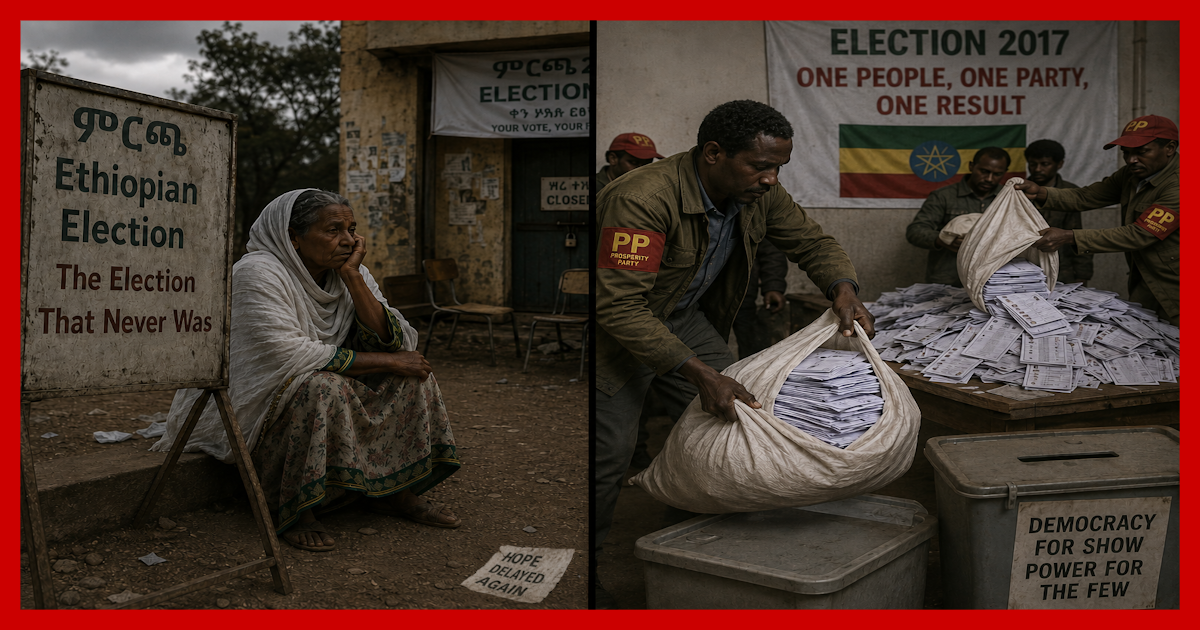
Regression Preference Syndrome: Debunking the Regressive Tendency in Ethiopian Politics

Excerpt
Regression Preference Syndrome (RPS) is proposed as a political-psychological framework explaining Ethiopia's recurring tendency to favor historical rollback over incremental democratic progress. Using contemporary examples from autocratic rule, internal wars, unresolved national questions, maritime access discourse, and hard-power politics, the article argues that regression often appears psychologically easier than reform. It calls for Ethiopia to reject destructive coercive approaches, embrace soft power and negotiated settlements, and pursue gradual democratic progress instead of disruptive retrogressive steps that risk repeating historical cycles.
Introduction
Regression Preference Syndrome (RPS) is proposed here as a political-psychological metaphor describing the recurring tendency to perceive restoration of older political arrangements as easier, safer, more legitimate, and less risky than incremental democratic progress.
RPS does not refer to a medical condition. Rather, it is an analytical lens for understanding why societies repeatedly gravitate toward familiar historical templates despite the heavy costs already paid under those systems.
The framework suggests that institutional memory may function not merely as historical inheritance but as a psychological gravity pulling political actors toward familiar forms of power.
Time and again, Ethiopian politics appears to exhibit this tendency: reform is treated as dangerous experimentation, while regression is normalized as stability.
Building inclusive systems requires decades of compromise, learning, negotiation, institution building, and democratic patience. Dismantling them may take only weeks or months.
History, in this context, appears less as a teacher and more as a gravitational pull. The challenge before Ethiopia may therefore not merely be constitutional or political.
It may be psychological: Can an empire learn to progress without repeatedly seeking refuge in the past?
Understanding the Ethiopian Empire State: Historical Context for the Analysis
Before proceeding with the psychological analysis, it is important to briefly situate Ethiopia within its broader historical context, particularly for readers who may be less familiar with the empire's complex political evolution.
Modern Ethiopia did not emerge primarily through voluntary political union or negotiated state formation. Rather, much of the contemporary state structure was shaped during the late nineteenth-century imperial expansion through military conquest, territorial incorporation, and centralized rule. Many communities, particularly in the south, southwest, and east, entered the empire through violent incorporation rather than consensual political integration.
This historical experience remains deeply consequential because the question of how Ethiopia was formed continues to influence contemporary debates regarding identity, state legitimacy, federalism, self-determination, and the relationship between center and periphery.
Critics argue that the Ethiopian state has historically exhibited a recurring tendency to preserve unity through coercive means whenever political accommodation proved difficult. From imperial centralization to military rule and subsequent authoritarian tendencies, force has often appeared more institutionally familiar than negotiated transformation. The repeated recurrence of armed conflicts across different eras has reinforced the perception among many that state continuity has frequently depended on coercive power rather than durable consensus.
Another striking historical pattern concerns institutional continuity—or more precisely, the lack of it.
Successive Ethiopian governments have often dismantled or fundamentally altered the constitutional and institutional arrangements established by their predecessors. Imperial structures gave way to revolutionary military institutions. The Derg itself collapsed and was replaced by the federal order established after 1991. Today, debates increasingly suggest the possibility of another major structural reversal.
Rather than incremental institutional improvement, Ethiopian political history often appears characterized by cycles of rupture, demolition, reconstruction, and renewed contestation.
Political transitions frequently resemble resets rather than reforms.
This pattern bears particular relevance to the present moment. Current debates surrounding constitutional reform, the future of multinational federalism, and the reported proposals emerging around the Ethiopian National Dialogue process have generated significant concern among many observers.
Critics argue that the emerging direction risks replacing the existing multinational federal arrangement with administrative structures that increasingly resemble earlier imperial provincial models organized primarily around geographic administration rather than constitutionally recognized nations and nationalities.
For many Oromo observers, this concern carries profound significance.
The constitutional recognition of Oromia following 1991 represented not merely an administrative boundary but the formal political recognition of Oromo collective existence within the state structure. Consequently, proposals perceived as diluting, restructuring, or eliminating that recognition are viewed by many not simply as administrative reform but as existential questions touching identity, self-rule, political dignity, and historical justice.
Some critics therefore interpret current trajectories as reflecting deep tensions between Ethiopia's imperial inheritance and the federal restructuring introduced after 1991. In this reading, the debate extends beyond governance design into competing visions of the Ethiopian state itself.
It is against this historical background that the present analysis introduces Regression Preference Syndrome (RPS): a tendency whereby difficult contemporary challenges become addressed not through adaptive forward institutional development but through recurrent attraction toward earlier historical arrangements, even when those arrangements themselves generated unresolved tensions.
From this perspective, RPS is not merely a psychological metaphor. It may also describe a recurring political pattern: the tendency to seek solutions by returning backward rather than evolving forward.
Observable Characteristics of RCS
RCS has various observable signs with some of them as summarized below.
Incremental Reform Perceived as Threatening
RPS manifests when gradual democratic evolution is viewed as destabilizing while older arrangements appear psychologically safer.
Learning new democratic practices requires effort. Returning to familiar political templates requires memory.
Thus, reform becomes experimentation. Regression becomes comfort.
Historical Rollback Normalized Through Familiarity
The known past acquires emotional legitimacy independent of its historical record. Political imagination shifts from:
"How do we improve existing institutions?"
to:
"How do we restore previous arrangements?"
Regression becomes framed as restoration.
Diversity Management Viewed as Burden
Plural coexistence becomes exhausting. Accommodation appears cumbersome.
Uniformity becomes attractive. Centralized political imaginaries return.
The language of unity increasingly overshadows the language of negotiated diversity.
Preference for Hierarchy Over Negotiated Coexistence
Complex political bargaining gives way to command structures.
Hierarchy appears efficient. Negotiation appears slow. Compromise appears costly. Centralization appears decisive.
Hard Power Nostalgia
Perhaps the most visible manifestation is nostalgia for coercive state capacity.
- War.
- Force projection.
- Attrition.
- Militarized solutions.
Meanwhile, diplomacy, conflict transformation, confidence building, and negotiated settlements recede.
The state increasingly reaches for the hammer inherited from imperial history while neglecting the softer instruments required by plural societies.
RPS and Contemporary Ethiopia: 2018–Present
Although RPS may help interpret Ethiopia across multiple historical periods, this article restricts its analysis to the post-2018 period following the historic Oromo Protest and the rise of the OPDO/PP administration.
Several developments appear interpretable through this lens.
1. Autocratic Rule as a Manifestation of RPS
Perhaps one of the strongest contemporary manifestations of Regression Preference Syndrome is the gradual drift toward autocratic rule and centralized political control.
Progressive governance systems do not merely seek power.
- They seek legacy.
- They attempt to leave behind stronger institutions, broader participation, expanded freedoms, democratic innovations, and reforms that future generations can inherit.
- Progressive systems innovate toward openness.
Autocratic systems frequently move in the opposite direction.
- They become increasingly concerned with self-preservation.
- Power retention gradually eclipses transformation.
- Fear replaces confidence.
- Control replaces legitimacy.
- Hard power replaces persuasion.
- Dialogue appears weak.
- Negotiation appears unnecessary.
- Dissent becomes threat.
- Citizens become subjects.
- Institutions become instruments.
- Law becomes weapon.
In this sense, autocracy itself may be interpreted as a manifestation of RPS: An inability to transition from historical command-and-control paradigms toward modern democratic coexistence.
Critics argue that this tendency has increasingly become visible under the PP regime of PM Abiy Ahmed.
Among allegations repeatedly raised are structures such as Koree Nageenyaa death squads and the so-called Mafiyaa 120 criminal enterprises allegedly functioning as informal instruments of intimidation and political control.
Whether every allegation is fully verifiable is not the central issue here. The broader perception itself is revealing.
A growing segment of society increasingly believes innovation is being directed not toward democratic deepening or conflict resolution, but toward more sophisticated mechanisms of control.
Regression therefore does not always reproduce the past literally. Sometimes it modernizes older authoritarian instincts using newer tools.
The tragedy of regressive politics is not merely that it returns to the past. It may become creatively destructive.
Economic Development Under Self-Preservation Politics
Economic policy may itself become shaped by self-preservation.
Progressive developmental states seek employment generation, food security, wealth creation, environmental protection, regional balance, and human capital development.
Autocratic systems risk prioritizing visibility over transformation. Prestige projects begin substituting for structural development.
- Urban beautification.
- Monumental construction.
- Street-light corridors.
- Showcase infrastructure.
- These projects may create optics and impress visitors.
- They may dazzle foreign dignitaries.
- They may produce attractive images for state media.
- They may serve as monuments to the ruler's self-image.
Yet deeper developmental questions remain:
- Where are the jobs?
- Where is balanced regional development?
- Where is food security?
- Where is ecological protection?
- Where is broad-based wealth creation?
- Where is meaningful industrial policy?
- Where is the developmental program that lifts ordinary households across regions rather than decorating selected urban corridors?
Development risks becoming performative.
The state governs perception rather than transformation. Once again, RPS offers an explanation:
The appearance of progress becomes easier than the difficult work of building it.
2. The Tigray War
The devastating conflict represented a return to hard-power politics with immense human, social, and economic consequences.
Military resolution appeared easier than political accommodation.
The war exposed the fragility of Ethiopia's political settlement and the dangers of treating deep constitutional, regional, and political disputes as problems to be crushed rather than negotiated.
Within the RPS framework, the tragedy is not only that war occurred, but that war appeared to become thinkable as an instrument of statecraft in the first place.
That is the gravitational pull of regression.
When political imagination is exhausted, force becomes the substitute for wisdom.
3. Failure to Resolve the Oromo Question
Despite the political opening created by the Oromo Protest, the foundational Oromo question remains unresolved.
The continued inability to secure durable negotiated settlements with the OLA illustrates the preference for coercive approaches over political accommodation.
This is especially tragic because the Oromo Protest was one of the most consequential political movements in modern Ethiopian history.
It created the conditions for the regime change of 2018. It opened space for transformation.
It raised expectations of justice, recognition, accountability, and democratic restructuring. Yet the deeper Oromo national question remains suspended.
Instead of bold political settlement, the empire state has witnessed cycles of militarization, repression, mistrust, and unending insecurity.
RPS helps explain this failure:
- Negotiated settlement requires courage.
- Coercion requires only force.
- One builds a future. The other prolongs the past.
4. The Amhara Conflict
The emergence of another major internal conflict raises further questions regarding the continued dependence on force-centered responses to political crises.
Once again, political contradiction is pushed toward militarized confrontation.
Once again, grievances that require dialogue are met with coercive state reflexes.
Once again, Ethiopia appears trapped between unresolved historical claims, fragile institutions, competing identities, and the absence of trusted mechanisms for peaceful political negotiation.
The Amhara conflict, like others before it, should not be seen merely as a security problem.
It is also a symptom of a political system that repeatedly fails to transform conflict into dialogue before it becomes war.
5. Access to the Sea Through Hard Power Rather Than Negotiated Soft Power
The discourse surrounding maritime access and the strategic importance of the Port of Assab offers another useful illustration of RPS.
The aspiration for sea access is neither unusual nor illegitimate.
Landlocked countries naturally seek diversified trade routes, logistics corridors, and maritime outlets.
The question is not whether maritime access is needed.
The question is how it is imagined.
If maritime access is imagined through partnership, diplomacy, economic interdependence, and negotiated regional cooperation, it can become a source of mutual benefit.
If it is imagined through coercion, militarized rhetoric, or historical entitlement, it becomes another expression of hard-power regression.
Hard Power Versus Soft Power: A Missing Democratic Skill
One of the clearest illustrations of RPS may be found in Ethiopia's continued attraction toward hard-power solutions while under-utilizing the immense possibilities of soft power.
The port question is only one example.
The deeper issue is the political habit of imagining force before negotiation.
Within the RPS framework, concern emerges when strategic ambitions increasingly gravitate toward coercive pathways while negotiated alternatives remain secondary.
- What happened to mutually beneficial arrangements?
- What happened to long-term leases?
- What happened to joint economic zones?
- What happened to corridor diplomacy?
- What happened to regional trade integration?
- What happened to shared infrastructure?
- What happened to neighborly imagination?
Ports can be negotiated. Economic access can be leased. Corridors can be jointly developed. Infrastructure can be shared. Regional interdependence can itself become security.
Yet regressive political instincts often perceive force as more decisive because it promises speed. This reflects one of the central propositions of RPS:
Hard power promises immediacy. Soft power requires patience.
The irony is that soft power frequently produces more durable outcomes.
- A negotiated arrangement may create mutual prosperity.
- War risks mutual instability.
- A cooperative port arrangement may strengthen regional trade.
- A coercive approach may poison generations of neighborly relations.
- This principle extends far beyond maritime access.
Many of Ethiopia's internal political crises may also have benefited from stronger soft-power approaches:
- Negotiated settlements.
- Confidence building.
- Conflict transformation.
- Political accommodation.
- Dialogue.
- Accountability.
- Trust-building.
- Inclusive constitutional conversation.
The unresolved Oromo question, internal armed conflicts, and regional mistrust are good examples. These are fundamentally political questions requiring political solutions.
- Hard power may suppress symptoms. Soft power addresses causes.
- Hard power can impose silence. Soft power can create settlement.
- Hard power can defeat an opponent while leaving the core problem intact. Soft power can transform a relationship and solve the core problem.
The modern world increasingly rewards:
- Cooperation over conquest.
- Partnership over domination.
- Interdependence over coercion.
- Negotiation over attrition.
This is not weakness. It is the higher discipline of statecraft.
The ENDC and the Return of Historical Gravity
If circulating discussions and political signals prove accurate, Ethiopia may soon witness proposals emerging from the Ethiopian National Dialogue Commission (ENDC) that many critics already perceive as highly regressive.
Among concerns increasingly discussed are possible moves away from multinational federal arrangements toward geographically organized systems resembling earlier imperial administrative structures.
Whether these discussions materialize remains to be seen.
Yet the deeper question persists:
- Why does political imagination repeatedly move backward when moving forward remains possible?
- Why does institutional redesign resemble restoration?
- Why is incremental improvement difficult while rollback appears effortless?
- Why does the state find it easier to revisit older centralizing models than to improve, democratize, and refine existing plural arrangements?
RPS suggests a possible answer:
- Regression is psychologically cheaper than innovation.
- Memory is easier than transformation.
- The past requires remembrance.
- The future requires courage.
If the ENDC becomes an instrument for dressing regression in the language of dialogue, then its historical role may not be reconciliation but restoration.
And that would not solve Ethiopia's contradictions. It would intensify them.
Conclusion: Choosing Progress Over Regression
If RPS captures even part of Ethiopia's trajectory, then the lesson is not merely diagnostic. It is corrective.
Ethiopia must consciously reject destructive over-reliance on hard power and cultivate the skills and lasting benefits of soft power.
For too long, war, coercion, attrition, militarized responses, emergency rule, surveillance, and domination have repeatedly occupied center stage.
Yet hard power often leaves behind exhausted societies, unresolved grievances, economic destruction, traumatized populations, and recurring instability.
Soft power offers something different.
- Negotiated settlements.
- Political accommodation.
- Trust building.
- Conflict transformation and resolution.
- Regional cooperation.
- Institutional compromise.
- Democratic learning.
Many internal political quagmires draining lives and resources may prove more solvable through dialogue than force.
- The Oromo question cannot be bombed away.
- The scars of the Tigray war cannot be healed by denial.
- The Amhara conflict cannot be permanently settled through coercion.
- Regional mistrust cannot be cured by command.
- Maritime access cannot be sustainably secured through threats.
These problems demand political imagination:
- They demand the discipline of negotiation.
- They demand the courage to listen.
- They demand the humility to compromise.
Likewise, Ethiopia must embrace incremental democratic progress rather than pivot to undemocratic regress.
Democracy rarely advances dramatically. It advances gradually.
- Through stronger institutions.
- Better representation.
- Wider participation.
- Improved accountability.
- Broader inclusion.
- Protection of rights.
- Respect for diversity.
- Trustworthy elections.
- Independent institutions.
- Peaceful political competition.
- Incremental progress may appear slow. But it builds.
- Regression may appear fast. But it destroys.
The temptation to blast into the past may feel psychologically easier because memory offers familiarity.
Yet nations do not progress by restoring old certainties. They progress by learning new skills.
The modern era offers abundant lessons:
- Plural governance.
- Negotiated coexistence.
- Soft power diplomacy.
- Democratic accommodation.
- Shared prosperity.
- Self-determination.
The challenge before Ethiopia is therefore not whether it remembers its past. It clearly does.
The question is whether it can learn enough from the present to stop reliving it.
Because history should illuminate the road ahead. Not become the road itself.
References
- Ethiopia (Tigray): Non-international armed conflict (2020–) Estimated starvation-related casualties: between 150,000 and 200,000 to 13 March 2022; Estimated number persons in need of humanitarian assistance: 9,4 million across Amhara, Afar and Tigray as of May 2022. starvationaccountability, 2022.
- Mahemud Eshtu Tekuya, “Swimming Against the Current: Ethiopia’s Quest for Access to the Red Sea Under International Law”, Fordham International Law Journal, 2024.
- OT Editorial, To the Ethiopian National Dialogue Commission: You Are Wasting Your Time and Everyone Else’s, 31 January 2025, OROMIA TODAY.
- Yadessa Guma, Ethiopia Forward to the Past: The Politics of Nostalgia and the “Menelik Syndrome”, 28 April 2026, OROMIA TODAY.
- Oli Boran, The Myth of Ethiopia’s Historical Continuity, 17 March 2025, OROMIA TODAY.
- Oli Boran, How a False Unity of Mythical Ethiopia Was Manufactured Through Annexation and Assimilation, 9 April 2025, OROMIA TODAY.