The Ethiopian Perspective Gap: Why Some Voices Sound Like Truth—and Others Like Rebuttal
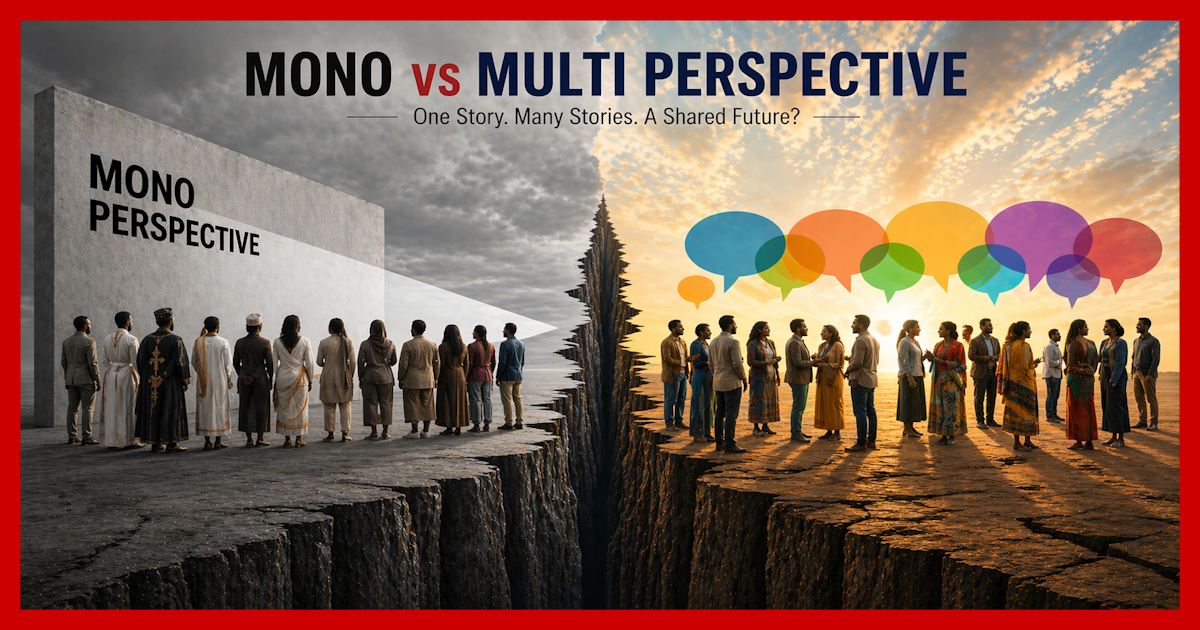
Excerpt
This op-ed explores how mono perspective sociopolitical views shape both art and politics, often presenting particular experiences as universal truths and thereby constraining meaningful dialogue. It argues that progress requires moving beyond such narrow vantage points—particularly among politicians, who are uniquely positioned to resolve complex sociopolitical issues. To do so, they must step outside mono perspective, engage competing realities with discipline, and adopt a genuinely multi-perspective approach capable of addressing long-standing tensions with clarity and fairness.
The Fallacy of One View Becoming All Views
In Ethiopia’s charged public sphere, disagreement is often treated as a clash of interests, identities, or ideologies. But beneath the noise lies a quieter, more consequential divide—one that shapes how reality itself is perceived.
This is the Ethiopian Perspective Gap: an asymmetry between those who experience their worldview as natural and self-evident, and those who must constantly navigate between their own understanding of the world and the dominant narrative imposed upon them.
It is the difference between unquestioned perspective and negotiated perspective. And until it is named, it cannot be bridged.
Perspective Is Produced—Not Given
No perspective emerges in a vacuum. It is produced within structures of power, history, and recognition [1,2].
Those historically positioned at the center of political and cultural authority often come to experience their viewpoint as universal. Their assumptions become the baseline. Their language becomes the medium. Their memory assumes the form of “national memory,” though its claim to represent the whole remains largely superficial. Over time, this produces what can be called a mono perspective—a worldview that feels complete, coherent, and sufficient unto itself.
Others challenging the mono perspective status quo do not have that luxury.
Marginalized communities that have had to argue for recognition, negotiate their rightful place, and contest dominant narratives develop something more complex: a dual awareness—an ability to see both from within and from without.
Call it compelled cognitive bilingualism: the necessity of thinking in two political and symbolic languages at once—one’s own, and that of the system one must constantly interpret, challenge, and survive within.
This is not a matter of virtue. It is a matter of condition.
When Art Speaks as If It Were the Whole
Consider the Das Tal track by Teddy Afro at the center of attention over the recent days [3]. From the perspective it was crafted to evoke, the song, for some, has stirred deep emotion—resonating as lament, warning, nostalgia, and plea. In doing so, it conveys a sense of "national fracture", a longing for unity, and a grief that feels both deeply personal and broadly collective.
But that resonance is not universal.
For others, the song reads differently—not as neutral reflection, but as a mono-perspective articulation of a "sectional national" sentiment presented as universal.
It presents a particular emotional experience as shared truth. It mourns a fragmentation that, for some, was never experienced as loss, but rather as long-overdue recognition.
This is not a rejection of art. It is a rejection of art presented as universality when it is, in fact, perspectival.
The backlash, then, is not accidental. It is not hypersensitivity.
It is the predictable response of audiences whose historical experience is not fully contained within the emotional frame being offered.
When a mono perspective speaks as if it were universal, rebuttal is not only justified—it is unavoidable.
The Failure of Political Perspective
In a society marked by competing historical experiences, political leadership demands more than representation. It demands the capacity to step outside one’s own narrative and engage others on their own terms.
Yet much of Ethiopian political discourse remains trapped in mono perspective—where inherited arrangements are defended as natural, and challenges to them are treated as disruptions rather than invitations to renegotiate legitimacy.
This is not simply a failure of empathy. It is a failure of political responsibility.
More troubling still, mono perspective is often sustained by narratives presented as settled fact but open to serious historical scrutiny due to foundations of falsehoods. Few politicians are willing to interrogate these inherited assumptions, even when they shape the very tensions they are tasked to resolve.
Among the most prominent is the claim of an unbroken, millennia-long Ethiopian continuity—the Ethiopia of 3000 years [4,5]. Likewise, the effort—most visibly associated with the Haile Selassie "Lion of Judah" period—to link Abyssinia to the Solomonic dynasty was long debunked by historians. Yet the narrative lingers, carried forward by its romantic and symbolic resonance, and still continues to find a place within the mono perspective that privileges continuity over complexity.
While the civilizational histories of the various constituents of modern Ethiopia—Abyssinia, Oromia, and other regions incorporated over time—are deep and varied, closer examination reveals a far more complex and layered formation, each with its own historical trajectory, than narratives of seamless continuity suggest.
The modern state—its name, institutions, and territorial configuration—only took shape far more recently, with formal adoption of the name in 1931 and international recognition following mid-twentieth-century developments [4,5]. Framed as seamless continuity, this narrative can obscure the complex and contested processes through which the modern state expanded and incorporated diverse regions in the late nineteenth century.
The point, as with the song’s perspective, is that what is presented as universal is not uniformly shared—especially in relation to narratives of seamless continuity of 3000 years.
In this regard, the ruling Prosperity Party has not merely failed to challenge mono perspective; it has, at critical moments, aligned itself with it—whether by design or expediency in the balancing act to stay in power. Rather than interrogating inherited assumptions, it has often relied on them, reinforcing narratives that simplify a deeply complex political reality.
More than that, it has at times moved to actively shape what it presents as "common narratives", most notably through revisions to school curricula that remove or dilute critical accounts of the Menelik II era—particularly the brutal experiences endured by the Oromo and other incorporated peoples. In doing so, history is not merely remembered; it is curated, streamlined, and recast in ways that privilege continuity over contestation, and unity over historical truth. This posture has not stabilized the political landscape; it has contributed to its dysfunction.
Over the past eight years, this has translated into a pattern of deferral, ambiguity, and selective engagement—where foundational questions are neither confronted nor resolved, but managed in ways that preserve short-term political advantage.
Therefore, expectations raised in 2018 that longstanding Oromo questions would be meaningfully addressed have, for many, given way to the perception that the state has become part of the problem it was meant to solve.
In such a climate, governance recedes and power preservation advances, and mono perspective—rather than being corrected—becomes institutionalized.
When the Status Quo Becomes the Starting Point
This failure becomes most visible not in theory, but in practice.
Watching recent debates among aspiring politicians to be elected or re-elected, one is struck not by the intensity of disagreement, but by the narrowness of departure. The starting point is almost always the status quo—rarely its origins, rarely its consequences [6].
Policies are discussed as if they emerged neutrally, rather than as products of history, power, and contestation.
This is where mono perspective quietly shapes political behavior. It does not announce itself. It simply assumes.
Take the question of language in a federal state. In an empire as linguistically and demographically complex as Ethiopia, the representational status of languages is not a technical detail—it is a question of recognition, dignity, and belonging. Yet political discourse often treats the current arrangement as settled, or worse, as unproblematic.
The result is not resolution, but avoidance.
A multi-perspective political approach would begin differently. It would ask: How did the current arrangement come into being? Whose interests did it historically serve? Why does it continue to generate tension?
Without such interrogation, what persists is not neutrality, but unexamined continuity.
Avoidance as Stability
A similar pattern emerges in the recurring tensions surrounding Finfinnee. This not only exposes the clash between mono perspective and its challengers—here articulated by Oromo nationalists—but also reveals how opportunistic political actors muddy the waters through strategic ambiguity, as recently demonstrated by Dr Birhanu Lenjiso [7], a candidate debating on behalf of the Prosperity Party.
Here, too, the issue is often framed as something to be managed, contained, or postponed—rather than confronted in its full historical and political complexity. The expectation seems to be that silence, or careful ambiguity, can substitute for resolution.
But unresolved questions do not disappear. They accumulate and problems are unavoidably compounded with passing time.
To avoid addressing them in the name of “not rocking the boat” is, in effect, to anchor the boat to the very tensions it seeks to escape. It preserves a fragile calm while allowing underlying fractures to deepen.
And here lies the paradox: what is often presented as stability is, in fact, the quiet maintenance of unresolved conflict.
The Cost of Not Asking
The deeper issue is not that politicians defend existing arrangements. That, in itself, is part of political life. The issue is that many do so without ever interrogating how those arrangements came to be, or why they remain contested.
This is where mono perspective becomes politically consequential. It narrows the field of vision. It makes certain questions appear unnecessary, even inappropriate.
But in a society marked by layered histories and competing claims, the refusal to ask difficult questions does not produce unity. It produces distance.
A more mature political posture would recognize that some grievances are not rhetorical—they are structural; some demands are not tactical—they are existential; and some debates cannot be deferred indefinitely without cost.
Empathy Has a Structure
It is tempting to frame this divide as a failure of empathy. But empathy itself is not simply a personal trait. It has a structure.
All groups are capable of narrow perspective. But power determines who can afford it.
Those whose worldview is continuously validated by institutions and narratives face little pressure to expand it. Those whose position is contested must constantly read, interpret, and anticipate the dominant frame. They become fluent in perspectives not their own.
This does not make one side morally superior. But it does mean that political dialogue is not symmetrical. One side often speaks from within a single, reinforced reality. The other speaks from a space of negotiation between realities.
Without recognizing this asymmetry, calls for “mutual understanding” risk becoming empty.
Beyond Noise: A Deeper Diagnosis
Ethiopia’s current tensions cannot be fully understood as mere polarization. They are better understood as a misalignment of cognitive worlds.
One worldview assumes the “nation” as given—coherent, continuous, and emotionally binding. The other treats the empire’s constituent nations and nationalities, in their plurality, as an open question—historically contested, politically constructed, and still in need of moral grounding.
This is why conversations stall. Each side hears the other, but not from the same starting point. What is self-evident to one is deeply contested to the other.
Toward an Honest Reckoning
Closing the Ethiopian Perspective Gap does not require consensus. It requires recognition.
That no perspective is neutral. That history shapes perception. That what feels universal may be particular. And that those who have long been expected to understand others may now be asking, simply, to be understood in return.
Until then, the pattern will repeat—across art, across politics, across public life.
Songs will be written. Rebuttals will follow. Policies will stall. Frustrations will deepen.
Not because Ethiopians cannot speak to one another, but because they are often speaking from worlds that have yet to fully meet.
Closing Reflection
The real divide is not between opposing views, but between those who have long been heard as the voice of the whole—and those who have long been required to listen, understand, and still insist: we are not fully in that story.
References
- Benedict Anderson, Imagined Communities: Reflections on the Origin and Spread of Nationalism, July 1997, Apple Books.
- Charles Taylor, The Politics of Recognition, 1992, Princeton Press.
- Elemoo Qilxuu, One Song, Five Messages, 21 April 2026, OROMIA TODAY.
- Oli Boran, The Myth of Ethiopia’s Historical Continuity, 17 March 2025, OROMIA TODAY.
- Oli Boran, How a False Unity of Mythical Ethiopia Was Manufactured Through Annexation and Assimilation, 9 April 2025, OROMIA TODAY.
- የብሔራዊ ቋንቋ ምን ይሁን? አማርኛ ፣ አፋን ኦሮሞ፣ ትግሪኛ ወይስ አፍ ሶማሌ? የፖለቲካ ፓርቲዎች ብርቱ ሙግት | ፋና መድረክ, 17 April 2026, Fana TV YouTube Channel, YouTube.
- Kumaa Daadhi, Much Ado About Nothing—The Illusion of Elections in Oromia and Ethiopia, 23 March 2026, OROMIA TODAY.