State-Sponsored Terrorism and Misrepresenting Crimes Against Oromo
Excerpt
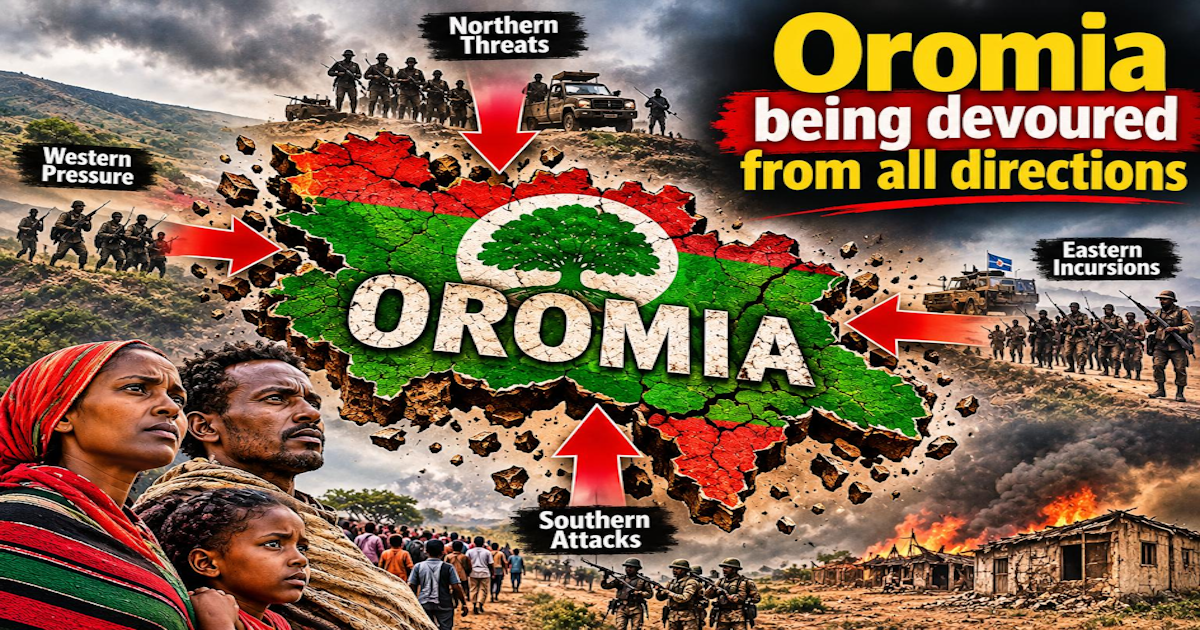
This article is inspired by a recent Oromia Today piece on crimes committed against Oromo by Amhara Fano. Since then, I have watched the same pattern repeat. A prominent commentator on African politics amplified the same distortion. Oromo grief goes unheard. Oromo communities are cast as perpetrators, not victims.
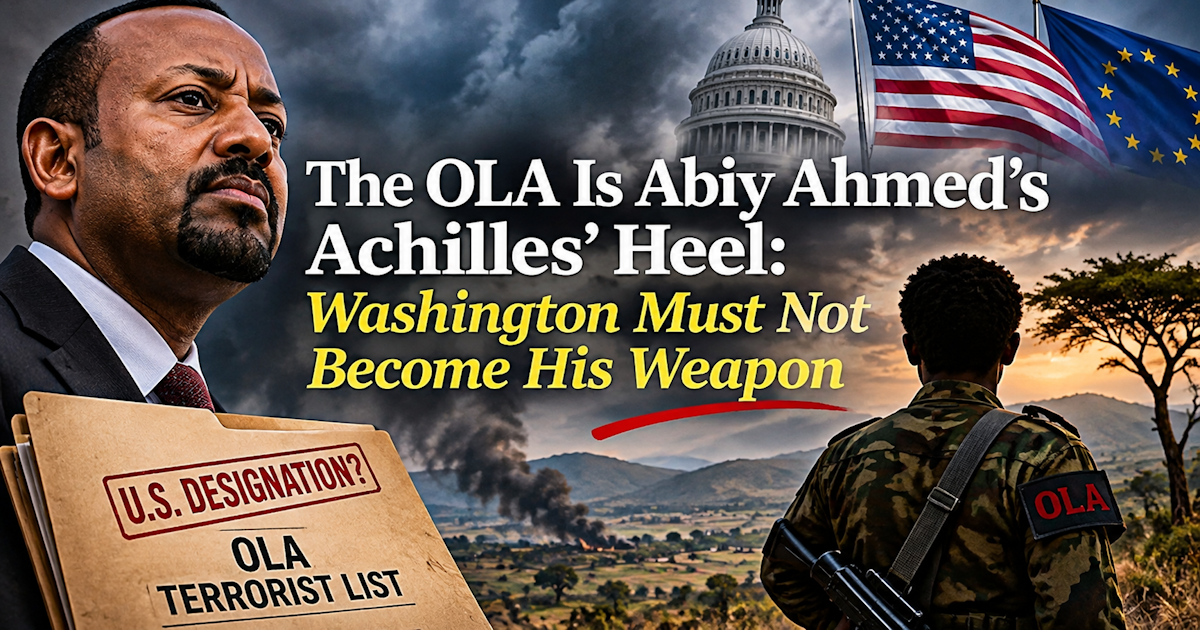
This article sets out to correct that record. It documents the Prosperity Party (PP) regime's sponsored terrorist operations against Oromo. It places them within a deliberate strategy. That strategy has two goals: to incite conflict between Oromo and other ethnic groups, and to delegitimise the Oromo Liberation Army (OLA)'s armed resistance. The post-2018 political opening subsequently narrowed through arrests and restrictions on Oromo opposition, while the OLA separated from the OLF and pursued armed resistance.
The Road Map to Demonisation of Oromo
The demonising of Oromo is not an aberration. It did not emerge with the current regime by accident. It was embedded in the Ethio-Amhara elite's roadmap from the start.
The Prime Minister signalled this in his inaugural speech. He confirmed it soon after, on his first official visit to America. There, he was welcomed as a hero for declaring himself a restorationist of Ethiopia's past glory. Those who claim to have handed him that roadmap have since spoken publicly. They say he delivered exactly what they gave him, from the word go.
The armed formations activated in Oromia since 2019 are part of this design. Their purpose is twofold: to erase Oromos from Finfinnee, and to demonise their struggle for self-determination as backward and anti-Ethiopian. Independent analysis of the post-2018 transition likewise documents a shift away from Oromo demands for self-rule and a renewed centralising Ethiopian nationalism [1].
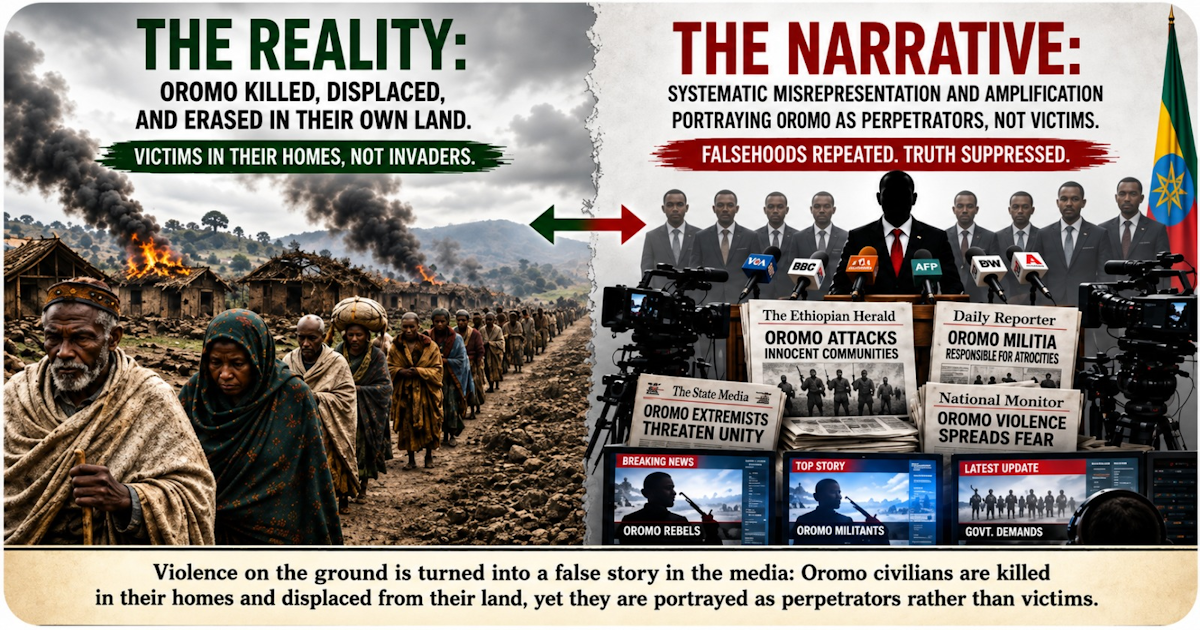
In pursuit of that roadmap, two organised sets of crimes have been committed against Oromos. Neither has entered the public domain. International media has hidden both. When they are occasionally reported, Oromos are portrayed as perpetrators rather than victims.
The first set of crimes is committed by the armed group known as Amhara Fano. Its prime objective is to restore imperial Ethiopia's golden days, with Amhara as the ruling elite. Amhara and Tigray settlers in Oromia support Fano's actions. These settlers were armed and financed in western Oromia, as the details below will show [2].
Part of this settlement began in 1974, during the drought that ended Emperor Haile Selassie's regime. A further wave came in 1984 and through the 1990s, bringing drought-affected Tigrayans and Amharas into western Oromia and, in part, Benishangul-Gumuz [3–5].
The second set of armed crimes against Oromos happens in western and central Oromia. These are PP regime-financed and trained terrorist groups. They operate under different names.
Gaachana Sirna ("defenders of the state") is documented as part of the regional counter-insurgency structure [6], while ACLED identifies the Gadaa Commando in recent fighting in western Oromia [7]. The state's use of the label "Shene" for OLA is separately documented in contemporary reporting [8–9]. The article also discusses the 120 Brigade below as part of this broader architecture.
The Nobel Prize-winning psychologist Daniel Kahneman made an important observation. A reliable way to make people believe falsehoods is frequent repetition. This works because familiarity is not easily distinguished from truth [10].
This is exactly what happens to Oromo. Crimes committed by Amhara Fano and other regime-sponsored settlers get repeated as crimes against them instead. Over time, Oromo cries lose currency. Other ethnic groups and the international community stop paying attention. Their testimony becomes background noise.
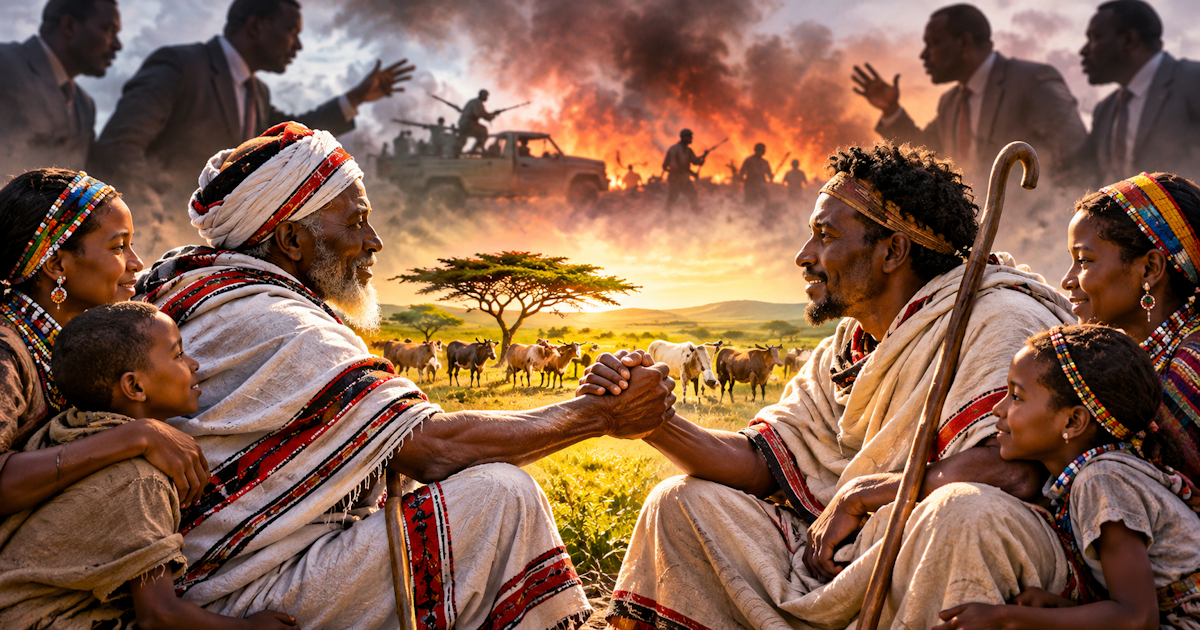
The settlers who were once welcomed in Oromia as fellow countrymen and women have since been groomed into an anti-Oromo force, armed to kill in the name of defending national unity against an invented Oromo identity threat. What was framed as drought resettlement turns out to be cover for a deliberate campaign to dilute Oromo identity and engineer demographic change in their own homeland.
The Crimes by Fano and Settlers Against Oromos
The settlers now defended as victims were placed on Oromo land by the Ethiopian state. This was not organic migration. The pattern began under the Derg's 1974–1991 resettlement and villagization programs and accelerated sharply after the 1984–1985 famine [4–5].
By March 1986, roughly 800,000 people had been relocated, most from the drought-stricken northern highlands of Wallo, Tigray, and Gojjam [5]. Their destination included western and central Oromia and areas adjoining Benishangul-Gumuz [4–5]. A further wave followed after 1996/97. Land redistribution in Gojjam pushed settlers into Gidda Ayana, Kiramu, Limmu, and Horro Guduru; the subsequent conflict dynamics involving settlers in western Oromia are documented in the Rift Valley Institute analysis [2].
That settler population is now the state's chosen instrument against Oromo self-defense. The Oromia regional state armed local Amhara farmers in Wallaga directly, while other armed groups developed alongside them in an increasingly militarized local environment [2]. Fano forces operate in coordination with armed settlers in parts of western Oromia [11]. Together they have produced a chronology of massacre, not isolated incidents.
In August 2021, 60 Oromo civilians were killed in reprisal attacks in Gida Kiremu [12]. In December 2022, reports documented killings, displacement and atrocities across East Waallaaga and Horo Guduru Waallaaga [13]. Most recently, on 23 August 2025, Amhara Fano militants stormed Hoomaa Gaalessaa village in Horro Guduru Waallaaga; Plaut's September 2025 report documents the escalation of Fano atrocities against Oromo civilians [14].
Central Oromia has borne a parallel toll. In March 2021, twelve Oromo civilians were killed riding an ambulance through Shewa Robit [15]. This followed earlier Axayyee and Kamisee clashes that had already left hundreds dead [16]. In August 2024, an escalation in Daarraa district, North Shawa, killed at least six civilians and destroyed over 50 homes [17].
By 2026, the violence had hardened into open insurgency. ACLED reports that Fano's Bizamo Command became increasingly active in Horo Guduru and East Wallaga and documents the sharp rise in militia activity and the August 2026 Tulu Lencha ambush [7]. The broader transformation of Fano from wartime ally into an insurgent force against the federal state is documented by the International Crisis Group [18].
Where settlers operate without uniform, the state supplies one of its own — militias raised, financed, and named in language borrowed from the very Gadaa institutions Oromo self-governance was built to protect.
Crimes by Armed Militia Organized and Armed by Regime
The second engine of violence against Oromos wears the state's own uniform, or something close enough to be mistaken for it. The Oromia regional regime established Gaachana Sirna as a regional security structure; its role in counter-insurgency and abuses against civilians is documented in the Journal of Oromo Studies [6].
Farmers in Horro Guduru Waallaaga have been pulled from buses at checkpoints, detained, and forced into training; refusal has been associated with imprisonment, torture, and denial of agricultural inputs [19–20].
Attribution of the June 2022 Tole massacre was disputed from the outset: regime-aligned accounts blamed OLA, while OLA publicly alleged that Gaachana Sirnaa was responsible [21–22]. More significantly, former Oromia Security Bureau head Brigadier General Kamal Gelchu is cited in the Journal of Oromo Studies as saying that Gaachana Sirnaa was formed to impersonate OLA [6].
A second, older instrument is the armed group led by Fekade Abdisa. He is a former OLF member operating outside any OLA command structure, and his group is commonly referred to as "Shene mootummaa" in reporting on the conflict [23]. The UK Home Office country note, drawing on multiple sources, places the group in East Wallega and Horo Guduru and describes it as operating outside OLA's command structure [23].
The Rift Valley Institute likewise discusses armed actors and splinter formations in western Oromia [2]. A Washington Post investigation described Fekade's force as a distinct armed group accused by residents of civilian killings and reported allegations that it cooperated with the regime, while also recording Fekade's denials [24].
The most recent addition to this architecture is the Gadaa Commando. ACLED reported the force in western Oromia on 28 August 2026 and described its participation in fighting in Fandaqaa kebele, Gida Ayana woreda, on 8 August 2026 [7].
ACLED's account describes allied fighters as "OLA/OLF-Shane" under Jaal Mosisa [7]. That terminology needs to be read alongside the regime's documented use of "Shene" as a designation for OLA [8–9] and reports of splinter or defected formations operating outside the OLA high command [23, 25].
The existence of a distinct OLA splinter under Sagni Nagasa, its December 2024 peace agreement with the Oromia administration, and subsequent disarmament are independently documented by Belgian country-of-origin reporting, Addis Standard, and Stratfor [26–28]. The distinction matters because not every force carrying the "Shene" or OLA label is necessarily part of OLA's command structure.
A further formation within this same architecture is the Moto Hayyaa Commando. It is organised in and around Ambo, led by General Hailu Gonfaa and Abbaa Garasu. Like the others, it is a regime-armed faction operating under a Gadaa-derived name. General Hailu Gonfaa operates within a 120-kilometre radius of Finfinnee (Addis Ababa). There, his forces have harassed and robbed the public under the pretext of supporting OLA's resistance.
They use the language of the struggle to justify banditry against the very civilians that the struggle claims to defend.
The killing in the villages and the story told about it afterwards are not separate acts — the second exists to make the first survivable in the eyes of the world.
National and International Media Campaign Against Oromo Identity
Two kinds of media work have demonized Oromo: domestic outlets that generate falsehoods, and international coverage that amplifies them. Local media in Ethiopia — including OBN, Fana, and thousands of regime social media brigades — have driven the domestic front. It distorts Oromo identity and downplays the role Oromo Qeerroo and Qarree played in overthrowing the EPRDF/TPLF regime in 2018.
This extends into faith. The dispute over Afaan Oromo in Orthodox liturgy and representation has been documented as part of the wider schism within the Ethiopian Orthodox Tewahedo Church [29–30]. The grievance included demands for wider use of Afaan Oromo in worship, greater representation of Oromo clergy, and church structures more responsive to Oromo congregants [29–30].
The Oromo grievance escalated on 22 January 2023, when three EOTC bishops — Abune Sawiros, Abune Ewostatewos, and Abune Zena Marcos — unilaterally ordained additional bishops and declared the "Synod of Oromia and Ethiopian Nations and Nationalities" [29]. The Holy Synod rejected the move and excommunicated the bishops; protests around the split resulted in deaths before a February 2023 reconciliation in which the church agreed to expand training and representation for Afaan Oromo-speaking clergy [29, 31].
Diaspora accounts describe Oromo congregants facing exclusion within EOTC communities over demands for Afaan Oromo services and expressions of Oromo cultural identity [30]. The dispute also extended online. A peer-reviewed study of EOTC-related Facebook pages documented hostile and derisive responses to demands for Afaan Oromo liturgy and wider Oromo representation within the church [32].
A second front amplifies this abroad. Ethio-Amhara social media narratives frequently present Oromo as perpetrators and Amhara communities as victims. At the same time, research and conflict reporting document serious violence, displacement, and competing armed actors across western Oromia, including Horo Guduru and East Waallaaga [11, 33].
The latest episode in this pattern involves journalist Martin Plaut. On 29 August 2026, Plaut issued an "urgent appeal" concerning deaths of Amhara civilians in Gida Ayana, East Waallaaga, and named the Gadaa Commando as a perpetrator [34]. OROMIA TODAY challenged that framing in an editorial "Martin Plaut and the Question of Selective Outrage" [35].
Its related response, "To Shimelis Abdissa and Caffee Oromia: History Will Judge You," forms part of the same debate over attribution and responsibility [36]. ACLED's separate reporting is important here because it identifies the Gadaa Commando as a regional security force active in the same conflict theater [7].
This method of arming a proxy and inverting the record did not begin in Oromia, and where it has gone unchecked elsewhere, the world only recognized it once the dead could no longer be counted quietly.
Global Precedent: When States Engineer Violence Against Their Own People
What has happened to Oromo since 2018 is not without precedent. In Darfur, Sudan, the Khartoum government armed and supported Arab militias, including the Janjaweed, in campaigns against Fur, Masalit, and Zaghawa communities; Human Rights Watch documented coordinated government and militia attacks and ethnic cleansing [37].
Holocaust and genocide reference sources record mass killing on a scale of hundreds of thousands and describe the international characterisation of the atrocities as genocide [38–39]. The later incorporation of Janjaweed elements into state security structures illustrates how irregular armed proxies can become institutionalised [39].
Ethiopia's own trajectory echoes Darfur's, with one telling divergence. Fano forces fought alongside the ENDF during the Tigray war and later resisted the federal regime's attempt to dismantle regional special forces and disarm militias.
The resulting confrontation developed into the Amhara insurgency from April 2023 onward [18]. Human Rights Watch's 2026 Ethiopia review documents the continuing conflict and civilian harm associated with armed confrontations involving federal forces and Fano [40].
Rwanda (1990–1994) shows what the media half of this pattern becomes if left unchecked. RTLM radio was closely connected to political and militia networks and used dehumanising broadcasts during the genocide; Human Rights Watch documented how broadcasting was used to identify, mobilise against, and target Tutsi civilians [41].
Later analysis continues to debate the precise causal weight of media, while affirming its important role in the genocidal environment [42]. Myanmar (2012–2017) shows the same mechanism at work on social media.
UN investigators concluded that Facebook had played a major role in spreading anti-Rohingya hatred and incitement [43–45]. The Carnegie analysis also documents analogous concerns in Ethiopia, including the UN special adviser's warning that online hate speech was helping normalise extreme violence [43]. A lawsuit filed in Kenya alleges that Meta's systems amplified hateful and violent content linked to ethnic violence during the Tigray war and seeks a $1.6 billion victims' fund [43, 46].
The cases of Darfur, Rwanda, and Myanmar show recurring mechanisms in which political violence, proxy or militia mobilisation, and information systems can reinforce one another [37, 41, 45]. The comparison does not by itself prove that every element is identical in Oromia; it provides a framework against which the evidence presented in this article can be assessed.
Kahneman's warning — that repetition makes falsehood indistinguishable from truth — is not abstract here; it is the operating method by which Oromo have been recast as aggressors for eight years running. A pattern sustained this long, and this consistently, is not an accident of circumstance — it persists because someone, somewhere, continues to benefit from the world believing the wrong side is guilty.
Misrepresenting Crimes Against Oromo and Beneficiaries
This culture of demonizing the victim, and amplifying without verifying, produces two distinct benefits for those behind it:
- Ideological — this lets the Ethio-Amhara elite make a claim. They claim the country's first enemy is its own ethnic diversity. They point to Article 39 itself, and the limited self-governance it offers to Ethiopia's nations and nationalities. It also lets them delegitimize, in advance, any Oromo claim that Finfinnee (Addis Ababa) be legally acknowledged as part of Oromia. Some international media and journalists amplify claims of Amhara victimhood while erasing crimes against Oromo. They carry a colonial mindset of their own — one in which a monarch and a strongman are preferable to nine empowered federal states governing themselves.
- Strategic — this benefit accrues directly to Abiy's regime. Conflict in OLA strongholds and the proliferation of armed actors can weaken opposition, fragment local security, and draw state forces into multiple theatres. The wider security environment in western Oromia, including the interaction of OLA, splinter groups, local militias, and regime forces, is documented by the Rift Valley Institute and UK Home Office country analysis [2, 23].
Naming who benefits changes nothing on its own — only sustained, undeniable documentation converts a named beneficiary into an accountable one.
Conclusion: Accountability and the Cost of Silence
The evidence in this article does not describe two sides of an ethnic conflict. It describes a design. The state placed settlers on Oromo land and armed them. When settlers kill Oromos, the state defends them with silence. Militias were raised under Gadaa's own name to fight Oromo resistance, while impersonating it.
A media apparatus, domestic and international, repeats the resulting deaths back to the world as Oromo aggression, rather than Oromo loss. Each piece functions on its own. Together, they form a single strategy.
A strategy has authors: the Ethio-Amhara elite who wrote the roadmap, that the PP regime delivered since April 2018.
Accountability cannot rest on repetition correcting itself. Kahneman's insight cuts both ways: familiarity can make repeated claims feel true even when evidence is weak.
That is why this case rests on named sources, not anonymous ones — a named former security chief, named commanders, a named investigation. What is missing is not evidence. It is sustained attention to it, before the next atrocity rather than after.
History does not forget the crime. It forgets the victims whose names were never said aloud. Oromia will not be one of them.
References
- Ethiopia Insight. "Peace in Ethiopia's Oromia Will Only Come Through Genuine Self-Rule." 8 January 2024.
- Abebe, Damena. "Conflict Trend Analysis: Western Oromia." Rift Valley Institute, March 2023.
- Tandfonline / Cogent Social Sciences. "Resettlement and State Farm in Central Ethiopia: Analyzing the Dhaadallee-Harroollee Resettlements and the Ethio-Yemen State Farm (1974–1991)." 2025.
- Cultural Survival. "Resettlement and Villagization: Tools of Militarization in SW Ethiopia." Cultural Survival Quarterly.
- Human Rights Watch. "Evil Days: Thirty Years of War and Famine in Ethiopia." 1991.
- Journal of Oromo Studies. "Invisible Conflict and Displacements: The Crisis in Oromia National Regional State in Ethiopia." 5 January 2026.
- Getachew Birru, Jalale. "Is Fano Militias' Activity Increasing in the Western Part of Ethiopia's Oromia Region?" ACLED Expert Comment, 28 August 2026.
- Addis Standard. "News: Fed. Attorney General Says Terrorist Designated 'Shene' Refers to Oromo Liberation Army; OLA Responds, Vows to 'Engage in Total War.'" 7 May 2021.
- Addis Standard. "OLA 'Acknowledges' Upcoming Negotiation With Ethiopia Government, 'Strongly Objects' Reference as 'Shene.'" 24 April 2023.
- Kahneman, Daniel. Thinking, Fast and Slow. Penguin, 2011.
- Regassa, Asebe, and Gemechu Abeshu. "Wollega Under Siege: Unravelling Layers of Violence, Displacement in Western Oromia." Addis Standard, 3 March 2025.
- Wikipedia. "2021 Gida Kiremu Massacres." Accessed September 2026.
- OLLAA (Oromo Legacy Leadership and Advocacy Association). "Gruesome Attacks Throughout Western and Central Oromia." 28 February 2023.
- Plaut, Martin. "Fano Amhara Militias Escalate Atrocities Against Oromo Civilians in Oromia." martinplaut.com, 18 September 2025.
- Wikipedia. "Shewa Robit Ambulance Massacre." Accessed September 2026.
- Wikipedia. "2022 North Shewa Clashes." Accessed September 2026.
- Addis Standard. "Ongoing Attacks by Armed Groups in Derra District of Oromia Region Claim Six More Lives in Latest Violence." 31 August 2024.
- International Crisis Group. "Ethiopia's Ominous New War in Amhara." Briefing 194, 17 November 2023.
- Addis Standard. "Farm or Fight: Farmers in Oromia's Horro Guduru Wollega Zone Struggle Against Forced Conscription Under Gachana Sirna." 20 November 2024.
- AllAfrica. "Ethiopia: Forced Conscription Resurfaces Across Oromia as Ethiopia Continues to Grapple With Security Crises." 14 August 2026.
- Ethiopia Insight. "Amhara Civilians Were Massacred in Tole, But Questions Remain." 8 July 2022.
- Filseth, Trevor. "Oromo Separatist Group Blamed for Massacre in Southern Ethiopia." The National Interest, 21 June 2022.
- UK Home Office. "Country Policy and Information Note: Oromos, the Oromo Liberation Front and the Oromo Liberation Army, Ethiopia." March 2026.
- Houreld, Katharine. "Rebel or bandit? His life illuminates Ethiopia’s hidden insurgency." The Washington Post, 21 May 2023.
- Addis Standard. "OLA Denies Split Following Reports of Central Zone Command Defection." 30 September 2024.
- Belgian Commissioner-General for Refugees and Stateless Persons (CGRS/CGVS). "Veiligheidssituatie in Oromia." 14 May 2025.
- Addis Standard. "Former OLA Commander Announces Peace Agreement Implementation Within Two Days." 6 December 2024.
- RANE / Stratfor Worldview. "Ethiopia: OLA Faction Begins to Disarm Following Peace Deal With Government." 5 December 2024.
- The Africa Report. "Ethiopia: Nationalism Creates Schism in Orthodox Church." 14 February 2024.
- OLLAA. "The Exclusion of Oromos by the Ethiopian Orthodox Church." 31 October 2023.
- Al Jazeera. "Ethiopian Orthodox Church Reaches Deal With Three Rogue Bishops." 16 February 2023.
- Chala, Geremew. "Online Hate Speeches as Threats to Peace and Deteriorations of Unity and Harmony Intra-Religion in the Ethiopian Orthodox Tewahedo Church (EOTC)." Cogent Social Sciences, 10 June 2024.
- Norwegian Organisation for Asylum Seekers (NOAS). "The Security and Human Rights Situation in Oromia, Ethiopia." 2025.
- Plaut, Martin. "An Urgent Appeal for Action Following Amhara Deaths." martinplaut.com, 29 August 2026.
- Oromia Today, "Martin Plaut and the Question of Selective Outrage." oromia.today.
- Oromia Today, "To Shimelis Abdissa and Caffee Oromia: History Will Judge You for a Shameful Failure of Duty." 17 March 2026.
- Human Rights Watch. "Darfur Destroyed: Ethnic Cleansing by Government and Militia Forces in Western Sudan." 6 May 2004.
- Holocaust Memorial Day Trust. "Genocide in Darfur." hmd.org.uk, 11 April 2024.
- United States Holocaust Memorial Museum. "Darfur." Holocaust Encyclopedia, encyclopedia.ushmm.org.
- Human Rights Watch. "World Report 2026: Ethiopia." 4 February 2026.
- Human Rights Watch. "Leave None to Tell the Story: Genocide in Rwanda." March 1999.
- The Conversation. "Debate Continues About the Media's Role in Driving Rwanda's Genocide." 2 May 2024.
- Crystal, Caroline. "Facebook, Telegram, and the Ongoing Struggle Against Online Hate Speech." Carnegie Endowment for International Peace, 7 September 2023.
- BuzzFeed News. "The UN Says Facebook Has Failed to Tackle Hate Speech in Myanmar — Here's Why That Matters." 27 August 2018.
- Al Jazeera. "UN: Facebook Had a 'Role' in Rohingya Genocide." 13 March 2018.
- Amnesty International. "Kenya: Meta sued for 1.6 billion USD for fueling Ethiopia ethnic violence." 14 December 2022.
Additional Sources Consulted and Not Cited
- AllAfrica. "Ethiopia: In-Depth — Farm or Fight: Farmers in Oromia's Horro Guduru Wollega Zone Struggle Against Forced Conscription Under Gachana Sirna." 6 September 2024.
- Wikipedia. "War in Amhara" / "Fano Insurgency." Accessed September 2026.
- Wikipedia. "Ano Massacre." Accessed September 2026.
- Wikipedia. "Qelem Wollega Massacre." Accessed September 2026.
- Wikipedia. "May 2023 Oromia Clashes." Accessed September 2026.
- Curate Oromia. "Silence in the Face of Slaughter: Ethiopia’s War in Oromia." 8 December 2023.