In Pursuit of Independent Oromia: Facing the Persistence of Empire and Countering the Fallacy of Imperial Democratization

Excerpt
In this sweeping argument for Independent Oromia, Tsegaye R. Ararssa contends that Ethiopia’s enduring imperial structure cannot be democratized without first being decolonized. Tracing the legal, political, military, cultural, and psychological mechanisms of imperial rule, he argues that Oromo self-determination requires reclaiming collective agency, revitalizing Gadaa and Oromummaa, and confronting fears over economic viability, regional security, internal tyranny, and international recognition.
Abstract
This piece examines the structural, legal, and psychological dimensions of the Oromo quest for self-determination against the historical and contemporary framework of the Ethiopian state. Moving beyond mainstream narratives that treat the Oromo struggle as a regional demand for civil liberties or democratic integration, this paper argues that the Ethiopian state remains fundamentally an un-decolonized empire-state that is impermeable to democratization efforts. Drawing inspiration from the post-colonial frameworks of Frantz Fanon, Ngũgĩ wa Thiong’o, and Aníbal Quijano, the analysis demonstrates how internal state concessions, superficial leadership shifts—or changes of hands at the top—and the consolidation of the contemporary Prosperity Party serve as strategic mechanisms of imperial pacification and re-centralization.
Furthermore, the piece exposes how the state’s failure to contain the Oromo collective consciousness through structural-legal manipulation routinely results in reliance on raw military force, manifested through localized command posts and state-sponsored drone warfare. Ultimately, the piece concludes that genuine democratization is a structural impossibility within an intact imperial configuration. True liberation requires the comprehensive dismantling of the state’s multi-layered legal-political, cultural, and epistemic infrastructure, replacing it with authentic Oromo collective agency and the Gadaa system, and rejects anxieties over geopolitical or economic inviability as manufactured roadblocks to absolute sovereignty.
An Empire Cannot Be Democratized Without Being Decolonized
The historic quest for Oromo self-determination highlights a fundamental political truth: an un-decolonized empire cannot be democratized, and internal reforms serve primarily to pacify colonial subjects and preserve the status quo. For more than a century, since the late 19th-century imperial conquests under Emperor Menelik II consolidated the modern Ethiopian state, the Oromo nation has been subjected to a hierarchical matrix relying on the systematic erasure of its political autonomy. In contemporary discourse, this anti-colonial struggle is frequently mischaracterized by external observers and metropolitan elites as a domestic plea for constitutional reform, civil rights, or equal integration (aka liberal equality). However, evaluating the Oromo movement through the lens of internal Ethiopian democratization fundamentally misunderstands the colonial architecture of the Ethiopian state. Because the state’s foundational logic is imperial, internal reforms function not as paths to liberation but as calculated strategies of containment designed to preserve Abyssinian structural hegemony.
This dynamic of co-optation mirrors the colonial counter-insurgency strategies diagnosed by Frantz Fanon (1963). When an imperial state faces existential crises driven by grassroots resistance—such as the historic #OromoProtests of Qeerroo and Qarree that destabilized the ruling Ethiopian People’s Revolutionary Democratic Front (EPRDF) between 2014 and 2018—the metropole rarely surrenders its power voluntarily. Instead, it offers tactical concessions to preserve the system’s core. Within the Ethiopian context, these concessions historically materialized as superficial leadership changes, such as the transition from Hailemariam Desalegn to Abiy Ahmed.
The post-2018 political transition under Abiy Ahmed offers a classic contemporary example of this strategy. By installing an ethnically Oromo figure at the apex of state power while simultaneously executing a neo-imperial, centralizing political agenda (Medemer), the state sought to co-opt Oromo identity to re-legitimize the empire and pacify the Oromo. Fanon observed that such maneuvers successfully recruit segments of the colonized elite, creating a buffer zone that neutralizes the revolutionary momentum of the masses.
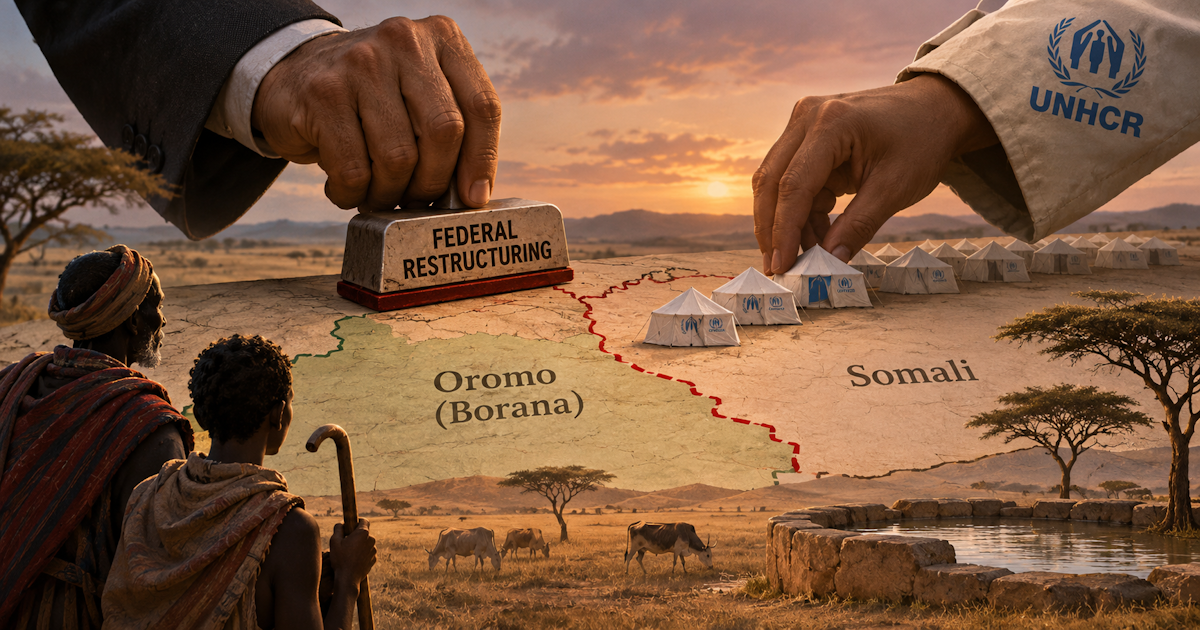
This pacification strategy reached its structural zenith with the dissolution of the Ethiopian People’s Revolutionary Democratic Front (EPRDF) and the subsequent consolidation of the Prosperity Party (PP). Far from being a vehicle for democratic transition, the PP operates as a modern instrument of imperial reconfiguration. By replacing the formal multinational federal architecture with a single, highly centralized party apparatus, the PP elite effectively dismantled the institutional protections—however flawed or poorly implemented—of the constitutionally promised national self-determination.
The contemporary Oromo quest for sovereign independence through the exercise of self-determination must therefore be understood not as a struggle to reform, humanize, or otherwise sanitize the Ethiopian state through democratizing the current regime, but as a project to reclaim collective agency completely outside imperial logic. Seeking rights within this modern, re-centralized state structure is a conceptual dead end and a political capitulation. True democracy requires absolute equality of sovereignty among political entities and the free expression of their consent to live—or not to live—within the confines of the empire in which they have hitherto been caged by force—a condition the centralized Ethiopian empire-state cannot grant without causing its own dissolution.
Contrary to what some commentators, such as Jawar Mohammed, assert, genuine democratization cannot be achieved before decolonisation. And true decolonisation cannot be achieved by a mere transfer of bureaucratic portfolios or a rearrangement of state personnel. A change of hands at the top of the power hierarchy—such as the one we saw when Hailemariam handed power to Abiy Ahmed—does not signal the achievement of freedom; nor does it fulfill the national aspirations of the Oromo and other colonized peoples for sovereign independence.
Achieving power by a particular elite is not the same as achieving freedom for the people from whom they come. The quest for power by some elites is not exactly the same as the quest of the masses for freedom. And it is well to remember that the struggle of the Oromo people has always been for justice and independence, not for putting some Oromos in power. In the case of colonized peoples such as the Oromo, the quest for freedom and justice trumps the elite quest for power.
Law as an Instrument of Othering and Dispossession
True decolonisation demands the comprehensive dismantling of the multi-layered colonial infrastructure that sustains imperial rule. For the Oromo nation, the Ethiopian state is a structural grid embedded across legal, political, cultural, and epistemic dimensions. As Ngũgĩ wa Thiong’o (1986) posits, the ultimate weapon of an imperial power is the cultural bomb, which destroys a people’s belief in their names, their languages, and their capacities, rendering them passive spectators in their own subjugation (see also Quijano 2000). Reclaiming Oromo collective agency and achieving freedom requires targeting this total infrastructure, beginning with the deconstruction of its political and legal framework.
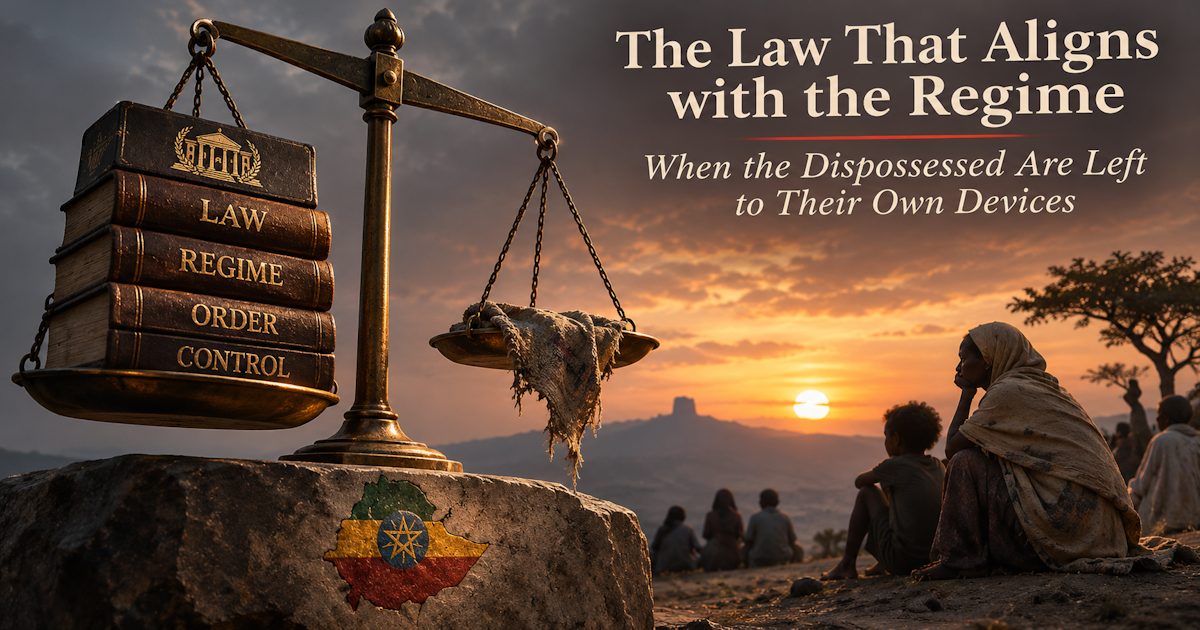
The legal infrastructure of the Ethiopian state has historically functioned as an instrument of Oromo land dispossession and cultural and demographic displacement. The law was the chief instrument for executing the settler-colonial logic of elimination. The traditional and modern constitutions of Ethiopia—i.e., the Kibre-Negest, Sir’ate-Mengist, Fews-Menfesawi, etc., and the modern written constitutions of 1931, 1955, 1987, and 1995, respectively—have been, to varying degrees, chief instruments of othering the Oromo and the other peoples of the wider South. Accordingly, over hundreds of years, the constitutions and other public laws of Ethiopia served as the site and technology for othering colonized subjects as:
- the “pagans” waiting to be proselytized or Christianized;
- the “savages/barbarians” waiting to be civilized;
- the “primitive” waiting to be modernized;
- the “oppressed” waiting to be emancipated;
- the “underserved” waiting to be equalized;
- the “marginalized/peripheralized” waiting to be included/centered;
- the “backward/underdeveloped” waiting to be developed; and
- the “terrorist” waiting to be securitized and/or disciplined.
Throughout, the laws were violent vectors of Christianization, civilization, modernization, socialist transformation, neoliberal development, and securitization. Most importantly, they were instruments of economic alienation, political domination, and cultural erasure (Ararssa 2017).
The legacy of dispossession, for example, traces its lineage directly back to the late 19th-century nafxanyaa (settler-garrison) system established during the Shewan military expansions. These conquests, marked by violent campaigns including the historic Aanolee massacre of 1886 and the Battle of Calanqoo in 1887, stripped Oromo communities of ancestral lands, reduced them to tenant laborers (gabbar), and codified their disenfranchisement into state law. The subsequent legal history of the empire, even in the era of codification—otherwise known as “Ethiopia’s era of juristic revolution” (1955–1965)—has consistently weaponized othering, alienation, and assimilation, tracing a direct line from the Kibre-Negest to modern legal frameworks that construct the Oromo as an enemy “other” (Jalata 2005; Bulcha 2011; Hassen 1990).
Changing Regimes, Changing Vocabulary, Enduring Empire
From the first written constitution in 1931 through the revised text of 1955, the imperial project pursued homogenization and homogenization under the guise of modernization. The creation of a modern parliament served as a cosmetic façade, concealing the institutionalization of imperial autocracy. After the attempted coup d’état of 1960 by the Neway Brothers was foiled and Abyssinia’s first internal democratic urge was brutally suppressed, public sentiment began to shift, especially among proponents of the student movement, through whom the “National Question” rose to prominence. Theirs, too, was a generation itching to democratize the empire.
After the students tabled the national question as an important political agenda, the Oromo and the other “others” were no longer viewed merely as the “savage other”; they began to be explicitly recognized not only as the downtrodden and impoverished but also as the “insulted and humiliated” of Ethiopia: conquered, oppressed, alienated, exploited, and vilified nations trapped in an empire that had turned out to be a “prison-house” for them.
Subsequent regimes merely altered the vocabulary of containment. The 1973 constitutional reforms—which, having been overtaken by the revolution, remained a draft—attempted to contain what they referred to as the “clan question.” The 1974 revolution shifted the empire from a monarchical to a military configuration under the Provisional Military Administrative Council (PMAC), the Derg. Yet the empire remained intact. What had been a monarchical empire now became a military and socialist empire.
The Derg’s fundamental motto and grundnorm was “Ethiopia Tiqdem,” which literally means “Ethiopia First”—a motto that subordinated all other matters, including the rights of colonized subjects. Contrary to what many assume to have been the end of empire because the emperor was dethroned, the Derg’s grundnorm re-enacted and endorsed the sanctity of the empire and its conquered territories. Subsequently, its 1987 Constitution of the People’s Democratic Republic of Ethiopia (PDRE) offered a token gesture of recognition to the “primitive others,” but only as secondary to the principle of “national unity and sanctity of territorial integrity.” The empire’s territories were constitutionally rendered indivisible and inalienable. The Derg vowed to subdue any and every nation for the sake of preserving the empire’s integrity. Preservation and pacification of the empire—and the creation of a new socialist man out of the oppressed “peasants”—was the fundamental state ethos.
When the 1991 Transitional Charter entered the scene with its new grammar of self-determination, despite the initial palpable optimism among many, the promise of genuine democratization was quickly betrayed. By 1992, as soon as the Oromo Liberation Front (OLF) was pushed out of the transitional process, the Oromo were recast as an “undigestible other.” The securitization of Oromo identity quietly re-entered the Ethiopian scene.
The 1995 Constitution reiterated the hope of self-determination, but having proclaimed self-determination in the absence of the self, it only positioned the EPRDF to use ethnonational recognition—and its managed federalism—as a mechanism of pacification. Once again, pacifying and preserving the empire trumped the decolonisation and democratization urge. Federalism became an instrument of regulation, converting self-rule into centralized control through a burgeoning bureaucracy that became increasingly penetrative into the hinterlands of the conquered territories. This produced a glaring oxymoron: a federalism without democracy that functioned as an administrative specter of apartheid, cementing party and state hegemony over regional entities through federal intervention acts, police laws, political party and electoral laws, and restrictions on the press and civil society (Ararssa 2017).
The democratic stir of 2005 exposed the state’s absolute refusal to democratize, turning the entire country, but especially Oromia, into a primary site of state violence and detention for dissidents. This expanded into full-blown state terrorism valorized by the anti-terrorism legislation of the mid-2000s, followed by the rise of “developmental statism” as a new civilizing ideology.
Prosperity Party and the Imperial Reconfiguration
Under the contemporary Prosperity Party regime, this extractive legal-structural framework has morphed into an authoritarian/autocratic system of absolute command, although not always so absolute in practice. The PP state enforces an aggressive urban restructuring project, using eminent domain to dispossess Oromo communities in modern metropolitan corridors, capital beautification schemes, and state-mandated zones. The Prosperity Party itself has disavowed its ethnonational identity and veered away from the identitarian politics its predecessor, the EPRDF, practiced, if only for purposes of elite co-optation and imperial pacification.
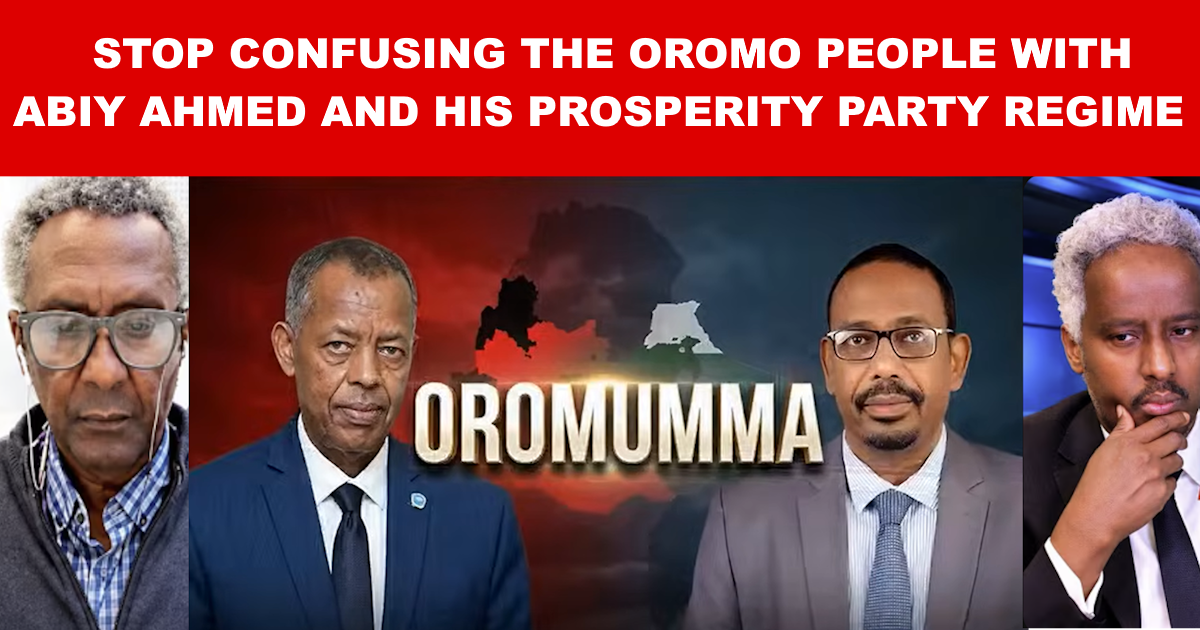
The recent attempt by commentators such as Jawar to characterize Abiy Ahmed’s PP as “an Oromo Government,” while the PP is fighting hard to distance itself from Oromos, is to indulge in self-delusion. To say that because Abiy and his group have achieved power, the Oromo have been liberated is another gross self-deception.
The PP’s open quest for a “return to the glory of olden days,” its attempt to revise the Constitution and undo the multinational federal system, its declared intent to abrogate the self-determination clause of the Constitution, and its attempt to dismantle Oromia and other states through clusterization demonstrate nothing but the imperial fantasy of the current regime. So, even if one maintains—just for the sake of argument—that empire has legally been rendered obsolete, as some tend to do, the return of that fantasy, almost with a vengeance, in Abiy’s discursive and political practice shows that the empire is alive and is actually striking back.
It is indeed striking hard—and with unmistakable genocidal streaks—almost as if regretting the recognition that the Constitution extended for purposes of imperial self-preservation and pacification of the colonized. But, as noted above, it is obvious that the Ethiopian colonial empire endured and outlasted several social and political upheavals. It merely had to change and adapt its name across the historical timeline:
- from “monarchical” (1931–1974),
- to “military” (1974–1987),
- to “socialist” (1987–1991),
- to “multinational federalist” (1991–2018),
- to “unitarist,” alias ye-Medemer empire (2018–2026).
The Repeated Failure of Democratization
Those who assert that what is required now is democratization, not national liberation, apart from refusing to see the overt persistence of empire throughout its history, choose to ignore the repeated and spectacular failure of democratization efforts thus far—in 1960, 1973, 1974, 1991, 2005, 2012, 2018, 2020, and 2025.
Generations of Oromos have hoped and tried, re-hoped and tried, and hoped against hope and tried to democratize Ethiopia—and failed.
Tadese Birru, Husein Suura, Haile Fida, Baaroo Tumsa, Meri’ed Niguse, Demissie Bulto, Merera Guddinaa, Negasso Gidada, Leencoo Lataa, Dawud Ibsa, and others have all tried and invariably failed. From our own generation, we have seen how Battee Urgessa, Hacaalu Hundessa, and thousands of other Qarree and Qeerroo gave a chance to the hope of democratizing Ethiopia, but eventually the empire consumed them and emphatically told their survivors that democratization is a mirage. The fact that self-proclaimed latter-day democratizers like Jawar Mohammed himself are exiled after unbearable acts of persecution is a testament to the refusal—no, the congenital inability—of the Ethiopian empire to democratize.
Democratization could not succeed thus far not for lack of effort or proponents. It failed because it is impossible to democratize a colonial empire before dismantling its anti-democratic, othering, hierarchical, genocidal, and repressive infrastructure. Doing so requires full-scale decolonisation. The starting point is launching—or enhancing—the struggle for national liberation, pursuing political independence and sovereign equality through the exercise of collective agency via self-determination.
Technically, reclaiming collective agency requires, among other things, erasing these imperial property regimes that treat Oromo land as a state-owned commodity, dismantling top-down authoritarian administrations, and establishing independent Oromia rooted in territorial and historical legitimacy.
When Containment Fails: Command Posts and Drone Warfare
When legal-structural maneuvers fail to entirely suppress the Oromo collective consciousness, the Prosperity Party routinely falls back on the ultimate guarantor of imperial hegemony: raw military force. This reliance on militarized violence is not an aberration or a temporary emergency measure; it is the operational methodology of a state that lacks organic domestic legitimacy.
In Oromia, this manifests itself daily through the institutionalization of military “command posts” that effectively replace civilian administration with martial law. Under this framework, vast swaths of the region are subjected to an uncodified state of siege in which constitutional protections are suspended and federal and regional security forces operate as occupying armies.
Furthermore, the state has elevated this violence through the deployment of modern tech-authoritarian tools, transitioning from traditional ground-based counter-insurgency to systematic drone warfare. Armed unmanned aerial vehicles (UAVs) are deployed extensively across rural Oromia—and other regions such as Tigray and Amhara—ostensibly targeting armed insurgencies but consistently executing extrajudicial strikes that terrorize agrarian populations and destroy communal infrastructure.
This reliance on aerial bombardment and localized command posts serves a dual purpose: it mathematically calculates physical deterrence while psychologically enforcing the empire’s omnipresence. By transforming the Oromo sky into a vector of kinetic violence and the ground into a matrix of military checkpoints, the PP regime exposes the absolute bankruptcy of its “democratization” narrative.
Reclaiming Gadaa, Oromummaa, and Epistemic Sovereignty
This structural violence cannot be undone without smashing the empire’s ideological hegemony and revitalizing the Gadaa system. The ideological infrastructure of the Ethiopian empire relies on an assimilationist, monocultural “Ethiopianist” narrative. This narrative positions Abyssinian cultural, religious, and linguistic norms as the sole civilized standard while historicizing the Oromo and other nations as peripheral actors.
This myth, also ingrained in what is known as “Ethiopian exceptionalism,” is built on a mimicry of European colonizers, whereby the state positioned itself as a symbol of Black independence while systematically disavowing its Black African identity and destroying indigenous Black structures within its borders. To break this colonial yoke in Oromia, this hegemony must be shattered by institutionalizing the Gadaa system.
Gadaa is the indigenous, egalitarian sociopolitical governance framework of the Oromo people, operating on principles of cyclical leadership rotation every eight years, collective decision-making through national assemblies (Caffee), and strict institutional checks and balances. Asserting the Gadaa system is not a nostalgic retreat into the past; it is a forward-looking assertion of an authentic political paradigm that directly invalidates the centralized, autocratic logic of the Ethiopian colonial empire (Legese 2000; Jalata 2025).
Concurrently, epistemic liberation demands centering Oromummaa—the cultural, philosophical, and psychological bedrock of Oromo national identity. The intellectual infrastructure of the empire has historically weaponized knowledge production to execute epistemic violence against the Oromo consciousness. For generations, the state-mandated prohibition of Afaan Oromo in education, media, and public administration served to marginalize Oromo thinkers.
This systemic suppression triggered the formation of the Maccaa and Tuulama Self-Help Association (MTSHA) in 1963, spearheaded by leaders such as Colonel General Tadesse Birru, marking the dawn of modern pan-Oromo nationalist consciousness. Epistemic liberation demands a systematic rewriting of history from the perspective of the conquered, exposing the structural violence of the empire’s founding and validating indigenous Oromo knowledge systems as independent academic frameworks (Quijano 2000). While institutions such as the Oromo Studies Association (OSA) and the Journal of Oromo Studies have done immense work, knowledge production must expand to fully displace imperial historiography (Jalata 2025).
The Politics of Fear: Is Independent Oromia Viable?
The final defense of an unraveling empire is psychological, relying on the weaponization of anxiety to paralyze the imagination of the colonized (Fanon 1963). When the material, legal, and intellectual justifications for imperial rule are dismantled, defenders of the state, such as Jawar, fall back on warnings that an independent Oromo nation is a geopolitical impossibility. They spread fears of economic inviability/economic war (“although naturally endowed, we are surrounded by less endowed regions”), geostrategic insecurity (“our neighbors will fight us”), and the risk of the emergence of internal tyranny (“look at Eritrea and South Sudan”). These fears of economic inviability, geopolitical insecurity, and internal tyranny can no longer serve as excuses to delay liberation.
The warning of economic inviability is a profound distortion of reality. The Ethiopian state structure is parasitically dependent largely on the extraction of Oromo resources. The Oromo nation possesses the foundational economic engine of the entire Horn of Africa, characterized by agricultural abundance, vast natural wealth, and dynamic human capital. The narrative of inviability turns the truth on its head: it is not Oromia that is economically unviable without the empire, but rather the Ethiopian empire that is structurally unviable without the forced extraction of Oromo wealth.
Decolonization corrects this asymmetry by ensuring that Oromo labor and resources are channeled into domestic development and regional trade networks based on mutual benefit rather than colonial theft. The fear of poverty among less-endowed neighbors, who might threaten Oromia’s security, is also a distortion. Most are as endowed as Oromia is. Some are more so, and some less.
As a nation that has suffered from manufactured poverty, it is Oromia’s national ethical imperative to establish a mutually agreed-upon economic and trade framework that ensures shared growth with its neighbors. To discourage the pursuit of independence on account of the risk of imagined economic strife in a supposedly poor neighborhood is nothing but fear of the burden of freedom. And it is an inexcusably defeatist position for a self-proclaimed politician like Jawar to hold. Even worse, it is a deliberate act of fearmongering intended to discourage the pursuit of independence.
Geopolitical Stability, Internal Tyranny, and International Recognition
Similarly, the specter of geopolitical insecurity is consistently invoked by regional, AU-based elites and international backers who fear that the dissolution of the Ethiopian state will destabilize the Horn of Africa. This argument assumes that the current imperial state represents a form of stability.
In reality, the Ethiopian empire is the primary source of chronic violence, civil war, famine, genocidal campaigns, and displacement in the region.
One cannot help recalling the genocidal wars that a UAE-emboldened Ethiopia is currently prosecuting even beyond its borders in the neighboring country of Sudan, and the destabilizing impact its illegal pursuit of sovereign access is creating in the region, especially in Eritrea and Somalia. Forcing disparate, historical nations into a centralized, coercive state apparatus creates an environment of perpetual conflict. The liberation of Oromia offers a path toward a sustainable regional architecture built on genuine regional agreements, security anchored in local legitimacy, and a democratic regionalism that is achievable only when its largest demographic entity exercises its right to self-determination.
The concern regarding internal tyranny—the fear that a post-independence state will merely replicate the despotism of the colonizer—is a valid historical trauma seen across post-colonial Africa. However, the Oromo nation possesses a powerful indigenous shield against autocracy: the Gadaa system. Because the Gadaa framework is inherently built upon decentralized power, mandatory leadership rotation, and institutional accountability (Legese 2000), the Oromo struggle does not have to build a democratic philosophy from scratch. It possesses a native defense mechanism against internal tyranny. However, even if tyranny befalls independent Oromia, it still remains independent, and its people reserve their collective agency to correct their own wayward government.
Some fear that independent Oromia may struggle to gain international recognition, citing the case of Somaliland. The fear of global hesitation or a lack of immediate diplomatic recognition cannot dictate the timeline of freedom. International law and global geopolitics are notoriously conservative, often prioritizing the artificial stability of existing borders over the human rights of stateless nations. Yet history demonstrates that international recognition is a lagging indicator of a reality achieved on the ground. When a colonized nation firmly reclaims its collective agency, organizes its economic power, and asserts its de facto sovereignty, the international community is eventually forced to adjust to the new geopolitical reality. (More on this in another installment.)
Freedom Is Not a Conditional Reward
To ask the Oromo people to wait for a more stable geopolitical climate, or to demand that they prove their “readiness” for independence to a global audience, is to accept the terms of colonial capitulation.
Freedom is not a conditional reward granted by an imperial metropole or a foreign superpower; it is an absolute baseline.
The reconfiguration of relations in the Horn of Africa cannot occur within the structures of the old empire. It can occur only after total decolonisation, when the Oromo nation breaks the colonial yoke completely and stands as an equal, sovereign actor on the world stage.
References
- Ararssa, Tsegaye R., Presenting Absence: The Figure of the Oromo in the Constitution(s) of Ethiopia—Law as a Site of Progressive Othering (Unpublished PhD Thesis, 2017).
- Bulcha, Mekuria, Contours of the Oromo Nation: History, Society and Culture (Centre for Oromo Studies, 2011).
- Fanon, Frantz, The Wretched of the Earth, trans. Constance Farrington (Grove Press, 1963).
- Hassen, Mohammed, The Oromo of Ethiopia: A History, 1570–1860 (Cambridge University Press, 1990).
- Jalata, Asafa, Oromia and Ethiopia: State-Formation and Ethnonational Conflict, 1868–2004 (Red Sea Press, 2nd ed., 2005).
- Jalata, Asafa, “The Journal of Oromo Studies: An Intellectual Platform for Developing Oromo Liberation Knowledge” (2025) 29(2) Journal of Oromo Studies, 1–23.
- Legese, Asmarom, Oromo Democracy: An Indigenous African Political System (Red Sea Press, 2000).
- Quijano, Aníbal, “Coloniality of Power, Eurocentrism, and Latin America” (2000) 1(3) Nepantla: Views from South, 533.
- Thiong’o, Ngũgĩ wa, Decolonising the Mind: The Politics of Language in African Literature (James Currey, 1986).
Tsegaye R. Ararssa is an independent legal scholar, political and legal commentator, and public intellectual specializing in constitutional law/theory, human rights, and comparative federalism. His work focuses extensively on indigenous resistance, self-determination, and the political geography of the Horn of Africa.