The OLA Is Abiy Ahmed’s Achilles’ Heel: Washington Must Not Become His Weapon
Excerpt
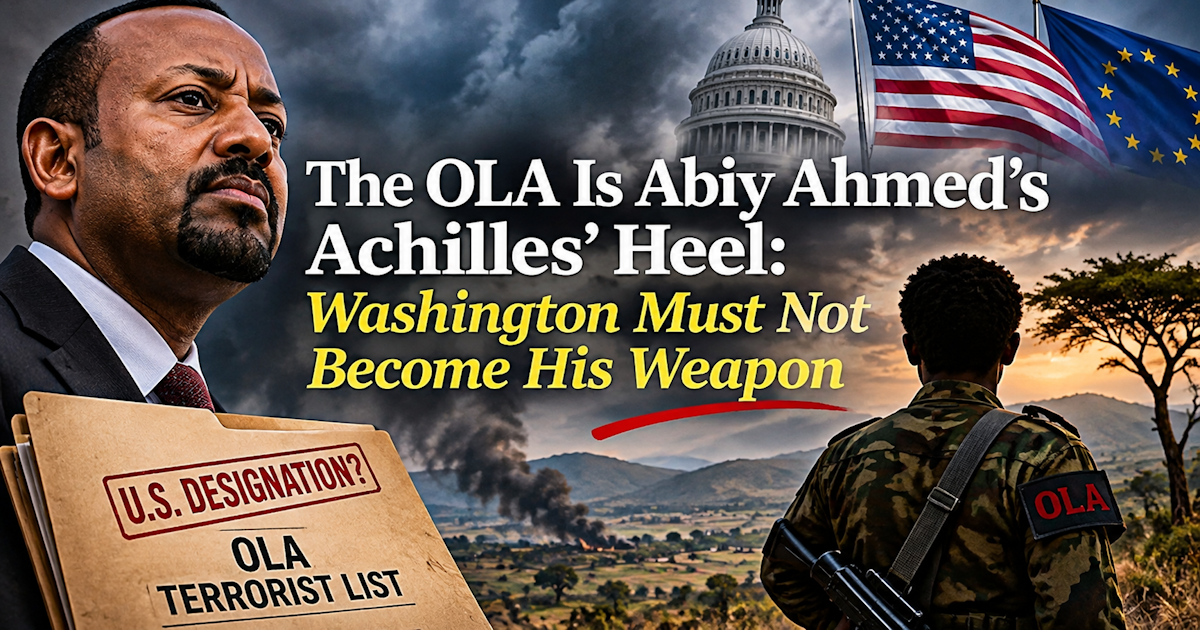
The Oromo Liberation Army (OLA) has, for quite a long time, become Abiy Ahmed’s Achilles’ heel, challenging the Prosperity Party’s claim to political legitimacy in Oromia. As reports emerge of the Abiy Ahmed regime lobbying Washington to designate the Oromo Liberation Army (OLA) a terrorist organization, a troubling question arises: Why now, after years of failed military campaigns and internationally facilitated peace negotiations? This exposé examines the Prosperity Party regime's political vulnerability, the disturbing pattern of unresolved atrocities, the failed 2023 peace negotiations, and why Washington must resist becoming an instrument of political suppression at the expense of lasting peace.
As reports emerge of Ethiopian regime efforts to secure a U.S. terrorist designation for the Oromo Liberation Army, the international community faces a fundamental question: Will it help advance a negotiated peace in Oromia—or lend its authority to a regime determined to eliminate a political challenger?
The Question Washington Must Ask
Reports that the Ethiopian regime is seeking to persuade the United States to designate the Oromo Liberation Army (OLA) as a terrorist organization should concern everyone who believes that Ethiopia's seemingly endless political and humanitarian crises require negotiated solutions rather than perpetual warfare.
The allegation, recently raised by political commentator Sajid Nadeem on his My Views on News YouTube channel [1], has yet to be independently substantiated. Nevertheless, its implications are sufficiently serious to warrant scrutiny.
If the reports are accurate, the question is not simply why Prime Minister Abiy Ahmed's Prosperity Party regime wants Washington to designate the OLA as a terrorist organization.
The more revealing question is: Why now?
After years of armed confrontation, two internationally supported rounds of peace negotiations in 2023, and repeated failures to achieve a durable political settlement [2], what has changed to justify such a move?
Has the OLA abandoned a peace agreement it previously accepted? Has it rejected a new, credible international peace initiative? Has independently verified evidence emerged that warrants a fundamentally different American assessment of the organization?
Or has something changed in the political calculations of the Prosperity Party regime itself?
The reported lobbying comes amid claims of OLA cooperation with other Ethiopian opposition and armed movements under an emerging Alliance for Survival. If this development is indeed the catalyst, Washington should be especially cautious about allowing a counterterrorism designation to become an instrument for suppressing political opposition.
The United States must evaluate the OLA on evidence and applicable law, not on the political convenience of the Ethiopian regime.
The OLA: The Achilles’ Heel of the Prosperity Party
To understand why the OLA occupies such an extraordinary position in the calculations of the Abiy Ahmed regime, one must first understand the political legitimacy problem confronting the Prosperity Party in Oromia.
Abiy Ahmed and the regional administration led by Shimelis Abdissa have repeatedly sought legitimacy through their Oromo identities and their claims to represent the political aspirations of the Oromo people.
But ethnic identity is not a democratic mandate.
Nor does the presence of Oromo officials in the highest offices of regime establish that the regime represents Oromo interests.
As constitutional scholar Tsegaye R. Ararssa has argued in his examinations of political representation, the distinction between the appearance of representation and substantive political emancipation is fundamental [3,4,5,6].
Representation is not liberation.
The OLA challenges the Prosperity Party precisely at this vulnerable point.
Its political argument is that Oromo identity at the summit of the Ethiopian state has not translated into meaningful self-determination, democratic accountability, or protection of the Oromo population.
The OLA's claim to represent Oromo aspirations must itself be subjected to democratic scrutiny. Armed resistance does not automatically confer a popular mandate. But neither can a regime claim that mandate simply because its leaders belong to the same nationality.
This is the Prosperity Party's dilemma.
If the OLA were successfully incorporated into an inclusive, peaceful political process, the Prosperity Party would have to compete for Oromo support without relying on military exclusion or the assertion that it alone speaks for the Oromo people.
Such competition could expose the difference between governing Oromia and possessing the consent of its people.
It is therefore reasonable to ask whether the regime's apparent determination to marginalize the OLA is driven exclusively by security concerns—or also by fear of losing its political constituency.
The OLA may be Abiy Ahmed's Achilles’ heel not because it can defeat the Ethiopian state militarily, but because its political existence challenges the regime's claim to speak for Oromia.
Washington Helped Open the Door to Peace in 2023
The United States is no stranger to the OLA or to the Ethiopian regime's dealings with it.
In April and May 2023, representatives of the Ethiopian regime and the OLA participated in peace talks in Tanzania. A second round followed in November, with international diplomatic involvement, including that of the United States and Norway.
These negotiations demonstrated something important: the conflict in Oromia was recognized as requiring a political settlement.
Although neither round produced a final agreement, their failure did not invalidate the principle of negotiation.
On the contrary, the persistence of the conflict makes renewed engagement all the more necessary.
Ambassador Ervin Massinga's diplomatic engagement with Ethiopia and the wider American involvement in peace efforts provide an important historical context for assessing any reported request for a U.S. terrorist designation.
Washington should be in a position to examine the record of those negotiations, including the proposals advanced, concessions considered, obstacles encountered, and reasons the talks failed.
Who demonstrated a willingness to compromise? Which substantive disagreements prevented agreement? What efforts were subsequently made to revive the process?
These questions should be answered through the diplomatic record rather than through the competing accusations of the parties.
It would be profoundly troubling if the same international partner that helped facilitate negotiations were now asked to impose measures that could make future negotiations substantially more difficult, without a compelling and independently established justification.
The United States should not abandon the possibility of peace merely because one party to the conflict finds the political consequences of peace inconvenient.
Why Is a Domestic Terrorist Designation No Longer Enough?
In May 2021, Ethiopia's parliament designated both the OLA, under the regime's designation of Shene, and the Tigray People's Liberation Front (TPLF) as terrorist organizations.
Following the Pretoria peace agreement of November 2022, the TPLF's designation was lifted in March 2023.
The OLA's designation remained.
This history raises an important question about the relationship between counterterrorism policy and political negotiations.
The TPLF's removal from the list demonstrated that a domestic terrorist designation need not be permanent and can be reconsidered in the context of a political settlement.
Why has the same political possibility remained elusive in Oromia?
If the Ethiopian regime's designation has been in place since 2021, why would it now seek an additional American designation?
The answer matters.
A U.S. designation could have far-reaching consequences for financial transactions, international relationships, fundraising, and the political environment surrounding future negotiations. Its precise consequences would depend on the legal designation employed.
If the objective is to prevent conduct meeting the legal criteria for terrorism, the regime should present verifiable evidence and permit appropriate scrutiny.
But if the objective is to isolate the OLA because it refuses to accept the Prosperity Party's political terms, then Washington would be facing an entirely different proposition.
Counterterrorism law must never become a substitute for political negotiation.
Nor should a regime's characterization of its opponents be accepted as conclusive evidence of their conduct.
The Elephant in the Room: Managed Instability
There is a larger and considerably more disturbing question surrounding Ethiopia's continuing violence.
For years, Oromia and neighboring regions have witnessed recurring massacres, displacement, communal tensions, and attacks whose perpetrators have frequently remained disputed, unidentified, or unaccountable.
In some cases, regime officials have attributed atrocities to the OLA. The OLA has denied responsibility for various attacks and has accused regime forces or regime-aligned actors of committing or facilitating violence.
Independent investigators and human rights organizations have also documented serious abuses involving multiple parties to Ethiopia's conflicts, including state security forces and armed opposition groups.
The existence of competing accusations does not establish the innocence or guilt of any particular organization.
Yet a persistent pattern demands examination.
Why do atrocities involving large numbers of civilians so frequently fail to produce transparent investigations, publicly available evidence, credible prosecutions, and meaningful accountability?
Why does the state, with its intelligence services, police, military, administrative structures, and prosecutorial powers, so often appear unable—or unwilling—to establish who committed such crimes?
This brings us to what may be called the Managed Instability Doctrine (MID) of the Prosperity Party regime.
Under this analytical hypothesis, political instability is not merely a failure of governance. It can also become an instrument of governance.
Violence, fear, ethnic polarization, and insecurity may create conditions in which the regime presents itself as the indispensable protector of populations whose security it has failed to guarantee.
In its most disturbing possible form, such a strategy could involve covert encouragement of violence, manipulation of armed proxies, selective intervention, deliberate nonintervention, or the exploitation of atrocities to discredit political opponents.
This is a hypothesis requiring rigorous investigation, not a judicial finding that the Ethiopian regime orchestrated every unexplained atrocity.
But it is a hypothesis that cannot responsibly be dismissed simply because the suspected perpetrator is the state itself.
Governments possess enormous advantages in controlling information, restricting access to crime scenes, directing investigations, and shaping official narratives.
That makes the question of state responsibility especially difficult—and especially important.
The absence of a proven perpetrator does not establish state culpability. But neither does the state's claim to be the protector of the population establish its innocence.
The international community should be willing to investigate both possibilities.
The Massacres in Arsii: Who Benefits From Impunity?
The repeated killings of Orthodox Christian civilians in parts of Arsii, Oromia, illustrate the gravity of this dilemma [7,8,9,10,11,12].
These atrocities have caused immense suffering and deepened fear and suspicion between communities.
Accusations concerning responsibility have often become part of a wider political struggle, with armed groups and regime authorities advancing conflicting narratives.
The fundamental issue, however, should not be reduced to which political organization can most effectively blame another.
It is the right of the victims and their families to know who committed the crimes, who enabled them, and why the perpetrators have not been brought to justice.
Where authorities accuse the OLA, they should disclose evidence capable of independent examination. Where allegations implicate regime forces or their associates, those allegations must receive equally serious scrutiny.
A credible investigation must be capable of reaching conclusions inconvenient to the regime conducting it.
Without such accountability, every new massacre becomes another opportunity for political manipulation.
And every unresolved atrocity further corrodes public confidence in the state.
Moyale: The Silence That Demands an Explanation
The deadly violence in Moyale in October 2026 [13,14,15] and still ongoing sporadically provides another troubling example of the gap between governmental responsibility and governmental response.
The clashes, displacement, and reported deaths in this strategically important border town demanded immediate and visible leadership from both the Oromia regional administration and the federal regime.
Yet the public response of the Oromia administration raised serious questions.
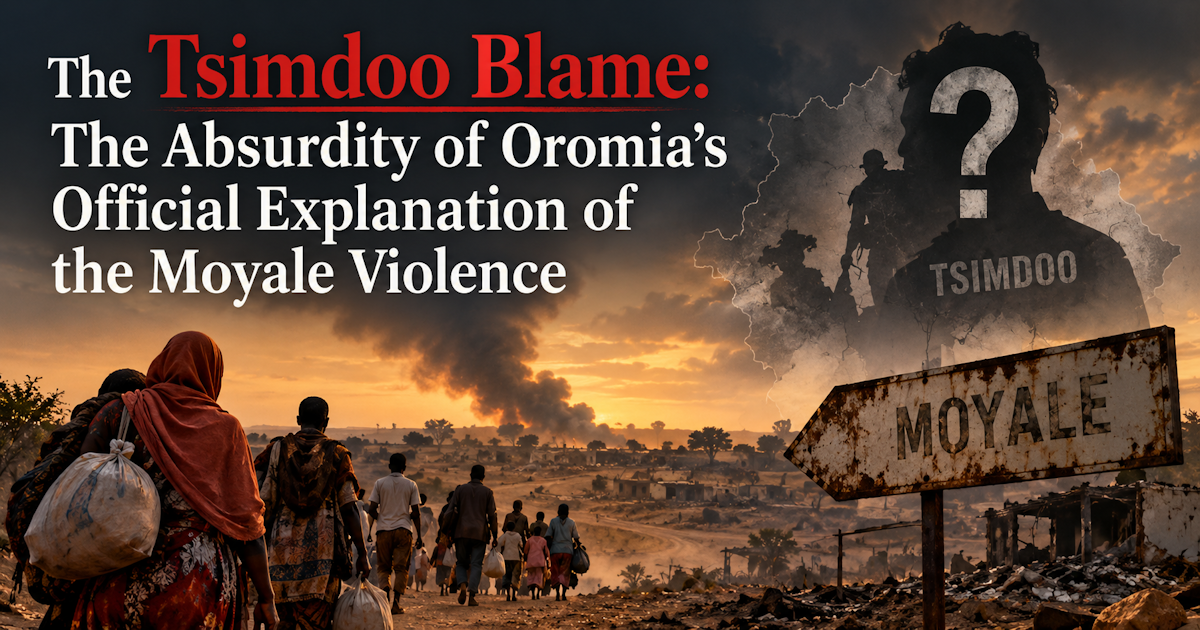
Its official explanation, which invoked forces associated with the northern Tsimdoo alliance, failed to address adequately the immediate circumstances that had brought Moyale into crisis.
The controversy surrounding the hoisting of a Somali regional flag, the subsequent confrontations, and the flight of civilians into Kenya required direct explanation and decisive intervention.
Instead, the political messaging appeared to redirect attention toward a broader external enemy.
Why?
- Why was there no sufficiently transparent public accounting of the events that triggered the violence?
- Why did the protection of civilians appear to command more urgent public attention from political figures across the Kenyan border than from some of the Ethiopian officials constitutionally responsible for their security?
- And why should the public accept an explanation invoking distant political adversaries without evidence establishing their operational involvement?
These are not peripheral questions.
They go to the heart of whether the regime is fulfilling its most basic responsibility: protecting the people under its jurisdiction.
The possibility that political actors deliberately exploited or aggravated the Moyale crisis deserves investigation. But proving that the regime instigated the violence requires evidence beyond its inadequate response.
Governmental silence is not proof of orchestration. It is, however, no defense against accountability for a failure to protect.
Benishangul-Gumuz: Another Dangerous Fracture?
Reports of killings in Benishangul-Gumuz add another disturbing dimension to the country's deteriorating security environment [16,17,18,19] and forms the wider pattern of MID of the Prosperity Party regime.
The timing for the recent attacks [16,17] is especially concerning in light of reports that the OLA and armed movements associated with Benishangul-Gumuz have established cooperation through the Alliance for Survival. An alliance between armed organizations make it logically impossible for individual members, splinter factions, infiltrators, or unrelated actors to commit violence. Nevertheless, the possibility that attacks could be used to provoke mistrust between allied movements warrants examination.
Who carried out the killings? What evidence connects the perpetrators to any organization? Were the victims targeted for their identity, location, or perceived political affiliation? Have independent investigators been permitted to establish the facts?
If the purpose of an attack was to fracture cooperation between armed movements, that conclusion must emerge from evidence rather than assumption.
The danger is that, in the absence of credible investigations, every atrocity becomes another weapon in Ethiopia's information war.
For a country already devastated by years of conflict, that is an intolerable situation.
The Alliance for Survival and the Regime’s Political Anxiety
The reported cooperation between the OLA and northern opposition forces presents a potentially important change in Ethiopia's political landscape.
For the Prosperity Party, one useful narrative has been that the Oromo population must support the existing regime to prevent the return of political domination by forces associated with Ethiopia's former ruling establishments.
That argument depends on portraying the regime as the indispensable defender of Oromo interests.
The alleged participation of OLA in a wider alliance [20,21] complicates that narrative.
It challenges the notion that Oromo political aspirations can only be protected through loyalty to the Prosperity Party.
It also raises the possibility of political cooperation across communities and regions that have experienced profound mistrust and conflict.
Such cooperation does not automatically make an alliance democratic, legitimate, or representative. Its members must be judged by their objectives, conduct, commitments to civilian protection, and willingness to submit to democratic accountability.
But cooperation between political adversaries of the regime is not, in itself, terrorism.
Nor is the pursuit of a political alliance sufficient grounds for a terrorist designation.
If the reported Ethiopian lobbying campaign is connected to the OLA's participation in the Alliance for Survival, Washington should insist on knowing precisely what conduct—not merely what political association—is alleged to justify the proposed designation.
The distinction is fundamental.
A regime may legitimately oppose an armed organization. It may not legitimately demand that another country classify that organization as terrorist simply because its political alliances threaten the regime's survival.
The Government Is Not the Oromo People
A central misunderstanding must be challenged.
The Prosperity Party regime is not synonymous with the Oromo people [15,22].
Neither is the Oromia regional administration.
The fact that Abiy Ahmed and Shimelis Abdissa are Oromo does not transform their policies into the collective will of the Oromo nation.
Oromo political identity is not a transferable entitlement that automatically confers legitimacy upon whoever occupies regime office.
A regime must earn legitimacy through accountability, constitutional conduct, protection of rights, and the freely expressed consent of the governed.
The distinction matters especially when international partners assess the conflict in Oromia.
To support the Ethiopian regime is not necessarily to support the Oromo people.
To question the regime's conduct is not to oppose Ethiopia's stability.
And to insist upon meaningful negotiations with the OLA is not to endorse every action or political claim made by the OLA.
The objective should be a democratic settlement in which political organizations compete through peaceful means and citizens—not armed actors or incumbent officials—determine who governs them.
The international community should not confuse the preservation of a particular administration with the preservation of peace.
A Direct Appeal to Washington, Brussels, and London
To the governments of the United States, the European Union and its member states, the United Kingdom, and other international partners of Ethiopia:
Before considering any request to designate the OLA as a terrorist organization, examine the full record.
- Examine the political circumstances surrounding the original Ethiopian designation in 2021.
- Examine the negotiations of April–May and November 2023.
- Examine the proposals made by both parties and the reasons those negotiations failed.
- Examine the allegations of abuses by all parties, including Ethiopian security forces, regime-aligned militias, and armed opposition organizations.
- Examine the recurring atrocities in Oromia, the unresolved killings in Arsii, the recent crisis in Moyale, and the violence reported in Benishangul-Gumuz, and over wider span of time, in Wallaga, Wallo, north and east Tuulama, Hararghee, and Baalee through proxy war and inter-ethnic violences believed to be staged by the regime.
- Examine whether the Ethiopian regime has pursued credible accountability or whether official accusations have too often substituted for independent investigation.
- Above all, examine whether a proposed designation would serve a legitimate, evidence-based counterterrorism purpose—or whether it would strengthen the political position of an incumbent regime while making peace more difficult.
The United States has its own legal standards for terrorist designations. Those standards must be applied independently, regardless of the wishes of the Ethiopian regime or the political sympathies of the OLA's supporters.
No armed organization should receive immunity from scrutiny.
But no regime should receive immunity from scrutiny either.
Washington should also consider the long-term consequences of measures that might further close the political space for negotiated settlement.
The objective of international engagement should be to reduce violence, protect civilians, uphold human rights, and support a credible democratic process.
It should not be to help one party achieve through international sanctions what it has failed to achieve through domestic political legitimacy.
The Test of International Credibility
There is a particular irony in the reported effort to secure American action against the OLA.
The Ethiopian regime has already had years to demonstrate that military pressure alone can resolve the conflict in Oromia.
It has not produced a durable settlement.
International diplomacy helped create opportunities for negotiation in 2023.
Those opportunities did not yield peace.
The appropriate response to failed negotiations should be to examine why they failed and determine whether a more credible, accountable, and inclusive process can succeed.
It should not automatically be to make negotiations harder.
If the Prosperity Party regime believes that the OLA poses a threat requiring additional international counterterrorism measures, it must establish that case with evidence.
If it believes that the OLA is incapable of participating in a peaceful political settlement, it should explain what specific conduct and negotiating positions support that conclusion.
And if the regime is genuinely committed to peace, it should demonstrate that commitment through actions that can be independently evaluated.
The same standard applies to the OLA. Its leadership must demonstrate respect for civilian life, humanitarian principles, and a credible path toward peaceful political competition.
Neither side should be permitted to hide behind rhetoric.
The stakes are far greater than the fortunes of either organization.
They concern the future of millions of people who have endured violence, displacement, insecurity, and political exclusion for far too long.
Peace Must Not Be Sacrificed to Political Survival
The most troubling possibility raised by the reported lobbying campaign is that international counterterrorism machinery could be enlisted in a domestic struggle over political legitimacy.
That possibility deserves serious scrutiny even before the lobbying allegation is independently confirmed.
For the Prosperity Party, the OLA represents more than an armed adversary. It represents an unresolved challenge to the regime's claim that Oromo political aspirations have been fulfilled through the accession of Oromo officials to power.
For the Oromo people, however, the question is not which politician claims Oromo identity most loudly.
It is whether their rights, security, dignity, and democratic aspirations are genuinely protected.
The answer cannot be imposed by the regime, the OLA, or a foreign power.
It must ultimately come from the Oromo people themselves through a free and credible political process.
If the Managed Instability hypothesis proves to describe even part of the regime's conduct, the implications would be grave. It would mean that some of the insecurity invoked to justify extraordinary state powers had also been exploited—or possibly cultivated—for political ends.
Such a possibility demands investigation, not complacency.
But the case for renewed peace efforts does not depend on proving that hypothesis.
The documented persistence of conflict, the failure of earlier negotiations, the suffering of civilians, and the absence of a durable political settlement already provide more than sufficient grounds for urgent international engagement.
Washington must not allow itself to become an instrument for settling Ethiopia's unresolved political contests.
The United States and its democratic partners should encourage credible negotiations, demand independent investigations, insist on civilian protection, and apply consistent legal standards to every party.
They should not mistake the survival of the Prosperity Party for the survival of Ethiopia.
Nor should they mistake the political defeat of the OLA for the achievement of peace.
The OLA may be Abiy Ahmed's Achilles’ heel. But the real test for Washington is whether it will help Ethiopia confront the causes of its conflict—or merely help its regime suppress another symptom.
The Oromo people deserve peace with justice, not another international endorsement of an endless war.
And the world should know the difference.
References
- Two News Stories about War in Tigray | Ethiopian Prime Minister's New Move against OLA, 7 November 2026, My Views on New YouTube Channel, YouTube.
- Roobaa Hawaas, A Missed Opportunity for Peace in Oromia, 22 November 2023, OROMIA TODAY.
- Tsegaye R. Ararssa, The Cosmetics of Representation: Systemic Continuity, Managed Federalism, and the Oromo Struggle in Contemporary Ethiopia, 5 October 2026, OROMIA TODAY.
- Tsegaye R. Ararssa, Spare Us the False Choice, Please: For the Oromo, PP and Fano Are One and the Same!, 24 September 2026, OROMIA TODAY.
- Tsegaye R. Ararssa, In Pursuit of Independent Oromia: Facing the Persistence of Empire and Countering the Fallacy of Imperial Democratization, 5 November 2026, OROMIA TODAY.
- Tsegaye R. Ararssa, The Last Frontier of Decolonisation: Why the Oromo Struggle Is Africa’s Unfinished Liberation, 11 October 2026, OROMIA TODAY.
- Arab Times / Anadolu Agency, “Gunmen Kill 34 More Orthodox Christians in Ethiopia”Arab Times / Anadolu Agency — “Gunmen Kill 34 More Orthodox Christians in Ethiopia”, 5 November 2026/
- World Council of Churches, Statement of solidarity and condemnation of repeated killings in Oromia, 29 October 2026.
- International Christian Concern, “60 Orthodox Christians Killed in Ethiopia”, 28 October 2026.
- Addis Standard, Holy Synod Confirms 60 Orthodox Faithful Killed in Latest Attacks in Oromia, Calls for Protection, Justice, 26 October 2026.
- Oromia Communication Bureau, "Humnooni Tsimdoo ofiin jedhan kisaaraa hamaa kaaba Itoophiyaatti irra gahe kallattii xiyyeeffannoo jijjiiruuf walitti bu'iinsa sabaa fi amantaa uumuuf sochiin taasisan fashaleera"- Obbo Hayiluu Addunyaa, 25 OOctober 2026, Facebook.
- Turtii Addaa Jaal Sabaa’if Galgoo waliin Ajajaa WBO Kibba baha Oromiya, Kush Media Network (KMN), 13 February 2026.
- OT Editorial, The Tsimdoo Blame: The Absurdity of Oromia’s Official Explanation of the Moyale Violence, 25 October 2026, OROMIA TODAY.
- OT Editorial, Shame on You, Shimelis Abdissa. Shame on You, Caffee Oromia. Again., 24 October 2026, OROMIA TODAY.
- OT Editorial, Here Is Why We Say the Oromia Government Is Not an Oromo Government
And Why the Federal Government's Claims to Oromo Leadership Ring Just as Hollow, 22 October 2026, OROMIA TODAY. - Tigray Military's Heavy Weapons Captured | Over 100 Killed in Two Incidents in Ethiopia, 7 November 2026, My Views on New YouTube Channel, YouTube.
- Ibidda Karaa Maraan Qabsiifame: Lola Gurguddaa WBO, Mo’amuu PP fi Fixins, 7 November 2026, The Horn Conversation YouTube Channel, YouTube.
- Addis Standard, Over 40 civilians, including children, killed in latest attack in troubled Metekel Zone, Benishangul-Gumuz region, 24 November 2025.
- allAfrica / Addis Standard, “Ethiopia: Over 11,000 Displaced By Armed Violence in Oromia-Benishangul Border Areas”, 7 June 2025.
- OT Editorial Team, The Week That Reshaped the Narrative of a Tottering Empire with Alliance Paradox, 28 September 2026, OROMIA TODAY.
- Yadessa Gurma, Alliance for Survival and the Lessons of History: Can Former Enemies Build a Common Future?, 21 September 2026, OROMIA TODAY.
- Kumaa Daadhii and Olii Boran, The PP Regime Now Has the Accolade: No Other Ethiopian Regime Has Acted Against the Oromo People So Intensely in Such a Short Time, 2 February 2026, OROMIA TODAY.