The Tsimdoo Blame: The Absurdity of Oromia’s Official Explanation of the Moyale Violence
Excerpt
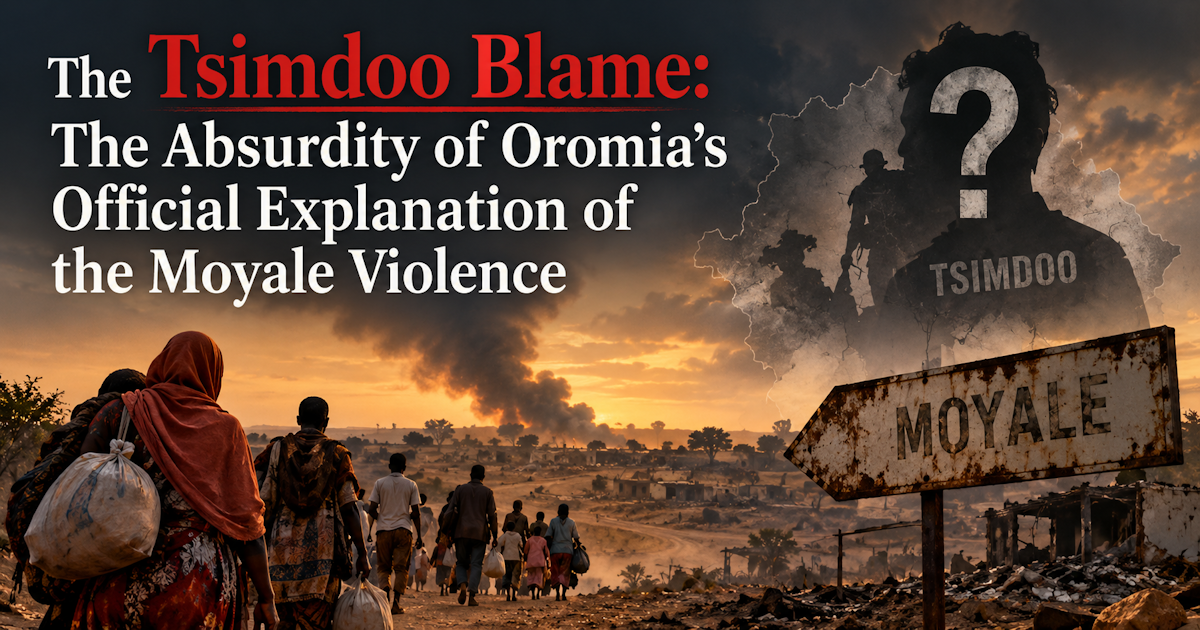
The Oromia government blames the devastating Moyale violence on Tsimdoo, a distant northern alliance, while sidestepping the Oromo–Somali territorial dispute and the reported hoisting of the Somali regional flag. How did a supposedly defeated northern force, as reported by the federal regime, become responsible for mass displacement and destruction hundreds of kilometers away in the south? Is the government alleging collaboration with Somali regional security forces—or diverting attention from their alleged involvement? This article examines the glaring contradictions, unanswered questions, and monumental absurdity of Oromia’s official explanation.
A Communiqué That Raises More Questions Than It Answers
When a government blames a distant enemy but cannot explain the violence at its own doorstep, its explanation raises more questions than it answers.
The first official communiqué from the Oromia Communication Bureau [1] concerning the devastating violence in southern Oromia is remarkable—not for what it explains, but for what it conspicuously avoids explaining.
Issued through its head, Hayiluu Addunyaa, the statement does not even mention Moyale by name, despite the town having become the focal point of international reporting on deadly violence and mass displacement. Equally conspicuous is the absence of any mention of 13-year-old Diqqoo Jaataan Aagaa, who lost her life in the violence and whose body, as of this writing, has reportedly yet to be returned to her family for burial.
Instead, it attributes the destruction of civilian lives and property in Moyale to Tsimdoo, a political and military alliance associated with forces in northern Ethiopia.
According to the communiqué, Tsimdoo, having suffered heavy losses in the north, is attempting to divert the federal government's attention by instigating ethnic and religious conflicts elsewhere in the country.
This is not an explanation. It is an accusation masquerading as one.
The violence around Moyale has been reported in the context of tensions involving Oromo and Somali communities and armed actors operating in the disputed border areas. The involvement of particular security forces and political authorities remains a matter requiring independent investigation. Nevertheless, the geographical, political, and historical dimensions of the conflict are hardly a mystery.
Yet the Oromia administration chooses to introduce an entirely different culprit: an alliance based hundreds of kilometers away in northern Ethiopia.
How extraordinary.
The Military Paradox: Defeated in the North, Devastating in the South?
Consider the government's own narrative.
The federal authorities have portrayed their military operations against Tsimdoo in northern Ethiopia as successful, claiming to have inflicted substantial losses on the alliance and weakened its capacity to challenge the state. Following the success, according to state media, they even instituted an interim caretaker government in Mekelle.
We are now expected to believe that this same supposedly weakened force has somehow acquired the capacity to unleash devastating violence in Moyale, far removed from its northern stronghold.
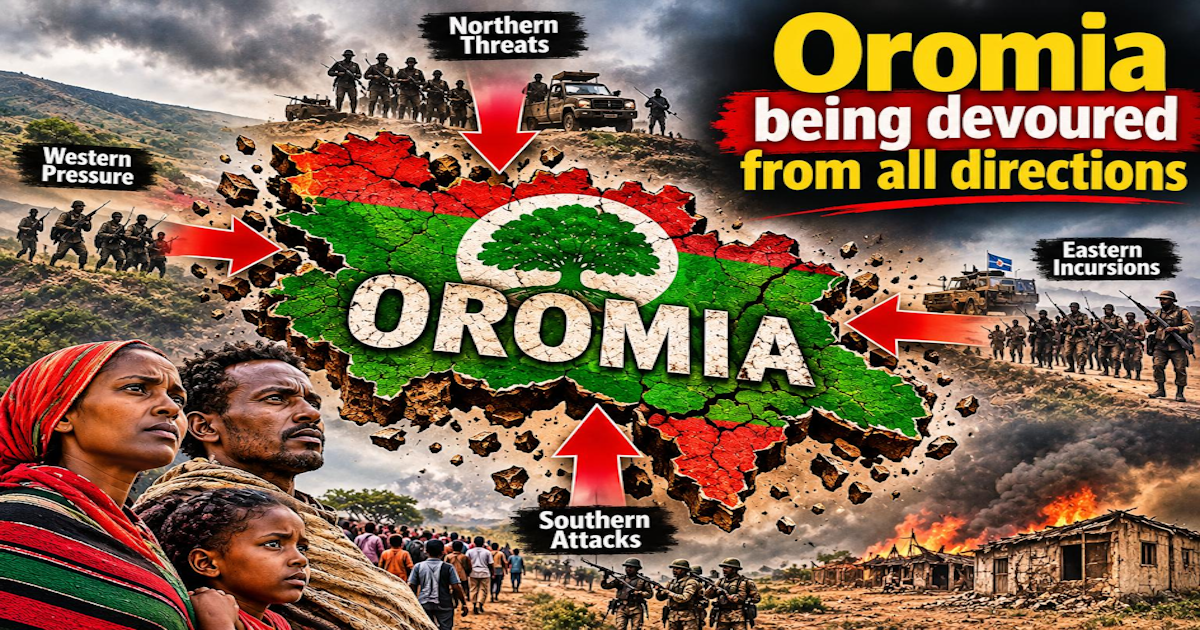
The resulting violence has reportedly driven tens of thousands of civilians across the border into Kenya, leaving families displaced, homes abandoned, and communities traumatized. The full death toll remains uncertain, with reports of mounting casualties requiring further verification.
How does a force supposedly defeated in its own northern stronghold suddenly become capable of inflicting such devastation in the distant south?
- Did its fighters travel hundreds of kilometers through territory under government control?
- Did they operate through local proxies?
- Did they finance, coordinate, or direct the attacks remotely?
- Or is the government suggesting that the perpetrators on the ground were somehow acting under Tsimdoo's command?
These are not rhetorical distractions. They are elementary questions arising from the government's own allegation.
The communiqué answers none of them.
There is, of course, a distinction between defeating an armed force in a particular engagement and eliminating its capacity to operate elsewhere. Nor would indirect involvement necessarily require northern fighters to travel physically to Moyale.
But that distinction only strengthens the demand for evidence.
If Tsimdoo was directly involved, the government must explain how. If it acted through proxies, the government must identify the alleged connections. If neither can be demonstrated, the accusation remains unsupported.
A government cannot substitute the repetition of an enemy's name for evidence of that enemy's responsibility.
The Uncomfortable Question of Federal Responsibility
The contradiction becomes even more troubling when we consider the federal government's responsibility for national security.
The same federal state that claims the military capacity to defeat a northern alliance is apparently unable to prevent devastating violence in a strategically important southern border town.
Moyale is not an inaccessible wilderness beyond the reach of the Ethiopian state. It is an important commercial and transport gateway connecting Ethiopia with Kenya.
How, then, could armed actors inflict such extensive destruction and cause mass displacement without an effective protective response from the state?
If the government's account is correct, it raises profound questions about the effectiveness of federal intelligence, military preparedness, territorial security, and civilian protection.
If the account is incorrect, it raises an equally serious question: why would the Oromia administration invoke a distant political adversary rather than confront the identity and conduct of the immediate perpetrators?
Either the government has failed to contain a supposedly weakened enemy, or its explanation is concealing more than it reveals.
These are not the only conceivable possibilities. But they are among the most consequential implications of the official narrative, and neither can be dismissed through political slogans.
There is also a striking contrast between the government's presentation of its northern military operations and the scale of civilian suffering reported from Moyale. The absence of comparable casualty reports from particular northern engagements does not establish that those operations were bloodless. Nevertheless, the authorities owe the public a coherent explanation of why a supposedly diminished adversary could allegedly produce such devastating consequences elsewhere.
Military victory proclaimed in one part of the country cannot serve as an excuse for catastrophic insecurity in another.
The Missing Actors in an Otherwise Familiar Conflict
Perhaps the most revealing feature of the communiqué is its selective identification of responsibility.
The statement names Tsimdoo repeatedly, describing it as a terrorist force engaged in destructive activities against the country.
Yet it avoids directly addressing the Oromo–Somali regional dimension of the violence.
- Where are the explanations concerning the armed actors operating in the affected areas?
- What role, if any, did security institutions associated with the Somali Regional State play?
- What communications took place between the Oromia administration, the Somali Regional State, and the federal government?
- What measures were taken to protect civilians before the violence escalated?
These questions are especially important because allegations concerning the involvement of Somali regional security actors have emerged in reporting on the conflict. Such allegations must be independently investigated rather than treated as established findings.
Responsibility must also be assigned precisely. The Somali people are not collectively responsible for the actions of armed groups, political leaders, or regional security institutions, just as the Oromo people cannot be equated with any particular government or armed organization.
The issue is not Oromo versus Somali as peoples. It is the conduct of identifiable armed actors and the responsibility of public authorities entrusted with protecting both communities.
If the Oromia administration possesses credible intelligence implicating Tsimdoo, it should disclose the basis of that conclusion to the extent compatible with legitimate security requirements.
- If it does not, why introduce the northern alliance into an already identifiable regional conflict?
- And if the administration believes that local perpetrators were acting under the direction of Tsimdoo, why does it not explain the relationship between them?
The omission is particularly difficult to reconcile with the communiqué's confident attribution of responsibility.
A government that knows enough to identify the mastermind should surely know enough to explain the immediate perpetrators.
The Somali Regional Flag: An Inconvenient Fact the Communiqué Cannot Explain
There is another crucial element of the Moyale confrontation that makes the Oromia administration's attribution of responsibility to Tsimdoo even more difficult to comprehend: the reported hoisting of the Somali Regional State flag in the disputed area.
If, as reported, the flag-raising helped trigger the confrontation, it raises an elementary question of political logic.
Since when did the assertion of Somali regional jurisdiction over disputed territory become an operation of a northern alliance allegedly seeking to destabilize the Ethiopian government?
The hoisting of a regional flag in disputed territory is not a politically neutral act. Depending on the circumstances and the authority behind it, it may represent an assertion of jurisdiction, a challenge to existing administrative boundaries, or an attempt to establish territorial control.
Such an act has an obvious connection to the longstanding territorial and administrative tensions between Oromia and the Somali Regional State.
Its connection to Tsimdoo, however, is anything but obvious.
- Is the Oromia administration suggesting that Somali regional security forces are members of, or collaborators with, the Tsimdoo alliance?
- Is it alleging that Tsimdoo directed the flag-raising as part of a coordinated operation to provoke conflict between Oromo and Somali communities?
- Or is it suggesting that the actions of Somali regional actors, whatever their immediate motivations, somehow served the political objectives of Tsimdoo?
These are three fundamentally different allegations. None can be established simply by declaring Tsimdoo responsible for the violence.
If the Somali Regional State's security institutions participated in the confrontation, their actions and chain of command must be examined independently of any alleged northern connection.
If Tsimdoo was also involved, the government must explain the relationship between these actors.
And if no such relationship can be demonstrated, the invocation of Tsimdoo risks becoming a political distraction from the immediate territorial dispute and the responsibilities of the authorities involved.
The question is particularly serious because the flag-raising, if confirmed as a precipitating event, offers a concrete starting point for investigating the sequence of events, the motivations of those involved, and the subsequent escalation.
A territorial confrontation cannot be adequately explained by naming a distant political alliance while refusing to explain the territorial claim at its center.
The Oromia administration owes the public an explanation of the flag incident, the identity and authority of those responsible, the response of regional security institutions, and the constitutional basis for any competing jurisdictional claims.
Until those questions are answered, attributing the tragedy to Tsimdoo does not resolve the contradiction. It deepens it.
From Explaining Violence to Redirecting Attention
There is an almost astonishing irony in the government's argument.
The communiqué accuses Tsimdoo of attempting to divert the federal government's attention from its activities in northern Ethiopia by provoking internal conflicts.
Yet the communiqué itself redirects public attention away from the immediate circumstances of the Moyale violence toward a distant political enemy.
The alleged diversion of government attention may itself be functioning as a diversion of public scrutiny.
This does not establish that the government is deliberately fabricating its allegations. Such a conclusion would require evidence of intent.
But it does expose a serious deficiency in the official explanation.
Instead of clarifying who committed the violence, how it developed, why civilians were left vulnerable, and what the authorities did to protect them, the statement places the tragedy within the familiar language of national enemies, sabotage, and threats to development.
The victims become secondary to the political narrative.
The government's priorities become the center of the story.
And the immediate questions of responsibility remain unanswered.
This pattern is especially troubling because it risks transforming a concrete failure of civilian protection into an abstract confrontation between the state and its political adversaries.
The dead cannot be protected retroactively by identifying a convenient enemy. The displaced cannot return home merely because the government has announced whom it blames.
They require security, accountability, humanitarian assistance, and credible guarantees against further violence.
The Responsibility That Cannot Be Delegated
Whether or not Oromia President Shimelis Abdissa personally delivers a statement is ultimately a secondary matter. A government is entitled to communicate through its designated officials.
But responsibility for the content of that communication, and for the administration's response to the crisis, cannot be delegated away.
President Shimelis Abdissa was expected to personally address the public on a crisis of such profound social and political significance.
The Oromia administration has a constitutional and political obligation to protect residents, defend lawful jurisdiction, pursue peaceful resolution of boundary disputes, and ensure that constitutional procedures are respected.
The federal government likewise bears responsibility for protecting civilians, maintaining national security, and addressing armed violence that crosses regional boundaries.
Neither government can discharge those responsibilities simply by attributing the tragedy to a political enemy.
Nor can the suffering of civilians be reduced to an unfortunate byproduct of an alleged campaign to distract the authorities.
The first duty of government is not to protect its political narrative. It is to protect the people.
The Absurdity Is in the Explanation, Not the Questions
The Oromia Communication Bureau may believe that its statement has identified the cause of the violence. In reality, it has opened an entirely new set of questions.
- How did Tsimdoo allegedly acquire such extensive operational reach?
- What evidence connects it to the attacks?
- Who carried out the violence on the ground?
- Why were civilians not adequately protected?
- What was the response of federal and regional security institutions?
- And why does an official statement concerning such a grave tragedy avoid naming Moyale itself?
These are questions of logic, evidence, and public accountability—not partisan preference.
A government is not obliged to disclose every intelligence detail during an unfolding security crisis. But when it publicly assigns responsibility for mass violence, it assumes the burden of providing a credible basis for that accusation.
The greater the certainty of the accusation, the greater the obligation to substantiate it.
Until the authorities address these elementary questions, the communiqué cannot reasonably be regarded as a satisfactory explanation of the Moyale tragedy.
Its central weakness is not merely that it blames Tsimdoo. It is that the accusation does little to explain the known circumstances of the violence while potentially obscuring the responsibilities of those closest to it.
And therein lies the monumental absurdity.
When a government identifies a distant political enemy but leaves the immediate perpetrators unexplained, the question is no longer merely whether its accusation is true. It is also whose accountability its chosen explanation may be obscuring.
The people of Moyale deserve answers grounded in evidence, not political convenience.
They deserve protection, not explanations that leave the essential questions unanswered.
Above all, they deserve a government that treats the loss of their lives, homes, and livelihoods as a crisis demanding accountability—not merely as another opportunity to denounce its enemies.
If Tsimdoo Is Defeated, Will Moyale Finally Be at Peace?
There is one final question that puts the Oromia administration's explanation to a simple test of logic.
- If Tsimdoo is responsible for the Moyale tragedy, does it follow that defeating Tsimdoo would bring the violence to an end, resolve the territorial dispute, and allow tens of thousands of displaced residents to return safely to their homes?
- Would the contested administrative boundaries suddenly become settled?
- Would the armed actors responsible for the immediate violence simply disappear?
If the answer is no, then the government has not explained the underlying conflict. It has merely named an alleged enemy.
Even if Tsimdoo were involved in aggravating the crisis, that would not explain away the territorial dispute or absolve the authorities responsible for protecting civilians.
The distinction is fundamental. Removing an alleged instigator is not the same as resolving the conditions that make violence possible.
The ultimate test of the government's explanation is not whether Tsimdoo can be defeated, but whether defeating it would make Moyale safe again.
Until the administration can answer that question, its accusation remains a profoundly inadequate explanation of the tragedy.
A Gentle Note to the Oromia Administration
We live in the Information Age. People have access to an unprecedented range of information sources, independent reporting, and competing perspectives through which they can examine events and form their own judgments.
The days when governments could exercise a near-monopoly over information, control public narratives through state-managed media, and expect their pronouncements to be accepted without question are long gone.
Blaming Tsimdoo may be politically convenient, but convenience is no substitute for a credible explanation. The public is already aware of the Oromo–Somali dimension of the Moyale conflict, including allegations concerning Somali regional security forces and the reported hoisting of the Somali Regional State flag that helped precipitate the confrontation.
- Is the Oromia administration suggesting that Somali regional security forces are part of the Tsimdoo alliance?
- If so, where is the evidence?
- If not, why invoke Tsimdoo while leaving the alleged involvement of Somali regional security forces unexplained?
The public is equally entitled to ask whether the omission of Somali regional forces amounts to shielding them from scrutiny and accountability, and if so what is behind this.
These are legitimate questions arising directly from the administration's own account, not accusations invented by its critics.
A communiqué riddled with unanswered questions, glaring omissions, and logical contradictions cannot withstand serious scrutiny.
Worse, presenting such an account as a satisfactory explanation of a tragedy involving the loss of innocent lives and the displacement of entire communities risks insulting the intelligence of the very public the government is supposed to serve—let alone independent journalists, analysts, and experts familiar with the conflict.
The public does not expect governments to know everything. It does, however, have every right to expect them not to present what they cannot substantiate as established fact.
The Oromia administration would do well to recognize that credibility is not conferred by official letterheads, government titles, or the authority of a communications bureau.
It is earned through truthfulness, transparency, consistency, and accountability.
In the Information Age, regimes may still control their official statements. They no longer control what the public is capable of knowing, questioning, or believing.
References
- Oromia Communication Bureau, "Humnooni Tsimdoo ofiin jedhan kisaaraa hamaa kaaba Itoophiyaatti irra gahe kallattii xiyyeeffannoo jijjiiruuf walitti bu'iinsa sabaa fi amantaa uumuuf sochiin taasisan fashaleera"- Obbo Hayiluu Addunyaa, 25 OOctober 2026, Facebook.
- OT Editorial, Shame on You, Shimelis Abdissa. Shame on You, Caffee Oromiyaa. Again., 24 October 2026, OROMIA TODAY.
- OT Editorial, Here Is Why We Say the Oromia Government Is Not an Oromo Government, 22 October 2026, OROMIA TODAY.