The Moyale Fiasco: Countering the Myth of Oromo Expansionism
Excerpt
Challenging the narrative of “Oromo expansionism” surrounding the October 2026 Moyale violence, Tsegaye R. Ararssa examines the disputed territorial claims, the legacy of the 2004 border referendum, and the non-expansionist foundations of Oromo nationalism. He exposes the fallacy of conflating Abiy Ahmed’s government with Oromo national aspirations, arguing that Oromia remains a victim, rather than a beneficiary, of the regime’s policies.
Abstract
This piece analyzes the October 2026 military escalation in the strategic border town of Moyale, countering the pervasive narrative advanced by Somali commentators that frames the conflict as an instance of "Oromo expansionism." By examining the circumstances of the recent offensive launched by Somali Regional State (SRS) forces—symbolized by the highly provocative hoisting of the of Somali's national flag within Oromia territory—the paper demonstrates that the crisis is driven by regional irredentism rather than Oromo aggression.
Furthermore, it contextualizes the Oromo national movement through its foundational 1971 Manifesto, highlighting its historically defensive, anti-imperial, and non-expansionist character. Finally, the piece deconstructs the analytical error of conflating Prime Minister Abiy Ahmed's regime with the Oromo nation, demonstrating that Oromia remains the primary target, rather than the beneficiary, of the federal government's unabated state repression.
Introduction: A Dangerous Distortion of the Moyale Crisis
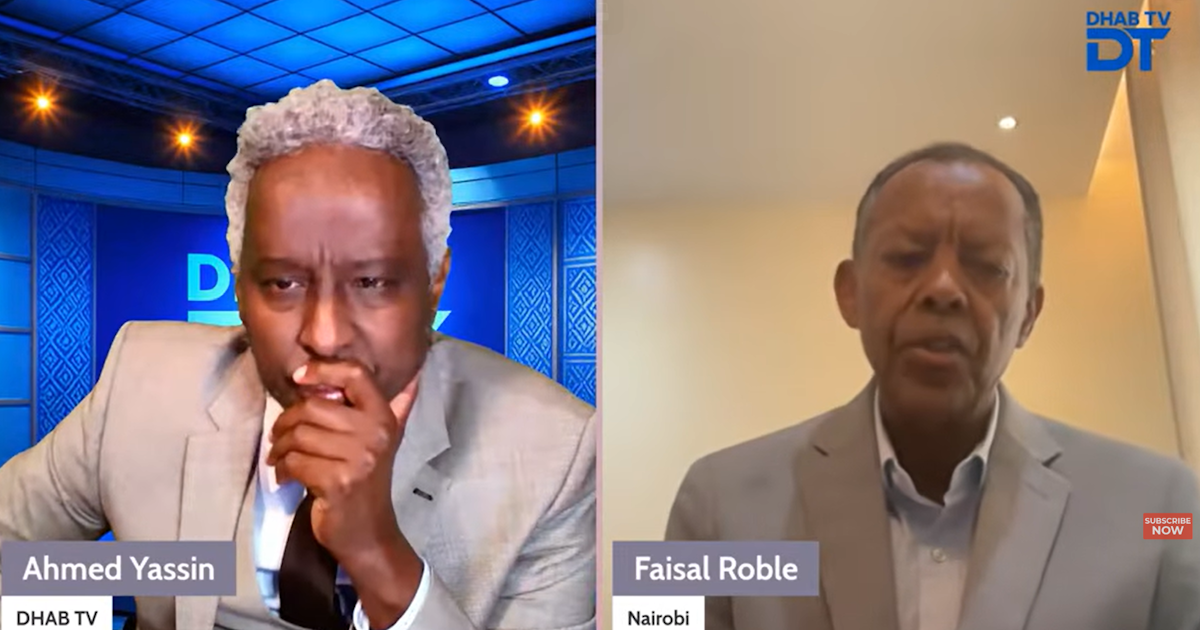
The recent escalation in the border town of Moyale—marked by a violent offensive by Somali Regional State (SRS) forces against local residents—has triggered a wave of dangerous disinformation across the Horn of Africa. Prominent Somali commentators, including Faisal Roble, have sought to frame these events as part of a grand campaign of "Oromo expansionism."[1]
This narrative is not only factually inaccurate regarding the recent aggression in Moyale, but it also relies on a severe distortion of historical facts (such as the 2004 referendum) and a deliberate misrepresentation of contemporary realities on the ground since October 22, 2026.
More fundamentally, this rhetoric catastrophically misreads Ethiopia's internal political dynamics by characterizing the current regime as an "Oromo government" serving an imagined ambition by "Oromo nationalists" to occupy neighboring territories.
To understand the crisis in Moyale, one must distinguish the Oromo people's struggle for national liberation from the imperial misadventures of the ruling Prosperity Party (PP).
The Reality of the Moyale Attack
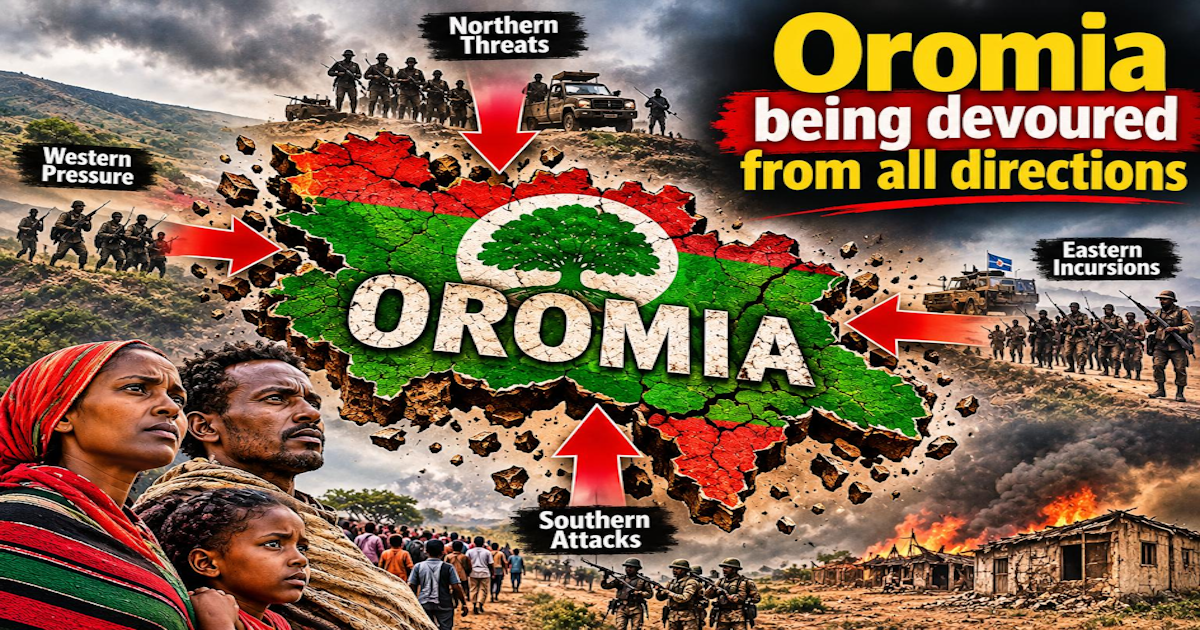
The facts on the ground directly contradict claims of Oromo aggression. The offensive began on October 22, 2026, when heavily armed Somali Regional State forces launched an unprovoked attack from the direction of Kebele 02, targeting civilian residents in Moyale.
The onslaught resulted in severe civilian casualties—including women and children—widespread arson, and the forced displacement of thousands of residents who fled across the border into Moyale, Kenya, to seek refuge.
The defining moment of this occupation occurred when the invading forces removed the Ethiopian national flag, which had been flying alongside the Oromia Regional State flag, and replaced both with the flags of the Republic of Somalia and the Somali National Regional State (SNRS).
This act exposes a critical logical contradiction in the mainstream Somali narrative: If this clash is merely a localized border dispute or an act of defense against Oromo encroachment, why hoist the sovereign flag of Somalia deep within internationally recognized Ethiopian territory?
The presence of the Mogadishu flag makes it glaringly apparent which political forces are actually pursuing irredentist and expansionist ambitions in broad daylight.
The 2004 Referendum: Historical Facts and Political Revisionism
The weaponization of historical memory is central to this disinformation campaign, particularly regarding the 2004 referendum.
Contemporary Somali commentators frequently distort the outcomes of the October 2004 plebiscite, which was held to settle contested administrative boundaries across approximately 420 kebeles spanning the Oromia and Somali regional states.
While the referendum resulted in the official transfer of a majority of these contested districts to the Oromia Region, based on demographic realities, the ruling elites of the Somali Regional State have consistently sought to retroactively delegitimize these democratic results.
Although the results of the referendums held in the 420 kebeles have never been implemented through demarcation and delimitation work on the ground, no referendum was conducted in nine kebeles in Moyale, eight kebeles in and around Mi'esso, two kebeles in Fiq Woreda, seven kebeles in Mayyuu Muluqqe, two kebeles in Jijjiga, or in Erer Woreda and Gooroo Baqaqsaa.
In Moyale, the National Electoral Board of Ethiopia (NEBE) stopped the referendum process mainly because large numbers of people had allegedly been transported into the town from Mandera and beyond, in Kenya, in massive convoys of Isuzu trucks to register as voters.
The SNRS election agents hastily issued Ethiopian identity cards to these individuals, in full public view, right in the center of town. They insisted that "these were Ethio-Somali residents of Moyale who had left for Kenya because they were displaced" years earlier.
Contrary to these facts, which are also documented in detail in the NEBE report, Somali commentators such as Faisal Roble speak rather irresponsibly as though a referendum had actually taken place in Moyale, unduly favored Oromos, and disadvantaged the Somali population of the town.
This crass historical revisionism is used to construct a false narrative of victimhood, portraying existing legal—and demographically corroborated—administrative boundaries as products of "Oromo encroachment," or even "invasion," to justify contemporary military expansionism.
The Myth of Oromo Expansionism: The 1971 Baseline
The accusation that Oromo nationalists harbor imperial or expansionist designs is a total fabrication that contradicts the core tenets of the Oromo national movement.
Historically, Oromo nationalism has been explicitly defensive and anti-colonial, framed against both European and Abyssinian imperialism.
As established as far back as the foundational 1971 Oromo Manifesto, entitled The Oromo: Voice Against Tyranny, the movement has maintained a strictly non-expansionist stance.
After analyzing the historical subjugation of the Oromo people, this seminal text declares:
[I]t is futile for an Oromo to be sincerely loyal to the [imperial Ethiopian] regime and to be law abiding since he is suspect and a criminal by accident of birth. The situation thus compels Oromo individuals [from] all walks of life to unite and to be vigilant and to rise in defense of their own identity which will always and everywhere haunt them with a spirit which is neither possible to kill nor [to] escape, even when and if in active cooperation with the racist and fascist regime of Haile Selassie.
This is not a dilemma for an Oromo worthy of the name, for there is one and only one way for his dignity, security, liberty and freedom. That single and sure way is to hold a common front against his oppressors and their instruments of his subjugation. In this, he is ready and willing to join hands in the spirit of brotherhood, equality and mutual respect, with other oppressed nationalities and all persons and institutions of goodwill. He is equally ready and prepared to pay any sacrifice and oppose any persons or groups that crossed or double-crossed or [in] any way hinders his mission of liberation from all forms of oppression and subjugation. An Oromo has no empire to build, but a mission to break an imperial yoke. That makes his mission sacred and his sacrifices never too dear.[2]
This text clearly demonstrates that the Oromo national movement lacks imperial ambitions.
At no point in history has it sought to build an "Oromo Empire" or absorb the lands of neighboring nations. The Manifesto explicitly declares that the Oromo "has no empire to build."
To date, no Oromo political program has adopted an expansionist or irredentist political grammar.[3]
Respect for Borders and Solidarity with Neighboring Peoples
Furthermore, the Oromo national liberation struggle stands in firm solidarity with all other oppressed peoples.
It is a movement that maintains an avowed respect for existing territorial borders, whether colonial-international or internal-regional.
Unlike expansionist Somali political elites who cling to the fantasy of a "Greater Somalia," Oromo political movements have historically adhered to the spirit and letter of the OAU's 1964 Cairo Declaration on the sanctity of colonial borders.
Consequently, Oromos have never laid claim to an inch of territory settled by neighboring peoples within sovereign states.
If Oromo nationalism were truly expansionist, claims would long ago have been made on the ancestral lands settled by the Borana, Gabra, and Orma peoples inside Kenya.
Instead, Oromos have consistently respected those borders, viewing Kenyan Oromos with fraternal pride rather than territorial appetite.
Finally, the foundational framing of the modern Oromo struggle is deeply committed to fraternal solidarity.
Oromo nationalists have historically sought active alignment with other colonized and oppressed groups in the Horn of Africa. This is evidenced by a decades-long history of mutual recognition between Oromo national forces and Western Somali political movements, including the Ogaden National Liberation Front (ONLF).
The Oromo struggle is directed against colonial and imperial dispossession and structural exploitation, not against neighboring national groups—and least of all our Somali brothers.
Present-day attempts by diaspora elites to manufacture a primordial territorial feud fundamentally betray this long-standing tradition of shared anti-imperial solidarity.
The Fatal Equivalence: Confusing Abiy Ahmed with the Oromo Nation
The fundamental error made by Somali elites today is the lazy—and perhaps deliberate—conflation of Prime Minister Abiy Ahmed's regime with the Oromo population at large.
Because Abiy Ahmed happens to be of Oromo descent, external analysts falsely attribute his imperial consolidation tactics to Oromo nationalist aspirations.
This is a fatal intellectual mistake for three critical reasons.
1. The War on Oromia
Oromia is not the beneficiary of Abiy's rule; rather, it is the primary target of his regime's most brutal military campaigns.
Oromo nationalists have been engaged in active armed resistance against Abiy's administration since 2019, seeking to withstand a devastating campaign aimed at crushing local autonomy under the pretext of eliminating the Oromo Liberation Army (OLA).[4]
2. The Role of the PP and OPDO
The ruling Oromia Prosperity Party (formerly the OPDO/ODP) does not represent the Oromo people or Oromo nationalism.
Its officials constitute a subnational administrative cohort functioning as an instrument of centralized, neo-imperial power.
Labeling Abiy and his inner circle "radical Oromo nationalists" is absurd, given how thoroughly they have distanced themselves from the Oromo struggle for self-determination and weaponized state power against it.
3. State Abandonment of Moyale
The behavior of both the Oromia regional administration and the federal Ethiopian government during the Moyale crisis demonstrates this disconnect.
To date, the Oromia regional administration has provided no material or political support to the attacked and displaced Oromo civilians in Moyale.
Simultaneously, the federal government has remained completely silent on the cross-border elements of the invasion.
Instead of securing the border and protecting displaced victims, federal authorities have used the crisis to scapegoat the local population, labeling them as supporters of the OLA—and, by extension, the so-called Alliance for Survival (referred to as Tsimdo by the regime)—to justify further state repression.
Conclusion: A Catastrophic Miscalculation
Diaspora Somali leaders, political commentators, and media outlets that exploit the Moyale crisis to mobilize anti-Oromo sentiment are playing a dangerous game.
By masking regional expansionist ambitions under the pretext of resisting Abiy Ahmed, they are alienating the Oromo nation—the very people who should be their natural allies against centralized tyranny in the Horn of Africa.
References
- Ethiopian National Election Board. 2004. Report on the Results of the Oromia-Somali Administrative Border Referendum. Addis Ababa: Government of Ethiopia.
- Organization of African Unity (OAU). 1964. Cairo Declaration on Border Disputes among African States (Resolution on the Intangibility of Frontiers / Sanctity of Colonial Borders). AHG/Res. 16(I). Cairo: OAU.
- Oromo National Liberation Front. 1971. The Oromo: Voice Against Tyranny. Foundational Manifesto.
Notes
[1] See Faisal Roble's lengthy tirade against the Oromo, aired on Dahab TV on October 28, 2026, available at https://www.youtube.com/live/SEN78Fq_zLE?si=KhE81U-KFeO2mEHV.
Faisal Roble makes a wild and entirely unsubstantiated claim that "Oromos are expansionists, that they claim any territory they see on the horizon, that after they took power in Ethiopia, they became radicalized, that they invaded the Somali territories on both sides of the border, including Moyale, that they are a threat to the countries in the Horn of Africa and beyond, including across the Red Sea, etc."
Examples of such comments abound, including a live media statement issued by a group of Somali residents of Minnesota, USA, available on the Ogaden News Agency (ONA) account at https://x.com/ogadennews_ona/status/2114729582691537288?s=51&t=YTTvBfjMR-dViyAxjgUvvA.
Other examples include several episodes on Dahab TV:
- MOOYAALE: https://www.youtube.com/live/ZZBL5rYSYxU, 28 October 2026.
- https://youtu.be/3dn0fot6YM0?si=By38TJaK-nl7z3tk
- https://www.youtube.com/live/ZZBL5rYSYxU?si=N99VJWcuLGRw_sFT
- https://www.youtube.com/live/epjmsiRYzPc?si=6EAp_sPVopO2gw7d
[2] The Oromos: Voice Against Tyranny (1971), p. 19.
[3] One may quickly retort that the Prosperity Party is the one employing that kind of political grammar and manifesting such ambitions.
But the Prosperity Party's transformation from the OPDO/ODP into a "non-ethnic, pan-Ethiopian" party was motivated precisely by its desire to disavow its Oromo identity and distance itself from the Oromo national liberation struggle.
That is also precisely why its first genocidal campaign was launched against the Oromo people in 2019.
[4] One need only recall the statement by a senior Prosperity Party official, Fekadu Tessema, who, in a speech during one of the sessions of Caffee Oromiyaa (the Oromia Parliament), declared that their campaign involved striking hard at Oromo civilians in order to eradicate the OLA.
In that speech, he said, "To eradicate the fish, we need to drain the sea."
This was reiterated recently by the Chief of the General Staff of the Ethiopian National Defense Force, Berhanu Jula, when he said, "What remains of the sea now is a few intermittent streams; and we are going to dry them."
When discussing the "intent to exterminate" as an element of a genocidal military campaign, there you have it.