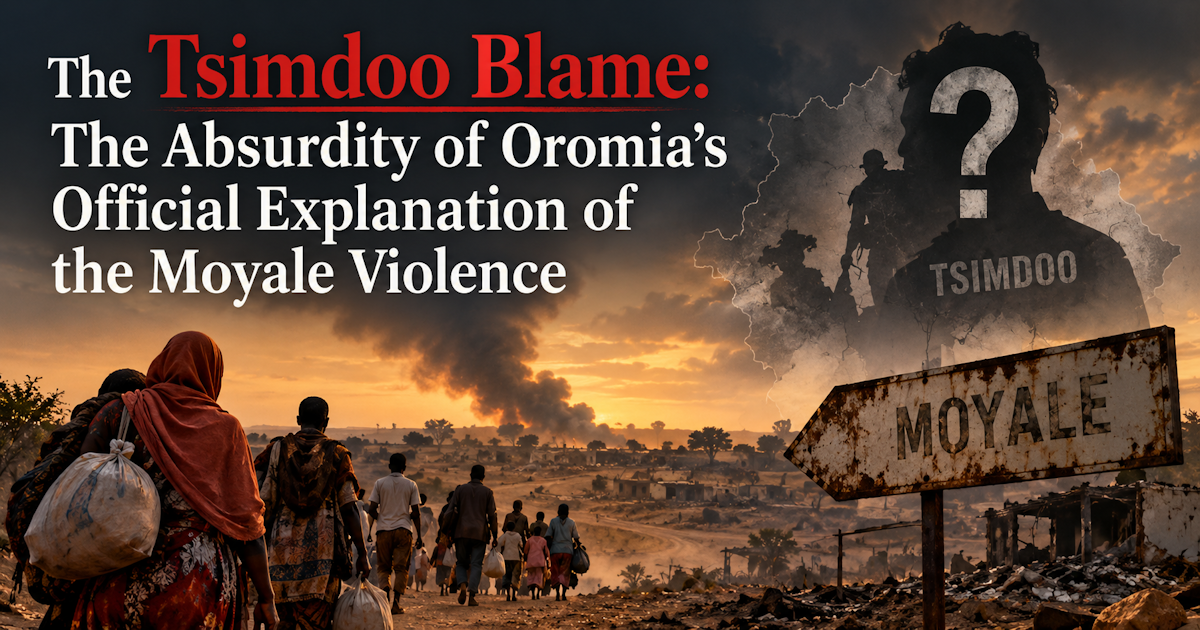
Oromia Under Pressure: The Attack on Borana, the Threat to Oromo Survival and the Urgent Imperative of Unity
Excerpt
As violence engulfs Borana and an estimated 50,000 people flee into Kenya, the tragedy in Moyale exposes a deeper crisis of insecurity across Oromia. This essay examines the threats to Oromo lives and territorial rights, the failures of political leadership, and the urgent imperative of an Alliance for Survival built on unity, legitimate self-defense, and collective responsibility.
The violence in Moyale is a stark warning that the security of Oromia cannot be separated from the political future of the Oromo people. At a time when Oromo communities face mounting threats from multiple directions, unity, collective security, and the right to legitimate self-defense have become more important than ever.
The Bloodshed in Borana: A Tragedy the World Must Not Ignore
A disturbing press release issued on November 3, 2026, by the independent international humanitarian organization Oromia Support Group (OSG) has drawn attention to a serious escalation of violence against Oromo civilians in Moyale and surrounding districts of Borana Zone, southern Oromia.
According to the organization, heavily armed Somali militias and Somali Regional State forces attacked Oromo residents between October 21 and 30, 2026, killing civilians and setting their homes ablaze. The organization further raises the possibility that fighters associated with the terrorist organization al-Shabaab may have assisted the attackers, although this allegation requires independent verification.
Among those reportedly killed was Diqqoo Jaataan Aagaa, a 13-year-old Oromo girl. Her death occurred amid tensions following the raising of the Somali Regional State and Somalia national flags at an administrative office on the Oromo side of Moyale on October 18. OSG reports that Somali forces subsequently withheld her body from her family for several days.
When Oromo residents demonstrated on October 21, their protests were rapidly suppressed as the violence intensified. Although national and international media initially reported at least nine deaths, OSG maintains that the actual death toll was considerably higher. On October 25, the organization reportedly received photographs from an informant it considered reliable, allegedly showing ten severed heads and the mutilated body of an Oromo police officer. These disturbing allegations require independent forensic investigation and verification.
The humanitarian consequences have been devastating. By late October, an estimated 50,000 people had fled across the border into Kenya, according to figures cited by the United Nations High Commissioner for Refugees (UNHCR), while thousands more reportedly sought refuge in Yabelo, Mega, Bokku, and Dubuluk. UNHCR cautioned that the cross-border figure remained provisional as registration and verification continued.
These are not merely statistics. They represent families uprooted, children deprived of security, communities torn from their ancestral homes, and people forced to abandon their livelihoods to escape violence.
Perhaps most disturbing is the reported absence of an effective response from Ethiopian federal and regional security forces. OSG also alleges that federal troops killed five Oromo civilians in Borana Zone on October 10, before the subsequent escalation of violence.
The Ethiopian government has a fundamental responsibility to protect civilians, regardless of their ethnicity or political affiliation. Its apparent failure to provide effective protection in the face of reported mass violence raises serious questions about the security and citizenship rights of Oromo communities.
A government that claims authority over a territory cannot evade responsibility for the lives and security of the people living within it.
Borana: An Ancestral Homeland Under Pressure
The violence in Moyale cannot be fully understood without considering the historical context of Borana and the long-standing territorial grievances of its people.
Borana is not simply a geographical district on the southern edge of Oromia. It is one of the historic heartlands of Oromo civilization, an important center of pastoral life, and a cradle of Gadaa, the indigenous system of governance that has shaped Oromo society for generations.
As OSG observes, Borana Oromo communities have experienced the progressive loss of substantial portions of their ancestral pastoral lands over approximately 140 years, with populations pushed westward by territorial expansion and competing claims.
This historical experience makes the current developments particularly alarming. The raising of another regional state's flag, and reportedly Somalia's national flag, on the Oromo side of Moyale, followed by violence against local residents, should not be dismissed as an ordinary administrative disagreement.
Territorial disputes must be addressed through peaceful dialogue, historical evidence, constitutional procedures, and mutually agreed legal mechanisms. They cannot legitimately be settled through armed intimidation, forced displacement, or the destruction of civilian communities.
No population should be forced to surrender its ancestral homeland simply because it lacks the military or political power to defend its rights.
A Wider Pattern: Oromia Under Pressure From Multiple Directions
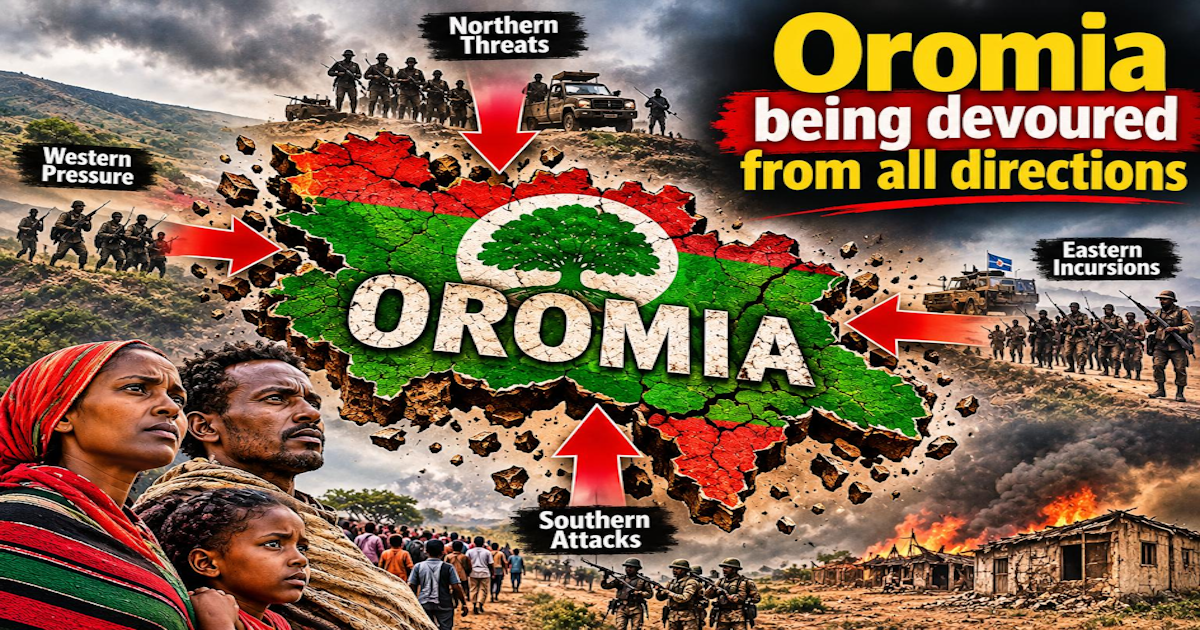
The unfolding tragedy in Borana must also be understood within the wider political and security crisis confronting Oromia.
Across different parts of Oromia, communities have experienced insecurity arising from armed incursions, territorial revisionist ambitions, political repression, military operations, and the failure of successive Ethiopian governments to resolve the country's fundamental nationality question.
In western Oromia, particularly Wallaga, armed incursions and territorial claims associated with Amhara ultranationalist movements have generated serious concerns about the safety of Oromo communities and the territorial integrity of the region. The promotion of alternative territorial identities and historical claims over Oromo lands has added another dimension to the conflict.
In southern Oromia, the developments in Borana demonstrate the vulnerability of communities living along contested administrative and regional boundaries. The displacement of tens of thousands of people constitutes a humanitarian emergency that deserves immediate international attention.
In eastern and northern parts of Oromia, the wider consequences of political instability, militarization, and the unresolved conflict between the Ethiopian state and Oromo political movements continue to expose civilian populations to insecurity.
These developments differ in their immediate causes, circumstances, and actors, but they share a common underlying problem: the persistent failure to guarantee the political, territorial, and security rights of the Oromo people.
The threats are not necessarily coordinated, nor should every conflict be attributed to a single actor or conspiracy. However, their cumulative impact is unmistakable. Oromo communities increasingly confront insecurity in different geographical directions, while their capacity to respond collectively remains constrained by political divisions and the absence of an inclusive national security framework.
This is precisely why the situation demands a broader Oromo political response rather than fragmented reactions to individual crises.
The Politics of Division: Turning Neighbors Against Neighbors
Equally concerning is the deliberate or reckless use of inflammatory ethnic narratives to justify violence and deepen divisions between neighboring communities.
OSG specifically challenges reports circulating in Somali media that portray the violence in Moyale as a consequence of supposed Oromo expansionism by an Oromo-led government. The organization argues that such claims are historically and politically misleading, particularly given the contraction of Oromo territory over generations.
These accusations are not harmless political commentary. When communities are repeatedly portrayed as territorial aggressors without credible evidence, such narratives can create an atmosphere in which attacks against them become easier to rationalize or justify.
The consequences of such hostility have reportedly extended beyond Ethiopia.
According to OSG, mobs in Borama, Somaliland, burned more than 150 homes belonging to Oromo refugees on October 29. Thousands of Oromo refugees in Hargeisa are reportedly fearful of further violence. Separate reporting by Addis Standard confirms that Somaliland officials condemned attacks on Oromo residents in Borama, although the precise extent of the destruction requires further verification.
The targeting of refugees because of their Oromo identity is particularly reprehensible. People who have already fled violence should not be subjected to further persecution in the very places where they seek safety.
A similar pattern of inflammatory accusations is emerging in relation to the reported killing of Ethiopian Orthodox Christians in Arsi Zone. OSG warns that allegations attributing the killing of 60 Christians to the Oromo Liberation Army, without credible substantiation, risk fomenting hostility between Oromo and Amhara communities.
The killing of innocent people, regardless of their religion or ethnicity, must be unequivocally condemned. Those responsible must be identified through credible and independent investigations and held accountable.
However, accusations must never become instruments of collective punishment, ethnic mobilization, or the indiscriminate assignment of guilt to entire communities.
The distinction between ordinary Amhara and Somali citizens, on the one hand, and armed organizations, political elites, or extremist movements, on the other, is essential.
Oromo political interests do not require hostility toward other peoples. Equally, peaceful coexistence cannot be built on the denial of Oromo political rights or the toleration of attacks against Oromo civilians.
The real danger lies in allowing political actors to transform legitimate grievances and territorial disputes into wider ethnic confrontations.
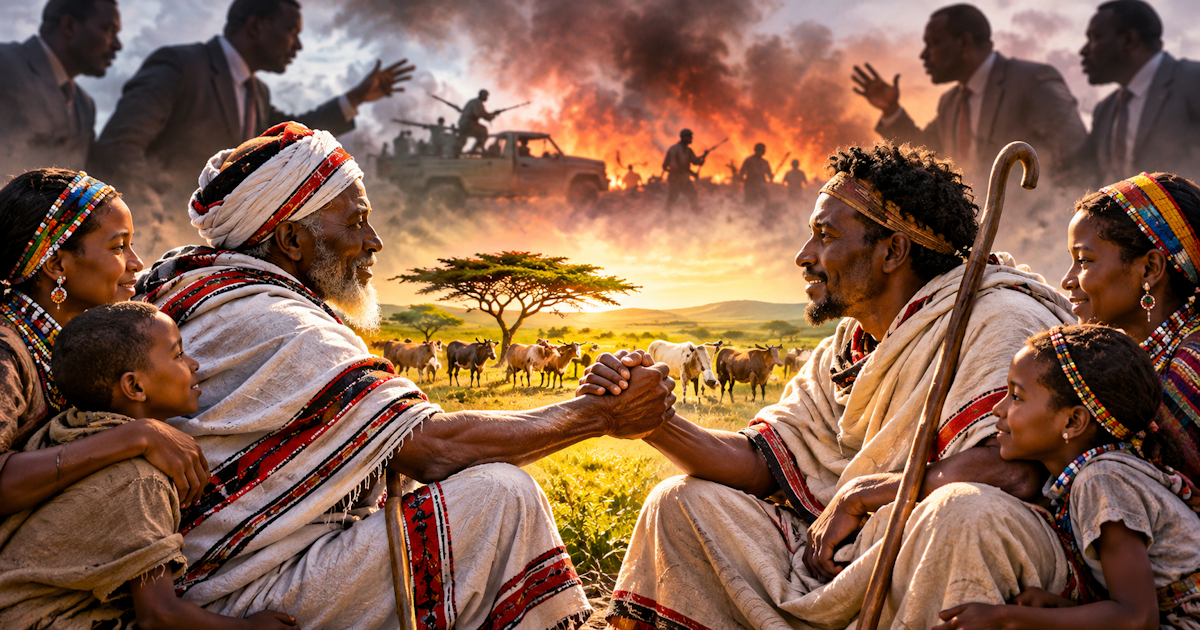
The Oromo and Somali peoples are not destined to be enemies. Nor should the actions of political authorities or armed groups be allowed to define relations between neighboring communities whose futures remain deeply interconnected.
The Ethiopian State and the Unresolved Nationality Question
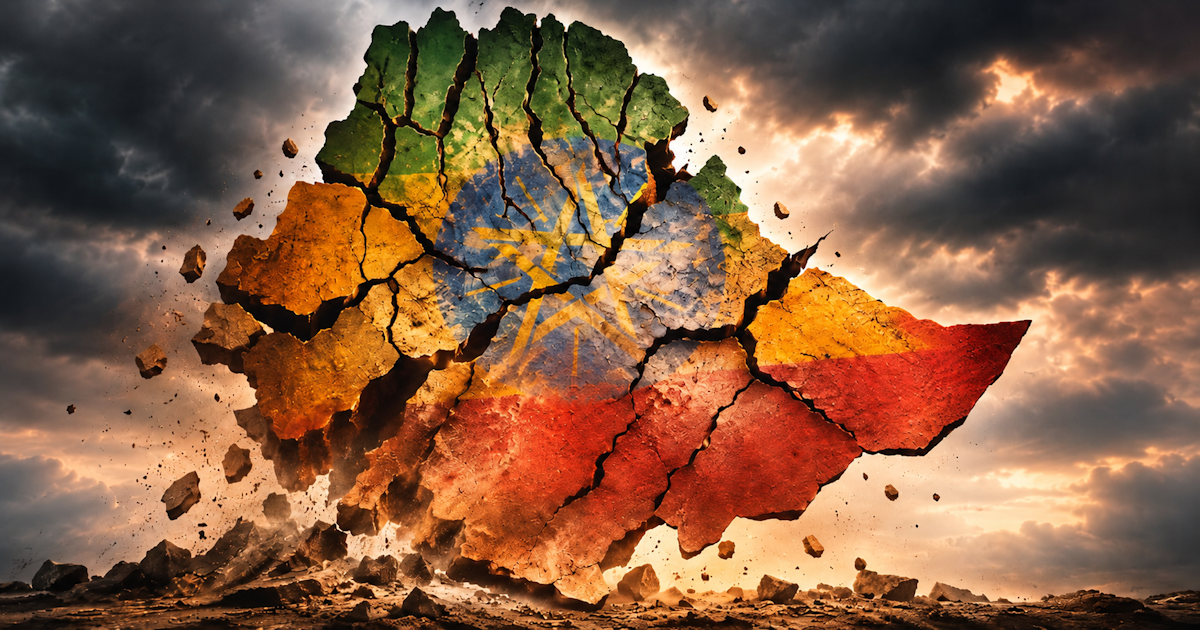
The recurring insecurity in Oromia is inseparable from the historical failure of the Ethiopian state to resolve the question of national self-determination.
From the incorporation of Oromo territories into the modern Ethiopian empire to the successive centralizing projects of the imperial, military, and contemporary federal governments, the fundamental question of who exercises political authority over Oromia has remained unresolved.
The overthrow of the Derg in 1991 and the introduction of multinational federalism raised expectations that the nationalities question would finally be addressed through self-government and democratic political arrangements.
However, the promises of federalism have remained deeply contested. Successive political developments have demonstrated the fragility of constitutional guarantees when they are not supported by genuine political accountability, institutional independence, and respect for the rights of nations and nationalities.
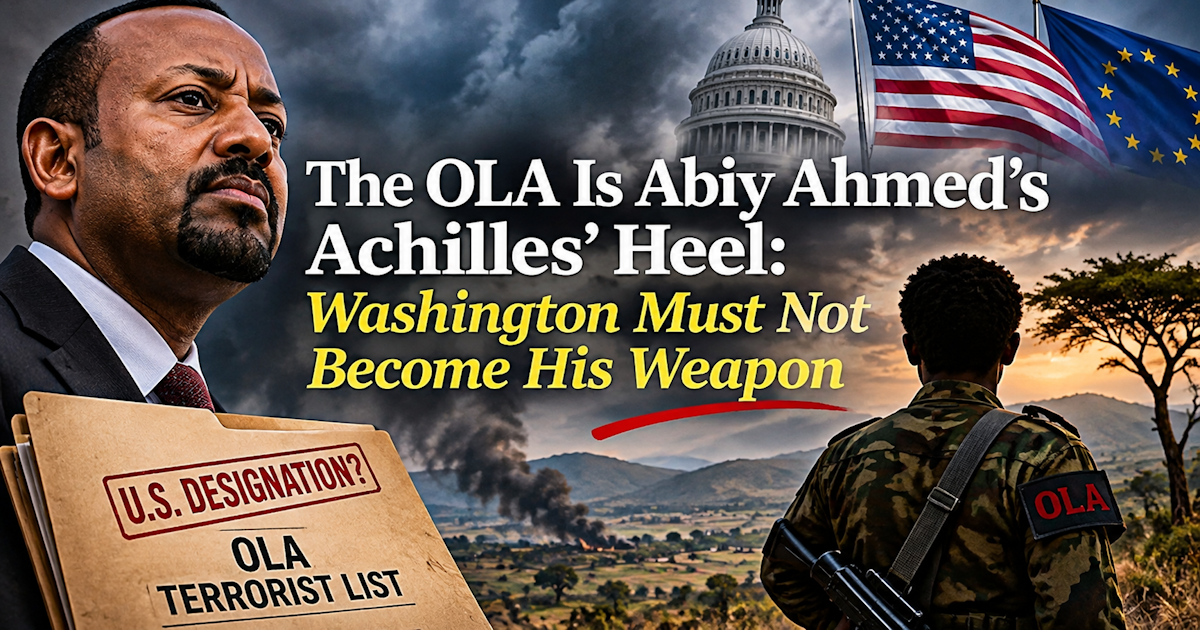
Since coming to power in 2018, Abiy Ahmed's Prosperity Party regime has increasingly pursued what critics regard as a centralizing political project. The dismantling or weakening of autonomous political space, military confrontation with Oromo political movements, and the failure of negotiations have deepened the crisis.
The November 2023 negotiations between the Ethiopian government and the Oromo Liberation Army failed to produce a lasting political settlement. The continuation of armed conflict has exacted a terrible price on civilian populations.
The fundamental lesson is that military force cannot resolve a political question that requires political recognition, negotiation, and a legitimate constitutional settlement.
Nor can the Ethiopian state credibly claim to guarantee national unity while failing to protect the territorial and political rights of the very peoples whose unity it seeks to preserve.
A durable political settlement must therefore go beyond temporary security arrangements. It must address the distribution of political power, the legitimacy of governing institutions, the protection of territorial rights, and the constitutional foundations of relations among Ethiopia's nations and nationalities.
Why Oromo Unity Matters More Than Ever
The present circumstances demand a serious reassessment of Oromo political priorities.
The Oromo people are not short of political organizations, intellectual resources, historical experience, or a tradition of resistance. What has repeatedly undermined their collective strength is political fragmentation, competing organizational interests, and the inability to sustain a common strategic position when the nation's fundamental interests are at stake.
At a time when Oromo communities face threats from multiple directions, this fragmentation carries increasingly dangerous consequences.
Unity does not mean that every Oromo political organization must abandon its political program, ideology, or institutional independence. Nor does it mean that legitimate disagreements should be suppressed.
Rather, it means recognizing that certain national interests transcend organizational boundaries.
The protection of Oromo civilians, the territorial integrity of Oromia, the right to self-determination, the preservation of Oromo identity, and the security of future generations are common national interests.
Political organizations may disagree on the future constitutional arrangement of Ethiopia, the timing and methods of political struggle, or the relationship between armed and peaceful political movements. Such disagreements should not prevent cooperation on issues fundamental to the survival and dignity of the nation.
Effective Oromo unity must therefore be built on mutual recognition, political equality, respect for organizational independence, and a shared commitment to protecting the Oromo people.
It must also extend beyond political organizations to include traditional institutions, Gadaa leaders, intellectuals, religious communities, civil society, businesspeople, women, youth, and the Oromo diaspora.
An Alliance for Survival: Unity Without Uniformity
The present moment calls for an Alliance for Survival: a broad political and civic understanding that places the security, dignity, and collective interests of the Oromo people above narrow organizational calculations.
The principle should be straightforward:
Cooperation without surrendering political independence. Unity without enforced uniformity. Collective action without abandoning legitimate political differences.
The experience of previous Oromo political alliances demonstrates that unity cannot be sustained by declarations alone. It requires trust, institutional mechanisms, transparent decision-making, and a willingness to compromise on secondary differences without sacrificing fundamental national interests.
An alliance worthy of the name must be more than a temporary convergence of political personalities or a symbolic response to the latest tragedy. It must establish a durable framework through which organizations and civic institutions can identify common priorities, coordinate peaceful political initiatives, respond to humanitarian emergencies, and pursue the protection of Oromo communities.
Its credibility will depend not merely on who joins it, but on whether its participants can translate declarations of solidarity into accountable and sustained collective action.
The Right to Legitimate Self-Defense: Protection, Not Revenge
One of the most important questions raised by the developments in Borana concerns the right of communities to defend themselves when their lives, homes, and livelihoods are threatened.
The right to life and security is fundamental.
Communities cannot reasonably be expected to remain passive when confronted with armed attacks, killings, arson, and forced displacement, particularly when the authorities responsible for protecting them are absent, ineffective, or themselves implicated in abuses.
The Oromo people have a legitimate interest in developing the political, civic, and institutional capacity necessary to protect their communities.
Legitimate self-defense, however, must not be confused with ethnic revenge, collective punishment, or indiscriminate violence.
It must be grounded in the protection of civilians, the defense of homes and communities, respect for applicable law and international humanitarian principles, and accountability for those responsible for attacks. It must never become a justification for targeting innocent people because of their ethnicity, religion, or place of origin.
The distinction is both moral and political: defending a community is not the same as seeking vengeance against another community.
The right of Oromo communities to security does not negate the rights of neighboring communities. Equally, the rights of neighboring communities cannot be invoked to deny the Oromo people their right to protect their lives, territory, and political future.
The Ethiopian government bears the primary responsibility for protecting all citizens. Where it fails to do so, the international community must not turn a blind eye to the vulnerability of affected populations.
There must be independent investigations, humanitarian access, protection for displaced people, and effective measures to prevent further attacks.
The responsibility of the Oromia regional administration extends beyond reacting to outbreaks of violence. It includes defending lawful jurisdiction, protecting residents, pursuing peaceful resolutions to boundary disputes, and ensuring that constitutional procedures are respected.
The ultimate measure of legitimate self-defense is not the harm inflicted on an adversary, but the innocent lives protected and the security restored to threatened communities.
An Urgent Appeal to the International Community
The international community must pay urgent attention to the situation in Borana and the wider deterioration of civilian security in Oromia.
The estimated displacement of 50,000 people into Kenya alone warrants an immediate humanitarian response. Refugees and internally displaced persons require emergency shelter, food, healthcare, protection, and assistance to return home voluntarily, safely, and with dignity when conditions permit.
UNHCR, working with humanitarian partners, has appealed for $8.9 million to support up to 50,000 people over three months. The agency has identified food, clean water, shelter, sanitation, and healthcare among the most pressing needs.
Independent investigations are also essential. The reported killings, destruction of homes, mutilation of victims, and withholding of a child's body must be thoroughly investigated. Those responsible, regardless of their position or affiliation, must be held accountable.
The international community should also examine the growing vulnerability of Oromo refugees in Somaliland and elsewhere, where displacement and ethnic hostility threaten people who have already endured profound suffering.
Most importantly, international engagement must address the underlying political crisis rather than treating each outbreak of violence as an isolated humanitarian emergency.
A sustainable solution requires respect for the political and territorial rights of the Oromo people, genuine dialogue, accountability, and a political settlement that addresses the unresolved nationality question.
Humanitarian relief can save lives, but it cannot substitute for political justice. Nor can temporary security interventions provide lasting protection where the underlying causes of conflict remain unresolved.
The Time for Collective Responsibility Is Now
The tragedy unfolding in Borana is a painful reminder that the security of Oromia cannot be taken for granted.
A 13-year-old girl should not lose her life because of the political disputes of adults. Families should not be forced to abandon their ancestral homes. Refugees should not face persecution in the very places where they seek protection. And no community should be left defenseless while those entrusted with protecting it fail to act.
The Oromo people must recognize that their security, dignity, and political future are interconnected.
The threats confronting Borana, Wallaga, and other parts of Oromia may have different immediate causes, but they demand a common commitment to civilian protection, territorial integrity, political rights, and collective security.
This is not a call for ethnic confrontation. It is a call for political maturity, national solidarity, and responsible collective action.
Oromo unity must rise above individual organizations, personalities, and temporary political calculations. It must be rooted in the recognition that the Oromo people have a common stake in the survival and security of Oromia.
The right to defend one's community is inseparable from the responsibility to protect innocent lives and uphold the dignity of all peoples.
History will not judge the Oromo people merely by the strength of their resistance, but also by their ability to build the political unity, institutions, and collective leadership necessary to secure a just and lasting future.
When communities are attacked in different corners of Oromia, the response cannot remain fragmented. The defense of Oromo lives, land, and political rights must become a shared national responsibility.
The time for Oromo unity is not tomorrow. It is now.
Source and Further Reading
Principal source
Oromia Support Group (OSG), Press Release, November 3, 2026, "Somali Region Forces Attack Oromo Civilians in Moyale." Issued by Dr. Trevor Trueman, Chair, Oromia Support Group.
Additional References
Prof. Galgalo Dika, Borana University, historical grievances and territorial losses of Borana pastoralists: Addis Standard — Contested Land and Historical Grievances