
The Balkan Ghost in the Horn of Africa: Why Centralism, Not Diversity, Is Shattering Ethiopia

Excerpt
The Balkan Ghost in the Horn of Africa challenges the claim that multinational federalism is responsible for Ethiopia’s disintegration. Drawing parallels with Yugoslavia’s collapse, Tsegaye R. Ararssa argues that the real existential threat is not diversity but authoritarian centralism—the attempt to impose national unity by dismantling constitutional autonomy and suppressing the rights of constituent nations.
Abstract
In contemporary commentary on the crisis in the Horn of Africa, conventional wisdom holds that Ethiopia’s multinational federalism—often labeled “ethnic federalism”—is the primary driver of its current instability. This commentary frequently invokes the experience of multinational federalism in Yugoslavia, attributing the Balkan wars of the 1990s and the federation’s eventual collapse to its federal arrangements. This essay challenges that thesis. It argues that in both the Balkans and Ethiopia, state fragmentation and mass violence were not caused by the institutional accommodation of diversity, but rather by reactionary, authoritarian attempts by central elites to undermine federal arrangements. Ultimately, the essay warns that the pursuit of forced national homogenization represents the gravest existential threat to multinational states.
The Fatal Misdiagnosis of Ethiopia’s Crisis
A comfortable consensus seems to have emerged among state-centric commentators and casual international observers tracking the tragic unraveling of the Ethiopian state. The diagnosis they offer is seductively simple: Ethiopia is drifting into severe conflict and potential state collapse because of its constitution. Specifically, they point the finger at the country’s system of multinational federalism—frequently disparaged by its critics as “ethnic federalism”—which, in 1995, recognized ethnolinguistic identities and constitutionalized the right to ethnocultural justice, chief among its guarantees being the right to self-determination.
To validate this view, commentators routinely invoke the ghosts of the late twentieth century, pointing to the violent dissolution of the Socialist Federal Republic of Yugoslavia (and the much less violent dissolution of the USSR) as definitive proof that institutionalizing diversity is a suicide pact for multinational states.
It is a neat, intuitive argument. It is also entirely wrong.
By misdiagnosing the disease, these observers are prescribing a cure that is actively killing the patient. A rigorous comparative examination of both the Balkans in the 1990s and the Horn of Africa today reveals a starkly different causal mechanism.
In both Yugoslavia and Ethiopia, the descent into mass violence and state fragmentation was not precipitated by the practice of multinational federalism. Rather, it was triggered by a reactionary, authoritarian impulse to dismantle it. Conflict erupts not when diversity is accommodated, but when central authorities attempt to violently subvert constitutional autonomy in the name of national unity.
How Yugoslavia Actually Died
To understand the current tragedy in Ethiopia, one must first understand how Yugoslavia actually died.
The popular narrative suggests that the country spontaneously combusted along ancient ethnic fault lines once the iron fist of communism relaxed. In reality, Yugoslavia survived Tito’s death for a decade under a complex, rotating collective presidency designed precisely to prevent any single nationality from dominating the others.
Its collapse began in earnest when Slobodan Milošević and Serbian ultranationalists weaponized a grievance-driven narrative of Serbian victimhood to launch the “Anti-Bureaucratic Revolution.”
The parallel with contemporary Ethiopia is precise and chilling.
Just as Milošević used street protests and populist fervor to strip away the constitutional autonomy of Kosovo and Vojvodina in 1989, contemporary Ethiopian centralists have sought to systematically dismantle the autonomy of regional states, even threatening to dismember them in the name of “clusterization.”
In the case of some regional states, notably Tigray and Oromia, the regime has gone further, launching what the author characterizes as genocidal wars to deny their peoples the right to self-governance.
Milošević’s fatal error was believing he could centralize the Yugoslav federation by packing the federal presidency with loyalists and intimidating dissenting republics. By attempting to bypass the complex federal checks and balances and centralize power under a hegemonic Belgrade, Serbian elites created an existential security dilemma for the other republics.
Slovenia, Croatia, and Bosnia did not secede merely out of a primordial desire for statehood; they sought to escape a centralized structure that had increasingly become an instrument of ethnic majoritarian dominance.
Ethiopia: The Balkan Script Revisited
Today, a terrifyingly similar script is playing out in the Horn of Africa.
For decades, Ethiopia’s multinational federal model—despite its deep democratic deficits under the previous ruling coalition—provided a framework that acknowledged the sovereignty of the country’s distinct nations and nationalities.
It was an imperfect promise of peace, but it held a complex, deeply pluralistic empire-state together by assuring historically marginalized groups that their languages, cultures, and regional self-governance were constitutionally protected.
The current existential crisis facing Ethiopia entered a decisive phase in 2019 when Prime Minister Abiy Ahmed, backed by Ethio-Amhara political elites, mistook a mandate for democratic reform for an opportunity to pursue aggressive centralization.
Driven by the hollow slogan of Medemer (synergy)—which, in practice, became another expression of the old unitarist mantra—the reform agenda quickly devolved into an ideology of forced homogenization.
The ruling coalition dissolved the ethnonationally representative constituent parties of the Ethiopian People’s Revolutionary Democratic Front (EPRDF) into a single, centralized Prosperity Party.
This institutional erasure bears a striking resemblance to Milošević’s consolidation of control over the League of Communists of Yugoslavia.
When the federal government in Addis Ababa subsequently attempted to postpone national elections, bypass constitutional mechanisms, and consolidate power under a singular, top-down party structure, it triggered the same kind of defensive response witnessed in the Balkans.
Regional states did not invoke their constitutional rights to self-determination out of caprice; they did so because the federal contract was being unilaterally torn apart.
The true ghost haunting the Horn of Africa is not multinational federalism. It is the authoritarian centralism that destroyed the possibility of coexistence in the Balkans—and now threatens to do the same in Ethiopia.
When Abiy Ahmed moved to enforce his will militarily, he transformed a constitutional dispute into a multifront civil war, thereby ushering in an era of what can only be described as genocidal madness.
The Centralist Delusion: Unity Through Domination
The tragedy of the “Ethiopianist” critique lies in its profound historical blindness.
The intellectuals and political elites who clamor for a return to a centralized, unitary state are nostalgic for an imperial past that never existed without mass violence.
They view the federal accommodation of identity as a source of division, failing to recognize that, in an imperial state composed of deeply rooted, historically subjugated nations, centralization is not necessarily an act of state-building. When imposed through coercion and domination, it becomes an act of aggression.
Just as the Serbian elite’s attempt to impose Belgrade-centric hegemony guaranteed the violent fracturing of Yugoslavia, the attempt to impose Addis Ababa-centric Amhara hegemony is fracturing Ethiopia.
The fundamental error is the assumption that political unity can be manufactured by suppressing the very diversity that constitutes the state.
In a multinational society, constitutional recognition of diversity is not inherently a threat to unity. It can be the very condition that makes voluntary political coexistence possible. To dismantle that accommodation in pursuit of an imagined homogeneous nation is to destroy the foundations upon which a shared political future might otherwise rest.
The Lesson of Yugoslavia: Federalism Was Not the Enemy
Yugoslavia did not collapse simply because it was a federation; it collapsed because Serbian nationalists tried to turn a federation into an empire.
If Ethiopia continues its slide toward total disintegration, it will not be because the 1995 Constitution divided the country. It will be because Abiy Ahmed and his ideological allies succumbed to the fatal centralist delusion—the belief that one can force a multinational society into a singular mold without shattering the glass entirely.
The lesson from the Balkans is therefore not that diversity must be suppressed to preserve the state. It is that a state which seeks to preserve itself by forcibly suppressing its constituent nations may ultimately bring about the very disintegration it claims to prevent.
The true ghost haunting the Horn of Africa is not multinational federalism. It is the authoritarian centralism that destroyed the possibility of coexistence in the Balkans—and now threatens to do the same in Ethiopia.
Selected References
- Laura Silber and Allan Little, Yugoslavia: Death of a Nation, Rev ed (Penguin 1997). Available on Amazon.
- Misha Glenny, The Fall of Yugoslavia (Penguin, 1996), Available on Amazon.
- Catherine Baker, The Yugoslav Wars of the 1990s, (Red Globe Press 2015), Available on Amazon.
- Christopher M Bennett, Yugoslavia’s Bloody Collapse: Causes, Course, and Consequences (New York University Press, 1995). Available on Amazon.
- Dejan Jovic, Yugoslavia: A State that Withered Away (Purdue University Press, 2009)., Available on Amazon.
About the Author:
Tsegaye R. Ararssa is an independent legal scholar, political and legal commentator, and public intellectual specializing in constitutional law and theory, human rights, and comparative federalism. His work focuses extensively on indigenous resistance, self-determination, and the political geography of the Horn of Africa.





**Review: The Ghost Has Already Entered the House**
Tsegaye R. Ararssa’s *The Balkan Ghost in the Horn of Africa* reverses the usual diagnosis. Ethiopia is not breaking apart because the 1995 Constitution recognised its nations. It is breaking apart because Finfinnee is trying to un-recognise them. The Yugoslav parallel holds. Milošević stripped Kosovo and Vojvodina of autonomy, and Abiy Ahmed dissolved the EPRDF’s national parties into the Prosperity Party. In both cases the federal contract was torn up from the centre in the name of saving the state. Ararssa’s central point should end the lazy habit of blaming “ethnic federalism” for violence organised against it: secession followed centralisation; it did not cause it.
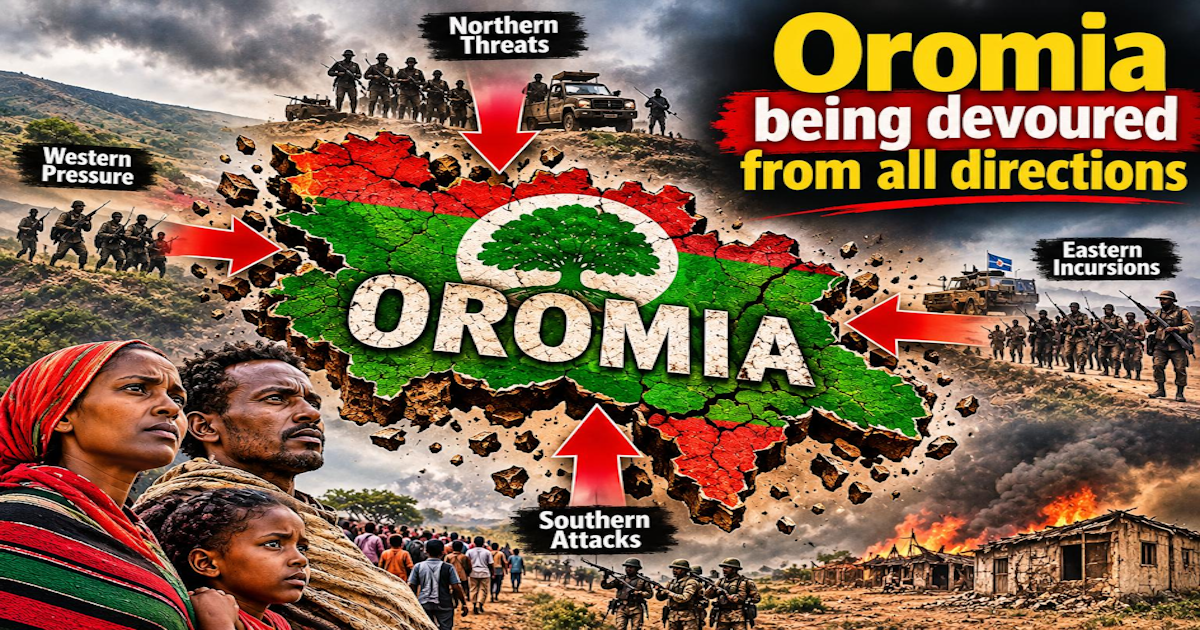
But the ghost is no longer at the door. It is inside Oromia. In a televised debate this year, Prosperity Party representatives said they want to remove the right to secession from Article 39 and divide large regions such as Oromia and Amhara. The Prime Minister has since confirmed the constitutional overhaul. Caffee Oromiyaa has voted to fold Oromia’s zones into clusters. Milošević needed street mobs to strip Kosovo’s autonomy. The Prosperity Party has Oromia’s own assembly do it.
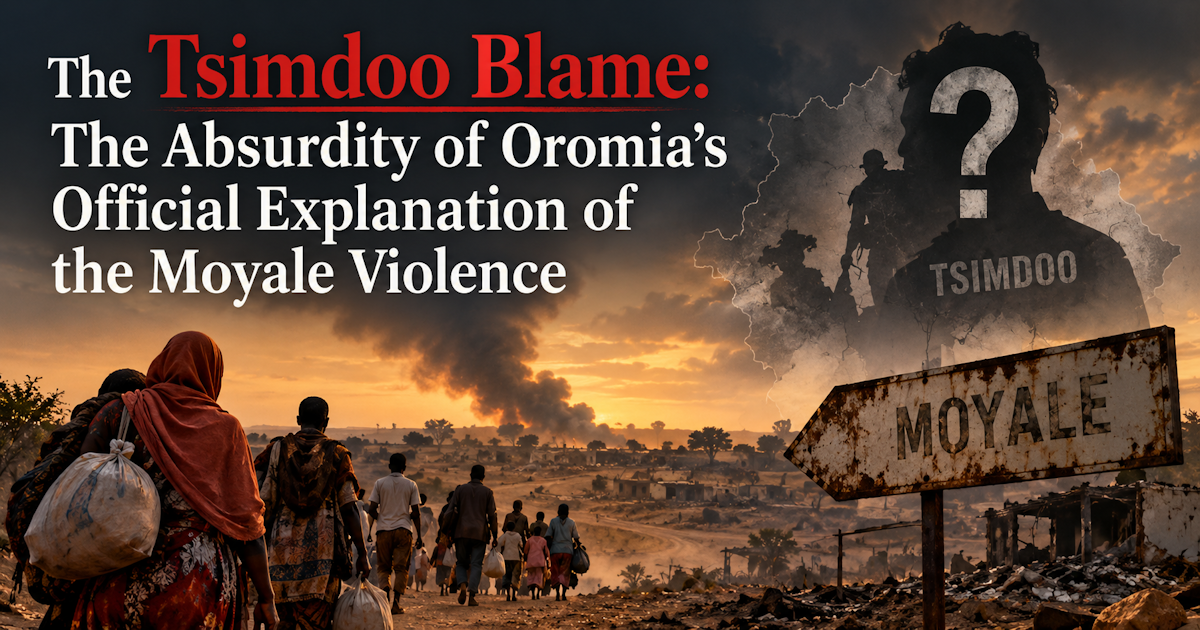
What the centre begins inside Oromia, it finishes on its borders, and Moyalee shows how. The fighting began when the Somali regional administration raised its flag in a kebele administered by Oromia. More than 50,000 people have fled into Kenya. This is presented as an ethnic clash, but it serves a design. On 30 September, Abiy stood at the groundbreaking of Dangote’s Lamu refinery and promised it would “connect regional markets.” The refinery’s planned fuel pipeline to Ethiopia runs through Moyalee. Instability now supplies the pretext to strip Oromia of the town before it becomes a trading gateway. Diree Dhawa was taken and federalised. Oromo farmers were pushed off their land around Finfinnee and Sheger. Each time, Oromos were cleared from the scene before the wealth arrived. A right to self-determination that its abuser can delete was never a guarantee, only a lease, and the lease is being cancelled one city at a time. For Oromia, independence is not a reaction to federalism’s failure but the answer to its deliberate abolition. Its time is now.
Sources:
– [Election Watch – PP debate](https://electionwatch-et.pages.dev/data/debates/4byg_qME7DQ)
– [Capital Ethiopia – Constitutional overhaul](https://capitalethiopia.com/?p=83089)
– [allAfrica – Moyale](https://allafrica.com/stories/202610280351.html)
– [Al Jazeera – Moyale displacement](https://www.aljazeera.com/news/2026/11/9/more-than-50000-displaced-by-deadly-ethiopia-border-clashes)
– [Kuwait Times / AFP – Lamu groundbreaking](https://kuwaittimes.com/article/50721/business/dangotes-kenya-refinery-new-chapter-for-africa/)
– [Citizen Digital – Abiy’s remarks](https://citizen.digital/article/museveni-leads-african-leaders-in-backing-dangotes-ksh22-trillion-lamu-refinery-n391185)
– [Vellum – LAPSSET pipeline](https://vellum.co.ke/inside-dangotes-planned-lamu-refinery-the-promise-risks-and-stakes-for-east-africa/)