The Cartography of Displacement: EPRDF, UNHCR and the Making of the Oromo-Somali Border Conflict
Excerpt
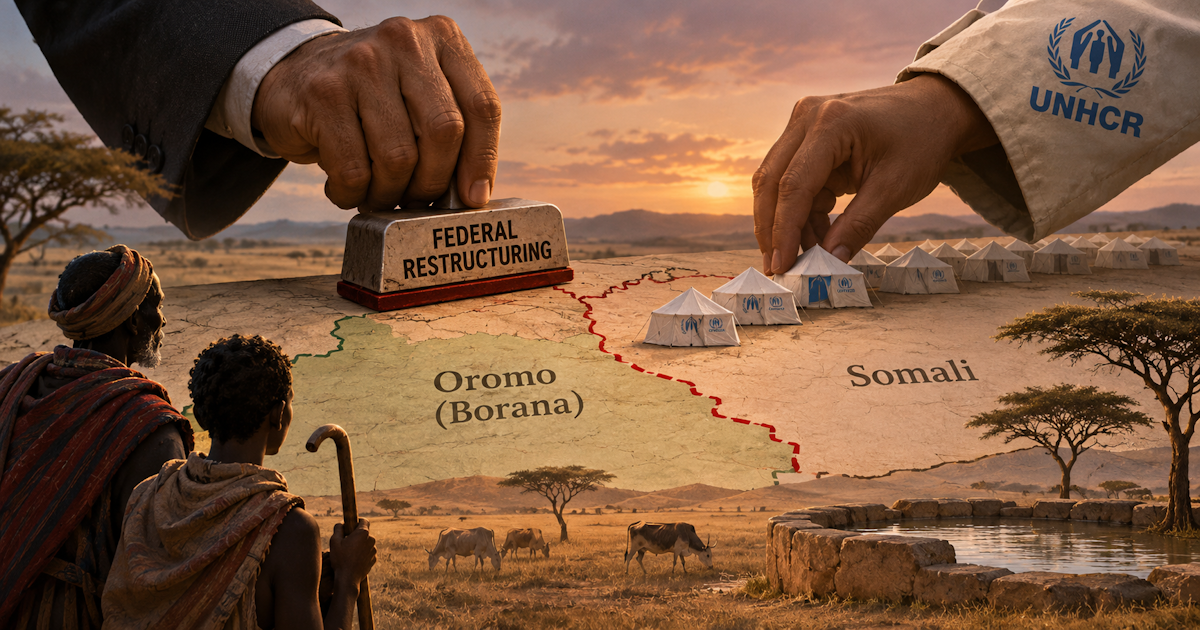
The Oromo-Somali Border Conflict is neither ancient nor accidental, Tsegaye R. Ararssa argues. Tracing its structural origins to post-1991 refugee repatriation, demographic engineering and Ethiopia’s multinational federal restructuring, he examines how humanitarian intervention, territorial administration and the flawed 2004 referendum transformed ancestral Borana lands and customary water systems into enduring sites of zero-sum territorial conflict, laying the foundations for today’s Moyale crisis.
Abstract
This essay examines the structural origins of recurring territorial violence along the Oromo–Somali borderlands in southern Ethiopia, challenging dominant narratives that blame primordial clan animus or climate-induced scarcity. Analyzing post-1991 state-building and international humanitarian governance, it argues that the annexation of the Liban and Dawa zones, and current expansionist claims over the strategic border town of Moyale, stem from a demographic rupture engineered between 1991 and 1993.
During that period, the United Nations High Commissioner for Refugees’ (UNHCR) “Cross-Mandate Approach” converged with the Transitional Government of Ethiopia’s multinational-federal project to settle tens of thousands of Somali-speaking returnees and migrants around vital Borana tulaa (deep-water well) complexes. By constitutionally tying territorial sovereignty to post-repatriation settlement patterns and ratifying the demographic fait accompli through the flawed 2004 referendum, state and international actors turned customary pastoral commons into permanent engines of zero-sum conflict.
Key Words: Oromo–Somali borderlands; Moyale; EPRDF; multinational federalism; Borana customary tenure; territorial sovereignty; humanitarian governance; UNHCR repatriation.
I. Introduction: The Fallacy of Humanitarian Neutrality
In the diplomatic lexicon of the Horn of Africa, the recurring violence along the Ethio-Kenyan frontier—most acutely visible in the October–November 2026 conflagrations across Moyale, Dawa and southern Oromia that displaced nearly 700,000 people and drove 58,000 refugees into Kenya’s Marsabit County—is routinely diagnosed through two comfortable truisms: primordial clan animus or climate-induced resource scarcity. Both explanations serve a distinct political utility. By framing the conflict around Moyale as an organic tragedy of ecology or ancient blood feuds, international observers absolve the modern state—and, more crucially, the international humanitarian apparatus—of authorship.[1]
Yet the territorial crisis engulfing Moyale and its surrounding districts is neither ancient nor accidental. It is the foreseeable outcome of a deliberate cartographic and demographic rupture executed in the early 1990s. Following the simultaneous collapse of the Derg regime in Ethiopia and the Siad Barre state in Somalia in 1991, the convergence of the United Nations High Commissioner for Refugees’ (UNHCR) repatriation logistics and the newly installed Ethiopian People’s Revolutionary Democratic Front’s (EPRDF) project of multinational federalism fundamentally re-engineered the human geography of southern Ethiopia, especially that of Oromia.[2]
Under the banner of humanitarian return, tens of thousands of Somali-speaking refugees and cross-border migrants—many lacking historical tenure in the Borana heartlands—were settled around vital ecological nodes inside Oromo territory.[3] Within a few years, these aid-dependent settlements were legally transmuted into permanent administrative jurisdictions: first as the Liban Zone and later, following its bifurcation, as the Dawa Zone of the Somali Regional State.[4] What began as an emergency relief operation became the legal and demographic scaffolding for the structural annexation of Borana rangelands, laying the groundwork for contemporary expansionist claims over Moyale itself.
To understand why peace initiatives in southern Ethiopia continually founder—including the fragile ceasefires following the late-2026 clashes sparked by the hoisting of a Somali regional flag in the Oromia-administered section of Moyale—political leaders, whether local or national, and diplomats must confront an uncomfortable premise: humanitarian intervention did not merely respond to displacement in the borderlands; it institutionalized a new regime of territorial dispossession.
II. Customary Tenure and the Tulaa Economy
To appreciate the magnitude of the post-1991 rupture, one must first dispense with the colonial and state-centric fiction that the arid rangelands of southern Ethiopia were terra nullius—an ungoverned expanse awaiting administrative inscription. For centuries prior to the late twentieth century, the ecological and political order of Dirre, Liban and the Moyale escarpment was governed by the Borana Oromo through the Gadaa generational-class system and Seera Margaaf Bisaanii (the customary law of pasture and water).[5]
In a semi-arid ecosystem characterized by erratic rainfall, sovereignty was not exercised through rigid linear borders but through institutional control over key hydrological assets.[6] Foremost among these were the tulaa—complexes of deep, hand-dug permanent wells, such as those in Eel Goof, Eel Lei, Chilanko and Hudet, capable of sustaining vast herds through severe dry seasons.[7] As environmental historians and anthropologists have extensively documented, the tulaa were not open-access commons. They were corporate properties excavated, maintained and ritually governed by specific Borana clans under the authority of the Abbaa Herregaa (father of water). Access to dry-season grazing reserves (kaloo) and wells was strictly regulated to prevent ecological collapse.[8]
Crucially, Borana customary law accommodated mobility and inter-ethnic coexistence without ceding underlying territorial title. Minority pastoralist groups, including segments of the Somali-speaking Garre and Gabra, historically negotiated seasonal grazing and watering rights as qubattoota (hosted guests or clients).[9] While these arrangements fostered bilingualism, trade and periodic alliances—and were occasionally punctuated by localized raiding—the foundational jurisdictional authority over the land and its deep wells remained unequivocally Borana.[10]
Even under the centralizing pressures of the Abyssinian empire following Menelik II’s conquest in the late nineteenth century, and later under the Derg’s Peasant Associations, the administrative architecture of the south largely recognized this underlying Borana territorial matrix.[11] It was only when the post-1991 state tethered exclusive regional sovereignty to the sheer numerical presence of linguistic groups that the ancient institution of guest-host reciprocity was weaponized against its hosts.[12]
III. The 1991–1993 Rupture: Humanitarian Logistics as Statecraft
The mechanism that dismantled Borana customary sovereignty was not a conventional military conquest but a humanitarian logistics operation. Between 1991 and 1993, as hundreds of thousands of refugees spilled across the frontiers into northern Kenya and southern Ethiopia, the UNHCR and Ethiopia’s Relief and Rehabilitation Commission (RRC) launched an ambitious repatriation and relief framework known as the “Cross-Mandate Approach.”[13]
Conceived as an innovative, holistic model to assist returning refugees, internally displaced persons (IDPs) and drought-affected local populations simultaneously, without bureaucratic verification of individual origin, the Cross-Mandate Approach proved ecologically and politically catastrophic on the ground.[14] By establishing food, cash and material distribution hubs inside southern Borana territory—most notably around Moyale, Hudet and Waacille—international agencies inadvertently constructed powerful demographic magnets.[15] As anthropologist Marco Bassi meticulously documented, the availability of UNHCR repatriation packages—comprising transport, cash grants and sustained food rations—triggered a massive inward migration from Kenyan refugee camps in Walda and Banissa, as well as from war-torn southern Somalia.[16]
While international administrators categorized these entrants as “Ethiopian returnees” fleeing the 1977–78 Ogaden War or Derg-era villagization, the empirical reality on the ground was far more complex. Under the doctrine of prima facie group determination and the suspension of individual screening, the porousness of the Ethio-Kenyan and Ethio-Somali frontiers—combined with the linguistic and clan overlaps of the Garre and Digodia across all three states—allowed tens of thousands of Somali-speaking pastoralists with no prior residential or customary tenure in Borana districts to register for repatriation and settle permanently inside Ethiopia.[17]
Within a few years, the demographic profile of the Moyale district underwent an artificial shock, surging by roughly 280 percent.[18] Crucially, these settlements were not dispersed randomly; they were concentrated directly upon strategic ecological choke points—the permanent tulaa complexes of Eel Goof, Eel Lei, Chilanko and Mubarak—effectively severing Borana wet- and dry-season transhumance routes.[19]
To view this demographic transformation merely as an unintended byproduct of humanitarian naïveté, however, is to ignore the acute geopolitical calculus of the post-1991 Ethiopian state. Following the June 1992 withdrawal of the Oromo Liberation Front (OLF) from the Transitional Government of Ethiopia (TGE), the ruling Tigray People’s Liberation Front (TPLF) viewed the Borana heartlands along the Kenyan border as a dangerous strategic flank and a potential rear base for Oromo insurgency.[20]
In this context, the UNHCR-funded influx of Somali-speaking returnees offered the EPRDF regime in Ethiopia a ready-made instrument of counter-insurgency through demographic dilution.[21] By acquiescing to—and actively facilitating—the settlement of Garrii and other Somali clans onto Borana pasturelands, the TGE erected a loyalist demographic buffer along the southern frontier. Humanitarian aid thus functioned as a subsidy for statecraft, allowing Ethiopia to neutralize Borana territorial cohesion without deploying a permanent garrison.[22]
IV. From Refugee Camps to Regional States: Institutionalizing Annexation
Had the 1991–1993 influx occurred under a unitary, civic administrative framework, it might have been absorbed through traditional Borana mechanisms of clientele and negotiated resource sharing. Instead, it coincided with Ethiopia’s radical constitutional restructuring into a multinational federal republic. Under Transitional Proclamation No. 7/1992 and subsequently Article 46(2) of the 1995 Federal Democratic Republic of Ethiopia (FDRE) Constitution, internal regional boundaries were ordered to be delimited on the basis of “settlement patterns, language, identity and consent of the people.”[23]
In the pastoralist borderlands of the south, this constitutional formula acted as a legal solvent upon indigenous land tenure. By privileging static “settlement patterns” and contemporary linguistic majorities over historical stewardship and customary law, the federal architecture rewarded the recent, aid-induced demographic surge with sovereign territorial title.[24] Vast swathes of the former Borana Awraja (province)—territories that had been integral to the Borana ritual and economic cosmos for centuries—were summarily excised and incorporated into Region 5, the Somali Regional State, as the Liban Zone.[25]
Years later, in a move designed to further consolidate administrative depth along the Oromia frontier, the Somali Regional State bifurcated Liban to establish the Dawa Zone, anchoring a permanent bureaucratic apparatus directly atop Borana grazing corridors and sacred water wells.[26]
When violent clashes erupted over this cartographic engineering, the federal government turned to majoritarian plebiscites to launder the demographic fait accompli. In October 2004, the House of Federation ordered a referendum, which the National Electoral Board of Ethiopia (NEBE) organised across 463 contested kebeles—the lowest administrative units—along the Oromia–Somali border. Voting was ultimately conducted in roughly 420 of them. Roughly 80 percent of the participating kebeles voted to remain in Oromia, while roughly 20 percent—concentrated in areas transformed by the 1990s repatriations—voted to join the Somali Regional State.[27]
The kebeles that remained recurrent flashpoints, such as Moyale and Mi’essoo, were largely those where no referendum was held, mainly because of bitter disagreement over the identity and eligibility of voters registered to participate.
For diplomatic observers, the 2004 referendum appeared to be a model of democratic conflict resolution. Under established international human-rights and humanitarian norms, however, it constituted a textbook violation of restorative justice.[28] The United Nations Principles on Housing and Property Restitution for Refugees and Displaced Persons—the Pinheiro Principles, adopted in 2005—affirm the right of refugees and displaced persons to restitution of housing, land and property of which they were arbitrarily or unlawfully deprived and establish principles governing return, documentation, restitution claims and the treatment of secondary occupants.[29]
Viewed through that restorative framework, conducting a majoritarian plebiscite a decade after state- and UNHCR-backed demographic engineering inverted the underlying principle of restitution: it used a numerical majority produced through humanitarian repatriation to extinguish the asserted preexisting corporate title of the Borana over their tulaa complexes and grazing commons.
Worse still, the plebiscite failed to resolve the status of Moyale town itself and several surrounding strategic kebeles, leaving the border city fractured under a volatile administrative dualism.[30] For over two decades, Moyale has been governed simultaneously by two competing woreda administrations—one reporting to Oromia, the other to the Somali Regional State—complete with parallel mayors, rival tax collectors and heavily armed regional security forces.[31]
Rather than settling the border, the post-1991 institutional framework laundered an unlawful enclosure into a constitutional boundary while freezing Moyale into permanent administrative warfare.
V. Expansionist Logic and the Geopolitics of Moyale
Once the annexation of the rural hinterland into the Liban and Dawa zones was legally normalised, the geopolitical logic of expansionism inevitably turned toward Moyale itself. In the political economy of the Horn, Moyale is no mere dusty frontier outpost; it is a critical overland commercial artery linking Ethiopia to Kenya and onward to the Kenyan coast, and an important component of the wider LAPSSET (Lamu Port–South Sudan–Ethiopia Transport) corridor.[32] Control over Moyale and its immediate approaches carries significant implications for customs revenues, cross-border trade networks and strategic leverage over Ethiopia’s southern transit routes.
Armed with the administrative legitimacy conferred by the creation of Liban and Dawa, Somali regional elites progressively shifted their posture from defending newly acquired rural settlements to asserting comprehensive territorial claims over Moyale town and adjacent Borana districts. As Fekadu Adugna has observed, multinational federalism transformed overlapping nationalist projects into zero-sum spatial contests, wherein every clinic, administrative office or regional flag planted in a kebele became an act of sovereign annexation—a dynamic vividly illustrated when the October 2026 opening of a Somali regional administrative office and flag-raising in what is described as the Oromia side of Moyale ignited full-scale armed confrontation.[33]
This expansionist trajectory is sustained by a profound politico-diplomatic blind spot. Ethiopian political leaders—both regional and national—as well as international donors, multilateral lenders and humanitarian agencies operating in southern Ethiopia routinely treat the boundaries of the Liban and Dawa zones as settled, neutral cartographic facts.[34]
When development agencies fund boreholes, road networks or administrative infrastructure within these zones—or when diplomatic missions treat recurring violence around Moyale as symmetrical clashes between two equally situated regional states—they actively subsidize the erasure of Borana customary tenure.[35] By failing to interrogate how these administrative zones came into existence in the early 1990s, the international community remains complicit in the very instability its humanitarian appeals seek to alleviate.
The recurrent cycles of mass displacement—culminating in the late-2026 crisis that uprooted nearly 700,000 civilians across Dawa and Borana—are not aberrations; they are the inevitable friction of an unhealed cartographic wound.
VI. Conclusion: Toward a Restorative Borderland Framework
The tragedy of the Oromo–Somali borderlands stands as a sobering indictment of how international humanitarianism and rigid state-building can conspire to destabilize fragile ecosystems. In the early 1990s, the UNHCR sought to solve a refugee crisis by anchoring mobile populations to fixed points on a map, while the Ethiopian state sought to secure what it viewed as a restive frontier by converting those settlements into ethno-national territorial jurisdictions.
Together, they dismantled a centuries-old customary order that had successfully balanced ecological scarcity with inter-ethnic reciprocity, replacing it with an institutionalized engine of zero-sum conflict.
For diplomats and policymakers seeking durable peace around Moyale, the lesson is unambiguous: stability cannot be achieved merely by policing ceasefires or pouring relief aid into the symptoms of displacement while leaving the underlying territorial architecture intact. Treating the post-1991 administrative map as sacrosanct guarantees perpetual insurgency, because no pastoralist society can accept the permanent alienation of its life-sustaining tulaa wells through bureaucratic fiat.
A genuinely restorative framework requires decoupling pastoralist resource access from exclusive ethno-regional territorial sovereignty.[36] Rather than doubling down on linear borders and majoritarian referenda in ecological zones that demand mobility, mediators must advocate for special, cross-regional resource-sharing regimes grounded in customary law—recognizing primary Borana stewardship over ancestral wells while guaranteeing regulated, non-sovereign grazing rights for neighboring Somali clans.
Above all, Ethiopian political leaders and the diplomatic community must abandon the fiction of their own neutrality, acknowledge the demographic distortions wrought by the 1991–1993 repatriations, and stop mistaking the cartography of annexation for a foundation of peace.
Notes
- For foundational analyses of how post-1991 demographic shifts and state restructuring reshaped the southern Ethiopian frontier, see Marco Bassi, “The Politics of Space in Borana Oromo, Ethiopia: Demographics, Elections, Identity and Customary Institutions,” Journal of Eastern African Studies 4, no. 2 (2010): 221–246; and Fekadu Adugna, “Overlapping Nationalist Projects and Contested Spaces: The Oromo–Somali Borderlands in Southern Ethiopia,” Journal of Eastern African Studies 5, no. 4 (2011): 773–787.
- On the intersection of post-Cold War UNHCR repatriation policies and Ethiopia’s transition to multinational federalism, see Tobias Hagmann and Mohamud H. Khalif, “State and Politics in Ethiopia’s Somali Region since 1991,” Bildhaan: An International Journal of Somali Studies 6 (2006): 25–49; and Asnake Kefale, Federalism and Ethnic Conflict in Ethiopia: A Comparative Regional Study (London: Routledge, 2013), 125–148.
- Bassi, “The Politics of Space in Borana Oromo,” 226–229.
- On the administrative creation of the Liban Zone under Region 5 (Somali Regional State) and its subsequent administrative subdivision to establish the Dawa Zone, see Fekadu Adugna, “Making Use of Kin Beyond the International Border: Inter-ethnic Relations along the Ethio-Kenyan Border,” in Borders and Borderlands as Resources in the Horn of Africa, ed. Dereje Feyissa and Markus Virgil Hoehne (Woodbridge: James Currey, 2010), 45–60.
- Asmarom Legesse, Gada: Three Approaches to the Study of African Society (New York: Free Press, 1973), 50–105; and Marco Bassi, Decisions in the Shade: Political and Juridical Processes among the Oromo-Borana (Trenton, NJ: Red Sea Press, 2005), 35–68.
- Gufu Oba, Nomads in the Shadows of Empires: Contests, Conflicts and Legacies on the Southern Ethiopian-Northern Kenyan Frontier (Leiden: Brill, 2013), 15–42.
- Johan Helland, “Social Organization and Water Control among the Borana,” Development and Change 13, no. 2 (1982): 239–258.
- Bassi, Decisions in the Shade, 72–85; and Oba, Nomads in the Shadows of Empires, 112–134.
- Günther Schlee, Identities on the Move: Clanship and Pastoralism in Northern Kenya (Manchester: Manchester University Press, 1989), 185–210; and Fekadu Adugna, “Overlapping Nationalist Projects,” 776–778.
- Oba, Nomads in the Shadows of Empires, 145–178.
- Ibid., 210–255; see also Bahru Zewde, A History of Modern Ethiopia, 1855–1991, 2nd ed. (Oxford: James Currey, 2001), 60–68.
- Jon Abbink, “Ethnicity and Conflict Generation in Ethiopia: Some Problems and Prospects of Ethno-Regional Federalism,” Journal of Contemporary African Studies 24, no. 3 (2006): 389–413.
- United Nations High Commissioner for Refugees (UNHCR), Review of the Cross-Mandate Approach in Ethiopia (Geneva: UNHCR Inspection and Evaluation Service, 1995); and Laura Hammond, This Place Will Become Home: Refugee Repatriation to Ethiopia (Ithaca, NY: Cornell University Press, 2004), 32–48.
- Bassi, “The Politics of Space in Borana Oromo,” 227–228.
- Ibid., 228.
- Marco Bassi, “Returnees in Moyale District, Southern Ethiopia: New Means for an Old Inter-Ethnic Game,” in In Search of Cool Ground: War, Flight and Homecoming in Northeast Africa, ed. Tim Allen (Trenton, NJ: Africa World Press, 1996), 68–84.
- On the broader context of Somali displacement in Kenya and Ethiopia during 1991–1993 and the use of prima facie refugee recognition, see Laura Hammond, Somali Refugee Displacements in the Near Region: Analysis and Recommendations, paper prepared for the UNHCR Global Initiative on Somali Refugees (2014); and Jeff Crisp, “A State of Insecurity: The Political Economy of Violence in Kenya’s Refugee Camps,” African Affairs 99, no. 397 (2000): 601–632.
- Bassi, “The Politics of Space in Borana Oromo,” 229 (calculating the demographic spike in Moyale woreda following the 1986–1987 and 1991–1993 UNHCR repatriation waves).
- Bassi, “Returnees in Moyale District,” 73–79; and Oba, Nomads in the Shadows of Empires, 288–296.
- Terrence Lyons, The Puzzle of Ethiopian Politics (Boulder, CO: Lynne Rienner, 2019), 41–58; and Asnake Kefale, Federalism and Ethnic Conflict in Ethiopia, 132–136.
- Bassi, “The Politics of Space in Borana Oromo,” 231–234.
- Ibid., 233–235.
- Transitional Government of Ethiopia, Proclamation No. 7/1992: A Proclamation to Provide for the Establishment of National/Regional Self-Governments, Negarit Gazeta, 51st Year, No. 2 (Addis Ababa, January 14, 1992); and Constitution of the Federal Democratic Republic of Ethiopia, Proclamation No. 1/1995, Art. 46(2).
- Dereje Feyissa, “The Experience of Gambella Regional State,” in Ethnic Federalism: The Ethiopian Experience in Comparative Perspective, ed. David Turton (Oxford: James Currey, 2006), 208–230.
- Asnake Kefale, Federalism and Ethnic Conflict in Ethiopia, 135–140.
- Fekadu Adugna, “Overlapping Nationalist Projects,” 780–782.
- Asnake Kefale, “Federal Restructuring in Ethiopia: Renegotiating Identity and Borders along the Oromo–Somali Ethnic Frontiers,” Development and Change 41, no. 4 (2010): 615–635.
- Alfred de Zayas, “The Right to One’s Homeland, Ethnic Cleansing, and the International Criminal Tribunal for the Former Yugoslavia,” Criminal Law Forum 6, no. 2 (1995): 257–314.
- United Nations Sub-Commission on the Promotion and Protection of Human Rights, Principles on Housing and Property Restitution for Refugees and Displaced Persons (Pinheiro Principles), UN Doc. E/CN.4/Sub.2/2005/17 (June 28, 2005), especially Principles 2, 10, 15 and 17.
- Fekadu Adugna, “Overlapping Nationalist Projects,” 782–784.
- Ibid., 783; see also International Crisis Group (ICG), Managing Ethiopia’s Unsettled Transition, Africa Report No. 269 (Brussels: ICG, February 2019), 18–21.
- On the strategic and economic significance of Moyale within the Ethiopia–Kenya transport corridor and wider regional connectivity, see Hannah Elliott, “Planning, Property and Plots at the Gateway to Kenya’s ‘New Frontier’,” Journal of Eastern African Studies 10, no. 3 (2016): 511–529.
- Fekadu Adugna, “Overlapping Nationalist Projects,” 781–785.
- Ibid., 784.
- On how ostensibly neutral development and humanitarian interventions in contested Ethiopian borderlands can inadvertently entrench territorial claims, see Tobias Hagmann and Benedikt Korf, “Agamben in the Ogaden: Violence and Sovereignty in the Horn of Africa,” Political Geography 31, no. 4 (2012): 205–214.
- For policy models advocating customary-anchored, non-exclusive resource governance in pastoralist borderlands, see Gufu Oba, Nomads in the Shadows of Empires, 305–320; and John G. Galaty, “Boundary-Making and Pastoral Conflict along the Kenyan–Ethiopian Borderlands,” African Studies Review 59, no. 1 (2016): 97–122.
Bibliography
Abbink, Jon. “Ethnicity and Conflict Generation in Ethiopia: Some Problems and Prospects of Ethno-Regional Federalism.” Journal of Contemporary African Studies 24, no. 3 (2006): 389–413.
Bassi, Marco. Decisions in the Shade: Political and Juridical Processes among the Oromo-Borana. Trenton, NJ: Red Sea Press, 2005.
Bassi, Marco. “Returnees in Moyale District, Southern Ethiopia: New Means for an Old Inter-Ethnic Game.” In In Search of Cool Ground: War, Flight and Homecoming in Northeast Africa, edited by Tim Allen, 68–84. Trenton, NJ: Africa World Press, 1996.
Bassi, Marco. “The Politics of Space in Borana Oromo, Ethiopia: Demographics, Elections, Identity and Customary Institutions.” Journal of Eastern African Studies 4, no. 2 (2010): 221–246.
Crisp, Jeff. “A State of Insecurity: The Political Economy of Violence in Kenya’s Refugee Camps.” African Affairs 99, no. 397 (2000): 601–632.
de Zayas, Alfred. “The Right to One’s Homeland, Ethnic Cleansing, and the International Criminal Tribunal for the Former Yugoslavia.” Criminal Law Forum 6, no. 2 (1995): 257–314.
Elliott, Hannah. “Planning, Property and Plots at the Gateway to Kenya’s ‘New Frontier’.” Journal of Eastern African Studies 10, no. 3 (2016): 511–529.
Federal Democratic Republic of Ethiopia. Constitution of the Federal Democratic Republic of Ethiopia. Proclamation No. 1/1995. Addis Ababa, August 21, 1995.
Fekadu Adugna. “Making Use of Kin Beyond the International Border: Inter-ethnic Relations along the Ethio-Kenyan Border.” In Borders and Borderlands as Resources in the Horn of Africa, edited by Dereje Feyissa and Markus Virgil Hoehne, 45–60. Woodbridge: James Currey, 2010.
Fekadu Adugna. “Overlapping Nationalist Projects and Contested Spaces: The Oromo–Somali Borderlands in Southern Ethiopia.” Journal of Eastern African Studies 5, no. 4 (2011): 773–787.
Feyissa, Dereje. “The Experience of Gambella Regional State.” In Ethnic Federalism: The Ethiopian Experience in Comparative Perspective, edited by David Turton, 208–230. Oxford: James Currey, 2006.
Galaty, John G. “Boundary-Making and Pastoral Conflict along the Kenyan–Ethiopian Borderlands.” African Studies Review 59, no. 1 (2016): 97–122.
Hagmann, Tobias, and Benedikt Korf. “Agamben in the Ogaden: Violence and Sovereignty in the Horn of Africa.” Political Geography 31, no. 4 (2012): 205–214.
Hagmann, Tobias, and Mohamud H. Khalif. “State and Politics in Ethiopia’s Somali Region since 1991.” Bildhaan: An International Journal of Somali Studies 6 (2006): 25–49.
Hammond, Laura. This Place Will Become Home: Refugee Repatriation to Ethiopia. Ithaca, NY: Cornell University Press, 2004.
Hammond, Laura. Somali Refugee Displacements in the Near Region: Analysis and Recommendations. Paper prepared for the UNHCR Global Initiative on Somali Refugees, 2014.
Helland, Johan. “Social Organization and Water Control among the Borana.” Development and Change 13, no. 2 (1982): 239–258.
International Crisis Group (ICG). Managing Ethiopia’s Unsettled Transition. Africa Report No. 269. Brussels: International Crisis Group, February 2019.
Kefale, Asnake. “Federal Restructuring in Ethiopia: Renegotiating Identity and Borders along the Oromo–Somali Ethnic Frontiers.” Development and Change 41, no. 4 (2010): 615–635.
Kefale, Asnake. Federalism and Ethnic Conflict in Ethiopia: A Comparative Regional Study. London: Routledge, 2013.
Legesse, Asmarom. Gada: Three Approaches to the Study of African Society. New York: Free Press, 1973.
Lyons, Terrence. The Puzzle of Ethiopian Politics. Boulder, CO: Lynne Rienner, 2019.
Oba, Gufu. Nomads in the Shadows of Empires: Contests, Conflicts and Legacies on the Southern Ethiopian-Northern Kenyan Frontier. Leiden: Brill, 2013.
Schlee, Günther. Identities on the Move: Clanship and Pastoralism in Northern Kenya. Manchester: Manchester University Press, 1989.
Transitional Government of Ethiopia. Proclamation No. 7/1992: A Proclamation to Provide for the Establishment of National/Regional Self-Governments. Negarit Gazeta, 51st Year, No. 2. Addis Ababa, January 14, 1992.
United Nations High Commissioner for Refugees (UNHCR). Review of the Cross-Mandate Approach in Ethiopia. Geneva: UNHCR Inspection and Evaluation Service, 1995.
United Nations Sub-Commission on the Promotion and Protection of Human Rights. Principles on Housing and Property Restitution for Refugees and Displaced Persons (Pinheiro Principles). UN Doc. E/CN.4/Sub.2/2005/17. June 28, 2005.
Zewde, Bahru. A History of Modern Ethiopia, 1855–1991. 2nd ed. Oxford: James Currey, 2001.
About the Author:
Tsegaye R. Ararssa is an independent legal scholar, political and legal commentator, and public intellectual specializing in constitutional law/theory, human rights and comparative federalism. His work focuses extensively on indigenous resistance, self-determination and the political geography of the Horn of Africa. Email: tsegayenz@gmail.com