Ambo: Cruelty in Plain Sight — Violence, Impunity, and the Political Crisis in Oromia
Excerpt
In Ambo, a shocking act of violence against young adults exposes more than individual cruelty—it reveals a growing pattern of impunity and normalized abuse across Oromia. What appears as a single incident reflects a deeper crisis, where violence is increasingly visible, accountability is absent, and fear is woven into daily life. As informal actors and unchecked forces shape events on the ground, the question is no longer whether this is isolated, but how far the pattern extends.
Ambo, Oromia
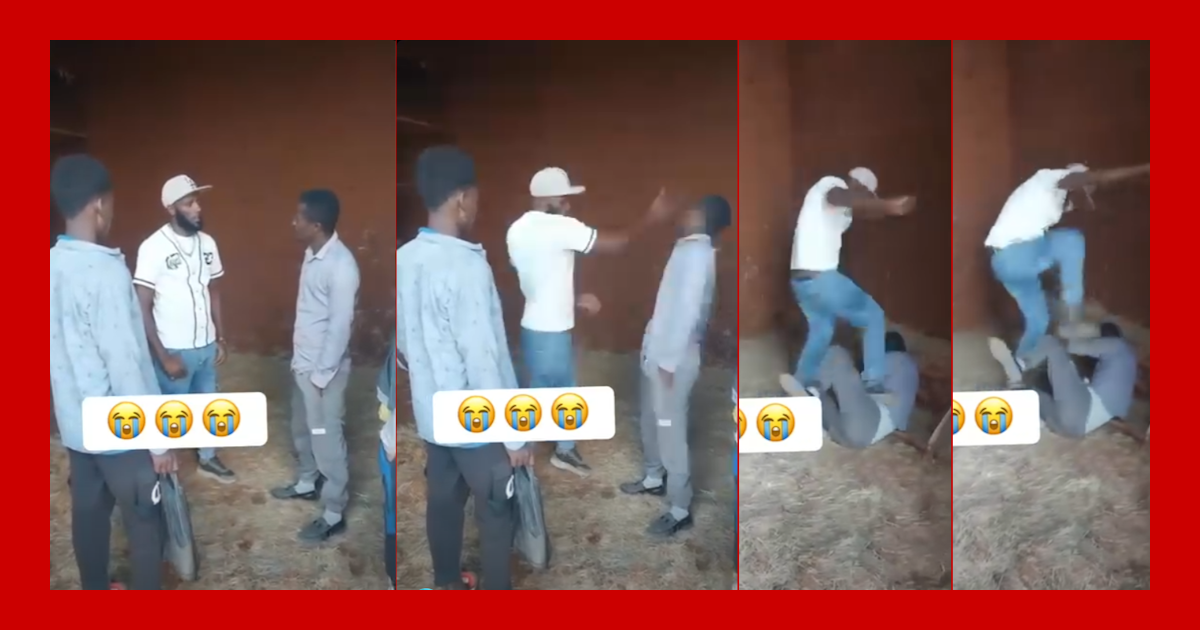
In a disturbing scene that has circulated among residents, a fully grown man is seen torturing young male adults in broad daylight. The victims appear defenceless. The perpetrator shows no hesitation. There is no visible intervention. What the video does not show—but what can be inferred—is the presence of an armed figure behind the camera, explaining the chilling compliance of the victims, who do not attempt to resist.
For many in Oromia, the most unsettling aspect is not the act itself—but how familiar it feels.
This is not an isolated incident. It reflects a widening pattern of cruelty that points to a deeper and more structural political crisis unfolding across Ethiopia’s largest region. What is increasingly evident is that such acts are not random breakdowns of order, but symptoms of a system under strain—one in which violence, visibility, and impunity are becoming intertwined.
From Security Operations to Social Breakdown
For years, the conflict in Oromia has been framed primarily as a security matter—an armed confrontation between the state and the Oromo Liberation Army (OLA). Within this framing, civilian suffering has often been presented as incidental, an unfortunate byproduct of unavoidable operations.
However, mounting evidence challenges this narrative. Civilians are not merely caught in the crossfire; they are increasingly at its center.
Reports from across Oromia describe arbitrary arrests, beatings, enforced disappearances, and extrajudicial killings affecting ordinary people [1,2]. Investigations by Amnesty International and Human Rights Watch document patterns of abuse by state forces, regional police, and allied militias, often carried out with little restraint [1,2].
What is changing now is not only the scale of abuse, but its visibility and normalization. Violence is no longer confined to detention centers or remote rural operations. It is unfolding in towns, in neighborhoods, and increasingly in plain sight—seen, recorded, and shared.
This transition from hidden repression to public cruelty marks a critical shift: it suggests not just loss of control, but a transformation in how power is exercised and perceived.
The Rise of Informal Violence
Alongside formal security structures, a more ambiguous and deeply troubling phenomenon has emerged: the rise of informal enforcers—vigilante groups and loosely organized civilian actors operating in a grey zone of authority.
These actors blur the boundary between state and non-state violence. Their mandates are unclear, their accountability limited, and their actions often shielded by silence or passive tolerance from local authorities [3].
The incident in Ambo reflects this shift with disturbing clarity. Whether acting independently or under informal direction, the perpetrator embodies a broader pattern—violence exercised without accountability, and increasingly without concealment.
This evolution matters. When violence becomes decentralized and informally delegated, it acquires a new character: more unpredictable, more intimate, and more corrosive to the social fabric. Communities are no longer merely governed—they are exposed to diffuse and persistent fear.
What is emerging is not simply disorder, but a form of outsourced coercion, where force is exercised through actors who operate at arm’s length from formal structures, yet within a permissive environment that enables their actions.
Youth Under Suspicion
Young people, particularly teenage boys, are increasingly caught at the center of this evolving landscape of violence.
In a context where suspicion frequently substitutes for evidence, youth are often profiled as alleged supporters or sympathizers of OLA. This exposes them to harassment, detention, and abuse without due process [2,4].
The Ambo case illustrates this dynamic starkly. The victims were not combatants, but vulnerable civilians—targeted not for what they had done, but for what they were presumed to represent.
In such an environment, youth itself becomes a liability. A generation comes of age under scrutiny, where identity invites suspicion and vulnerability invites exploitation.
Impunity as Policy
A defining feature of the crisis in Oromia is not merely the presence of violence, but the persistence of impunity.
Despite years of documented abuses, there is little evidence of consistent or transparent accountability. Investigations are rare. Prosecutions rarer still [1,2].
This absence of consequence does more than allow violence to continue—it enables its transformation. Acts that might once have been concealed are now carried out openly, suggesting a growing confidence among perpetrators that they will face no repercussions.
Over time, impunity ceases to be a failure of the system and begins to resemble a feature of it—a condition under which violence is not only tolerated, but effectively sustained.
It is within this context that incidents like the one in Ambo must be understood: not as anomalies, but as visible expressions of a deeper governing logic that remains insufficiently examined.
The Political Context: Three Possible Futures
The escalation of violence must be situated within Ethiopia’s broader political trajectory. The Oromo question—long centered on self-determination, governance, and equality—remains unresolved. Three possible futures continue to shape the region’s direction:
- Fragmentation and Independence
Sustained repression and widespread abuses risk deepening alienation, strengthening secessionist sentiment, and pushing Oromia toward demands for independence.
- Federal Reform and Genuine Autonomy
A political solution grounded in meaningful federal reform, accountability, and respect for rights could stabilize the region. However, such a path requires confronting abuses by state and non-state actors alike.
- Regime Continuity and Entrenched Repression
If current trends persist, Oromia may face further militarization and the deepening institutionalization of violence. The rise of vigilante brutality and public acts of cruelty—such as the Ambo incident—points toward a trajectory in which violence becomes embedded in everyday governance rather than an exception to it.
A Crisis Beyond Numbers
Quantitative data can illustrate scale, but it cannot capture the full reality of the crisis.
A single act—such as the torture of teenage boys and young adults in Ambo—reveals something more profound: the erosion of social norms, the weakening of communal protection, and the gradual normalization of cruelty.
These are not isolated fractures. They are signals—early, visible, and deeply concerning—of a broader pattern that demands systematic examination.
Understanding this pattern in its entirety will be essential to grasping not only what is happening, but why it is happening, and where it may lead.
Conclusion: What Is at Stake
The crisis in Oromia is no longer confined to armed confrontation. It has evolved into a crisis of governance, accountability, and human dignity.
If acts of violence like those witnessed in Ambo continue without consequence, they risk becoming not exceptions, but expectations—woven into the fabric of everyday life.
And when cruelty becomes ordinary, its consequences extend far beyond individual victims. It reshapes communities, deepens cycles of fear and retaliation, and narrows the already fragile path toward any peaceful political future.
The evidence is no longer in question. What remains uncertain is whether there is the political will to confront not just individual incidents, but the broader patterns that sustain them.
Incidents such as the one in Ambo—and similar reports emerging from towns like Shashamane, as well as across parts of Arsi and Bale—have not occurred in obscurity. A month ago, we reported a similarly disturbing incident in Arsi, accompanied by video footage showing a frail elderly man subjected to abuse by militiamen acting as thugs [6].
These are not isolated accounts but part of a recurring pattern. Such incidents unfold within a political environment where regional and federal authorities cannot plausibly claim unawareness. Whether acknowledged publicly or not, such patterns of violence persist in a context shaped by decisions at the highest levels of the regional and federal regimes, namely by Oromia's regional president Shimelis Abdissa and Ethiopia's prime minister Abiy Ahmed.
As of this writing, it has emerged that residents of Ambo reportedly [7] sought permission to stage a peaceful demonstration against the brutality—carried out by an individual identified as Kasaye Qananisa (pictured in the header image). Their request was denied by the authorities. This response raises a stark and unavoidable question: when citizens are prevented from protesting acts of violence, while those acts themselves go unchallenged, what conclusion is left to draw? The pattern suggests not merely a failure to act, but an environment in which such violence is effectively tolerated, if not sanctioned, at both regional and federal levels.
Side Story: The Blunder That Exposed Kasaye Qananisa’s Terror Network
Used to assaulting almost any passer-by he considered an OLA sympathizer, Kasaye Qananisa appears to have operated for some time with a sense of total impunity. Then, by sheer miscalculation, he attacked the wrong person. In what would become a revealing turning point, he reportedly beat a member of the ruling establishment, a member of ENDF, who was moving in civilian clothes.
The victim soon returned to the scene, this time in uniform, accompanied by several military colleagues in a military vehicle. By then, Kasaye Qananisa had already fled. The group then headed to the mayor’s office, as it had already become widely suspected that Kasaye Qananisa enjoyed close ties with the town authorities.
What followed only deepened those suspicions. Fully aware of Kasaye Qananisa’s standing with higher officials—including, reportedly, connections reaching as far as Shimelis Abdissa—the mayor is said to have offered not justice, but mediation and reconciliation. That attempt reportedly collapsed dramatically when a gun was pointed at the mayor’s head in a demand to hand over Kasaye Qananisa immediately.
At that point, the incident had already begun to attract wider attention, and the mayor’s subsequent phone call reportedly served as yet another warning signal, giving Kasaye Qananisa the chance to flee the town. He was later said to have been arrested in the capital following a manhunt.
The moral of this astonishing story is as chilling as the story itself: the criminality of Kasaye Qananisa and his accomplices—locally referred to as “Code 120 Mafia”—might never have come to light at all had he not mistakenly targeted someone with ties to the very system that had enabled him. That is what makes this case so revealing. It suggests that the violence was not merely the work of rogue thugs acting in isolation, but of a network emboldened by protection, silence, and proximity to power.
The use of informal actors to intimidate and suppress perceived opposition points to a broader strategy in which coercion is diffused, deniable, and sustained. Silence, in this context, is not neutral—it functions as a condition that enables these practices to continue.
A more comprehensive analysis of these emerging patterns—and the structural mechanisms through which power is maintained—will be explored in a forthcoming publication.
References
- Amnesty International. “Beyond Law Enforcement: Human Rights Violations by Ethiopian Security Forces in Oromia.” 2020.
- Human Rights Watch. World Report (Ethiopia sections, various years 2022–2025).
- Norwegian Organization for Asylum Seekers. “The Political and Security Situation in Oromia.” 2025.
- Associated Press. “Civilians Caught in Conflict in Ethiopia’s Oromia Region.” 2024–2025 reporting.
- United Nations Office for the Coordination of Humanitarian Affairs. Ethiopia Situation Reports (2024–2025).
- OT Editorial, To Shimelis Abdissa and Caffee Oromia: History Will Judge You for a Shameful Failure of Duty, 17 March, OROMIA TODAY.
- "የፓርላማ አባሉና የአምቦው ማፍያ 120", 17 Apr 2026, Ethio Forum YouTube Channel, YouTube.