When Diplomatic Language Meets Contested Histories: A Gentle Note to the UN Secretary-General
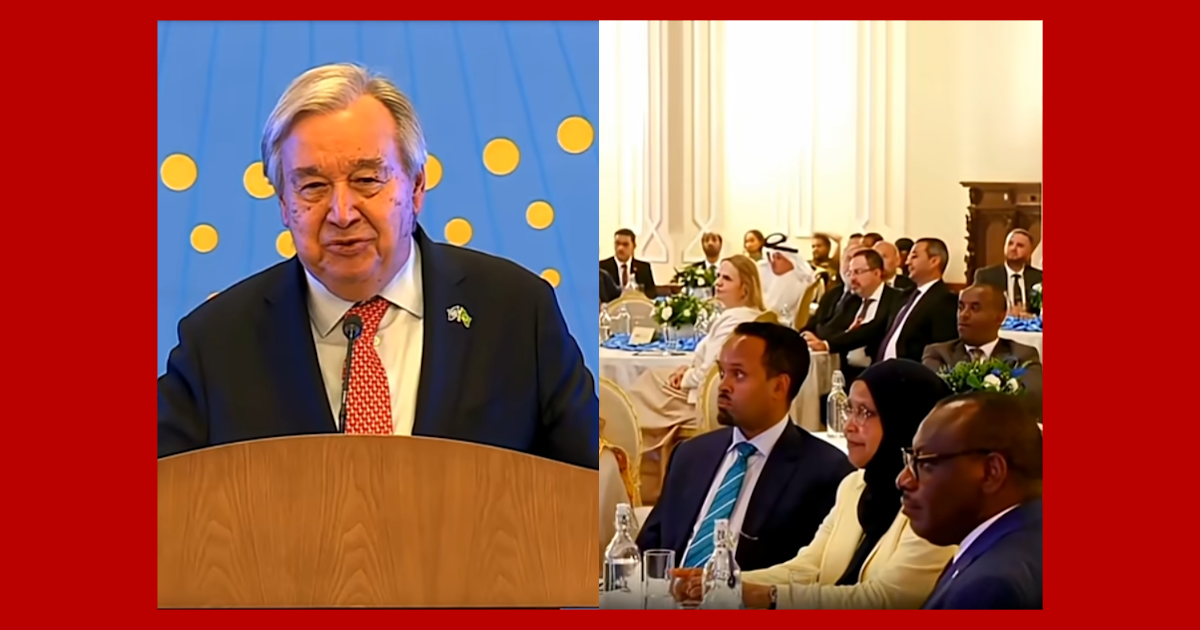
Excerpt
UN Secretary-General António Guterres’ recent remarks in Finfinnee (Addis Ababa) praising Ethiopia as an “old civilization” and celebrating its preserved independence were welcomed by many. Yet for historically marginalized nations and nationalities within Ethiopia, such diplomatic language may unintentionally reinforce contested state narratives. This article offers a respectful reflection on historical plurality, collective memory, and the responsibility of international institutions when speaking about complex multinational states.
One Speech, Many Histories
On 13 May 2026, during remarks delivered in Finfinnee (Addis Ababa), United Nations Secretary-General António Guterres praised Ethiopia’s history, role in African diplomacy, and partnership with the United Nations [1,2]. The speech was clearly well-intentioned and delivered in the spirit of friendship and cooperation.
For many listeners, the words were inspiring.
Yet for many others — particularly among historically marginalized nations and nationalities such as the Oromo and other peoples whose incorporation into the modern Ethiopian state remains part of contested historical memory [3,4]— some of the historical characterizations may have sounded less celebratory and more painfully familiar.
This article is therefore not a criticism of the Secretary-General himself. Rather, it is a gentle reflection on the responsibility that accompanies global platforms and diplomatic language when addressing societies with deeply contested histories.
Words matter.
Particularly when spoken from the podium of the United Nations.
The Weight of Diplomatic Language
The Secretary-General stated:
“Ethiopia represents an old civilization.”
This sentence may appear harmless, even obvious, at first glance.
Indeed, few would dispute that the Horn of Africa contains some of humanity’s oldest civilizations, institutions, and historical traditions.
The civilizations associated with ancient Abyssinia, the Aksumite legacy, and the remarkable historical achievements that emerged from them occupy an important place in African history.
Equally, however, the region is home to other deep civilizational traditions and indigenous systems of governance and social organization. Among them is the Oromo Gadaa system — internationally recognized and inscribed on UNESCO's Representative List of the Intangible Cultural Heritage of Humanity in 2016 [5]—a sophisticated democratic socio-political institution for its indigenous governance philosophy and age-grade system — alongside the rich histories and institutions of many other peoples of the region.
The difficulty therefore is not whether ancient civilizations existed. They undoubtedly did.
The difficulty arises when the diverse civilizational inheritance of multiple peoples becomes retrospectively merged into a single uninterrupted state narrative projected over the entirety of the modern Ethiopian state.
Unfortunately, over successive regimes, a dominant state narrative gradually emerged in which “Ethiopia” came to be presented not merely as the successor state to Abyssinia, but increasingly as its historical continuation and civilizational equivalent.
For many historically marginalized communities, this has created the perception that the histories and civilizations associated with the predecessor polity became generalized across the entirety of the modern state, while other historical experiences received comparatively limited or no recognition.
Modern Ethiopia, as it exists today, largely emerged through late nineteenth-century imperial expansion and incorporation. Vast territories inhabited by Oromo, Somali, Sidama, Wolayta, Afar, and many other peoples became part of the expanding Abyssinian state during this period.
From this perspective, the statement “Ethiopia represents an old civilization” may be interpreted not as a neutral historical observation but as a continuation of a state narrative that retrospectively projects a singular ancient identity over territories and peoples with distinct histories and civilizations of their own.
A more historically inclusive formulation might have been:
Modern Ethiopia is home to multiple regionally rooted civilizations, indigenous institutions, and historical traditions, many of which developed independently over long historical periods.
The difference may appear subtle. For many communities, however, it is enormous.
“Preserved Independence” — Whose Historical Memory?
The Secretary-General further stated:
“Ethiopia was able to preserve its independence when most of the continent was divided by colonial powers.”
This is perhaps one of the most widely repeated diplomatic narratives associated with Ethiopia.
And it carries some truth.
The resistance of Ethiopia—then known as Abyssinia—together with the heroic contributions of fighters from annexed territories, including Oromia, against European colonial occupation remains a powerful symbol of African anti-colonial resistance. Yet here too historical memory becomes layered.
For many peoples incorporated into the Ethiopian empire during imperial expansion, the experience remembered in collective memory is not always one of preserved independence but of lost autonomy, conquest, incorporation, and state centralization.
This does not invalidate Ethiopia’s anti-colonial significance in the period of transition from Abyssinia to modern Ethiopia. Nevertheless, historical framing matters, particularly where complex histories and multiple collective memories coexist. Rather, it invites a broader historical lens in which resistance to external domination and the memories of internally colonized and marginalized peoples can both be acknowledged without one eclipsing the other.
Both perspectives may simultaneously be true:
- Ethiopia, then known as Abyssinia and with fighters from annexed territories, resisted European colonial domination.
- Some peoples within modern Ethiopia experienced annexation into the expanding Abyssinian imperial state as a loss of self-rule.
These histories coexist. Ignoring one in favor of the other risks transforming history into selective memory.
Abyssinia, Ethiopia, and Historical Continuity
Another point requiring nuance concerns historical continuity itself. International diplomatic narratives often speak as though present-day Ethiopia existed unchanged across millennia. For many scholars and historically conscious communities, however, the transition from Abyssinia to modern Ethiopia is neither simple nor uncontested.
The polity internationally known as Abyssinia joined the League of Nations in 1923. The modern Ethiopian state later inherited and expanded that political legacy while incorporating multiple nations and territories, including the Oromo nation of Oromia. Although the term "Ethiopia" has ancient Greek origins and appeared in various historical and religious texts [4], it was formally adopted as the official name of the state under Emperor Haile Selassie's 1931 constitution. The country's admission to the United Nations as a founding member in 1945 subsequently consolidated that designation internationally. Whether the name "Ethiopia" should be retrospectively applied to all preceding Abyssinian history, however, remains a matter of historical and political contention. Critics argue that such retrospective usage risks creating a misleading impression of uninterrupted historical continuity stretching back millennia, thereby obscuring the distinct histories and identities of the various peoples and territories incorporated into the empire at different times.
For historically marginalized peoples, therefore, the question is not whether Abyssinia possessed ancient civilization. The question is whether the historical experience of all peoples incorporated into modern Ethiopia receives equal recognition.
Many feel it does not.
The Unintended Consequence of Diplomatic Narratives
The Secretary-General certainly did not intend historical exclusion. Diplomatic speeches often rely on established state narratives and ceremonial formulations. The difficulty is that repetition itself confers legitimacy.
When global institutions repeatedly describe Ethiopia as a singular uninterrupted civilization without acknowledging historical plurality, many marginalized communities perceive this as validating old state narratives that have historically minimized their own experiences.
This is particularly sensitive in Ethiopia where history itself remains one of the central political battlegrounds. History here is not merely about the past. It shapes identity, legitimacy, belonging, constitutional debates, and visions of the future.
The United Nations and the Responsibility of Historical Sensitivity
The United Nations was built upon principles of equality, dignity, and recognition.
Not only recognition of states. Recognition of peoples.
In complex multinational societies, historical sensitivity matters. Language that appears neutral to one community may reopen historical wounds for another.
This is especially true in Ethiopia where the memories of conquest, incorporation, marginalization, assimilation, and struggles for recognition remain very much alive.
The UN need not adopt one historical interpretation over another. Nor should it.
But perhaps international diplomacy can evolve toward language that recognizes plurality.
Not one history. Many histories.
Not one civilization. Many civilizations.
Not one memory. Many memories.
A Gentle Note to the Secretary-General
Mr. Secretary-General,
Your speech celebrated Ethiopia. It resonated with some listeners, while others listened with discomfort. Not because they reject history but because they remember a different history.
A history less visible in state narratives. A history often absent from international speeches.
The United Nations carries immense moral authority. With that authority comes the opportunity to speak in ways that honor not only states, but also the many peoples whose memories live within them.
Historical sensitivity is not revisionism. It is recognition.
And recognition is often where peace begins.
Appendix: Transcript of UN Secretary-General’s Recent Speech in Finfinnee (Addis Ababa)
Ethiopia represents an old civilization.
When [sees?] the success, the government in Ethiopia, the fastest growing economy in the world, I have to say that, those that have a solid past will have a solid future.
[Applause]
Ethiopia was able to preserve its independence when most of the continent was divided by colonial powers. And the gain that was possible thanks to the strength of civilization that Ethiopia represented. And Ethiopia has been in the United Nations, a champion for all other African countries to become independent. Not only you were able to represent Africa in the signing of the charter, but you have been working hard to make sure that all African states could become members of the United Nations after gaining their independence with your support.
[Applause]
Now, this very city of Addis Ababa that I visit at least once a year, and I never recognize it; It is changing with the speed of light. But this city has become one of the most significant global diplomatic centers in Africa as home to the headquarters of the African Union and as the continent's third largest United Nations station hosting one of our largest country teams in the world.
For decades, Ethiopian women and men have served with distinction as uniformed and civilian personnel in United Nations peace operations agencies, funds, and programs around the globe. Collectively, they have helped protect civilians, build stability, and strengthen peace in some of the most difficult and dangerous places in the world. And our partnership goes both ways.
The United Nations has been and we want to be a committed partner to Ethiopia and the partner whose team here has as only objective to serve Ethiopian people and to make sure that we support the strategy of the Ethiopian government.
[Applause]
References
- Haasawa ajaa'ibaa Antooniyoo Guutaareez waa'ee Itiyoophiyaa fi Magaalaa Finfinnee irratti dubbatan., 13 May 2026, OBN Afaan Oromoo Plus, Facebook.
- Antonio Gutters Speaks on Addis Ababa’s Transformation & Ethiopia’s UN Commitment..., 13 May 2026, YouTube.
- Oli Boran, The Myth of Ethiopia’s Historical Continuity, 17 March 2025, OROMIA TODAY.
- Oli Boran, How a False Unity of Mythical Ethiopia Was Manufactured Through Annexation and Assimilation, 9 April 2025, OROMIA TODAY.
- Gada system, an indigenous democratic socio-political system of the Oromo, Inscribed in 2016 (11.COM) on the Representative List of the Intangible Cultural Heritage of Humanity, 2016, UNESCO.