Spare Us the False Choice, Please: For the Oromo, PP and Fano Are One and the Same!
Excerpt
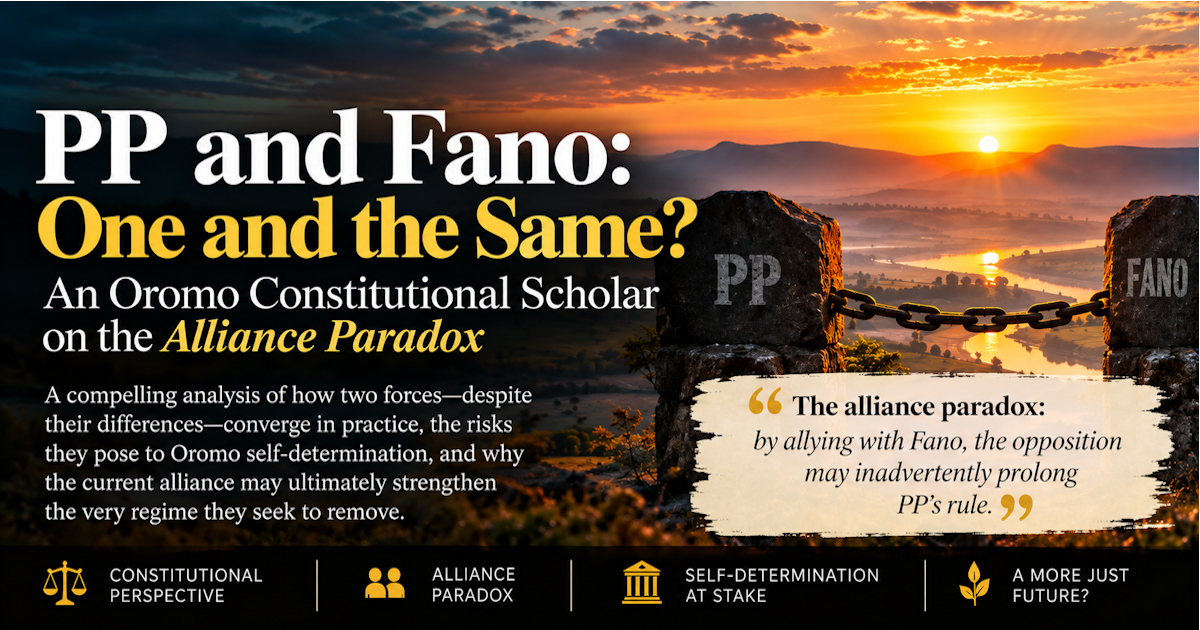
In this opinion essay, constitutional scholar Dr Tsegaye R. Ararssa examines the emerging Alliance for Survival from an Oromo perspective, arguing that despite their political and organizational differences, PP and Fano have produced similarly damaging consequences for Oromo self-determination. He questions whether an alliance built around opposition to Abiy Ahmed can offer a credible path beyond the political and constitutional conflicts that preceded it.
As far as the Oromo are concerned, there is no difference between the Prosperity Party (PP) and Fano. They both target Oromos for attack and Oromia for dismantling. They have both been doing this for the last eight years. During the first four of these eight years, they did it in collaboration and coordination. They have both waged and executed a genocidal war on Oromia and Tigray, and they are both executing it to perfection until this very moment.
For readers less familiar with Ethiopian politics since 2018, a few words may help set the context for the more direct argument that follows. This is not to suggest that PP and Fano are organizationally or politically identical; clearly, they are not. Rather, from the standpoint of their effect on the Oromo people and their opposition to Oromo self-determination, the distinction between them has increasingly become one without a meaningful difference.
Their partnership in all the genocidal wars they waged and prosecuted together (between 2020 and 2022) was not an accident, nor was it merely tactical. That they have the same modus operandi—using war as politics, terror as a method, and genocide of their perceived ethno-national “enemy” as a strategy—is not an accident, either. Together, they perpetrated state terror (2020–2022).
Having gone apart, they are still applying the same terrorist/genocidal tactics in their own realms. They both consider the Oromo and the other nations of Ethiopia as their nemeses. They define the Oromo and other nations, especially the Oromo, as their unrelenting “historical enemies.”
PP and Fano are not essentially different from one another. They are just extensions of one another. No, they were one and the same. They were using, reading, and acting from the same script: that of the restorationists of the old Abyssinian empire (à la Kibre Negest). And they desire the return of Ethiopian politics to medieval times.
They have the same political DNA. They operate from, and towards, the same road map. In undoing the constitutional promise of self-determination and multinational democracy, they are one and the same. For example, they both used the so-called National Dialogue Forum as a platform for their shared goal of “restoration” of their fantasy of imperial glory.
The fact that PP tabled the anti-Oromo agenda in the Dialogue Commission and with Fano sympathizers at the top and all dancing to its soundbite is a testament to this fact. In fact, we all know—and have known for eight years now—that the agenda of revising the constitution in the name of conducting a “National Dialogue" that will lead to something that resembles a "national consensus” was set, framed, and given to Abiy in 2018 by none other than the “midwives” of Fano including, namely Andargachew Tsige and Berhanu Nega, and its many organizational tentacles like NAMA, ECSJ, etc., who are now happily cohabiting with Abiy Ahmed.
Just remember the series of anti-Oromo public statements issued regarding the discussions on Finfinnee, Dirre Dhawaa, and other Oromo cities and territories; or their positions about what should be a single “national” language; about the structure of regional administration; etc., etc. You will note who had a self-proclaimed “stake” in it just as much as the PP regime.
The fact that some of their daft imperial overtures were rebuffed in the Dialogue Commission Conference by the Oromo and “others” of the state caused a shared, albeit variant bitterness, disappointment and frustration among members of both PP and Fano, which is another testament to their fundamental shared objectives.
They have the same end goal: the rehabilitation and resuscitation of the old Abyssinian empire. To achieve this, they both want to erase the Constitution, undo the multinational federal setup, and de-recognize equality among nations and faiths. Initially, they sought to use Abiy Ahmed for the task—until they fell out with each other over Tigray, with their territorial claim therein, and the Pretoria Ceasefire Agreement (PCA) that interrupted the genocidal agenda.
True to character, as partners in a seemingly continuous war pact, their relationship could not survive the “peace” promised by the PCA. After the PCA, they found Abiy Ahmed untenable as a partner. And they stuck to their guns—literally.
And they started their campaign against Abiy Ahmed as a thinly veiled genocidal and terrorist campaign against anything and everything Oromo. Hence, the unfiltered anti-Oromo propaganda was set in motion in the form of hate speech, ethnic slurs, vilification, and demonization of Oromos, Oromia, and Oromummaa.
Beyond the discursive violence, which in itself constitutes stochastic terrorism, they continue to foment a similarly genocidal war campaign against the Oromo people. In this regard, it would suffice to mention the mayhem and chaos they have been causing lately among civilians in east Wallagga, southwest Shawa, west Shawa, and the Gurage Zone of Ethiopia.
The Oromo public have no problem with alliances per se. I, for one, have been one of the lone voices calling for an “alliance for peace,” an alliance against the regime that trades in war and does not seem to survive or thrive without war.
I have long been part of the movement for Solidarity of Nations. I have worked closely with this group towards forming the United Front -- a coalition of national liberation fronts fighting for self-determination against the PP regime from 2019–2022.
That was not just a tactical alliance. It was an alliance of national forces that had clearly stated shared strategic interests towards self-determination through a peaceful, just, democratic, and inclusive transitional arrangement and beyond just deposing the regime. That was an alliance towards forming a clearly mapped-out political dispensation that is pegged on the principles of substantive peace, transitional justice, collective self-determination, and individual human rights, democracy, equality, and solidarity.
That was a principled alliance. It was definitely more than a war pact.
The problem we have with the so-called “Alliance for Survival” is the unconditional and unqualified admission of Fano into what would otherwise be a genuine alliance for peace and national survival.
Like PP, Fano is an equally war-mongering and genocidal formation with overtly terrorist tactics. After all, Fano is a collective name for a group of disparate armed/terrorist formations with no political vision and no political manifesto to date except for a draft posted by a faction led by Eskinder Nega that has styled itself as the Amhara Fano People’s Organization.
It is, therefore, no accident that they cannot articulate an end game beyond Abiy Ahmed. They cannot say exactly what they are fighting for. To put it generously, it is no exaggeration to describe them as “rebels without a cause.” Yet, in the Amhara-inhabited areas of the region, they have emerged as the principal force resisting the regime’s indiscriminate violence against the people. This has made them a rallying point for the disaffected, giving them a cloak of legitimacy and the appearance of a coherent political formation.
Fano’s public statements, media reports, and sustained social media campaigns across numerous platforms suggest that it is not a force with which the Oromo and the “other” peoples of Ethiopia can readily form an alliance. Terrorist acts attributed to Fano—including the beheading of a young civilian, the massacre of women and children in thousands, large scale looting of properties and livestock, the burning of farms, harvests, mills, and private property, and the displacement of tens of thousands of Oromos as part of what we regard as ethnic cleansing—will continue to stand between Fano and the Oromo public.
At the very least, before admitting Fano into the Alliance, its members should have demanded explanations for these acts and for Fano’s alleged complicity in, and active prosecution of, genocidal projects. They should also have sought clarity on its expansionist rhetoric and its positions on multinationalism and federalism. These are fundamental political questions that cannot simply be set aside for the sake of an alliance against a common enemy.
The Oromo public understands that the PP regime is prosecuting a brutal and unnecessary—and possibly genocidal—war in the Amhara region. We denounce the PP regime’s war against the peoples of the region and stand in solidarity with them. However, we cannot stand with an armed formation styled as Fano while it continues—even after the establishment of the Alliance—to wage what we regard as a genocidal war against Oromos.
We have questions that need answers, explanations that must be given, and, where warranted, apologies that must be made.
In the interest of peace, we also need to see a change of heart, expressed not merely in words but in deeds. That must include credible commitments to abandon terrorist tactics, expansionist ambitions, and the rhetoric and conduct that have fueled what we regard as genocidal campaigns against the Oromo.
Likewise, we understand the importance of an alliance for the Tigray people and the TPLF. We understand that Tigray should have bilateral agreements with the powers that be in order to guard against the possibility of being besieged once again. We stand in solidarity with them in their fight against the regime that committed genocide against them before and is committing it now. But we also want them to understand why we won’t unconditionally stand with Fano.
They need to understand that standing with Fano is like formally inviting and supporting them in their continuing genocidal war in Oromia. It is like supporting the PP regime in its war against our people and the peoples beyond Oromia.
For us, there is no difference between the two, as both are engaged in active genocidal wars against the Oromo. Ours has been the unfortunate task of fighting the same war from two sides that fell out with each other over ways of “disciplining” and subjugating Oromos and the other “others” of Ethiopia.
Finally, about the individuals who have entered into this Alliance in the name of the Oromo Liberation Army, OLA: Let it be known to all that these individuals, such as Marroo Dirribaa and Jireenyaa Guddataa, are trying to gain the legitimacy they have long lost in the army by seeking recognition from outside.
For over a year, this group has severed its relationship with the commanders and the Executive Team (aka Gumii Shanee) and has been hiding from members who ask questions. Operating mostly from outside Oromia, they have been dividing and destabilizing the army, assassinating and marginalizing commanders who raise questions and seek clarification, conspiring with enemies (twice with the PP regime and for over a year with Fano), and are now joining Fano to enable this new chapter of genocidal war against our peoples. The request by the leadership to hold a Congress, assess the situation, and correct their mistakes fell on deaf ears.
The result is what we see now: the treasonous individuals forming an unprincipled alliance with Fano in the name of the OLA, which the vast majority of the OLA—I can say almost all, except the stooges and assassins serving Marroo—stand against.
The OLA considers this alliance with Fano a betrayal of the fundamental causes of the Oromo National Liberation Struggle.
In fact, the OLA views it as capitulation on the part of the so-called leadership. Having seen that the idea of collaborating with Fano was roundly rejected within the army and among our people, they tried to keep the unholy alliance hidden from the public—including by denying its very existence just days before it became public through Zemene Kasse’s televised reading of their statement.
«The Alliance that was supposed to shorten the days of the PP regime may, unwittingly, be helping to prolong its life in power.»
This is because people, dismayed at seeing individuals claiming to represent their own front and army enter into an alliance with Fano, appear increasingly inclined to tolerate—or even support—Abiy Ahmed’s regime rather than accept Fano as an ally.
This is happening despite our best efforts to urge the Oromo public to reject the false choice being placed before them: siding with either Fano or the PP regime.
For the Oromo and the peoples of the wider south, the two may occupy opposing positions today, but the consequences they represent are fundamentally the same. The choice between them is therefore a false one. Our task is to resist both wherever and whenever necessary until our peoples achieve the freedom they deserve.
An alliance formed for survival should not become an alliance for the survival of the very regime it was formed to remove.
#The_Beautiful_ones_are_not_yet_born!
#Keenya_karaan_dheeraa_dha!