Caffee Oromiyaa Opens—and Oromia Suddenly Shrinks
This is Spectacularly Bizarre!
Caffee Oromiyaa, the Oromia Assembly, opened today its new session on Monday, 28 September, following the June election.
New lawmakers walked in.
And Oromia walked out shrunk with a new map.
No publicly tabled proposal. No visible debate. No amendments. No drawn-out argument over boundaries. Just a unanimous vote—and, in the blink of an eye, Oromia was redrawn.
What Just Happened?
Some of these "newly elected" lawmakers may barely have found their seats in the chamber. Yet they have already put their hands up for something rather more consequential: rearranging Oromia itself by shrinking.
And remarkably, not a single dissenting voice. No votes against. No abstentions. Just a unanimous show of hands for something as consequential as redrawing the map of Oromia in an instant.
A map shrinks, every hand goes up, and it is done. It is difficult to believe this is for real.
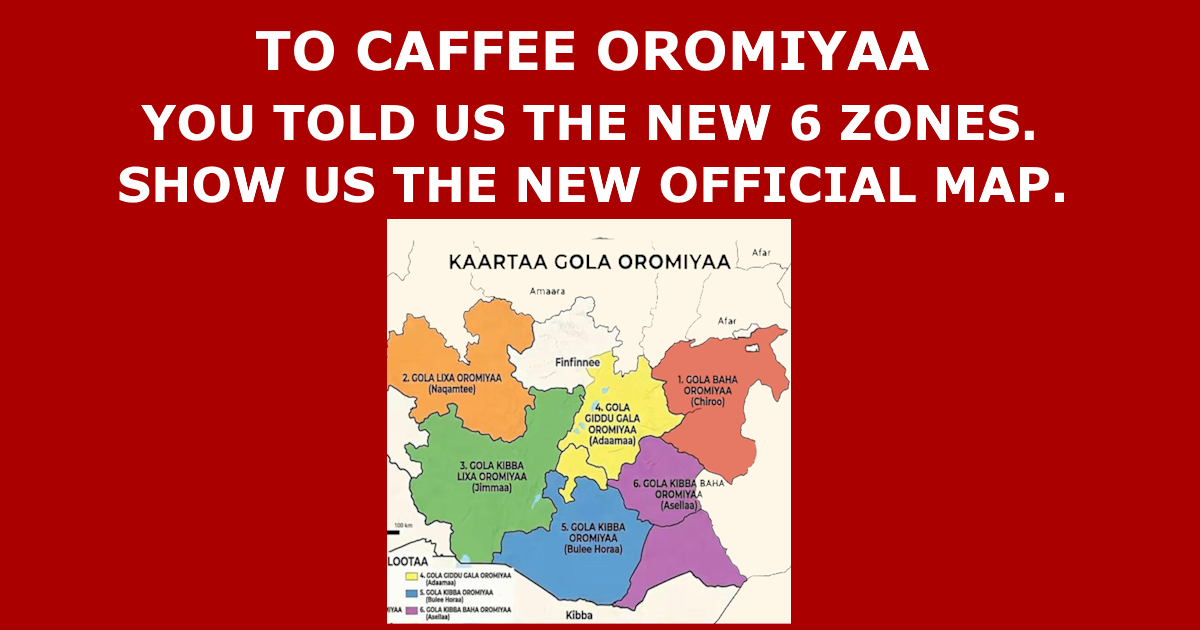
The 21 existing zones are now shown restructured into just six zones, each headed by an administrator reportedly carrying the rank of vice president.
Twenty-one to six.
New administrative structure. New map. New vice-presidential-level administrators.
All in a blink.
But even that is not the elephant in the room.
Look at the map in the header of this article.
It is not simply the familiar questions of Finfinnee and Dirre Dawaa. A vast expanse around Finfinnee—territory comparable in scale to what has been described as Central Oromia—appears to have been excised from Oromia on the new map.
That raises questions far bigger than administrative tidying.
What Exactly Did Caffee Oromiyaa Approve?
- What is the legal status of this map?
- Where did the missing territory go?
- Who designed this restructuring?
- When was it designed?
- Why was something of this magnitude apparently presented and approved with such extraordinary speed?
And above all: is this merely administrative “clusterization”—or is clusterization the vehicle for something much bigger to dismantle Oromia?
For years, Oromos have argued over plans, boundaries, Finfinnee's expansion, and what became infamous as the Master Plan. Now an "elected Oromia Assembly" convenes and, almost instantaneously, a radically restructured Oromia appears on a map.
This story is only beginning and there is clearly much more to establish: what exactly was approved, what legal or administrative meaning the map carries, who prepared it, and why it was adopted with such extraordinary speed.
But for now, the question practically asks itself:
Is this the “clusterization” the regime has been preparing—and, if so, is its ultimate purpose the administrative dismantling of Oromia?
Or have we just witnessed MASTER PLAN 2.0—the so called Clusterization—in an instant?
Did these elected lawmakers—or are they?—just walk into Caffee Oromiyaa to rubber-stamp the PP regime’s plan to dismantle Oromia?
Surely, an instant and unanimous vote on something this consequential—with no visible discussion, debate, dissent, or even an abstention—has all the hallmarks of a decision handed down by the PP regime rather than one deliberated by a legislature. If that is what happened, this was not parliamentary scrutiny; it was political choreography.
Such a charade belongs to the theater of autocracy, not the workings of a democracy.
A Note of Caution
The restructuring of Oromia’s 21 zones into six has been announced before Caffee Oromiyaa [1], and the video presentation of that announcement is our reference for the restructuring itself. However, we are still awaiting an official map reflecting the newly announced structure, and none has been forthcoming.
The map reproduced above is not such an official post-announcement map. It was circulated months earlier and appeared, at the time, to be testing public reaction to a proposed restructuring.
That distinction matters. Announcing a territorial and administrative reorganization of this magnitude without simultaneously publishing the corresponding official map inevitably raises more questions than it answers. Transparency has hardly been a defining feature of this administration, but telling the public that Oromia has been fundamentally restructured while withholding the map that shows precisely what that means takes opacity to another level.
For now, those unanswered questions belong squarely at the door of Caffee Oromiyaa and the Oromia Regional State Administration.
This article will develop as more information, documents, and explanations emerge.
References
- Godinaaleen kanaan dura 21 turan gara Godinaalee 6 caaseffamuu himame, 28 September 2026, Oromia Communication Bureau YouTube Channel, YouTube
- Elemoo Qilxuu and Olii Boran, Erasing Oromia: How a Fringe Party Exposed the Complacency and Paralysis of Oppressed Nations and Nationalities of the Ethiopian Empire, 7 December 2025, OROMIA TODAY.