The Mirage of Maritime Destiny: Ethiopia's Neo-Imperial Misadventure Over Assab and the Red Sea
Excerpt
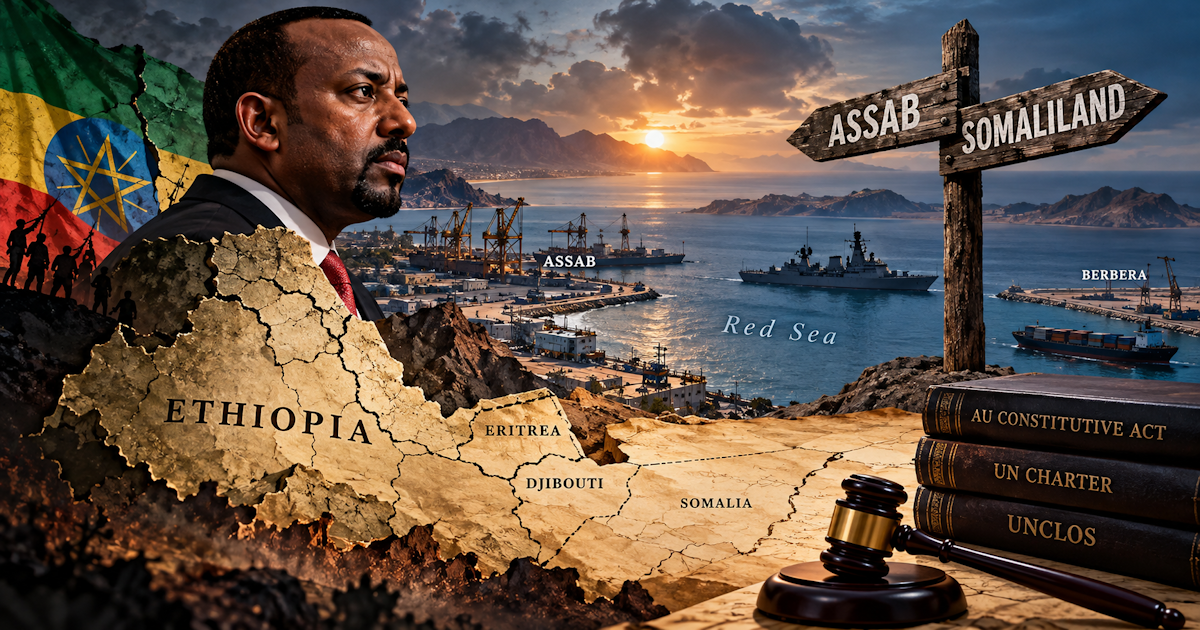
The Mirage of Maritime Destiny examines Ethiopia’s renewed pursuit of Red Sea access through the lens of its imperial past, challenging the Abiy Ahmed regime’s claims over Assab and its controversial Somaliland deal. Tsegaye R. Ararssa argues that legitimate maritime access cannot come at the expense of neighboring states' sovereignty, warning that external geopolitical ambitions risk becoming a distraction from Ethiopia’s unresolved internal conflicts and democratic failures.
Introduction
The contemporary geopolitical theater of the Horn of Africa is being reshaped by a highly volatile neo-imperial distraction.
In October 2026, fresh from being sworn in for another five-year term amid a renewed and increasingly fractured civil war in the country’s north, Prime Minister Abiy Ahmed once again used the floor of the federal parliament to beat the drums of maritime destiny, declaring that access to the Red Sea is an indispensable requirement for Ethiopia’s “civilization.” Yet, when viewed through an uncompromising anti-colonial lens, the regime’s erratic maneuvers—alternating between belligerent threats to forcibly retake the Eritrean port of Assab and the transactional, legally contentious 2024 Memorandum of Understanding (MoU) with Somaliland—reveal themselves not as a coherent grand strategy but as a dangerous misadventure.
This frantic pursuit of a sovereign maritime foothold reflects a classic authoritarian mechanism: a desperate attempt to manufacture external prestige while diverting domestic and international attention from the severe, systemic fractures tearing the internal empire apart.
The Imperial Past Behind Ethiopia’s Landlocked Present
The historical reality of Ethiopia’s landlocked status is a direct structural consequence of its own imperial-colonial past. When Eritrea successfully concluded its war of independence and formally achieved independence in 1993, it did not “steal” Ethiopia’s coast; rather, it dismantled a brutal, decades-long Abyssinian military occupation that followed the illegal annexation of 1962. With Eritrea’s independence confirmed through a UN-observed referendum, monitored by the United Nations Observer Mission to Verify the Referendum in Eritrea (UNOVER)—established pursuant to General Assembly Resolution 47/114—the ports of Assab and Massawa came under the sovereignty of the independent Eritrean state, leaving Ethiopia to confront its new geographic reality.
For more than three decades, the Ethiopian state has adapted to its landlocked status, relying primarily on commercial transit through Djibouti. However, the current administration’s sudden portrayal of that status as an “existential obstacle” represents a radical and retrogressive shift. By asserting a “historical and geographic right” to ports situated within the sovereign borders of neighboring countries, Addis Ababa is actively resurrecting the expansionist and chauvinistic rhetoric of the late nineteenth-century Abyssinian empire. In effect, it is declaring that the sovereignty of neighboring African nations is subordinate to Ethiopia’s extractive economic needs.
From Assab to Somaliland: A Maritime Strategy Adrift
Nowhere is the structural incompetence of this maritime campaign more apparent than in the regime’s shifting and opportunistic tactics. When its veiled military threats to march on Assab in late 2023 encountered formidable regional resistance and an immediate military buildup along the Eritrean border, the regime pivoted toward the highly controversial Somaliland deal.
By offering the prospect of unilateral recognition of Somaliland’s statehood in exchange for a 20-kilometer stretch of coastline intended for naval and maritime facilities, Addis Ababa did not secure a reliable gateway to the sea. Instead, it triggered a major multinational diplomatic backlash. This transactional overreach contributed to a growing convergence of strategic interests among Somalia, Egypt, and Eritrea, creating an increasingly hostile regional environment for Ethiopia and complicating its position within the evolving Red Sea security architecture, including initiatives associated with Saudi Arabia.
The Right to the Sea Is Not the Right to Seize It
Granted, Ethiopia deserves access to the sea. Such access is a recognized legal right of landlocked countries, entirely separate from the regime’s irrelevant, demographically driven argument that Ethiopia is home to a population of approximately 120 million people. Under modern international law, a country’s population size confers no entitlement to override the territorial integrity or political independence of sovereign states.
The question of how to secure genuine and sustainable maritime connectivity cannot be answered through the barrel of a gun or through predatory, nonbinding agreements that disregard international law and the sovereignty of neighboring states. In particular, the 2024 MoU with Somaliland raises serious questions under the Constitutive Act of the African Union, especially Article 4(b), which establishes respect for borders existing at the time of independence, and Article 4(g), which enshrines the principle of noninterference by member states in the internal affairs of one another. By negotiating directly with Somaliland over matters affecting Somalia’s internationally recognized territorial integrity, Addis Ababa has invited allegations that it is circumventing the sovereign authority of the Federal Government of Somalia. The broader resort to threats of military force must also be assessed against Article 2(4) of the United Nations Charter, which requires member states to refrain from the threat or use of force against the territorial integrity or political independence of any state.
Genuine access to international waters for a landlocked nation requires negotiated interdependence, regional institutional frameworks, and strict adherence to international maritime law, particularly the United Nations Convention on the Law of the Sea (UNCLOS). Under Article 125(1) of UNCLOS, landlocked states are explicitly granted the right of access to and from the sea for the purpose of exercising the rights provided for under the Convention, including those relating to the freedom of the high seas and the common heritage of humankind. However, Article 125(2) establishes a crucial legal qualification: the terms and modalities for exercising freedom of transit must be agreed upon between the landlocked states and the transit states concerned through bilateral, subregional, or regional agreements. Article 125(3) further recognizes the legitimate interests of transit states in exercising their full sovereignty over their territories.
UNCLOS establishes a right of access and freedom of transit; it does not confer a right to annex sovereign territory or unilaterally establish naval bases through arrangements that disregard the internationally recognized sovereignty of coastal states. Neighboring countries, including Somalia, have maintained that Ethiopian commercial access to the sea can be accommodated through lawful negotiations, provided such arrangements are transparent, mutually agreed upon, and fully respectful of the territorial integrity and sovereign equality of the coastal states concerned.
An Empire at War With Itself Cannot Command Its Neighbors
However, a centralized, autocratic political machine cannot tolerate the patient, rules-based diplomacy that a genuinely consensual federation would require. The Prosperity Party regime, accused of waging genocidal wars to “punish and discipline” the diverse nations within its borders, governs through the coercive apparatus of militarized “Command Posts” and applies the same coercive, extractive mindset to its foreign policy. The tragedy of the contemporary Ethiopian state lies in its persistent inability to move beyond its imperial blueprint. Just as it seeks to domesticate, discipline, and balkanize the ethno-national groups within its frontiers, it seeks to discipline its neighbors through geopolitical bullying.
Ultimately, Ethiopia’s misadventure over the Red Sea illustrates a fundamental decolonial truth: a state structurally incapable of delivering internal justice, peace, democracy, and self-determination to its own peoples risks remaining a volatile and untrustworthy actor on the international stage. True stability in the Horn of Africa will never be built upon the grand delusions of an empire that has yet to undergo genuine decolonization.
References and Authorities
International Treaties and Founding Charters
- African Union. (2000). Constitutive Act of the African Union. Adopted on 11 July 2000 in Lomé, Togo; entered into force on 26 May 2001. Article 4(b): Respect for borders existing at the time of independence; Article 4(g): Noninterference by member states in the internal affairs of one another.
- United Nations. (1945). Charter of the United Nations and Statute of the International Court of Justice. Signed on 26 June 1945 in San Francisco; entered into force on 24 October 1945. Article 2(4): Prohibition of the threat or use of force against the territorial integrity or political independence of any state.
- United Nations. (1982). United Nations Convention on the Law of the Sea (UNCLOS). Concluded on 10 December 1982 in Montego Bay, Jamaica; entered into force on 16 November 1994. 1833 U.N.T.S. 397. Article 125(1): Right of access to and from the sea and freedom of transit; Article 125(2): Agreement on the terms and modalities of transit; Article 125(3): Sovereignty and legitimate interests of transit states.
United Nations Resolutions and Institutional Reports
- United Nations General Assembly. (1992). Resolution 47/114: United Nations Observer Mission to Verify the Referendum in Eritrea (UNOVER). Adopted at the 92nd plenary meeting on 16 December 1992. UN Document A/RES/47/114.
About the Author:
Tsegaye R. Ararssa is a Melbourne-based independent legal scholar, public intellectual, and regular commentator on legal and political issues in Ethiopia and the Horn of Africa. He specializes in constitutional legal theory, international human rights, and minority rights in the Horn of Africa. He can be reached at tsegayenz@gmail.com.