
Ethiopian Restorationist Ideologues (ERI)
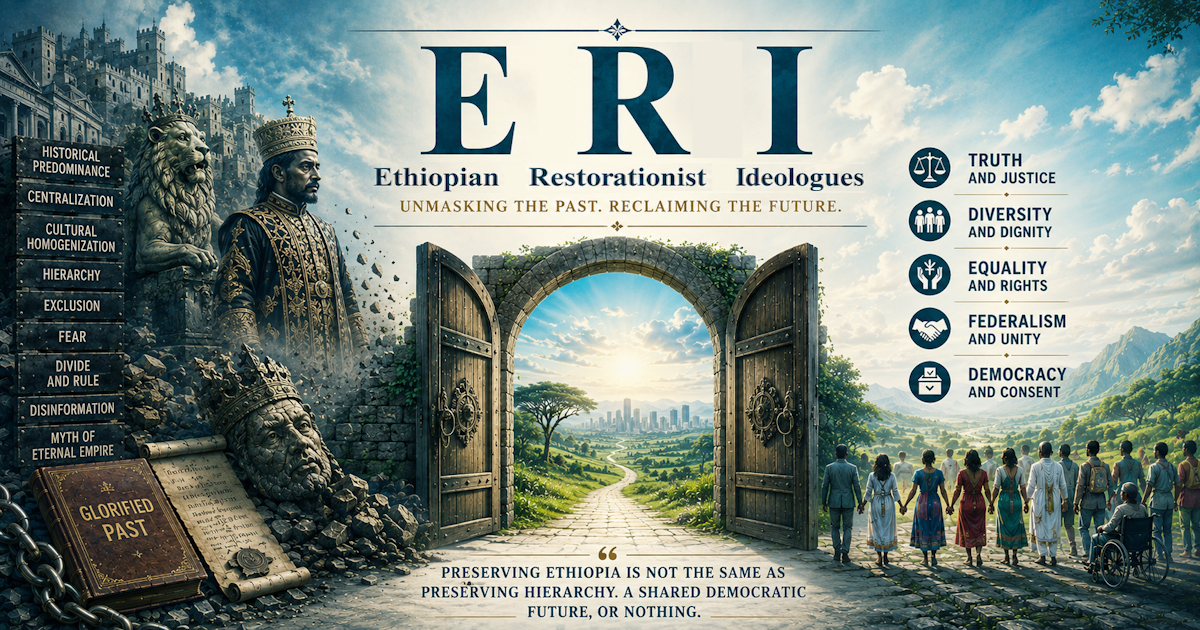
A Special Joint Edition by Members of OROMIA TODAY Editorial Team
A conceptual framework proposal and analysis for understanding Ethiopia's current political quagmire.
You can listen to the audio of this article.
Excerpt
This essay introduces Ethiopian Restorationist Ideologues (ERI) as a framework for understanding a fragmented but recognizable current in Ethiopian politics. It argues that ERI occupies a conservative political space without having evolved into democratic conservatism, confusing preservation of Ethiopia with restoration of its historical hierarchy. Ethiopia needs a conservatism that preserves what can withstand democratic scrutiny while leaving imperial restorationizm to history.
1. Naming the Unnamed: A Conceptual Framework
Ethiopian Restorationist Ideologues, or ERI ኢሪ, is a collective term for an identifiable ideological current in Ethiopian politics whose adherents may be scattered across numerous political parties, organizations, intellectual circles and media platforms but share a broadly restorationist conception of the Ethiopian empire state.
The restoration at issue is not necessarily a literal return to monarchy or empire, but the recovery of political, territorial and cultural assumptions associated with the centralized unitarist political order of imperial Ethiopia and by opposition to, or a desire to substantially dismantle, the multinational federal settlement that replaced it.
ERI should not be understood simply as another name for advocates of administrative centralization. Its restorationizm has a broader political, historical and cultural dimension. Imperial Ethiopia was not merely a centralized state; it produced a hierarchy of political power, language, culture and national identity.
Amharic acquired a privileged position within the machinery of the empire state, while Amhara culture became disproportionately associated with the official conception of "Ethiopian identity". For sections of the political elite, that historical arrangement also provided status, influence and access to state power without the democratic mandate that would ordinarily be required to exercise comparable authority in a genuinely representative multinational polity.
ERI is not ethnically homogeneous. Its adherents can be found among individuals from a range of Ethiopia's ethnic communities, including Gurage, Oromo, Wolayita and others. For historical reasons, however, the current has drawn a particularly significant share of its political and intellectual advocates from among Amhara elites. This demographic association should not be mistaken for an ethnic definition: ERI identifies an ideological orientation, not an ethnic identity.
It is therefore important to distinguish this ideology categorically from the Amhara people. ERI does not describe an ethnic community, nor does it presume that Amharas generally subscribe to restorationist or undemocratic politics. Just as individuals from other ethnic backgrounds may embrace ERI politics, Amharas may reject it. The term describes an ideological constituency among political elites and activists, particularly those who seek to preserve or recover aspects of the historical political and cultural hierarchy associated with the imperial state.
ERI identifies an ideological orientation, not an ethnic identity.
One of the characteristic expressions of this outlook is the apparently inclusive proposition that “we are all one”. In itself, the aspiration to national unity is neither objectionable nor inherently anti-democratic.
The difficulty arises when oneness has already been culturally and historically defined: when unity effectively means continuing the state-building trajectory established during the imperial era, retaining the privileged position of one language and cultural tradition while displaying little sensitivity to the languages, identities, historical experiences and demands for self-government of other peoples.
The objection, therefore, is neither to Amharic nor to Amhara culture. Both have an entirely legitimate place within Ethiopia's diverse cultural inheritance. The objection is to the transformation of any particular language, culture or historical experience into the presumed default expression of Ethiopian identity, against which others are expected to assimilate, subordinate themselves or demonstrate their Ethiopian credentials.
In this broader sense, ERI restorationizm is not merely nostalgia for a lost form of government. It is nostalgia for a political and cultural order—and, for some of its elite advocates, for the status and privilege that accompanied it.
Put more succinctly:
Their nostalgia is not simply for a lost state; it is for a lost hierarchy.
And therein lies the contradiction at the heart of its language of unity:
“We are all one” becomes exclusionary when “one” has already been culturally defined.
2. How We Got Here
ERI is, in an important sense, a relic of the Abyssinian imperial political mindset. Its contemporary adherents are not ethnically homogeneous, but the ideological tradition from which it draws emerged from a much narrower historical political order. Its remarkable present-day homogeneity of outlook derives not from common ethnicity but from a common reaction to the displacement of an older system—particularly among political and intellectual constituencies that regarded the structures, status and national identity fashioned under that system as something worth preserving.
To understand why this matters, ERI needs to be situated within the broader evolution of political ideology.
Most mature democratic systems eventually develop recognizable political tendencies conventionally described as the right, center and left. The terminology varies from country to country, but the underlying political impulses are familiar.
- Conservatives emphasize continuity, institutional stability, inherited values and caution towards rapid change.
- Liberals occupy a broad territory around individual liberty, constitutionalism, pluralism and negotiated reform.
- Progressives and social democrats place greater emphasis on equality, redistribution and the correction of inherited social and political inequalities.
These categories did not emerge fully formed, nor were they evidence that those societies had always been democratic. On the contrary, modern conservatism itself developed amid enormous political upheaval. What political maturity gradually accomplished was something subtler: it taught competing ideological camps to distinguish the preservation of a country from the preservation of every historical arrangement through which that country had once been governed.
Britain provides an obvious illustration. British conservatism emerged while Britain was itself an imperial power. Yet the contemporary conservative tradition does not ordinarily demand the restoration of the British Empire, the political privileges of the landed aristocracy, restricted suffrage or the social hierarchies of Victorian Britain. Institutions once fiercely resisted by conservatives eventually became part of the accepted democratic settlement. Universal suffrage, political equality and the end of empire changed what it was politically legitimate to conserve.
The same evolutionary pattern, with important national differences, can be observed elsewhere. American conservatives may vigorously defend constitutional continuity, national traditions and limited government without thereby seeking restoration of the eighteenth- or nineteenth-century social order. Canadian conservatives operate within a country whose contemporary constitutional identity accommodates federalism, bilingualism, multiculturalism and increasingly the recognition of Indigenous rights. Political disagreement remains substantial, but mainstream conservatism generally begins from the accumulated democratic settlement rather than demanding wholesale restoration of an earlier hierarchy.
This reveals something important about mature conservatism.
Conservatism does not mean preserving everything inherited from the past. It requires deciding what remains worthy of preservation after the past has been subjected to democratic judgment.
Empires themselves demonstrate the same principle. They leave languages, institutions, laws, architecture, administrative traditions, cultural practices and collective memories behind. These relics are not inherently objectionable. English did not become illegitimate when the British Empire disappeared; Roman law did not become worthless when Rome ceased to rule an empire. The historical inheritance survives while the political hierarchy that once accompanied it loses its claim to legitimacy.
The crucial distinction is therefore between inheritance, nostalgia and restorationizm.
- Inheritance accepts what history has left behind.
- Nostalgia romanticizes aspects of what has disappeared.
- Restorationizm crosses the political threshold by seeking to make elements of the superseded order normative again.
2.1. Ethiopia’s Interrupted Ideological Evolution
Ethiopia presents a markedly different trajectory. Rather than experiencing a gradual consolidation of democratic political competition, its modern history has been characterized by repeated rupture: imperial monarchy was displaced by revolutionary military rule; the centralized military state was displaced by multinational federalism; and the federal settlement itself has remained the subject of continuing existential contestation.
Consequently, Ethiopia has struggled to develop the settled political floor upon which conventional conservative, liberal and progressive competition normally takes place.
In a mature democratic system, political opponents may disagree fiercely about taxation, redistribution, social policy, the appropriate size of government or the distribution of power between levels of government while accepting the legitimacy of the constitutional arena within which they compete.
Ethiopia repeatedly returns instead to more foundational questions:
- Whose state is Ethiopia?
- What constitutes the Ethiopian nation?
- What political status should its constituent peoples possess?
- Which languages represent the state?
- How much self-government should those peoples exercise?
- And which historical account of the state should provide its legitimating narrative?
Until those questions acquire a broadly accepted democratic foundation, ordinary ideological competition remains distorted by the unresolved politics of state formation.
This helps explain why Ethiopia's progressive and conservative tendencies have developed so asymmetrically.
The progressive side is comparatively recognizable. It includes political currents demanding various combinations of democratic rights, national self-government, linguistic equality, cultural recognition, territorial autonomy and self-determination. These movements differ enormously among themselves and cannot simply be grouped into a single ideology. Their common historical direction, however, is towards renegotiating inherited relationships of power on the basis of greater equality.
The preservationist side is considerably murkier, because it immediately confronts a fundamental question:
What exactly is being preserved?
Here lies the ideological space in which ERI emerged.
2.2. Conserving the Country or Conserving the Old Order?
There is nothing inherently undemocratic about Ethiopian conservatism. A democratic conservative tradition could legitimately value the continuity of Ethiopia as a common political community, cherish its accumulated historical inheritance, defend stable institutions, favor evolutionary over revolutionary change and argue for strong common institutions within an agreed constitutional framework.
Such a conservatism could value Amharic without demanding its historical predominance. It could celebrate Amhara culture without making it the cultural template of Ethiopian identity. It could defend Ethiopian unity without treating national self-government as inherently hostile to that unity. It could disagree with Oromo, Somali, Tigrayan, Sidama or other political demands while nevertheless beginning from the proposition that these peoples enter the constitutional conversation as political equals.
That is where ERI, in its present manifestation, gets preservation profoundly wrong.
Rather than clearly separating Ethiopia from the imperial political architecture through which Ethiopia was historically organized, ERI tends to conflate preservation of the country with preservation—or recovery—of important features of the older conception of the country.
Historical predominance becomes national tradition; centralization becomes unity; resistance to cultural homogenization becomes fragmentation; and demands for multinational equality can consequently be portrayed as threats to Ethiopia itself.
The result is not mature conservatism but a politically underdeveloped form of right-wing restorationizm.
ERI is therefore best understood not simply as Ethiopia's conservative ideology, but as an infantile precursor struggling to become one. It occupies political territory that, in a more mature democratic system, could be occupied by a legitimate conservative tradition, yet it remains burdened by unresolved attachments to the imperial settlement.
The route towards maturity is nevertheless conceptually straightforward, even if politically difficult.
It begins by accepting the equality of Ethiopia's constituent peoples. It requires separating cultural inheritance from political privilege, national continuity from imperial hierarchy, and legitimate conservatism from restorationizm. It requires recognizing that the disappearance of an historical privilege is not necessarily the destruction of the culture with which that privilege was associated.
Most importantly, it requires answering the preservationist question differently.
The question cannot remain: how much of the old Ethiopia can be restored?
It must become: what can Ethiopians, as political equals, agree is worth preserving together?
Only then can a genuinely democratic Ethiopian conservatism emerge.
Such an ideological evolution would not require conservatives to abandon Ethiopia; paradoxically, it could make their case for preserving it considerably stronger. A shared state defended on the basis of equality is fundamentally different from one defended through nostalgia for an order whose historical legitimacy remains contested.
This may be one of ERI's greatest political miscalculations. In attempting to preserve Ethiopia through attachment to an older conception of Ethiopia, it risks alienating precisely those peoples whose voluntary attachment would provide the strongest democratic foundation for the country's continued existence.
Preserving Ethiopia is not the same thing as preserving the historical hierarchy through which Ethiopia was once governed.
That distinction is where restorationizm ends and democratic conservatism can finally begin.
3. Identifying Tenets of ERI
ERI is not a formal organization and therefore has neither a manifesto nor an agreed political programme. Its ideological coherence is instead revealed through a recurring collection of assumptions, arguments and rhetorical habits. Individual adherents need not exhibit every characteristic, but together these provide a useful means of recognizing the broader political current.
3.1. Citizenship Without Nationality
One of the most persistent ERI propositions is the elevation of citizenship as the supposedly correct alternative to recognizing Ethiopia's nations and nationalities.
Citizenship is, of course, indispensable to any democratic state. Nothing in the recognition of nations, nationalities or peoples diminishes the importance of equal individual citizenship. The concepts answer different questions.
- Citizenship describes an individual's legal and political relationship with the state;
- Nationality or peoplehood describes a collective identity that may possess linguistic, cultural, historical and, under a multinational constitutional order, political significance.
Presenting the two as mutually exclusive therefore performs an important ideological function.
It allows an unresolved question of collective political identity to be displaced by the unobjectionable language of individual equality.
The problem is not the word citizen. It is the attempt to make citizenship do the conceptual work of erasing nationality.
A mature democratic position should be capable of accommodating both: equal citizens and equal peoples.
Where the terminology of nations and nationalities itself becomes objectionable, the objection may reveal something deeper than a preference for civic vocabulary:
an unwillingness to recognize the multinational character of the state.
Not all ERI-aligned political parties explicitly place the words citizen or citizenship in their names. The more revealing feature is the recurring discourse beneath the labels: the elevation of an undifferentiated Ethiopian civic identity while nations, nationalities and peoples are demoted, avoided or portrayed as politically divisive categories.
Party branding frequently reinforces this preference through names derived directly from Ethiopia, Ethiopian or similarly unifying national terminology, sometimes extending into deliberately emotive vocabulary such as “mother,” as exemplified by the name Enat Party, "unity or togetherness" as in Hibir Party.
None of these words is objectionable in itself, nor does an Ethiopia-centered party name establish an ideological position on its own.
Their significance emerges when the language of common citizenship and national belonging is repeatedly deployed as a substitute for—rather than alongside—the recognition of Ethiopia's constituent peoples.
The linguistic preference then becomes politically revealing:
the problem is not that ERI speaks the language of citizenship, but that it too often invokes the citizen in order to make the nation disappear.
3.2. Historical Amnesia as a Political Starting Point
History presents ERI with a more difficult problem.
The formation of modern Ethiopia contains episodes of conquest, incorporation, dispossession, resistance, assimilation and unequal cultural relationships that complicate a seamless narrative of consensual national construction. Confronting those histories raises uncomfortable contemporary questions about political legitimacy, territory, language, identity and historical justice.
A characteristic response is therefore some version of:
Whatever happened, we are here now; let us forget the past and move forward together.
The sentiment can sound conciliatory. Yet reconciliation and historical erasure are fundamentally different things.
From Historical Amnesia to Counter-History
Historical denial does not always operate through silence. When inconvenient history cannot simply be ignored, another strategy becomes available: construct an alternative history capable of displacing it.
This tendency is particularly visible in some narratives concerning the Oromo. At its most extreme, it moves beyond disputing particular interpretations of Ethiopian history and begins questioning the historical presence of Oromo in territories they regard as their homeland.
Claims that the Oromo originated in Madagascar provide an especially striking example. Such a proposition does not become historical explanation merely through repetition. It immediately generates elementary but scientific questions of evidence: When did this migration supposedly occur? By what route did a substantial population move from an Indian Ocean island to the Horn of Africa? What archaeological, linguistic, genetic or documentary evidence demonstrates it? Which populations occupied the territories concerned beforehand, and what historical record explains their displacement or absorption?
These are not rhetorical objections. They are the ordinary questions that any serious migration hypothesis must survive.
The same methodological problem arises in contemporary attempts to resolve the contested history of Finfinnee by identifying it with an earlier settlement commonly referred to as Barara and then treating that identification as proof of prior Amhara ownership. Even if evidence ultimately establishes the location of historical Barara, several separate propositions would still require demonstration: that Barara occupied the site of present-day Finfinnee; that its inhabitants can properly be assigned the modern ethnic identity subsequently attributed to them; and, most importantly, that the existence of such a settlement establishes exclusive territorial ownership capable of overriding the documented historical relationship between the surrounding Oromo communities and the territory.
Locating an old settlement and establishing contemporary territorial ownership are not the same historical exercise.
Other extraordinary narratives attributed to polemical historical literature have gone further still, portraying Oromo origins in ways incompatible with elementary human biology—such as absurd claims that Oromos came out of the sea—and established patterns of human migration.
Such claims are important here not because every ERI adherent accepts them—clearly they do not—but because they illustrate how far historical denial can travel when the desired conclusion precedes the investigation.
This reverses the proper relationship between evidence and history.
- Historical inquiry begins with evidence and asks what conclusions it supports.
- Ideological counter-history begins with the required conclusion and searches for a narrative capable of supporting it.
The distinction matters enormously to the ERI framework. If the political objective is to deny Oromo indigeneity, territorial continuity or historical claims, almost any alternative origin story can become attractive provided it relocates the Oromo somewhere else.
But moving a people around in narrative does not move them through history.
Nor can competing historical claims be resolved merely by producing another book, fairytale narratives, map or ancient place-name.
Claims about population movement, settlement and territorial continuity must be subjected to the same disciplines applied elsewhere: chronology, documentary evidence, archaeology, historical linguistics, anthropology, genetics where relevant, and critical examination of sources.
The burden of evidence does not disappear because the historical conclusion is politically convenient.
Oromo audiences may understandably dismiss some of the more extravagant stories with humor and laughter. For an analytical framework, however, they are worth documenting for a more serious reason.
They demonstrate that historical amnesia and invented counter-history can perform the same political function. One erases an inconvenient past; the other supplies a more convenient replacement.
That brings us back to the central problem of ERI's relationship with history:
History cannot be authoritative when it legitimizes Ethiopia, irrelevant when it records injustice, and infinitely rewriteable when it recognizes Oromo claims.
The future cannot be built by denying the past—particularly when elements of that past remain embedded in the present.
A society cannot reasonably demand that historical grievances cease to matter while political arguments seeking to preserve consequences of that history remain active.
Nor can history simultaneously be invoked to establish the antiquity and legitimacy of the Ethiopian empire state and dismissed as irrelevant when the same historical record reveals conquest and inequality.
3.3. The Politics of Superior Ethiopianism
ERI discourse frequently presents its own conception of Ethiopia as synonymous with superior Ethiopian patriotism itself.
Under this framing, commitment to a centralized or culturally homogenized conception of the state becomes evidence of patriotism, while those demanding multinational federalism, greater self-government, territorial rights or alternative constitutional arrangements may be characterized as secessionists, extremists, reactionaries, traitors or even terrorists.
This rhetorical maneuver does more than criticize opposing political programmes. It questions the opponents' legitimate membership in the political community.
The effect is to create a circular definition:
A patriotic Ethiopian believes in our conception of Ethiopia; anyone who rejects our conception of Ethiopia demonstrates that they are not sufficiently patriotic.
Democratic patriotism cannot operate in this manner. A citizen must be able to dispute the constitutional structure of the state, criticize its history and advocate fundamental reform without thereby forfeiting political legitimacy.
For ERI adherents, even conspicuous displays of devotion to the national flag can become a performative measure of patriotism, carrying the implicit suggestion that those who do not participate with equal fervor are somehow less Ethiopian or less patriotic. This phenomenon is particularly visible in the Amhara region and Amhara political and media landscape, where the traditional Ethiopian flag without the central emblem is displayed with notable prominence and where the green-yellow-red tricolor is frequently incorporated into digital-media logos, graphics, backgrounds and other visual branding.
Such symbolism is not necessarily ideological in every instance, and attachment to a national flag should not itself be treated as evidence of ERI politics. Yet within the historical and political context examined here, the conspicuous use of the traditional tricolor can carry meaning beyond ordinary patriotism. The symbolism is historically loaded: the modern Ethiopian tricolor emerged from the state-building order of the late nineteenth century, precisely the historical inheritance toward which restorationist politics frequently looks. The issue, therefore, is not the flag itself but the political work it can be made to perform.
A national symbol can cease to function merely as an expression of common belonging when one political tradition appropriates its conspicuous display as a badge of superior patriotism—the implicit message shifting from “I am Ethiopian” to “I am the more authentic Ethiopian, and we are the custodians and cheerleaders of Ethiopia.”
3.4. Selective Memory, Misinformation and the 1974 Escape Hatch
A further characteristic is the selective treatment of historical evidence, often accompanied by misinformation and, at times, deliberate disinformation that minimizes, reframes or removes inconvenient aspects of the imperial record.
One particularly convenient argument holds that whatever injustices belonged to imperial Ethiopia became historically irrelevant when the monarchy fell in 1974. The implication is that because the imperial government disappeared, the political questions produced by the imperial system disappeared with it.
But regimes and systems are not synonymous.
A monarchy can fall in a day. Institutional hierarchies, cultural assumptions, linguistic inequalities, territorial disputes, patterns of political privilege and competing historical memories can survive for generations.
This is precisely why the distinction between imperial inheritance and imperial restorationizm matters. The argument is not that contemporary Ethiopia remains literally governed by an emperor. It is that some unresolved consequences of state formation survived the monarchy, while political currents continue to defend or seek the recovery of elements of the political and cultural settlement associated with that period.
Declaring the empire dead in 1974 therefore cannot, by itself, answer questions about what the empire left behind.
A regime can end on a date. A political inheritance cannot.
Nor does moving forward require pretending that the road behind us never existed. The democratic alternative is more demanding: establish what happened, distinguish inheritance from injustice, preserve what remains valuable, remedy what remains unequal, and construct the future upon acknowledgment rather than denial.
3.5. ERI Hate Multinational Federalism but Love “Geographic Federalism”
Perhaps no ERI proposition reveals the restorationist project more clearly than its hostility towards multinational federalism coupled with its enthusiasm for what is commonly presented as “geographic federalism.”
Indeed, geographic federalism, widely advocated within Ethiopian unitarist politics, has become a defining feature of the restorationist agenda and has a rather curious definition. In practice, it envisages a return towards territorially defined provinces reminiscent of the imperial administrative order, breaking up contemporary multinational regions and severing the constitutional relationship between recognized peoples and territorial self-government.
The apparent calculation is that dismantling the political geography created by the 1995 federal Constitution will somehow diminish, depoliticize or ultimately erase the national identities it recognizes.
It will not.
Nations and nationalities do not disappear because administrative boundaries are redrawn; attempting to make them politically invisible is more likely to intensify the very political attrition the redesign purports to resolve.
The constitutional recognition of Ethiopia's multinational reality has already changed the terms of political contestation:
the genie is out of the bottle with the 1995 Multinational Federation Constitution and cannot simply be forced back in.
To redraw the map in the image of the old provinces in the hope of restoring the old political logic is precisely what makes ERI not merely conservative, but restorationist.
The terminology "geographic federalism" itself requires clarification. Territorial or geographic federalism is not fictitious.
Federations can indeed be organized into constituent units whose boundaries are not principally intended to correspond to particular national or linguistic communities. Such arrangements may be particularly workable where the principal constituent units are not themselves conceived as the territorial expression of distinct ethnolinguistic peoples possessing their own languages, cultures and historically rooted claims to collective self-government.
The United States and Australia provide familiar examples. Ethiopia presents a fundamentally different constitutional problem: its federal structure arose precisely in response to politically mobilized peoples for whom language, identity, territory and self-government had become central questions of state legitimacy. A federal model cannot therefore be transplanted from one historical setting to another while ignoring the political problem that federalism is expected to resolve.
Federal arrangements are institutional responses to the political societies in which they operate. The relevant question is therefore not whether geographic federalism exists somewhere in the world. It plainly does. The question is what political problem replacing Ethiopia's multinational federation with geographically redesigned units is supposed to solve.
Here the ERI argument becomes considerably more revealing.
Ethiopia's existing federal structure did not arise because somebody developed an irrational fascination with ethnicity and drew administrative boundaries accordingly. Whatever the defects of its implementation, multinational federalism emerged from a historical problem: peoples possessing distinct languages, identities, territories and political histories demanded recognition and self-government within a state whose earlier centralizing project had frequently denied precisely those claims.
Calling the proposed replacement “geographic federalism” does not make that historical problem disappear.
Mountains do not demand linguistic rights.
Rivers do not seek cultural recognition.
Valleys do not demand self-government.
People do.
Geography can help determine administrative boundaries, but geography cannot tell us which political communities inhabit the territory, what historical relationships exist between them, or what constitutional arrangements they consider legitimate.
This is why the apparently innocent substitution of geography for nationality deserves scrutiny. If existing national regions are to be dismantled and replaced by geographically constituted provinces, the decisive question becomes: what happens to the political status presently attached to the peoples inhabiting those regions?
If Oromo self-government is transformed into administration of an arbitrarily delimited geographic province, something more consequential than a boundary has changed. A political subject has been converted into an administrative population.
That is the real constitutional issue.
The argument cannot therefore be allowed to hide behind cartographic vocabulary. Those advocating geographic reorganization must explain plainly whether Ethiopia's constituent peoples retain their collective political status, their institutions of self-government and their constitutional authority over matters assigned to them—or whether those rights are precisely what the proposed redesign is intended to dilute.
If the latter is the objective, then “geographic federalism” is not merely an alternative technique for drawing regional boundaries. It is a mechanism for depoliticizing nationality by territorial redesign.
That would explain its attraction to ERI.
- Multinational federalism begins with the proposition that Ethiopia contains politically relevant peoples entitled to recognition and self-government.
- Restorationist politics is uncomfortable with that premise because it competes directly with the older conception of Ethiopia as a single political nation administered from the center.
The disagreement, therefore, is not fundamentally between two varieties of map. It is between two conceptions of who constitutes the federation.
One begins with peoples who agree to share a state while retaining meaningful self-government.
The other risks reducing those peoples to individual citizens distributed among administrative territories whose boundaries and authority derive principally from the central state.
There is nothing inherently undemocratic about territorial federalism. But neither is there anything inherently democratic about calling a political project geographic.
A constitutional arrangement must be judged by the distribution of power it produces, the rights it recognizes and the consent upon which it rests—not by the innocuousness of the adjective attached to it.
ERI must therefore answer the question that “geographic federalism” too conveniently avoids:
If multinational federalism is the disease, what exactly about the political recognition of Ethiopia's nations and peoples is supposed to be the pathology?
Until that question is answered, changing the adjective changes nothing about the underlying political objective.
You cannot resolve a nationality question by renaming it a geography question.
3.6. Irrational Fear of Oromo Political Ownership
Perhaps the most sensitive feature of ERI politics is also one that cannot be avoided merely because articulating it is uncomfortable: the recurring anxiety surrounding Oromo political ownership, territorial claims and self-government.
Political disagreement is legitimate. What deserves examination is the point at which disagreement becomes an unwillingness to recognize Oromo claims as legitimate subjects of historical, democratic and constitutional consideration at all.
Finfinnee provides perhaps the clearest illustration, but the same zero-sum logic extends well beyond the city to the wider political question of Oromia itself.
The restorationist imagination frequently converts Oromo recognition into non-Oromo loss.
Recognition of Finfinnee's historical, territorial and constitutional relationship with Oromia is consequently discussed as though it would necessarily dispossess, expel or politically subordinate the city's non-Oromo residents.
But none of those consequences logically follows.
Non-Oromo residents can retain their homes, property, citizenship, political participation, language, cultural freedom, security and equality before the law. Recognition of Oromo political ownership does not require ethnic ownership of individual rights.
The question for ERI is therefore remarkably simple:
If your rights remain intact, what precisely are you being asked to surrender?
That question exposes the zero-sum assumption at the center of the controversy. Oromo recognition is imagined as somebody else's dispossession; Oromo political gain becomes non-Oromo political loss.
Yet territorial belonging and equal citizenship coexist perfectly well elsewhere. London does not cease to belong territorially to England because millions of Londoners have identities, origins and languages extending far beyond England. Nor does London's territorial location diminish their rights as Londoners or British citizens. The analogy is neither historically nor constitutionally exact, but it illustrates an elementary principle:
The territorial identity of a city need not prescribe the ethnic identity of its residents.
There is, however, an important asymmetry that ERI must confront.
The Oromo case is not presented merely as a contemporary competition for greater political advantage.
It arises from a historical account of conquest, dispossession, loss of land, political subordination and cultural marginalization whose consequences Oromo advocates argue remain unresolved.
Seen from that perspective, the political vocabulary naturally includes acknowledgment, apology, restitution, reparation, institutional reform and guarantees against repetition.
The appropriate remedies can legitimately be debated. The underlying grievance cannot simply be made illegitimate because confronting it is politically uncomfortable.
This is why the two sides of the dispute cannot automatically be treated as symmetrical.
A people seeking recognition and remedy for what it regards as historical dispossession is making a different kind of claim from those opposing that recognition because they fear what its acknowledgment might mean for themselves—particularly when their own legitimate rights can remain fully protected.
The asymmetry can again be reduced to two questions.
What does the Oromo claimant say was lost?
- Land, territorial belonging, political recognition, cultural dignity and meaningful self-government feature prominently in the answer.
What must the protected non-Oromo resident lose if those claims are recognized?
- If citizenship, residence, property, political participation, cultural identity and equality before the law all remain intact, the second answer becomes considerably harder to identify.
That is where fear deserves examination.
Anxiety may be understandable when people have been persuaded that recognition of Oromo rights threatens their homes or their place in Ethiopia. But once those legitimate interests are expressly protected, continued opposition increasingly ceases to resemble self-protection and begins to resemble resistance to Oromo recognition itself.
The progression can then become corrosive: fear produces anxiety; anxiety produces resistance; resistance, continually reinforced by zero-sum narratives, can harden into contempt.
What began as an imagined threat can eventually produce rhetoric and behavior experienced by Oromo as hostility or even hatred.
This is precisely why historical injustice requires a different political response. Historical responsibility does not mean inherited personal guilt. Contemporary non-Oromo residents need not be blamed for wrongs they did not commit.
But societies can inherit unresolved political obligations even when individuals do not inherit culpability.
- Acknowledgment is not humiliation.
- Reparation is not revenge.
- Recognition is not eviction.
- Self-government is not domination.
Nor does remedy require reversing the historical hierarchy and placing somebody else beneath it.
The Oromo case is strongest precisely when it rejects that temptation. The democratic objective should be recognition without dispossession and belonging without exclusion: addressing Oromo grievances while protecting every legitimate right of every resident.
Seen from this perspective, much of the existential drama surrounding Finfinnee becomes strangely unnecessary. If residents can continue living, working, owning property, raising families, preserving their identities and participating equally in the political life of the city, recognition of Finfinnee's relationship with Oromia need not constitute the catastrophe that restorationist politics imagines.
Indeed, attempting permanently to detach Finfinnee politically from Oromia against sustained Oromo opposition would not extinguish the underlying claim. It would risk converting a disputed constitutional question into an enduring grievance, perpetuating precisely the political attrition from which everyone would benefit by escaping.
A durable settlement must therefore seek justice rather than merely declare victory for one side.
And this is perhaps where ERI most needs to pause.
When nobody is asking you to surrender your legitimate rights, opposing another people's recovery of theirs cannot indefinitely be explained as self-defense.
The democratic answer is not reciprocal hostility but the dismantling of the false zero-sum premise from which hostility grows.
Justice for the Oromo need not mean injustice for anyone else. But avoiding injustice to others cannot become the justification for perpetuating injustice against the Oromo.
Or reduced to its simplest human proposition:
You lose nothing by the Oromo no longer being denied.
The onus therefore falls on ERI to rethink the premise from which its opposition begins: not how Oromo political recognition can be prevented, but how a just and sustainable settlement can be achieved once irrational fears of what that recognition supposedly takes away from others are dispelled.
The question worth asking is no longer “What will the Oromo gain?” but “What legitimate right will anyone else actually lose?”
If the answer is none, then resistance to Oromo recognition cannot indefinitely be defended as protection of others.
The path toward a durable settlement begins precisely where the zero-sum imagination ends: with the recognition that justice gained by one people need not be justice lost by another.
Before, We Leave This Section: A Tongue-in-Cheek Litmus Test
There is a tongue-in-cheek test, familiar from Ethiopian political humor, that provides an unexpectedly revealing illustration of the ERI mindset.
Three propositions are presented in succession. For present purposes, we deliberately use Addis Ababa rather than Finfinnee so that disagreement over the city's name does not interfere with the experiment.
“Addis Ababa is the capital city of Ethiopia.”
Overwhelmingly: Yes. Of course.
“Addis Ababa is the capital of Africa”—in the familiar symbolic sense arising from its status as the headquarters of the African Union.
Again, overwhelmingly: Yes. Proudly so.
Then comes the third proposition:
“Addis Ababa is the capital city of Oromia.”
Which, of course, it is. And suddenly the machinery can begin to seize. The effortless affirmation disappears. There may be hesitation, qualification, discomfort or outright rejection.
That reaction is what makes the joke analytically interesting.
Nothing happened to Addis Ababa between the three sentences. The city did not move. No resident was dispossessed. No citizenship changed. No property was confiscated. Ethiopia did not disappear. The African Union did not pack its headquarters and leave.
Only one word changed:
Oromia.
And therein lies the litmus test. A person may happily accommodate multiple identities for the same city when those identities enlarge Ethiopia's importance—capital of Ethiopia, diplomatic capital of Africa—yet become uncomfortable when another entirely real political relationship places the city within an Oromo constitutional frame.
The humor therefore exposes something more serious than inconsistency over capitals. It asks whether the objection is genuinely about the administrative complexity of a city carrying several political functions—or whether the discomfort begins specifically when Oromo political ownership enters the proposition.
Of course, hesitation at the third statement cannot by itself identify an individual as ERI; people may object for constitutional, historical or terminological reasons of their own. But the proposition being tested is remarkably simple: Addis Ababa is also the capital of Oromia, just as London is simultaneously the capital of England and of the United Kingdom. A city can occupy more than one political or administrative role without one negating the other.
It is a joke, not a political-science instrument. But good political humor often works precisely because exaggeration reveals an underlying contradiction.
And this particular joke leaves ERI with an awkwardly simple question:
If Addis Ababa can comfortably be Ethiopian enough to be Ethiopia's capital and African enough to be called Africa's capital, why does acknowledging its role as Oromia's capital suddenly become so difficult
Perhaps the funniest part of the joke is that nobody needs to supply the punchline.
The hesitation is the punchline.
3.7. Coordinated Campaigns and Narrative Manufacturing
ERI's political method is not confined to selective history, invented counter-narratives or contested maps. The digital age has provided something considerably more powerful: the ability to manufacture, amplify and repeatedly circulate a political narrative until repetition itself begins to resemble corroboration.
Social media is particularly suited to this method. A claim no longer needs to travel through a political party, scholarly institution or conventional editorial process before reaching a mass audience. An interview fragment, provocative interpretation, historical assertion or constitutional claim can be extracted from its original context, reframed and reproduced across commentators, podcasts, social-media accounts and political networks with extraordinary speed.
The underlying political calculation is hardly new:
Repeat a narrative widely enough and its familiarity may eventually be mistaken for evidence.
Indeed, the genesis of this essay lies partly in observing what appeared to be three distinct but strikingly convergent campaigns. They initially seemed sufficiently connected to warrant an article of their own under the working title “When Intellectuals Double Down on History's Mistakes.”
All three concerned Finfinnee, particularly as its status became entangled with the Ethiopian national dialogue.
- The first involved a campaign directed at constitutional scholar and Oromo activist Dr. Tsegaye Ararssa following an interview on OMN and his subsequent sharing on X of an article published by OROMIA TODAY. Statements attributed to him were reframed in ways that, in the view advanced here, substantially distorted the constitutional and political argument he had actually made, while commentary surrounding the shared article became increasingly polemical.
- The second emerged through a podcast by Moges Z. Teshome advancing an elaborate collection of reasons (9 according to him) why Finfinnee should not form part of Oromia. What was remarkable was not merely disagreement with the Oromo position—such disagreement is entirely legitimate—but the extent to which historical, demographic and constitutional propositions were assembled to support a predetermined conclusion while leaving the foundational question largely untouched: what principle determines Finfinnee's territorial relationship with Oromia in the first place?
- The third was more extraordinary still: a reported proposal associated with representation from the Amhara region seeking a territorial or administrative stake in Finfinnee, including the possibility of relocating and administering some regional functions from the city.
The significance of such a proposition extends beyond its practical feasibility. It reveals a conception of territorial entitlement in which Finfinnee begins to resemble a divisible national asset—a political pie from which competing constituencies might claim a share—rather than a city whose territorial status must be resolved through history, constitutional principle and the rights of the peoples directly concerned.
At first glance, these three episodes appear unrelated.
One concerns the treatment of an Oromo constitutional scholar. Another concerns arguments advanced through contemporary media. The third concerns an apparent political claim associated with regional representation.
But viewed through the ERI framework, their convergence becomes difficult to overlook.
The common denominator is Finfinnee.
More specifically, each challenges, directly or indirectly, the proposition that the relationship between Finfinnee and Oromia should be approached primarily through Oromo historical claims, territorial continuity and constitutional rights. Different arguments arrive by different routes at remarkably similar political destinations.
That observation became the turning point for this essay.
What initially appeared to warrant an article about three provocative episodes raised a larger question: were these isolated controversies, or manifestations of a broader and recognizable ideological current?
Following that question led away from the individual protagonists and toward ERI itself.
The more important analytical subject was no longer who said what on a particular podcast, interview or social-media thread.
It was the recurring architecture beneath the arguments: historical denial, anxiety about Oromo political ownership, hostility toward multinational federalism, elevation of undifferentiated citizenship over nationality, and the repeated presentation of Oromo political recognition as a threat to Ethiopia or to other Ethiopians.
The three controversies therefore matter here primarily as case studies.
They illustrate how an ideological current that is organizationally fragmented can nevertheless generate strikingly convergent narratives. No central command structure need exist. No thirty political parties need gather in a room and agree upon talking points.
Ideological coordination can occur without organizational coordination when participants share the same assumptions, fears and desired political destination.
This distinction is important.
Similarity of narratives alone does not prove a centrally coordinated campaign, and this essay should not allege one without evidence. What can legitimately be examined is narrative convergence: the repeated appearance, amplification and mutual reinforcement of substantially similar propositions across otherwise separate political actors and platforms.
That phenomenon is particularly powerful in the digital environment.
A disputed claim can begin with one speaker, acquire apparent authority through repetition by another, become simplified into a slogan by a third, and eventually circulate detached from the evidence upon which the original proposition supposedly rested. What began as an assertion then returns to public discourse disguised as something “everybody knows.”
Repetition creates familiarity. Familiarity creates apparent normality. But neither creates truth.
This is where ERI's organizational fragmentation can paradoxically become an advantage. Because the current does not speak through a single party or manifesto, substantially similar propositions can appear to arise independently from numerous directions. The audience encounters not one ideological source but politicians, commentators, academics, activists, podcasters and social-media personalities apparently arriving separately at comparable conclusions.
The resulting impression can be one of spontaneous consensus.
But consensus—whether spontaneous, coordinated or merely amplified—remains subject to the same evidentiary burden as any individual claim.
Thirty repetitions do not constitute thirty pieces of evidence.
Nor does digital virality transform a historical assertion into history, a constitutional preference into constitutional principle, or a territorial aspiration into territorial entitlement.
This is why the original three-story article ultimately gave way to the ERI framework. The individual controversies were interesting; the recurring political grammar connecting them was more important.
The task here is therefore not to catalogue every provocative statement produced within Ethiopian digital politics. It is to identify the pattern beneath them and subject recurring claims to evidence, constitutional reasoning and historical scrutiny.
ERI may be organizationally scattered, but its narratives frequently travel in formation.
And that yields perhaps the simplest test for this seventh tenet:
When many voices repeat the same proposition, the first question should not be how many are saying it. It should be whether any of them has proved it.
The pattern described here is not entirely new, nor did it originate with contemporary social media.
Years ago, an independent scholar presented research to an Oromo Studies Association (OSA) conference, subsequently published in the Journal of Oromo Studies (JOS), examining what the scholar identified as a recurring pattern among sections of Amhara intellectual and political discourse: the use and repetition of polemical narratives concerning the Oromo, sometimes with the effect—or apparent purpose—of demeaning, delegitimizing or demoralizing the people whose political claims were being contested.
While the precise findings and terminology of that study should be allowed to speak through the source itself, its relevance here lies in the broader phenomenon it identified: political narratives do not have to persuade through evidence alone if persistent repetition can alter the social cost of challenging them.
A more recent example illustrates the mechanism at almost microscopic scale.
In a video circulating online, an Amhara activist discussing the use of Finfinnee rather than Addis Ababa reportedly proposed an extraordinarily simple method for discouraging Oromo from using the indigenous name: repeatedly characterize its use as "faaraa"—an Amharic slang carrying connotations of backwardness, unsophistication or primitive foolishness—until Oromo themselves become embarrassed enough to abandon it.
The proposition may sound almost too crude to deserve serious analysis. It deserves it precisely because of its simplicity.
The objective is not to demonstrate historically that Finfinnee is an incorrect name. It is not to defeat its use through linguistic evidence. It is to attach a social penalty to the act of using it.
Do not disprove the name. Make its users ashamed of saying it.
That distinction takes us from historical argument into social psychology.
Repeated ridicule can attempt to transform an identity marker into a stigma. Once stigma becomes socially internalized, coercion no longer needs to operate exclusively from outside; members of the targeted community may begin policing themselves.
What appears superficially as teasing can therefore reveal a much larger political technique: make the assertion of an identity socially costly enough and some people may eventually suppress it voluntarily.
This is precisely why apparently trivial linguistic insults should not always be dismissed as playground politics.
Language, names and symbols are among the principal means through which collective identities are maintained. Attempts to delegitimize them through ridicule may therefore perform political work disproportionate to the apparent triviality of the insult.
The contemporary digital environment has vastly expanded the reach of such methods. Few Oromo public intellectuals illustrate the resulting phenomenon more clearly than the Australia-based constitutional scholar and Oromo activist Dr. Tsegaye Ararssa.
Before relocating abroad, Dr. Tsegaye taught generations of Ethiopian students, including individuals who subsequently became prominent in Oromo, Amhara and Ethiopian political life. His later scholarship and activism, combined with a substantial Oromo audience on digital platforms, have made him an unusually influential voice in debates concerning constitutionalism, multinational federalism, self-determination and Oromo political rights.
They have also made him an unusually persistent target.
Criticism of a scholar is neither objectionable nor evidence of an ideological campaign. Academics who enter public political debate should expect their arguments to be challenged vigorously.
The relevant distinction is between challenging an argument and attempting to delegitimize the person making it.
In Dr. Tsegaye's case, campaigns have extended beyond disagreement with his constitutional analysis into allegations concerning extremism, incitement and terrorism, together with efforts aimed at restricting his access to social-media platforms. One particularly large online campaign reportedly attracted millions of expressions of support for action against him.
A campaign does not rebut constitutional scholarship by accumulating signatures against the constitutional scholar. Nor does describing an academic as dangerous answer the argument that supposedly makes him dangerous.
Millions of repetitions of an unsupported allegation do not strengthen its evidence. Three million do not transform it into fact.
But, mass participation can sometimes conceal the weakness of the original proposition by shifting attention from “What is the evidence?” to “Look how many people believe it.”
That is precisely the subtle distortion this seventh tenet seeks to expose: the multiplication of believers can create the illusion that the evidence itself has somehow multiplied.
There is neither space nor analytical value in cataloging every polemical campaign directed at Oromo intellectuals—or at the Oromo as a people—over the years. Their sheer volume would make exhaustive documentation impractical and, more importantly, unnecessary for the purpose at hand: the objective is not to inventory every instance, but to identify the recurring political pattern they collectively reveal.
One final episode, however, deserves mention because it raises a more disturbing question: what happens when the language normally associated with inflammatory popular politics enters institutions that exist precisely to elevate intellectual discourse?
At a professional conference held in Washington, D.C., in 2023, individuals emerging from a conference setting were reportedly recorded referring to Oromo using a racist or ethnically derogatory term.
We understand that attribution matters enormously, and as such the conduct of identifiable individuals cannot legitimately be generalized to an entire scholarly association, ethnic community or conference without evidence that the institution itself endorsed, tolerated or participated in it.
But the episode remains relevant for precisely the opposite reason.
Learned institutions should represent environments in which evidence disciplines prejudice.
Their purpose is to subject claims to scrutiny, expose weak arguments and replace ethnic caricature with intellectual inquiry. When derogatory ethnic language appears even at the margins of such environments, it deserves examination not because it proves institutional racism, but because it demonstrates that education and professional status do not automatically immunize political discourse against ethnic contempt.
A prejudice does not become scholarship merely because the person expressing it has credentials.
This brings the argument back to ERI.
The danger identified in this section is not that every repeated argument constitutes a conspiracy, that every Amhara intellectual participates in a coordinated campaign, or that criticism of Oromo activists is inherently illegitimate. Such propositions would reproduce exactly the indiscriminate reasoning this essay seeks to criticize.
The concern is narrower and more defensible.
Where substantially similar narratives repeatedly circulate across political parties, intellectual networks, digital media and activist platforms; where historical propositions are amplified more readily than they are demonstrated; where Oromo political claims are answered by delegitimizing those who articulate them; and where ridicule, stigma or allegations of extremism substitute for engagement with the underlying argument, a recognizable method of political contestation emerges.
Some instances may involve genuine coordination. Others may arise organically among people who share the same ideological assumptions. Still others may simply be imitation and amplification.
But from the perspective of ERI, the political effect can be remarkably similar: many apparently independent voices can create an atmosphere of consensus around a proposition whose evidentiary foundation remains surprisingly non-existent as with historically inaccurate and revisionist anti Oromo campaigns.
This is why numbers, virality and repetition must never be confused with corroboration.
A thousand accounts repeating a historical claim do not constitute a thousand historical sources.
A million signatures opposing a scholar do not constitute a rebuttal of his scholarship.
And a room containing learned people does not transform ethnic contempt into intellectual argument.
The democratic remedy is almost embarrassingly conventional: produce the evidence, identify the source, confront the argument, and allow the claim to survive or fail on its merits.
Anything less may win a digital campaign. It does not win an argument.
And herein lies the central lesson of this seventh tenet:
Repetition can manufacture familiarity. Coordination can manufacture visibility. Numbers can manufacture the appearance of consensus. None of them can manufacture truth.
This is a lesson ERI adherents need to take to heart. It is also an essential prerequisite for addressing the deep political fractures of the Ethiopian empire state. Reconciliation cannot be built upon manufactured narratives, baseless campaigns or the repetition of politically convenient claims.
If the objective is genuinely to heal a deeply contested polity, the starting point must be evidence, historical honesty and a willingness to confront uncomfortable truths rather than manufacture more convenient ones.
4. In Conclusion: From Restorationizm to Democratic Conservatism
This essay has attempted to introduce a framework for understanding a distinctive current in Ethiopian politics: Ethiopian Restorationist Ideologues or ERI ኢሪ.
The term is not intended to describe an ethnic community, a formal political coalition or everyone who values Ethiopian unity. It identifies an ideological tendency whose preservationist instincts remain entangled with nostalgia for political and cultural arrangements inherited from imperial Ethiopia.
Right-leaning or conservative politics has a legitimate place in any democratic sociopolitical order. Indeed, a healthy democracy needs political forces that value continuity, institutional stability, accumulated experience and caution in the face of sweeping change.
Conservatism at its democratic best asks an indispensable question: what have we inherited that remains valuable enough to preserve?
The difficulty in Ethiopia is that its preservationist political current has yet to sufficiently separate that question from another, altogether different proposition: what can be recovered from the political order of the past?
That distinction is fundamental.
Ethiopian conservatism still has considerable ideological work to do in determining what can legitimately be distilled from the country's complicated historical inheritance and carried into a democratic future.
Cultural heritage, shared institutions, historical memory, common citizenship and voluntary national solidarity may all provide legitimate objects of preservation.
Historical hierarchy, cultural predominance and political relationships inherited from an imperial order do not acquire democratic legitimacy merely because they are old.
Imperial restorationizm—even in its most diluted form—offers no credible answer to Ethiopia's deeply entrenched contemporary political questions. The empire itself belongs to history. The task before the present generation is not to reconstruct its political assumptions under new terminology, but to determine which elements of the common inheritance can survive democratic scrutiny and be shared without diminishing the rights, identities or self-government of others.
This requires political actors associated with the ERI current to undertake perhaps the most difficult transition of all: to disentangle love of the empire state from attachment to the hierarchy through which that empire was historically governed.
They need not disown Ethiopia. They need not disown Amharic, Amhara culture, common history or the aspiration to maintain a shared state.
What they must disown is the proposition that any historical predominance associated with those inheritances creates a contemporary political entitlement.
A democratic conservative may seek to preserve Ethiopia; what cannot legitimately be preserved is an unequal relationship among the peoples expected to constitute it.
The starting point must therefore be political equality. Once Ethiopia's constituent peoples are accepted as equal participants in determining the character of their shared political future, conservatism itself can begin to mature.
Conservatives can argue for continuity; progressives can argue for deeper transformation; liberals and other political traditions can advance competing conceptions of rights, pluralism, institutions and individual freedom. The resulting spectrum need not conform neatly to a single left–center–right line.
Mature democracy is composed precisely of such overlapping shades of political disagreement conducted upon an agreed foundation of equality.
That would represent an extraordinary political transition for Ethiopia: from repeatedly contesting who owns the state to democratically contesting how a state belonging equally to its peoples should be governed.
ERI can evolve into a democratic conservative tradition—but only by relinquishing imperial nostalgia, accepting the equality of competing national identities and learning the fundamental democratic distinction between preserving an inheritance and restoring a hierarchy.
Ethiopia does not suffer from having conservatives and progressives. It suffers when the political ground beneath them remains unsettled and when preservation is confused with restoration.
The way forward is therefore neither collective amnesia nor perpetual captivity to history.
It is to confront the past honestly, preserve what can withstand democratic scrutiny, discard what cannot, and allow genuinely conservative, liberal and progressive traditions to compete over the future.
Such competition must itself rest upon a commitment to truth and intellectual integrity. Repetition cannot substitute for evidence, manufactured narratives cannot substitute for history, and coordinated campaigns cannot substitute for democratic argument. A mature political culture does not defeat opposing ideas by stigmatizing those who articulate them or by manufacturing the appearance of consensus; it confronts claims on their merits, submits competing histories to evidence and allows persuasion rather than intimidation to determine which arguments endure. A democracy cannot mature while its political narratives remain exempt from the discipline of truth.
Preserving Ethiopia is not the same thing as preserving the historical hierarchy through which Ethiopia was once governed. Until that distinction is accepted, restorationizm will continue masquerading as conservatism.
The same democratic transition requires abandoning the zero-sum politics examined in the Oromo case. Recognition of historical injustice, restoration of political dignity and accommodation of legitimate territorial and constitutional claims need not diminish the rights of anyone else. A democratic conservative tradition should have nothing to fear from such a settlement; indeed, if preserving Ethiopia is its objective, justice among the peoples who constitute it should be understood not as a threat to that objective but as one of its strongest foundations. Justice gained by one people need not be justice lost by another.
Taken together, these are not demands that ERI abandon Ethiopia, but an invitation to rethink what preserving Ethiopia should mean. It means conserving what can survive democratic scrutiny, relinquishing what depends upon inherited hierarchy, accepting the equality of the peoples with whom the state is shared, and replacing manufactured certainty with the more demanding discipline of evidence, dialogue and democratic consent.
Once that distinction is accepted, Ethiopia may finally begin the much more ordinary—and much healthier—politics of deciding, democratically, what is worth conserving and what must be left to history.



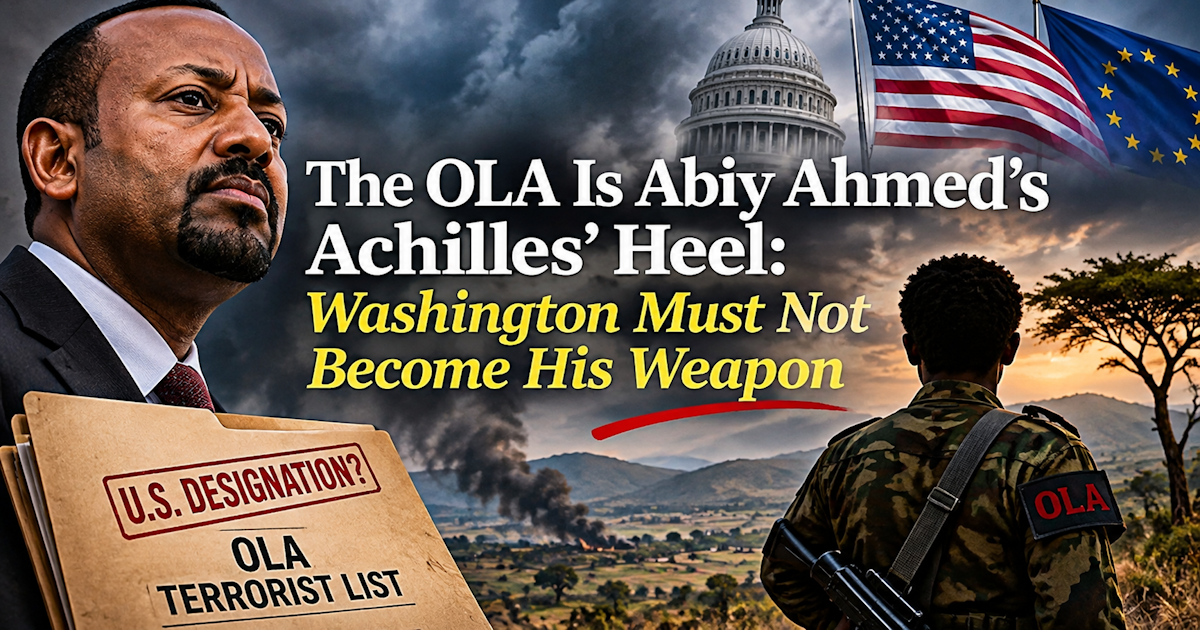

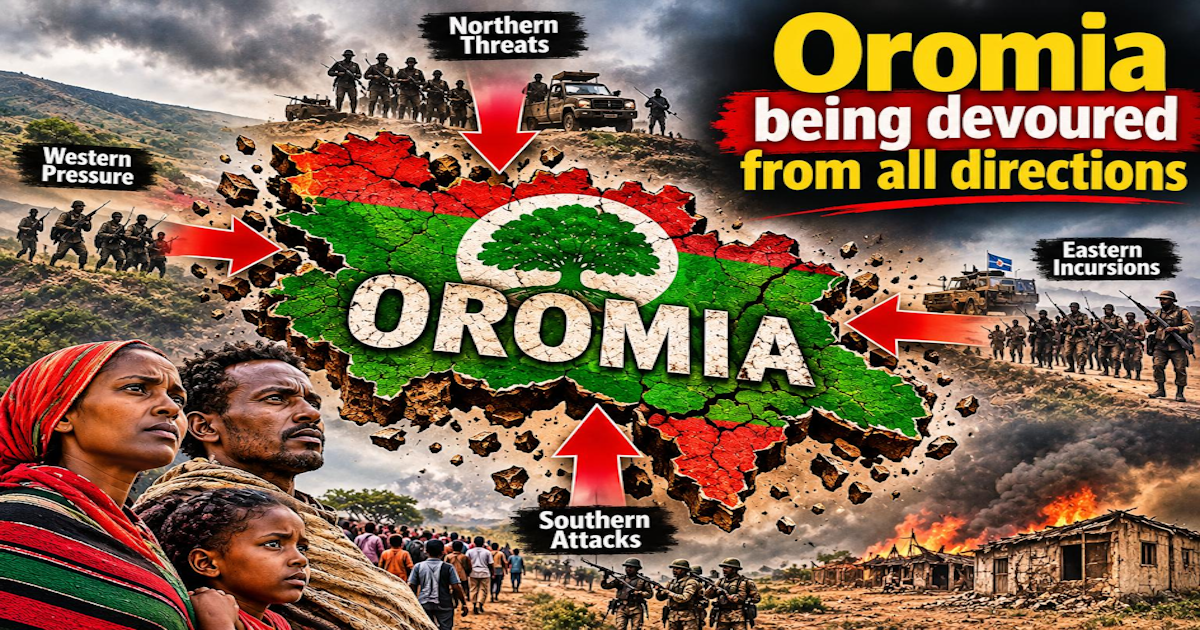
Fano did not emerge from nowhere, and it did not begin killing Oromo civilians by accident. On August 30, 2022, Amhara Fano militia entered Agamsa town in Horo Guduru Wollega and killed more than fifty-one Oromo civilians, part of a pattern that had already claimed thirty-seven lives in nearby Haro the previous October. Less than a month after Agamsa, the same militia struck Jarte Jardaga, killing more than fifty and displacing thousands. In November 2022, Fano returned to Kiremu district and killed a district court judge along with dozens of residents. In December of that year, video circulated showing Fano fighters posing with the decapitated heads of people they labeled “Shane,” while allied forces executed twenty more civilians in Hanger Gutin. By September 2025, a single day’s raid in the same Horo Guduru corridor had killed more than thirty people and displaced over six thousand.
This is not incidental violence attached to an ideology. It is the ideology’s logical terminus.
The ERI essay identifies, correctly, a rhetorical progression: fear produces anxiety, anxiety produces resistance, resistance hardens into contempt. What that essay leaves as a psychological observation, Western Oromia has lived as a body count. The “irrational fear of Oromo political ownership” catalogued as ERI’s sixth tenet does not stay contained in podcasts and op-eds. It arms itself. Fano’s own recruitment logic borrows directly from the ERI grammar of geographic dispossession and demographic threat, translating the abstract claim that Oromo self-government threatens non-Oromo Ethiopians into a concrete campaign against the villages, farms, and administrators of Horo Guduru and East Wollega. A Fano commander’s leaked declaration that Oromia would become the group’s “battlefield” is not a departure from ERI’s ideological premises. It is what those premises sound like once they stop being argued and start being enforced.
The Ethiopian state’s posture compounds the ideological point rather than complicating it. Prime Minister Abiy Ahmed publicly called Fano “a source of pride for the Amhara people and Ethiopia as a whole” in July 2022, weeks before Agamsa. Federal forces have since been repeatedly accused of vacating towns just ahead of Fano’s arrival and of tolerating, where they have not actively enabled, a militia operating deep inside another region’s constitutionally recognized territory. This is restorationism’s institutional face: a state that will not name Fano as what residents and the Oromo Liberation Army have called it, a campaign of ethnic violence against Oromo civilians, because doing so would require confronting the same territorial and hierarchical assumptions the ERI essay spends its length dismantling in the abstract.
The essay asks what a non-Oromo Finfinnee resident stands to lose from Oromo constitutional recognition, and answers: nothing enforceable, nothing legitimate. Western Oromia supplies the dark twin of that answer. What Oromo residents of Horo Guduru and East Wollega have lost defending against that same restorationist anxiety is not hypothetical — it is mass graves, millions displaced, a judge murdered in his own district. The zero-sum premise ERI treats as a rhetorical error is, on this ground, a body count. Naming the ideology is necessary. Naming its armed wing, and the state that shields it, is what makes the naming matter.
Commendation is due to the Oromia Today Editorial team for a rigorous and intellectually compelling critique of the ENDC-organised platform’s attempt to legitimise ERI under the guise of national consensus. In extending that framework, it is the drivers of this ideologue that require naming, not the ideology alone.
Chief among those drivers is the Ethiopian Orthodox Church, which has functioned as an institutional harbour for revisionist ideology rather than a neutral custodian of faith. The comparison with the Serbian Orthodox Church is instructive, and sobering. There, the fusion of church and national identity — rooted in the medieval Nemanjić dynasty and the Kosovo myth, but deliberately intensified through the twentieth century — did not remain a matter of symbolism. By the time of the 600th anniversary commemoration of the Battle of Kosovo Polje in 1989, church and state nationalism had merged so completely on the public stage that the church became an active participant in the ethnic mobilisation that helped drive Yugoslavia’s disintegration into war. The lesson is not that religion alone causes conflict, but that a church which fuses itself with one people’s national narrative forfeits its capacity to hold a multiethnic state together — and can instead become one of the institutions that pulls it apart. Ethiopia, with its own unresolved multinational settlement, cannot treat that precedent as merely academic. The Church of England was deliberately severed from Rome so that religious authority could serve the English crown’s political interests rather than a supranational one. The Ethiopian Orthodox Church has played a comparable role, fusing itself with Amhara-Ethiopian imperial identity until the two became, in the popular imagination, one and the same. Beyond the church, this ideology is sustained through education, the arts, the designation of a national language, theatre, and cultural shows at home and in the diaspora — which is why an average person in Europe, Africa or the Caribbean instinctively associates Ethiopian identity with Amharic speech and Orthodox Christianity, and finds it hard to accept that other identities exist just as fully.
The clearest recent proof of the church’s active role was the protest staged across Europe against Oromo Orthodox Christians seeking a church service in Afaan Oromo, laying bare the gap between the church and the revisionist current. I agree that despite the fall of the monarchy in 1974, the institutions sustaining this ideologue remained intact. Revisionists still see Afaan Oromo in schools as a threat to national unity — meaning Ethio-Amhara elite identity — which is why Amhara Fano’s strategic objective is to restore the unitary state. Across Europe, the church banner is displayed alongside the imperial flag rather than the crucifix most Christians identify with, confirming the institution’s self-presentation is as political as it is devotional.
Those aligned with ERI have been here since 1974 and will keep contesting every step, demonising the Oromo and others in their way, even under a different political banner. But the institutions that produce and sustain the ideology — church, classroom, stage, cultural hall — will remain the same. It is imperative to put the imperial machinery and its institutions behind us if Ethiopia is to continue as a coherent country.