The Week That Reshaped the Narrative of a Tottering Empire with Alliance Paradox

You can listen to the audio of this article.
Excerpt
The Alliance for Survival promised to reshape Ethiopia’s political balance. Within days, it had done something stranger: old enemies became allies, former allies remained enemies, Amhara Fano gained unexpected stature, and some of Abiy Ahmed’s fiercest opponents began wondering whether the incumbent might be preferable to the alternative. Welcome to the alliance paradox—and one extraordinary political week.
When the Political Compass Starts Spinning
In a matter of days, the newly declared Alliance for Survival has begun reshaping the political narrative of the Ethiopian state.
Ethiopian politics is no stranger to alliances, and certainly no stranger to alliances that eventually fail. Nor should anyone underestimate an alliance formed, as its rather heavily loaded name announces, for “survival.” But this one stands apart for the political whirlwind it has created almost from the moment of its birth. It attracted remarkable international attention, alongside an explosion of commentary across Ethiopian digital media, podcasts, YouTube channels, and social media.
And little wonder. The Alliance has managed to bring under one roof political and armed forces whose recent histories would ordinarily make sharing the same roof difficult enough, never mind contemplating a common political future.
That is Not a Coalition Diagram. It is Political Spaghetti.
Consider just two of the relationships.
The TPLF and Amhara Fano stood on opposing sides of one of the most devastating wars in Ethiopia’s recent history. Allegations of grave crimes, including genocide, have traveled in both directions, while territorial disputes arising from the war remain unresolved. Yet today they find themselves inside the same Alliance, united by the proposition that the regime of Abiy Ahmed must go.
Then there is the OLA and Amhara Fano. Here, too, the historical baggage is hardly carry-on luggage. Oromo political discourse has repeatedly characterized Amhara Fano as an imperial restorationist force wedded to a chauvinistic conception of Ethiopia fundamentally incompatible with Oromo self-determination, and 21st century politics for that matter. Anti-Oromo rhetoric, allegations of atrocities, racial insults, territorial claims, and accusations of expansionism have all formed part of this deeply antagonistic relationship.
And now representatives claiming the mantle of the OLA and Amhara Fano are members of the same Alliance.
If that were the entire story, Ethiopian politics would already have supplied us with enough material for the week.
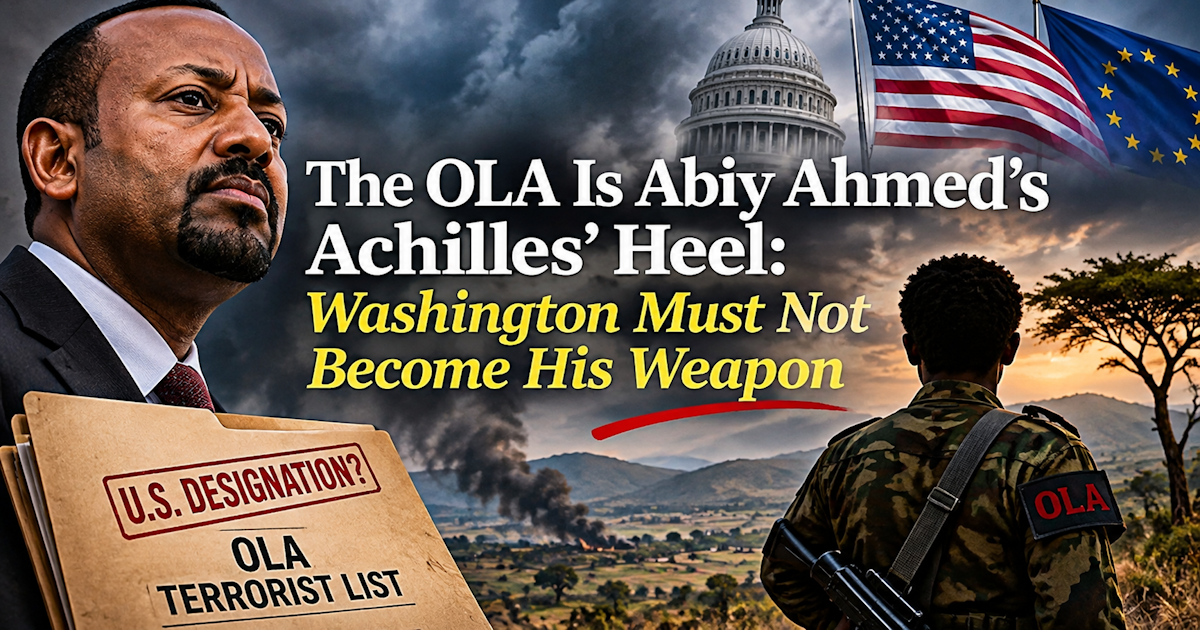
Unfortunately—or fortunately, for political satirists—there is Abiy Ahmed and the Prosperity Party (PP).
The Alliance exists principally to remove his regime. Yet PP itself has historical, political, or military tentacles connecting it to virtually every major actor now assembled against it.
PP is, after all, largely the institutional descendant of the EPRDF, the coalition dominated for nearly three decades by the TPLF until the political upheavals of 2018. Abiy emerged from the OPDO, one of that coalition’s constituent parties, before dissolving most of the EPRDF into the Prosperity Party. Thus, one of today’s principal forces seeking to remove PP once presided over the political system from which PP itself emerged.
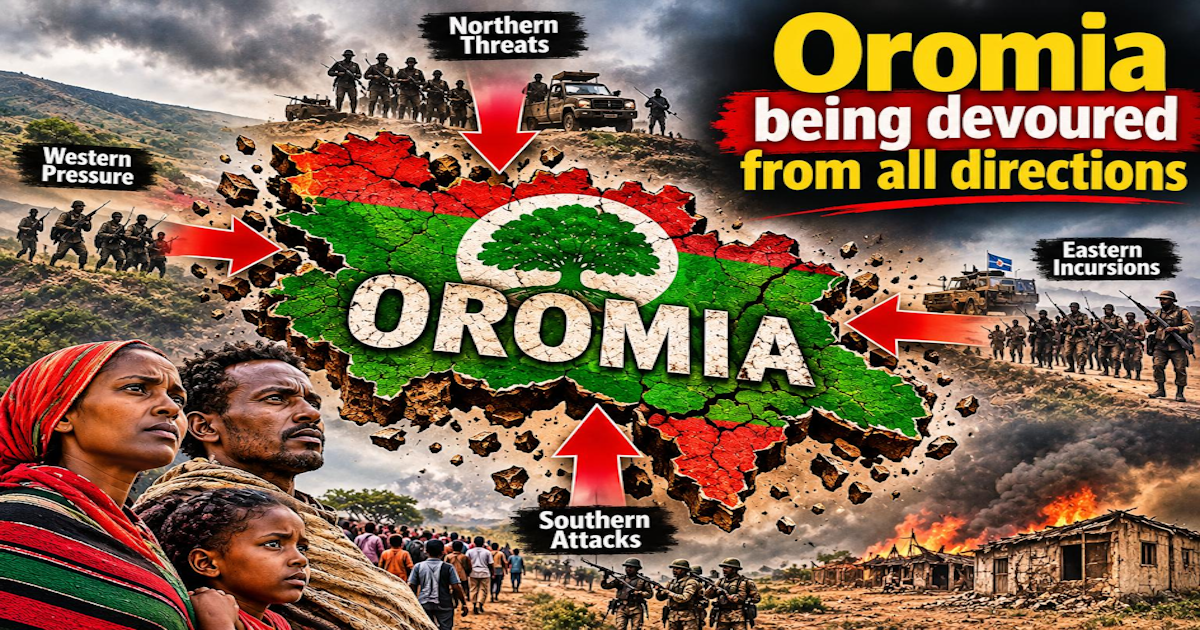
The Oromo relationship becomes even more labyrinthine. A regime whose Oromo wing likes to present itself as the political custodian of Oromia, calling itself "Oromo government" when suited, has spent much of its existence fighting the OLA—another organization claiming to represent Oromo national aspirations and now represented within an alliance seeking to remove that same regime. For PP, keeping the OLA at bay—and, if possible, eliminating it as a viable political and military force—is seen as essential to preserving its claim to Oromia as a dependable political constituency.
Then we arrive at Fano.
The federal regime and the Amhara regional establishment once encouraged, armed, and fought alongside Fano forces during the war in Tigray. Abiy Ahmed publicly praised Fano in those days, even organizing an award ceremony to honor notable Fano fighters soon after the end of the Tigray war. He declared in parliament Fano as being a pride of the "the Ethiopian nation" and they can roam as far afield as Jijigaa in the Somali region. Field Martial Birhanu Jula is also playing to the same tune saying "we have no quarrel with Fano".
That relationship subsequently collapsed spectacularly after the Pretoria Agreement, and the former wartime partners became battlefield enemies. Amhara Fano is now part of an alliance whose declared purpose is to remove the regime with which it once fought side by side.
Try drawing all of that on a whiteboard without running out of arrows.
TPLF fought Fano.
Fano fought alongside the PP regime.
PP emerged from the political order once dominated by the TPLF.
PP fights the OLA.
Fano fights the PP regime.
OLA representatives now sit alongside Fano.
TPLF now sits alongside both.
And everybody, for the moment, agrees about Abiy Ahmed.
That last qualification—for the moment—is doing heroic work.
The complications do not even end there. In an opinion essay published only days after the Alliance was announced, constitutional scholar Dr Tsegaye R. Ararssa placed the PP regime and Fano in essentially the same political compartment from the perspective of Oromo interests. His argument is not that the two are organizationally identical—they plainly are not—but that, judged by their effect on Oromo self-determination and security, the distinction has increasingly become one without meaningful difference.
So an Oromo contemplating the week’s developments is presented with an intriguing political menu: a regime fighting the OLA; Fano fighting that regime; an Alliance containing people associated with the OLA alongside Amhara Fano; the TPLF allied with the same Amhara Fano it fought during the Tigray war; and a prominent Oromo constitutional scholar arguing that, from an Oromo perspective, PP and Fano ultimately present variations of the same political threat.
That is not a coalition diagram.
It is political spaghetti.
And Then Something Even More Interesting Happened: The Hyenas Arrived
The Alliance was supposed to change the balance against Abiy Ahmed. Instead, its announcement appears to have changed conversations about Abiy Ahmed.
Public reaction erupted. Some of the fiercest criticism came not from supporters of the regime but from people vehemently opposed to it. Oromo media platforms opened their phones to callers. Podcasters dissected the Alliance from every conceivable angle. Social media produced the inevitable combination of outrage, prophecy, conspiracy, history lessons, and instant constitutional expertise.
People who had spent years condemning PP suddenly found themselves contemplating the alternatives being assembled against it.
Then came expressions that Ethiopian political satire could hardly have manufactured more efficiently: “better the devil you know,” and the considerably more zoological proposition that a well-fed hyena may be preferable to a hungry one.
The regime, unsurprisingly, did not need an engraved invitation to notice the opening. Any regime facing an opposition coalition will exploit contradictions among its opponents; this one suddenly had contradictions in abundance.
Within seven extraordinary days, it sometimes felt as though seven years of Ethiopian political antagonisms had been compressed into a single week.
Old enemies became allies. Former allies remained enemies. Opponents of the regime found themselves defending it against its opponents. People who wanted Abiy Ahmed gone began worrying about who might arrive after him. An Alliance for Survival intended to shorten the life of the regime even generated the delicious possibility that it might, however inadvertently, help prolong it.
The alliance paradox had arrived: an opposition can become so alarming that it makes an unpopular incumbent look temporarily reassuring.
And amid all this political cacophony, we at OROMIA TODAY found ourselves unable to resist the most unserious way of asking a rather serious question:
Who actually had a good week?
So, with no polling model, no algorithm, and absolutely no claim to scientific precision, here is our thoroughly opinionated scorecard of who emerged from this extraordinary week smiling—and who probably wishes the week had never happened.
Agree with it, disagree with it—or remain magnificently indifferent.
But what a week.
Now, the Winners and Losers of the Week That Was
After all that political spaghetti, somebody must have gained and somebody must have lost. Not necessarily territory, votes, or power—but something equally valuable in politics: perception, legitimacy, and narrative advantage.
And this being Ethiopian politics, there is one small complication: some of the week’s biggest winners may not even be standing on the Alliance podium. Some may be watching from a safe distance, wondering how their adversaries managed to deliver the prizes to them.
In a week like this, apparently, you don’t even have to enter the race to collect a trophy.
🏆 Winner: The Oromo People
Yes, admit it. You are surprised.
But there is a reason.
The extraordinary international coverage of the Alliance—from Western media to Middle Eastern 24-hour news channels—has inadvertently done something rather useful. Much of that coverage, supplemented by interviews with people who actually follow events on the ground, has presented Ethiopia not as a country approaching some grand national consensus, but as a political system struggling with profound and unresolved conflicts.
That picture sits rather awkwardly beside the recently concluded National Dialogue Conference, with its thousands of participants and carefully cultivated image of “a united Ethiopia discussing with itself.”
Then came this week.
Suddenly, much of the real political argument appeared to be taking place somewhere else entirely: among armed movements, excluded political forces, aggrieved national constituencies, regional actors, diaspora communities, and a public furiously debating what the Alliance might mean.
The contrast could hardly have been more unfortunate for the official narrative.
The National Dialogue was supposed to demonstrate Ethiopia talking to itself.
This week suggested something rather different:
Abiy was discussing with Abiy while much of Ethiopia was waiting outside the conference hall.
For the Oromo in particular, whose fundamental political questions remain unresolved despite the elaborate national dialogue process, the collapse of that carefully constructed appearance of consensus is no small thing.
Sometimes exposing the fiction is itself a victory.
🏆 Winner: Amhara Fano
Whatever else one may say about Fano, it had an extraordinary week in publicity.
The televised appearance of Zemene Kasse reading the Alliance statement gave Fano something political movements spend years trying to acquire: visibility, stature, and the unmistakable appearance of being central to a national political event.
For a movement carrying enormous political baggage—and facing serious allegations concerning its conduct and objectives—the optics were remarkable.
More remarkable still was the company.
Fano suddenly appeared alongside forces with which it has profound historical, territorial, and ideological disagreements. Some of those forces have previously regarded it not merely as an adversary but as an imperial restorationist movement fundamentally incompatible with their own political aspirations.
Yet there it was: not outside protesting, not somewhere at the bottom of the press release, but apparently occupying center stage.
And therein lies perhaps the week’s greatest gift to Amhara Fano:
legitimacy by association.
The Alliance may eventually have to explain what its members actually agree upon beyond removing Abiy Ahmed. Fano, meanwhile, has already received something considerably more immediate.
A seat at the table—and, for one extraordinary television moment, the microphone.
🏆 Winner: Abiy Ahmed
Without lifting a finger.
An Alliance formed expressly to hasten his departure appears to have reminded some of his fiercest opponents why they are frightened of what might replace him.
That gives us the mother of all alliance paradoxes:
An opposition can become so alarming that it makes an unpopular incumbent look temporarily reassuring.
Nobody needed to fall in love with Abiy Ahmed. Nobody needed to forget the wars, repression, political failures, or grievances of the past eight years.
The Alliance merely had to make the alternative look sufficiently unsettling.
And almost immediately, that old political cliché—“better the devil you know”—began acquiring a distinctly Ethiopian zoological upgrade:
A well-fed hyena may be preferable to a hungry one coming to replace it.
There may be no more damning commentary on an opposition alliance than discovering that its arrival has caused some of the regime’s opponents to reconsider the relative merits of the regime.
The Alliance for Survival was created to pose an existential threat to Abiy Ahmed.
Instead, during its extraordinary first week, it may have accidentally given him something every struggling incumbent dreams of:
an opposition against which he can look like the safer option.
For a man who was supposed to be the principal loser from the Alliance’s creation, that is quite a week’s work.
Especially when he didn’t have to do the work.
And Now, the Losers of the Week That Was
Time to visit the other side of the podium.
💥 The Loser: Abiy Ahmed
Yes, again.
Win some. Lose some. Occasionally, in Ethiopian politics, manage both in the same week.
The clue is in the National Dialogue.
Enormous resources, including substantial international support, have been poured into a National Dialogue process presented as the forum through which Ethiopia would confront its deepest political divisions and negotiate a common future. Thousands of participants were assembled. Conferences were held. Speeches were delivered. Cameras rolled. The reassuring picture was of a country finally sitting down to talk to itself.
And then came this week.
Outside the conference halls stood virtually every political contradiction the Dialogue was supposed to help resolve: armed insurgencies, wars between the center and the regions, unresolved questions of self-determination, territorial disputes, competing visions of the state, excluded political forces—and now an Alliance for Survival explicitly organized to remove the regime presiding over the entire dialogue process.
If this week did not expose the hollowness of the official National Dialogue narrative, one wonders what possibly could.
The cruelest part is that the Alliance accomplished this without intending to.
Its very existence asks an awkward question: if Ethiopia’s defining political forces are fighting the regime, fighting one another, forming emergency alliances outside the process, and debating the future of the state everywhere except inside the National Dialogue, precisely who has been dialoguing with whom?
Which takes us back to our earlier conclusion:
Abiy was discussing with Abiy while much of Ethiopia was waiting outside the conference hall.
Still, never underestimate Abiy Ahmed’s remarkable ability to swim against the political tide—and occasionally announce that the tide is flowing in the opposite direction.
Who knows? The National Dialogue may yet proceed to its triumphant conclusion, another conference may be convened, another communiqué issued, and an international audience assured that Ethiopia has successfully discussed its differences.
As though none of this had happened.
Abiy Ahmed may have won the Alliance paradox this week.
But the National Dialogue lost its alibi.
💥 The Losers: OLA and TPLF
The clue is already sitting in the winners’ column.
When an alliance created to remove Abiy Ahmed somehow makes Abiy Ahmed a winner, while simultaneously handing Fano an extraordinary and arguably undeserved upgrade in political stature, somebody has badly miscalculated.
That somebody—or, more accurately, those somebodies—must include the OLA and TPLF.
Let us admit something unfashionable in the age of political expediency:
Principles matter.
But politics has another inconvenient rule:
Perceptions matter too.
There is nothing inherently wrong with tactical alliances. Politics sometimes requires cooperation between forces that profoundly disagree. Tactics concern how you navigate today’s battlefield; strategy concerns where you intend to arrive tomorrow.
The trouble begins when the public can see the tactic but cannot see the destination.
Tell people, explicitly or implicitly, “First we remove the common enemy; we will sort out our differences afterward,” and an obvious question follows:
Sort them out how?
That is where the OLA and TPLF appear to have made the week’s monumental miscalculation.
These are not political novices encountering Ethiopia’s contradictions for the first time. Both organizations emerge from political traditions that helped put multinational federalism and national self-determination at the center of the response to perhaps the most difficult question confronting the Ethiopian state: how do profoundly different nations and peoples coexist within a single political framework without returning to domination by the center?
Whatever its failures in practice—and there were many—the federal experiment that emerged from 1991 recognized something fundamental:
Ethiopia’s diversity could not simply be commanded out of existence.
More than three decades later, the underlying problem has hardly become simpler.
If anything, the battlefield is murkier, the grievances deeper, the distrust greater, and the cost of another historical miscalculation potentially catastrophic.
That should have made the OLA and TPLF more demanding about the political foundations of an alliance, not less.
Instead of merely assembling everyone who currently wants Abiy Ahmed gone, they had another possibility: strengthen the solidarity of forces committed to multinational democracy, self-determination, genuine federalism, and an inclusive political settlement—and invite others to join that project by accepting its minimum principles.
That would have been an alliance built around a destination rather than merely around an enemy.
Instead, by bringing Fano into the tent without first resolving—or at least publicly confronting—the profound ideological and territorial questions separating them, the OLA and TPLF allowed the Alliance’s biggest unanswered question to overshadow its declared purpose.
The question is no longer simply:
How do you remove Abiy Ahmed?
It is:
What exactly are you proposing to put in his place?
And “we shall discuss that afterward” is not reassuring when some of the people around the table have recently been shooting at one another, accusing one another of atrocities, contesting territory, and advancing fundamentally incompatible visions of the Ethiopian state.
That is not strategic ambiguity.
That is a political IOU written against an uncertain future.
Worse still, the immediate political dividends appear to have traveled in precisely the wrong direction.
Amhara Fano gained visibility and stature.
Abiy Ahmed gained an opportunity to look comparatively reassuring.
And the OLA and TPLF inherited the burden of explaining why yesterday’s fundamental contradictions should suddenly be postponed until tomorrow.
That is quite an achievement for an alliance designed to weaken the incumbent.
Yet this need not be a permanent defeat.
The OLA and TPLF still have an opportunity to insist that opposition to Abiy Ahmed is not itself a political program. They can articulate the minimum principles upon which cooperation rests, clarify the constitutional destination they envisage, and make clear which fundamental rights and political settlements are not negotiable merely for the convenience of assembling a larger anti-regime front.
They can still strengthen the solidarity of progressive forces rather than dilute it through an alliance whose contradictions threaten to overwhelm its purpose.
🤝 Respect by Omission
And what about the other members of the Alliance?
The Ogaden National Liberation Front (ONLF), the Afar Revolutionary Democratic Unity Front (ARDUF/Uguugumo), the Benishangul Peoples’ Liberation Movement (BPLM), and the Gumuz Peoples’ Democratic Movement (GPDM) have received rather less attention in our winners-and-losers accounting.
That omission is deliberate.
In a week dominated by the extraordinary contradictions surrounding Fano, the OLA, the TPLF, and the PP regime they seek to remove, these organizations have had considerably less of an axe to grind in the political whirlwind we have been examining. They represent peoples with their own histories of marginalization, grievances, struggles, and aspirations, and their participation in the Alliance deserves to be considered on those terms rather than casually dragged into controversies largely generated by the bigger protagonists.
Indeed, there may be something to be said for having passed through this extraordinary week without becoming either the principal beneficiary of its contradictions or their most conspicuous casualty.
No accidental elevation to national savior.
No spectacular ideological somersault requiring three pages of explanation.
No sudden transformation of yesterday’s mortal enemy into today’s indispensable comrade.
And, as far as we can tell, no hyena comparisons.
In Ethiopian politics, that may qualify as an achievement in itself.
So we leave these organizations out of our winners-and-losers ledger not because they are unimportant, but because sometimes the most respectful political commentary is knowing whom not to turn into the punchline.
This week supplied more than enough volunteers.
But This Week?
And so we arrive at the end of a week in which almost everyone appears to have gained something they did not expect—and lost something they probably did not intend to surrender.
Amhara Fano gained stature. Abiy Ahmed gained, however briefly, the luxury of looking like the safer option to some of his fiercest opponents. The carefully curated image of a country resolving its differences through a National Dialogue was confronted by the considerably messier spectacle of the real political contest taking place outside the conference hall. Meanwhile, the OLA and TPLF found themselves explaining an alliance whose tactical purpose may be obvious, but whose strategic destination remains anything but.
Old enemies discovered a common enemy. Former allies discovered new reasons to remain enemies. Political principles collided with political expediency. And somewhere along the way, the familiar “devil you know” acquired four legs, sharp teeth, and a healthy appetite.
Only Ethiopian politics could take an Alliance for Survival and leave us wondering, after its first extraordinary week, exactly whose survival it has helped most.
There is no diplomatic way around it.
When your new alliance makes your enemy look safer and your most controversial partner look more legitimate, you have not won the political week.
Worse, you have managed the rare political feat of redistributing the rewards in precisely the opposite direction from the one intended.
You have handed your opponents the trophies—and volunteered to carry them onto the podium.
What a week indeed.