Teaching Law in a Fractured World: What Legal Academics Owe Broken Domestic and International Orders
Excerpt
At a time when armed force challenges the authority of courts and constitutions, what do legal academics owe a fractured world? Tsegaye R. Ararssa examines the erosion of international law and Ethiopia’s constitutional order, arguing for scholarly courage, consistent accountability and the preservation of collective memory.
Abstract
Across both the post-1945 international legal architecture and fragile domestic constitutional orders, raw armed force is increasingly displacing legal restraint. From U.S. sanctions crippling the International Criminal Court and diplomatic paralysis in the face of ongoing devastation in Gaza and the West Bank, to mass atrocities, forced conscription, and constitutional breakdown across Ethiopia and the wider Horn of Africa, the rule of law faces an existential crisis—interrupted only occasionally by rare counter-currents such as the International Court of Justice’s landmark November 2026 genocide ruling in The Gambia v. Myanmar. Against this backdrop, this essay interrogates the civic and ethical obligations of legal academics. Critiquing both the retreat into hyper-formalist abstraction and the complicity of jurists who lend intellectual cover to state violence, it argues that legal scholars serve as "soft legislators" and custodians of public memory. True scholarly rigor does not demand moral neutrality in the face of genocide and systemic impunity; rather, it requires interpretive integrity, institutional courage, and an unwavering commitment to protecting the vulnerable against the politics of raw power.
Keywords: legal academia, international humanitarian law, constitutional breakdown, Ethiopia, Palestine, International Criminal Court, Rohingya genocide, scholarly neutrality, collective memory
I. Men with Swords, Global and Local
Last week in Washington, D.C., U.S. Secretary of State Marco Rubio stood before a gathering of conservative lawyers at the Federalist Society’s 2026 National Lawyers Convention and issued a chilling warning to the International Criminal Court (ICC) (Rubio, 2026a). Defending sweeping U.S. sanctions aimed at dismantling the tribunal "brick by brick"—measures under which the entire Court was added to the U.S. Treasury's Specially Designated Nationals List in October 2026 and independent judges were frozen out of their bank accounts and deprived of basic digital infrastructure (U.S. Department of State, 2026)—Rubio invoked a Roman general’s blunt dismissal of civic charters: "Stop quoting laws to men with swords" (Plutarch, ca. 100/1917, Life of Pompey, 10.2; Rubio, 2026a).
Those words are not mere rhetorical posturing; they are spoken over the rubble of Gaza and the steadily annexed hills of the West Bank, where an entire population has been subjected to starvation, relentless bombardment, mass displacement, and settler-state dispossession in full view of the world, even as the legal institutions meant to halt those crimes are systematically starved of political will and financial lifelines (Albanese, 2024, 2026a).
Weeks earlier, on the other side of the globe, that exact logic of raw force was playing out in real time across Ethiopia. Violence erupted along the Oromia–Somali regional border in Moyale beginning on October 22, 2026, driving an estimated 50,000 people—mostly women and children—across the frontier into northern Kenya within days, adding to the millions already uprooted across the country (United Nations High Commissioner for Refugees [UNHCR], 2026). In the north, the fragile truce established by the November 2022 Pretoria Ceasefire Agreement (African Union, 2022) unraveled into renewed clashes and drone strikes across Tigray (Rubio, 2026b). Simultaneously, communities in Wallaggaa, West and Southwest Shawaa, Waltaane (Mi’eesso, in Harargee) and elsewhere across Oromia endure relentless cycles of extrajudicial killings, abductions, and mass displacement. In towns across Oromia and beyond, young people are being forcibly conscripted to bolster the ranks of the Ethiopian National Defense Force (ENDF) in multi-pronged wars of attrition against Oromia, Amhara, and Tigray—even as the regime entangles itself in Sudan’s devastating civil war in support of the Rapid Support Forces (RSF).
At first glance, a cabinet secretary’s speech in Washington, ongoing devastation in Palestine, and drone strikes or border clearances in the Horn of Africa might appear to inhabit separate political universes. In truth, they are twin symptoms of a single, global pathology: the systematic repudiation of legal restraint by those who command armed force. When the world’s most powerful states openly sneer at international tribunals as obstacles to raw power, they validate and embolden every domestic autocrat who treats a national constitution as disposable paper.
For those of us who study, teach, and write about international and constitutional law—and particularly those observing the Horn of Africa—these crises are not merely humanitarian emergencies. They are profound indictments of both a collapsing post-1945 international order and failing domestic constitutional states. They force a reckoning upon the legal academy—one that can no longer be deferred through procedural evasion or polite silence.
II. The Twin Collapse of Institutional Restraint—and a Rare Counter-Current
Across the globe, public faith in the institutions meant to restrain raw power is collapsing. At the international level, the post-war architecture built upon the Charter of the United Nations (1945), the Geneva Conventions (International Committee of the Red Cross [ICRC], 1949), and the promise of universal accountability under the Rome Statute (UN General Assembly, 1998) is visibly buckling. Courts are routinely treated as partisan obstacles rather than neutral arbiters; multilateral treaties are discarded the moment they become politically inconvenient; and the specialized vocabulary of international humanitarian law—terms such as proportionality, distinction, and self-defense—is routinely twisted to excuse mass civilian suffering rather than prevent it.
To be sure, flickers of institutional courage still pierce the gloom. Yesterday, 19 November 2026, in a historic and unprecedented judgment in Application of the Convention on the Prevention and Punishment of the Crime of Genocide (The Gambia v. Myanmar), the International Court of Justice ruled by nine votes to six that Myanmar committed genocide against its Rohingya minority during its 2017 military campaign, ordering reparations, restitution, and the safe return of displaced survivors (International Court of Justice [ICJ], 2026; United Nations, 2026). Marking the first time in its 80-year history that the World Court has held a state directly responsible for committing genocide under the 1948 Genocide Convention—in a case bravely brought by a small West African nation acting to vindicate universal treaty obligations—the decision stands as an encouraging exception to an otherwise faltering legal order. Yet a single landmark judgment at The Hague cannot by itself arrest the broader tide of impunity—especially when it arrives nearly a decade after the atrocities against the Rohingya, and while real-time devastation in Gaza and escalating dispossession in the West Bank are met with diplomatic vetoes, arms shipments, and institutional paralysis. When powerful states shield allies from accountability and openly threaten the tribunals tasked with enforcing international law, legal rulings risk becoming posthumous epitaphs rather than instruments of protection.
Domestically in Ethiopia, a parallel erosion has long hollowed out the constitutional state from within. What little public faith remains in the legal institutions meant to safeguard citizens has frayed to breaking point. Courts are widely viewed as instruments of executive convenience rather than independent guardians of rights. Constitutional provisions guaranteeing federal self-rule, regional autonomy, and fundamental human freedoms (Constitution of the Federal Democratic Republic of Ethiopia [FDRE Constitution], 1995, arts. 8, 13–44, 47, 52) are practically superseded by executive fiat, deployed selectively for cosmetic diplomatic consumption, or weaponized as instruments of lawfare against political dissidents and journalists. Formal constitutional bodies are quietly undermined or supplanted by ad hoc, extra-constitutional committees or commissions (for example, the so-called National Dialogue Commission) and command posts that enable the regime to do whatever serves its hold on power. Meanwhile, the much-publicized "transitional justice" process has stalled into a performative exercise in state-managed impunity—a mechanism designed not to uncover truth or deliver redress to victims, but to launder state culpability before international donors.
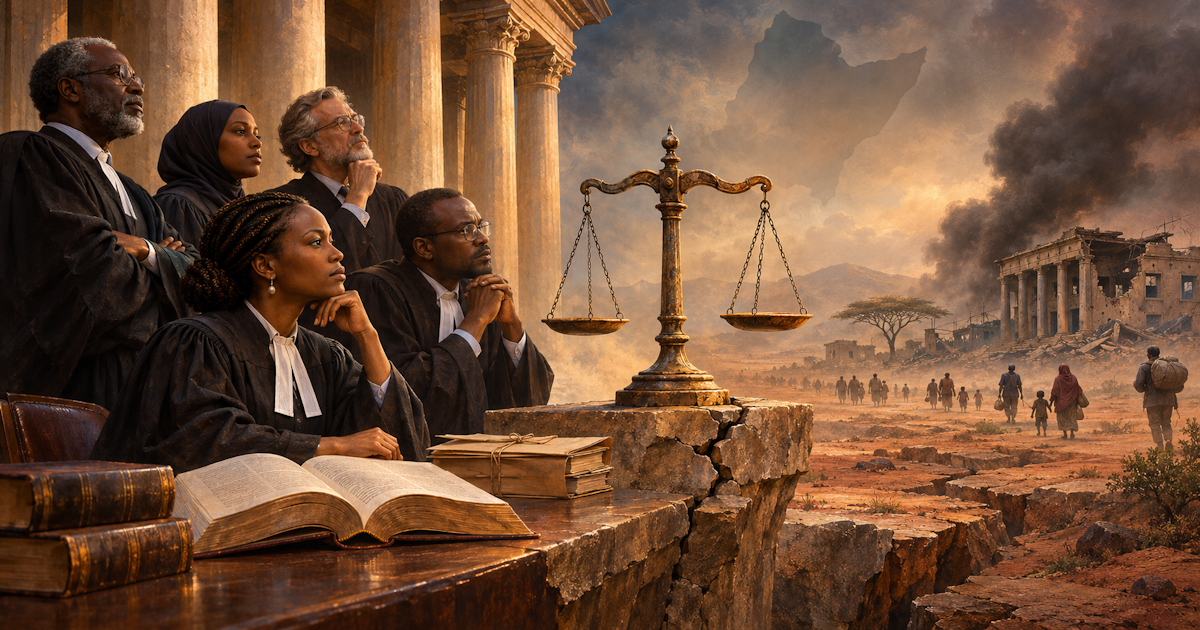
In an era marked by genocide, wars of attrition, near-total institutional breakdown, deep social polarization, and authoritarian consolidation, universities—and legal academics in particular—face an urgent, existential question: What is our purpose? What do we do now in the face of continuing massacres, engineered starvation, mass displacement, and the destruction of entire ways of life? How do we conduct ourselves in the face of unabashed state terror?
III. The Retreat into the Ivory Tower—and the Mercenaries of Legalism
For decades, a dominant strain of legal academia has answered that question by retreating into the ivory tower of safe abstraction. Inspired by a narrow, hyper-formalist positivism, too much legal scholarship treats international law, constitutional federalism, administrative law, or criminal procedure as intricate, self-contained technical puzzles devoid of human consequence. In seminars and law reviews, mass atrocities are sanitized into doctrinal debates over jurisdiction, standing or evidentiary thresholds. By severing legal rules from the flesh-and-blood realities they govern, scholars purchase professional comfort at the cost of moral relevance.
Worse still, when legal thinkers step out of the ivory tower and enter the public arena, too many do so not to restrain power, but to serve it. Every authoritarian project and imperial adventure finds willing architects among the credentialed elite—scholars and jurists who lend sophisticated intellectual cover to raw state violence. Globally, we have watched prominent lawyers craft clever rationalizations for illegal occupations, collective punishment, torture, and the dismantling of international accountability mechanisms. Domestically in Ethiopia, legal minds have lent their expertise to draft legalistic justifications for endless wars and states of emergency, arbitrary mass detentions, the dismantling of regional representation, the unconstitutional extension of the tenure of a parliament whose term had expired, and the outlawing of elections scheduled under the supreme law of the land (FDRE Constitution, 1995, arts. 54, 58).
History offers no shortage of warnings about where this path leads. From the jurists of Weimar Germany, who used constitutional emergency powers to dismantle democracy from within, to the legal architects of apartheid in South Africa and segregation in the American South, the law has rarely been destroyed solely by men with swords. Almost always, men with pens have walked ahead of them, clearing the doctrinal path and dressing brute force in the dignified robes of legality.
IV. The Price of Integrity and the Shame of Selective Silence
Meanwhile, those international lawyers and jurists who do insist on applying the law without fear or favor face unprecedented retaliation. Consider the ordeal of Francesca Albanese, an international human rights lawyer serving as the unpaid UN Special Rapporteur on the situation of human rights in the Palestinian territories occupied since 1967. For fulfilling her mandate—documenting systematic violations of international law by the Israeli government (Albanese, 2024, 2026a)—she has been barred from entering the territories she is tasked to monitor, subjected to relentless, coordinated smear campaigns, and targeted with sweeping U.S. sanctions. Frozen out of basic banking systems and barred from traveling to New York, she was reduced to addressing the UN General Assembly via video link on October 29, 2026, simply for doing her job (Albanese, 2026b).
Against the backdrop of such personal sacrifice by independent jurists, UN rapporteurs, and ICC judges, the relative silence of much of the legal academy feels all the more indefensible. Tenured academics in stable democracies enjoy extraordinary institutional protection—a shield expressly designed to allow scholars to speak uncomfortable truths without fear of losing their livelihoods. Yet while independent jurists risk financial ruin and personal safety to uphold legal norms, too many within the academy retreat into cautious ambiguity.
We debate doctrinal minutiae from the safety of university campuses while hesitating to name the defining moral catastrophes of our time: the ongoing genocide in Gaza and the relentless dispossession in the West Bank (Albanese, 2024); the devastating, largely ignored mass atrocities unfolding in Sudan and the Democratic Republic of the Congo; the unresolved genocide in Tigray and the ongoing ethnic cleansing in Western Tigray; the years of terror, aerial bombardments, and mass displacement in Wallaggaa; the brutal conduct of war and unfolding chaos in Amhara and Oromia; and the recurring border violence tearing communities apart in Moyale (UNHCR, 2026).
What makes this silence particularly corrosive is its selectivity. When the "rules-based international order" is invoked rigorously against geopolitical adversaries while suspended for strategic allies—or forgotten altogether when mass graves are dug in the Global South—it ceases to be a legal order at all. Similarly, when domestic legal commentators scrutinize abuses by non-state armed groups while excusing far larger campaigns of state terror, or mourn civilian suffering in one region while ignoring it in another, "scholarly caution" becomes indistinguishable from complicity. Selective outrage is not neutrality; it is politics masquerading as prudence.
V. Soft Legislation and the Civic Burden of the Classroom
When I first wrote down my personal pledges as a young legal scholar over a decade ago (Regassa, 2011), I wanted to articulate a different vision of the profession—one rooted in civic responsibility and commitment to just social causes rather than detached, clinical observation. Today, amid daily assaults on human dignity across both the international system and the tottering Ethiopian state, those early commitments feel less like lofty ideals and more like essential survival mechanisms for any shared future.
To teach and write about the law is to carry both an extraordinary privilege and a heavy civic burden. Unlike diplomats or lawmakers, academics do not negotiate treaties or draft proclamations; unlike judges, we do not issue arrest warrants or hand down verdicts. Yet we legislate softly and persuasively.
Every lecture delivered in a classroom devoted to international law, human rights, humanitarian law or constitutional law—and every article published in a journal—shapes how future judges, prosecutors, advocates, policymakers, and citizens understand the boundaries of justice. The legal classroom is where the professional conscience of a generation is formed. When law students see their professors treat grave breaches of international law and mass constitutional violations as mere theoretical case studies—or worse, as "politically sensitive" topics best avoided to maintain collegial harmony—we teach them a devastating lesson. We teach them that the law is a game for peaceful times, and that it becomes optional precisely when the stakes are highest.
That quiet influence comes with a clear, affirmative mandate: we must use our intellectual voice to help society imagine a fairer, more humane world, calling for a “new heaven and new earth” in the tradition of prophetic interpellation. Watching international tribunals face financial strangulation while civilians from Rafah to El Fasher, from Mekelle to Naqamtee, and from Abeshge to Moyale are starved, bombed, and driven from their ancestral lands in real time, it is profoundly tempting to succumb to despair—to conclude that international charters and domestic constitutions are merely polite fictions masking the eternal rule of force. Yet milestones like the World Court’s long-awaited reckoning in The Gambia v. Myanmar (ICJ, 2026) remind us that persistent, principled legal advocacy can still pierce impunity and etch undeniable truth into the judicial record.
Legal academics must actively push back against the cynicism and fatalism that paralyse public life. Cynicism is the authoritarian’s greatest ally; once citizens believe that law is nothing more than a fraud, they abandon the struggle to hold power accountable. Our job is not merely to describe the scarred legal landscape as it currently exists, however barren it may look, but to map out how it might be cultivated and rebuilt to empower people to recover their agency, exercise their right to self-determination, sustain equal citizenship, and foster human flourishing.
VI. Stewardship, Hermeneutics, and Collective Memory
At its core, legal scholarship is an act of stewardship. Legal academics are custodians of the public texts—treaties, constitutions, regional charters, statutes, and judicial precedents—by which a diverse society and an international community agree to live together. Approaching those texts requires rigorous discipline, hermeneutical integrity, and uncompromising intellectual honesty.
In a public square crowded with state and corporate propaganda, ethnic chauvinism, bad-faith legalism, and hollow performativity, our role is to insist on interpretive integrity paired with human compassion. Law is not an abstract mathematical formula; it is a lived reality and a site of fierce social contestation. At its best, it is the fragile shield that determines who receives humanitarian aid and who is protected from collective punishment; whether a family in Gaza or Kivu, Tawila or Al Kashafa, Angar-Saassigaa or Kiiramuu, Debarq or Zenzelma, May Woini or Hitsats, or Mekele or Moyale is shielded from arbitrary state violence; whether displaced citizens can safely return to their ancestral lands; and whose lives are deemed worthy of equal legal protection. We must interpret the law faithfully to uphold its highest universal promise, while fiercely challenging those who twist procedural technicalities to inflict systemic violence upon the vulnerable.
Fulfilling this duty requires drawing a hard, bright line between genuine scholarship and the politics of raw power. It requires us consciously to restrain ourselves from becoming ‘reactionaries’ of the type that Mark Lilla called “philotyrannical intellectuals” (Lilla, 2001, 2016), or wanton apologists for power (like the Ethiopian “intellectuals” whom we witnessed worshiping at the shrine of “Abiymania” on the eve of and during the Tigray genocide). As society’s paid thinkers, we are entrusted with time, resources, and institutional protection to generate and preserve knowledge—both "useful and ornamental," in the words of Benjamin Franklin (1749, p. 11)—not so we can justify state repression, excuse official neglect, or legitimize the abuse of authority. History judges harshly the jurists and scholars who used their intellects to normalize atrocity simply because it wore the guise of "national security", “right to exist,” or "constitutional order."
Equally vital is our obligation to act as a voice of collective memory. Both international diplomatic processes and state-controlled domestic commissions have an inherent tendency to sanitize history, reducing profound human suffering into dry procedural footnotes and bureaucratic reports—or erasing it altogether in the name of political expediency. We must resist that erasure. We must be worthy witnesses. We must re-call the absented. We must re-member the dismembered. By grounding our research in real-world impact and documented testimony, we ensure that the experiences of the besieged, the displaced, and the silenced—from Rafah to El Fasher, from Goma to Mekelle, and from Western Tigray to Wallaggaa and Moyale—are never scrubbed from the legal record. When state archives are falsified or sealed, rigorous legal scholarship becomes an indispensable archive of truth for future accountability.
VII. The Myth of Neutrality and the Courage to Choose a Side
Of course, speaking out carries real and uneven risks. For scholars working inside authoritarian states like Ethiopia, academic freedom is severely constrained; speaking the truth can mean dismissal, exile, imprisonment, or worse. Even from the diaspora or within tenured Western institutions, naming international crimes and criticizing powerful states or domestic regimes invites fierce backlash, coordinated defamation, donor pressure, and accusations of partisanship.
Defenders of strict academic neutrality often argue that taking a moral stand or naming ongoing atrocities compromises scholarly objectivity. Yet neutrality in the face of genocide, ethnic cleansing and systemic impunity is a philosophical illusion. As Archbishop Desmond Tutu famously observed, in situations of injustice, choosing neutrality is choosing the side of the oppressor (Tutu, as cited in Brown, 1984, p. 19). When an elephant has its foot on the tail of a mouse, claiming to be neutral will not be appreciated by the mouse.
Rigor and moral conviction are not mutually exclusive; indeed, true scholarly rigor demands moral clarity. We can—and must—engage fairly with competing historical claims, scrutinize abuses committed by all state and non-state armed actors without double standards, and maintain the highest evidentiary and methodological standards, all the while refusing to abandon our foundational ethical compass. Objectivity means faithfulness to evidence and law, not moral indifference to human slaughter.
Ultimately, being a custodian of justice requires choosing a side when core principles are tested. It means defending the rule of law against arbitrary decrees and threats of force, insisting on the universality of human rights and equal dignity before the courts, and upholding the sanctity of human life against those who treat populations as expendable collateral. If we are to make mistakes in our work, we must operate under a clear ethical imperative: to err on the side of freedom rather than oppression, and to keep speaking measured, persistent words of reason—especially to men with swords.
Protecting the weak from the strong and the powerless from the powerful is not merely a noble sentiment reserved for law school graduation speeches. For those of us entrusted with the study and teaching of the law, it is the bare minimum. In a fractured world and a war-torn Ethiopia, we can afford to do nothing less.
References
- African Union. (2022, November 2). Agreement for lasting peace through a permanent cessation of hostilities between the Government of the Federal Democratic Republic of Ethiopia and the Tigray People's Liberation Front (TPLF). Peace Agreement Database.
- Albanese, F. (2024, March 25). Anatomy of a genocide: Report of the Special Rapporteur on the situation of human rights in the Palestinian territories occupied since 1967 (UN Doc. A/HRC/55/73). United Nations Human Rights Council.
- Albanese, F. (2026a, October 12). Truth under the rubble: Media in the time of genocide (UN Doc. A/81/432). United Nations General Assembly.
- Albanese, F. (2026b, October 29). Human dignity under strain: The humanitarian and human rights consequences in the occupied Palestinian territory [Remote video statement to the UN General Assembly]. United Nations Information System on the Question of Palestine (UNISPAL).
- Brown, R. M. (1984). Unexpected news: Reading the Bible with third world eyes. Westminster Press.
- Constitution of the Federal Democratic Republic of Ethiopia. (1995, August 21). Proclamation No. 1/1995. Federal Negarit Gazeta, 1st Year, No. 1. Refworld.
- Franklin, B. (1749). Proposals relating to the education of youth in Pennsylvania. Printed by Benjamin Franklin and David Hall. National Archives Founders Online.
- International Committee of the Red Cross. (1949, August 12). Geneva Convention relative to the protection of civilian persons in time of war (Fourth Geneva Convention) (75 UNTS 287). ICRC Treaties, States Parties and Commentaries.
- International Court of Justice. (2026, November 19). Application of the Convention on the Prevention and Punishment of the Crime of Genocide (The Gambia v. Myanmar) [Judgment on the merits]. International Court of Justice.
- Lilla, M. (2001). The Reckless Mind: Intellectuals in Politics. New York Review of Books/Penguin Books.
- Lilla, M. (2016). The Shipwrecked Mind: On Political Reaction. Penguin Books.
- Plutarch. (1917). Lives, Volume V: Agesilaus and Pompey. Pelopidas and Marcellus (B. Perrin, Trans.). Harvard University Press. (Original work published ca. 100 C.E.). Perseus Digital Library
- Regassa, T. (2011). “Pledges of a Legal Academic.” Mizan Law Review, 5(2), 311–312.
- Rubio, M. (2026a, November 13). Keynote remarks at the Federalist Society's 2026 National Lawyers Convention [Speech]. Mayflower Hotel, Washington, D.C., United States. U.S. Department of State.
- Rubio, M. (2026b, October 15). Secretary Rubio's call with Ethiopian Prime Minister Abiy [Readout]. U.S. Embassy in Ethiopia.
- United Nations. (1945, June 26). Charter of the United Nations (1 UNTS XVI). United Nations.
- United Nations. (2026, November 19). World's top court finds Myanmar guilty of genocide against Rohingya. UN News.
- United Nations General Assembly. (1998, July 17). Rome Statute of the International Criminal Court (last amended 2010). International Criminal Court.
- United Nations High Commissioner for Refugees. (2026, October 28). UNHCR warns of growing humanitarian needs as thousands flee Ethiopia to Kenya [Press Release]. UNHCR.
- U.S. Department of State. (2026, October 9). ICC sanctions: Imposed sanctions, fact sheets, and statements regarding the International Criminal Court (Pursuant to Executive Order 14203). U.S. Department of State.
Additional References
- Huseen Dooyyoo, Four Thousand Voices, One Script: The Political Logic Behind Ethiopia’s National Dialogue, 8 August 2026, OROMIA TODAY.
- OT Ediorial, When the Center Is Chosen Before the Dialogue Ends, 13 August 2026, OROMIA TODAY.
- OT Ediorial, The Empire That Never Learns: Can a Misconceived National Dialogue Teach Ethiopia What History Could Not?, 5 August 2026, OROMIA TODAY.
- OT Editorial, To the Ethiopian National Dialogue Commission: You Are Wasting Your Time and Everyone Else’s, 31 January 2025, OROMIA TODAY.
Tsegaye R. Ararssa is an independent legal scholar, political and legal commentator, and public intellectual specializing in constitutional law/theory, human rights, and comparative federalism. His work focuses extensively on indigenous resistance, self-determination, and the political geography of the Horn of Africa.