
The Empire That Never Learns: Can a Misconceived National Dialogue Teach Ethiopia What History Could Not?
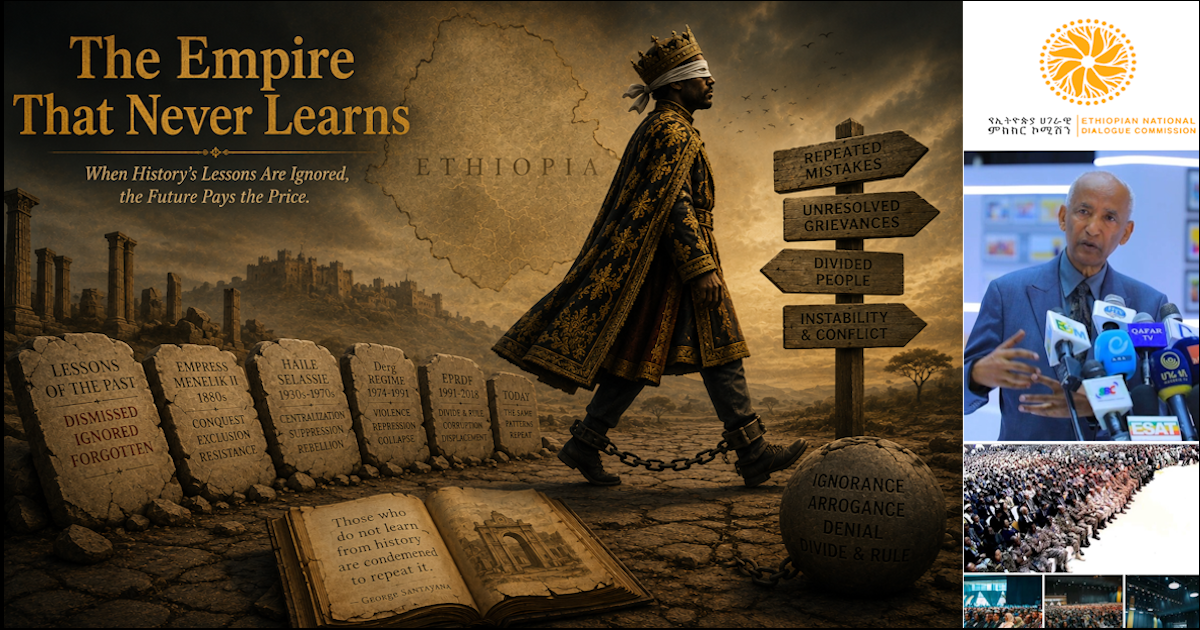
Excerpt
Can a misconceived national dialogue teach Ethiopia what history could not? This essay explores why empires never learn when they substitute political expediency for constitutional principle. Drawing lessons from Ethiopia's flawed national dialogue, it argues that justice postponed is development delayed, and that only the courage to confront historical injustices honestly can finally break the cycle of repeating history instead of learning from it.
1. Introduction
History is not unforgiving because people make mistakes. Mistakes are part of the human condition. History becomes unforgiving when societies refuse to learn from them. The greatest tragedies of nations seldom arise from a single error; they arise from the persistent habit of repeating the same error, often with greater conviction than before. Every missed lesson becomes another missed opportunity—choosing poverty over prosperity, conflict over reconciliation, disorder over stability, and ultimately the burdens of the past over the promise of the future.
History occasionally presents nations with rare opportunities to resolve long-standing injustices and liberate themselves from the weight of unresolved grievances. Such moments are precious because they enable societies to redirect their intellectual, political and economic energies towards building the future rather than endlessly contesting the past. Every opportunity seized closes one chapter of history. Every opportunity squandered merely postpones its resolution—whether by five years or fifty. The dispute does not disappear; it simply becomes more deeply entrenched, more emotionally charged, and more costly for the next generation to confront.
This is perhaps the greatest tragedy of Ethiopia's modern political experience. The country has never lacked opportunities for renewal. What it has repeatedly lacked is the collective willingness to embrace them. Again and again, moments that could have laid the foundations for lasting reconciliation have instead become occasions for reaffirming inherited assumptions. Questions that might have been settled through justice have been deferred through denial. The result is a nation that repeatedly expends its finest intellectual and political energies debating yesterday instead of building tomorrow.
The cost of this failure extends far beyond politics. Every unresolved historical injustice carries an opportunity cost. It is measured not only in periodic conflict or constitutional crises, but also in schools never built, businesses never established, scientific discoveries never pursued, investments never realized, and generations whose creativity is diverted from innovation towards perpetual political contestation.
Justice, therefore, is not a distraction from development. It is one of its essential foundations.
Nations prosper not because they suppress difficult questions, but because they possess the courage to resolve them fairly and move forward together. The Ethiopian experience offers no shortage of such recurring episodes. One could fill volumes tracing this pattern across successive political eras—from imperial expansion to military dictatorship, from revolutionary promises to constitutional experiments, and now to yet another moment in the country's search for a durable political settlement.
Each generation declares itself ready to turn a new page, yet too often finds itself reproducing the assumptions that created the previous chapter. It is this recurring failure to learn that has occupied my thoughts in recent days.
Ironically, it comes at a time when Ethiopia is engaged in what is presented as a historic process of "national dialogue" under the auspices of the Ethiopian National Dialogue Commission (ENDC) [1,2]—a process ostensibly intended to confront the country's unresolved political questions with honesty, intellectual humility and political courage.
2. The Elephant in the Room: Mishandling the Oromo Question Yet Again
The Prosperity Party (PP) administration, which emerged in 2018 from the constituent parties of the EPRDF under the leadership of Prime Minister Abiy Ahmed, inherited power at a moment of extraordinary historical significance. Its ascent to power, as a caretaker administration until a general election, was made possible by the Oromo Protest movement of 2014–2018—a sustained popular uprising against decades of political marginalization, historical injustice and authoritarian rule. The administration therefore assumed office not simply with a change of government, but with an unmistakable political mandate: to address the long-standing grievances that had fueled the movement.
Those grievances—often collectively described as the Oromo Questions—extended far beyond ordinary political demands. They encompassed unresolved historical injustices dating back to the imperial period, persistent territorial disputes affecting Oromia, the constitutional status of cities such as Finfinnee and Dirree Dhawa, and the controversial Finfinnee (Addis Ababa) Integrated Master Plan, whose proposed expansion into surrounding Oromo districts became the immediate catalyst for the mass protests. Not everyone, however, accepted that the new administration intended to honor that mandate.
The Oromo Liberation Army (OLA), under the leadership of Kumaa Dirribaa (Jaal Marroo), publicly declared that the OPDO/ODP-led government could not be trusted to resolve the Oromo Questions and refused to lay down its arms. At the time, many regarded that position as unnecessarily skeptical. Events that followed would convince many Oromos that those concerns were not without foundation.
Within a remarkably short period, the reformist narrative gave way to an increasingly coercive political order. Oromo opposition leaders were imprisoned, political organizations were systematically weakened, thousands of Oromos were detained, and credible allegations emerged regarding extrajudicial killings and the activities of the Koree Nageenyaa security structure [3]. By the time of the 2021 general election, no Oromo opposition party was able to participate in the electoral process.
The political agenda that had carried the government to power had quietly receded into the background, replaced by an unmistakable emphasis on political consolidation around Prime Minister Abiy Ahmed. Increasingly, public discourse appeared to shift from fulfilling the constitutional aspirations of the reform movement towards strengthening the authority and longevity of a single political leader.
This evolution was symbolically reinforced by the Prime Minister's own public recounting of his mother's prophecy that he would become Ethiopia's "seventh king." Whatever personal significance such a prophecy may hold, its repeated public invocation inevitably invites constitutional reflection when accompanied by proposals that would further concentrate executive authority—raising legitimate questions as to whether the country's political trajectory is moving towards institutional democracy or an increasingly personalized presidency.
Against that backdrop, therefore, the sudden emergence of a nationwide "national dialogue" raises an unavoidable question.
Whose national priority was it intended to address?
The central demands that had animated the Oromo protest movement had not been resolved. They had scarcely been addressed. Yet, instead of confronting those constitutional and historical questions directly, the country was invited into a broad and loosely defined national conversation encompassing virtually every political issue imaginable.
As one constitutional scholar observed in an interview on OMN (Oromo Media Network) [4], the ENDC was conceived as a mechanism to diffuse the Oromo Questions by subsuming them within a wider national agenda. In this view, demands such as genuine Oromo self-rule, the restoration of Oromia's constitutional boundaries, and the elevation of Afan Oromo to full federal working-language status were recast as broader "Ethiopian" questions rather than addressed on their own constitutional merits.
The effect was to replace a focused constitutional discourse with a more diffuse national conversation, thereby postponing engagement with the issues at the heart of the Oromo struggle.
This, in my view, represents the latest example of Ethiopia's recurring failure to learn from its own history. Rather than confronting the country's most fundamental constitutional questions at their source, the process risks dissolving them into an open-ended discussion among thousands of participants—many of whom possess neither the constitutional expertise nor the representative mandate to determine questions of such profound historical and legal significance.
Nowhere is this more apparent than in the treatment of issues concerning Oromia. One of the more extraordinary features of the dialogue has been the assumption that questions relating to Oromo constitutional rights—such as the status of Finfinnee or Dirree Dhawa—should be settled through a national consultation involving participants from across Ethiopia. Yet constitutional rights are not ordinarily subjected to majoritarian negotiation simply because they are politically contentious.
To illustrate the point, one might ask a simple comparative question. Would anyone seriously propose convening the people of England and Wales to determine Scotland's constitutional future? The proposition would rightly be regarded as absurd.
The principle is straightforward: matters that concern the constitutional rights and self-government of a particular constituent nation cannot derive their legitimacy merely from the numerical preferences of those outside it. That, ultimately, is the elephant in the room.
The most important questions concerning Oromia cannot be resolved by circumventing the very people to whom those constitutional rights belong.
Until that basic principle is acknowledged, Ethiopia risks repeating a familiar pattern—mistaking procedural spectacle for genuine political settlement, while once again postponing the difficult but indispensable task of addressing the Oromo Question with the seriousness it demands.
3. Can a Misconceived National Dialogue Teach Ethiopia What History Could Not?
At first glance, the question may appear paradoxical. How can a process founded upon questionable premises possibly offer meaningful lessons? Yet history often teaches in precisely that way. Failed experiments, flawed institutions and misguided political projects frequently illuminate truths that success leaves concealed.
Their greatest value lies not in what they accomplish, but in what they reveal.
If Ethiopia is prepared to examine the present national dialogue with intellectual honesty rather than political expediency, it may yet serve a constructive purpose. Not because it has resolved the country's constitutional questions, but because it has exposed many of the assumptions that continue to obstruct their resolution. In that sense, even a misconceived dialogue can become an unexpected teacher.
The lessons that follow are therefore not offered as a critique of a single political process. They are presented as broader constitutional and democratic principles—lessons that Ethiopia must eventually embrace if it is to escape the recurring cycle of postponing justice, repeating history and delaying the peace and development to which all its peoples aspire.
4. What Ethiopia Must Learn from a Misconceived National Dialogue
History rarely repeats itself because nations lack intelligence. More often, it repeats itself because political actors construct convenient solutions designed to avoid difficult truths.
Instead of confronting historical injustices with honesty and courage, they seek procedural shortcuts, rhetorical distractions or majoritarian exercises that create the appearance of progress without addressing the substance of the problem. Such approaches may postpone disagreement for a season, but they cannot resolve it.
Durable political settlements are built upon sound principles, not convenient expediency. The present national dialogue regrettably illustrates several recurring mistakes from which Ethiopia ought to learn.
4.1. Constitutional Rights Do Not Derive Their Legitimacy from External Majorities
Perhaps the most fundamental lesson is that constitutional rights cannot be subjected to external approval simply because they are politically contentious.
Identity, territorial integrity, self-government and constitutional status are not matters to be determined by those who possess no constitutional stake in them. They belong, first and foremost, to the constitutional communities to whom those rights have been assigned. The debates surrounding Finfinnee and Dirree Dhawa illustrate the point.
When the 1995 Constitution [5] recognised Oromia as one of Ethiopia's constituent regional states, it did not simultaneously transform Oromo cities into constitutional islands detached from Oromia. Questions concerning the constitutional rights of Oromia should therefore be approached through constitutional interpretation, historical context and dialogue with the people directly concerned—not by inviting external majorities to determine whether those rights should exist.
"Constitutional rights do not derive their legitimacy from external majorities."
That principle lies at the heart of constitutional democracy. Rights exist precisely because they are protected from fluctuating political majorities.
4.2. A Flawed Premise Cannot Be Corrected by Larger Numbers
One of the more curious features of the present dialogue has been the repeated emphasis on the participation of approximately four thousand discussants, as though numerical scale itself confers legitimacy.
It does not.
If the underlying constitutional premise is flawed, expanding participation merely enlarges the mistake.
"On a flawed premise, larger numbers merely produce a larger mistake."
Forty independent constitutional scholars representing diverse schools of constitutional thought would contribute far more towards resolving complex constitutional questions than four thousand discussants invited to deliberate upon an incorrectly framed premise. The legitimacy of a constitutional settlement rests not on how many people participate in the discussion, but on whether the right people are entrusted with answering the right questions under the correct constitutional principles. Representation should never be confused with expertise, nor participation with legitimacy. Constitutional truth is not established by a show of hands.
4.3. Dialogue Loses Its Meaning When Voices Are Scripted
A national dialogue derives its legitimacy not merely from the number of participants assembled, but from the independence of the voices they represent. Citizens are invited to such processes because they are expected to contribute their own experiences, perspectives and convictions—not because they are expected to reproduce official narratives.
There is credible evidence that many participants in the present dialogue underwent preparatory sessions before the discussions commenced. Training in itself is neither unusual nor objectionable. Participants in complex constitutional or political processes may reasonably receive briefings on procedures, discussion formats or the issues under consideration.
The difficulty arises when preparation crosses the line from informing participants to shaping what they are expected to say.
Citizens invited to deliberate should never feel obliged to advance a preferred political narrative. If any training is provided, its purpose should be to equip participants to think critically, express themselves freely, listen respectfully to opposing viewpoints and engage without fear of intimidation or reprisal. Those are the essential conditions of meaningful democratic participation.
Recent interviews with arriving discussants were revealing in this regard. A striking number introduced their contributions by emphasizing that they spoke "as Ethiopians seeking unity." Unity is, of course, an entirely legitimate aspiration. Yet when a common formulation repeatedly emerges before substantive deliberation has even begun, it inevitably raises questions as to whether participants are expressing independent convictions or reproducing themes that have already been encouraged.
A genuine dialogue seeks to discover what citizens think. It does not begin by telling them what they ought to think.
This distinction is fundamental. Not long ago, citizens were widely reported to have been instructed how to vote in general elections. If a similar culture of political direction now extends to a national dialogue, the process risks becoming less an exercise in public deliberation than a rehearsal of predetermined conclusions.
Independent voices are not an inconvenience to democracy; they are its lifeblood. A dialogue whose participants are expected to conform rather than to think freely ceases to be a dialogue in the true sense of the word.
4.4. Honest Politics Requires Honest Arguments
A recurring weakness in Ethiopian political discourse is the tendency to substitute emotionally appealing narratives for principled constitutional reasoning. Only days ago, in an interview with the Amhara Media Corporation (AMECO) [6,7], Prime Minister Abiy Ahmed argued that Amhara and Oromo communities have intermarried for generations. That observation is undoubtedly true and entirely worthy of celebration. Shared families, friendships and cultural exchange enrich every society. Yet such realities neither erase historical injustices nor resolve constitutional questions.
Intermarriage cannot answer questions of historical dispossession, constitutional recognition or the rights of indigenous peoples.
Those issues deserve to be addressed openly and honestly on their own merits rather than being obscured by emotionally persuasive but constitutionally irrelevant arguments. A similar example arises in recent claims that the principle of self-determination has somehow become obsolete because of its historical association with communist political thought. This is equally misleading.
The right of peoples to self-determination neither originated with communist ideology nor disappeared with it. It remains a recognised principle of international law and is reflected in the Charter of the United Nations [8,9,10] and subsequent international human rights instruments.
Political convenience should never be allowed to redefine established constitutional or legal principles. As of this writing, only a preview has been released of an interview with Prime Minister Abiy Ahmed scheduled to be broadcast by OBN (Oromia Broadcasting Network) [11] on an unspecified future date. Even within that brief preview, however, the Prime Minister made a series of extraordinary statements that exemplify the very pattern of political discourse examined in this essay.
Among the assertions were emphatic declarations that "Oromo is fully liberated; period!" that "Oromo is Ethiopia, and Ethiopia will not secede from Ethiopia," and, more remarkably still, a reference suggesting a territorial claim on Eritrea on behalf of the Oromo people. Whatever the broader context of the forthcoming interview may reveal, these statements are striking because they once again substitute sweeping political slogans and emotionally charged narratives for careful engagement with the constitutional and historical questions under discussion. None of these assertions addresses the unresolved constitutional grievances that gave rise to the Oromo protest movement. Instead, they redirect attention towards themes of unity, symbolism and geopolitical aspiration while leaving the underlying questions untouched.
This recurring pattern—responding to constitutional problems with rhetorical reassurance rather than principled constitutional reasoning—is precisely what this essay seeks to highlight. If the preview accurately reflects the broader tenor of the interview, it serves as yet another reminder that Ethiopia's greatest challenge is not the absence of political discourse, but the persistent reluctance to confront its foundational questions with the intellectual honesty they demand.
Indeed, it is difficult to imagine a more fitting illustration of the central theme of this essay: an empire that has yet to learn from its own history.
4.5. Historical Revisionism Is No Substitute for Reconciliation
Perhaps the most troubling habit in Ethiopian political life is the repeated temptation to rewrite history whenever historical reality appears politically inconvenient. Reconciliation cannot be built upon selective memory. Only days ago, Prime Minister Abiy Ahmed asserted that Emperor Menelik II and Ras Gobana jointly "created Ethiopia" [6,11], presenting a narrative that implies a partnership between the imperial conqueror and his Oromo general.
Such a characterization overlooks the profoundly contested place that Gobana occupies in Oromo historical memory. For many Oromos, Gobana symbolizes collaboration in the conquest and subjugation of Oromo society rather than a shared project of nation-building. Whether one agrees with that assessment or not is beside the point. What matters is that deeply contested historical experiences cannot simply be rewritten to support present-day political objectives. Attempts to sanitize history rarely produce reconciliation. More often, they deepen mistrust by suggesting that historical suffering itself is now open to political reinterpretation.
Genuine reconciliation begins not with historical revisionism but with historical honesty.
Only when societies possess the courage to acknowledge uncomfortable truths can they begin the far more difficult work of building a common future.
4.6. Finally, There Can Be No Genuine National Dialogue Without Peace
There is, however, another elephant in the room that cannot be ignored. The shortcomings of the present national dialogue do not arise solely from a flawed premise, an inappropriate constitutional framework or a questionable political agenda. They also arise from the extraordinary reality that the dialogue is being conducted while the country remains engulfed in multiple armed conflicts. Under such circumstances, describing the process as a national dialogue becomes difficult to sustain.
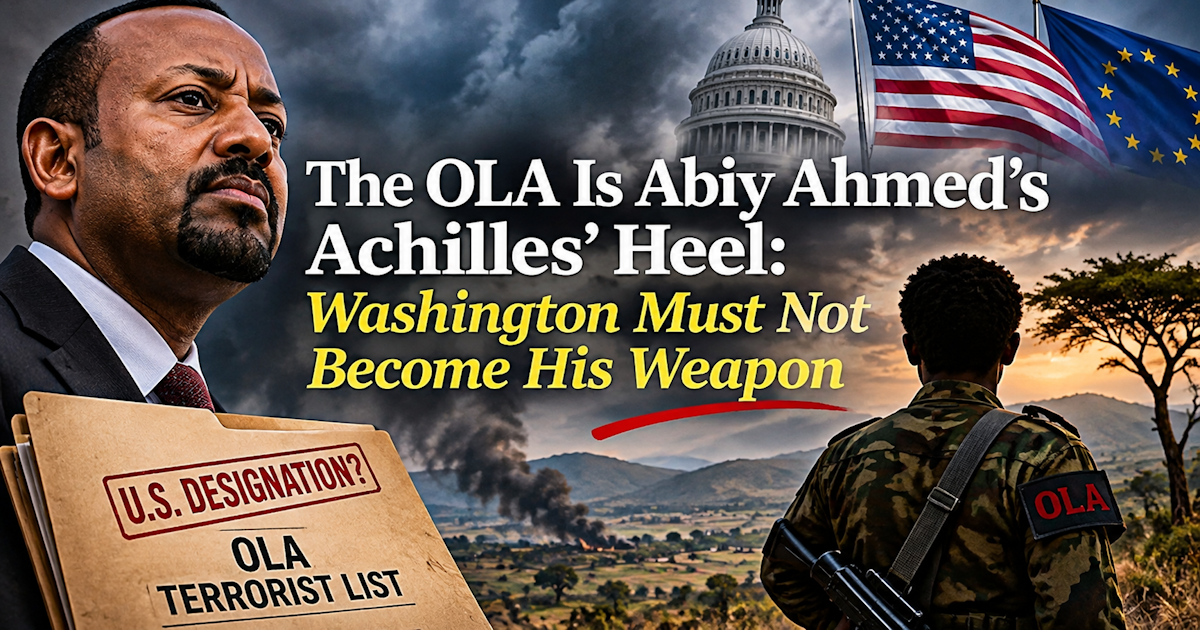
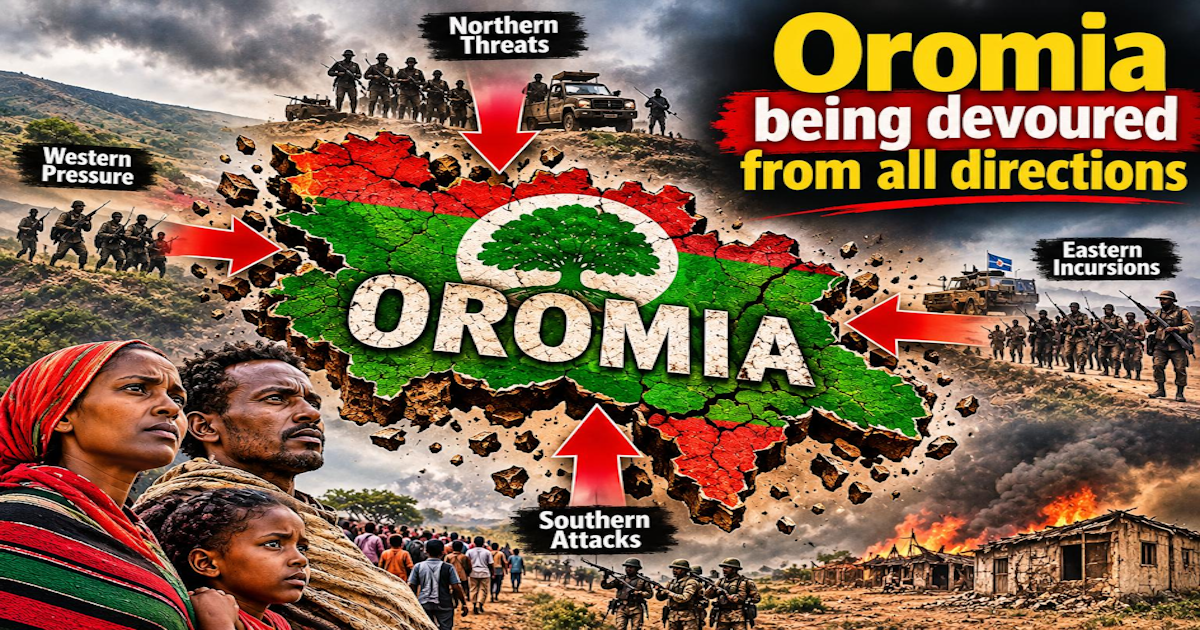
Large-scale armed confrontation continues in Oromia between the government and the Oromo Liberation Army (OLA), while the conflict in the Amhara region between government forces and Fano remains unresolved. Tigray, meanwhile, has yet to be meaningfully reintegrated into the federation following the devastating civil war of 2020-2022, and concerns persist over renewed instability. As of this writing, according to some sources [12], the war between ENDF (Ethiopian National Defense Force) and TPLF (Tigray People Liberation Front) has already broke out. These are not peripheral disturbances; they involve some of the country's principal political actors and some of its most consequential constitutional disputes.
A genuine national dialogue cannot proceed as though these realities exist outside the room. Peace is not the reward for a successful dialogue; it is often the necessary precondition for one. Before constitutional questions can be addressed with legitimacy and public confidence, those engaged in armed conflict must first be brought to the negotiating table.
A nation cannot negotiate its constitutional future while significant parts of that nation continue to negotiate their political future on the battlefield.
History offers an important lesson. Durable political settlements are rarely achieved by convening those who already agree while excluding those who continue to fight.
The first responsibility of a credible national dialogue is therefore not merely to facilitate discussion, but to create the conditions under which all principal stakeholders can participate without the shadow of war hanging over the proceedings.
Without such an inclusive peace process, the risk is that what is presented as a national dialogue becomes little more than a dialogue among those already within the political tent, while the country's most fundamental conflicts continue to be contested on the battlefield rather than resolved around the negotiating table.
5. Concluding Remarks
The lessons outlined above are by no means exhaustive, even within the narrow confines of the misconceived national dialogue examined in this essay. Many other unresolved issues of equal, if not greater, constitutional and political significance lie beyond its scope.
Among the most consequential are the deliberate territorial engineering and border redrawing pursued under the EPRDF as instruments of political expediency and divide-and-rule, with Oromia bearing the greatest burden of this strategy.
Equally important, the constitutional anomalies affecting Oromia's cities extend well beyond Finfinnee and Dirree Dhawaa, reflecting a broader pattern of political interference in Oromia's territorial and administrative integrity. Those issues deserve careful treatment in their own right rather than passing reference here.
Nor are the lessons discussed above revolutionary or uniquely Ethiopian. They reflect the ordinary requirements of any constitutional democracy seeking a durable political settlement: political legitimacy, inclusive participation, respect for historical realities, constitutional fidelity, and the willingness to confront grievances honestly rather than postpone or disguise them.
Yet when such principles are repeatedly ignored, history has an unfortunate habit of returning to demand payment.
Political shortcuts may postpone justice, but they can never eliminate it. Constitutional questions deferred are constitutional questions preserved.
The passage of time does not diminish them; it merely transfers them from one generation to the next, usually at a greater political, economic and human cost.
It is against this backdrop that the recent reactions to the debate over Finfinnee and Dirree Dhawa should be understood. They are not isolated incidents, nor merely disagreements over constitutional interpretation. They are manifestations of a deeper intellectual disposition—a reluctance to abandon inherited assumptions even when history, constitutional principle and political prudence all point in another direction.
There is an old and enduring wisdom that societies need not learn every lesson through their own suffering. The experience of others is often a far less costly teacher.
Mature constitutional democracies have accumulated centuries of practical experience in accommodating competing identities, balancing constitutional rights and resolving political disagreements through institutions rather than perpetual confrontation.
The United Kingdom and Canada, among others, demonstrate that constitutional questions touching upon identity, territory and self-government are best approached through principled constitutional processes, patient negotiation and respect for the communities directly concerned. They also remind us that reconciliation is not achieved by denying difficult histories but by confronting them with honesty, humility and mutual respect.
Ethiopia need not reinvent constitutional wisdom, nor must it repeat every historical mistake before discovering the lessons others have already paid dearly to learn.
Ultimately, this essay is not about Finfinnee alone. It is about a choice that confronts every generation.
A nation may continue defending inherited injustices with ever more sophisticated arguments, or it may summon the courage to resolve them with honesty and fairness. One path consumes decades in political attrition, mutual suspicion and recurring conflict. The other liberates a nation's intellectual, political and economic energies for the far more rewarding work of educating its children, strengthening its institutions, expanding its prosperity and building a shared future.
History rarely rewards those who postpone justice. It almost always rewards those who possess the courage to confront it.
For every historical injustice honestly resolved is one less political battle to be fought, one less grievance to be inherited, and one more opportunity for a nation to devote its time and talent to the work that truly matters: human flourishing.
That, perhaps, is the greatest lesson of all.
Nations do not become prosperous because they escape history. They become prosperous because they learn from it.
References
- Ethiopian National Dialogue Commission, Ethiopia.
- OT Editorial, To the Ethiopian National Dialogue Commission: You Are Wasting Your Time and Everyone Else’s, 31 January 2025, OROMIA TODAY.
- GIULIA PARAVICINI, In Ethiopia, a secret committee orders killings and arrests to crush rebels, A REUTERS INVESTIGATION, 23 February 2023, Reuters.
- OMN:ቆይታ ከዶ/ርፀጋዬ አራርሳ ጋር. 'ሀገራዊ ምክክር' እና መዘዞቹ!, 5 August 2026, OMN YouTube Channel, YouTube.
- Constitution of the Federal Democratic Republic of Ethiopia (official consolidated English text), Ethiopian Embassy, Brussels, Belgium.
- ጠቅላይ ሚንስትር ዐቢይ አሕመድ(ዶ.ር) ከአሚኮ ጋር ያደረጉት ቆይታ ክፍል-1, 31 July 2026, AMECO YouTube Channel, YouTube.
- ጠቅላይ ሚኒስትር ዐቢይ አሕመድ(ዶ.ር) ከአማራ ሚዲያ ኮርፖሬሽን (አሚኮ) ጋር ያደረጉት ቆይታ || ክፍል 2, 1 August 2026, AMECO YouTube Channel, YouTube.
- United Nations, Peace, dignity and equality on a healthy planet, United Nations Charter (full text), (for full text of the Charter, scroll to Chapter I, Article 1, paragraph 2).
- James Summers, Self-Determination in International Law, 23 March 2012.
- Self-Determination, Wikipedia.
- Afgaaffii Ministirri Muummee Abiyyi Ahimad(PhD) OBN waliin (a preview), 4 August 2026, OBN YouTube Channel, YouTube.
- Kaleb Moges and Yemane Nagish, Hundreds flee fighting in northern Ethiopia as fears rise of return to civil warHundreds flee fighting in northern Ethiopia as fears rise of return to civil war, 3 August 2026, BBC Tigrinya, BBC.




This is a powerful piece, and it names something too often obscured by procedural language: what’s at stake in this “national dialogue” is not administrative tidiness but the single constitutional thread — Article 39’s recognition of nations’ self-determination and Article 49’s framing of Finfinnee’s relationship to Oromia — that has held Ethiopia’s diverse nations and nationalities together within one state. Cut that thread, and what’s offered as reconciliation becomes its opposite.
The article’s reframing is essential: this isn’t a debate about federal cities versus autonomous regions. It’s a question of whether historical dispossession can be quietly ratified by relabeling it. The “imagine it happened elsewhere” thought experiment makes this vivid — success built on conquest doesn’t make the conquest legitimate, it just makes it harder to see.
Equally important is what the piece refuses to do: it doesn’t ask today’s Finfinnee residents to answer for Menelik’s conquests, and it doesn’t treat decolonization as eviction. Recognition, restitution, and reconciliation — the article’s own framework — leaves room for a cosmopolitan Finfinnee that is also, honestly, an Oromo city.
The deeper danger is procedural, not just territorial: a dialogue commission assembled without the mandate to touch Article 39 and 49 in the first place is positioning itself to unravel the very accommodation that makes a multinational Ethiopia possible — under the banner of dialogue rather than through it.
The timing compounds the illegitimacy. A government currently waging war against three regional states home to some 70 percent of the country’s population, with over 30 million people in need of food aid, has neither the moral standing nor the practical bandwidth to convene a credible national conversation on constitutional first principles. A state in that condition should be addressing the crises it has created, not assembling a sham dialogue to strip Oromia of its constitutional rights.