Ilfinash Qannoo: The Voice of a Generation That Still Speaks to Us
A Life That Became Part of Oromo History
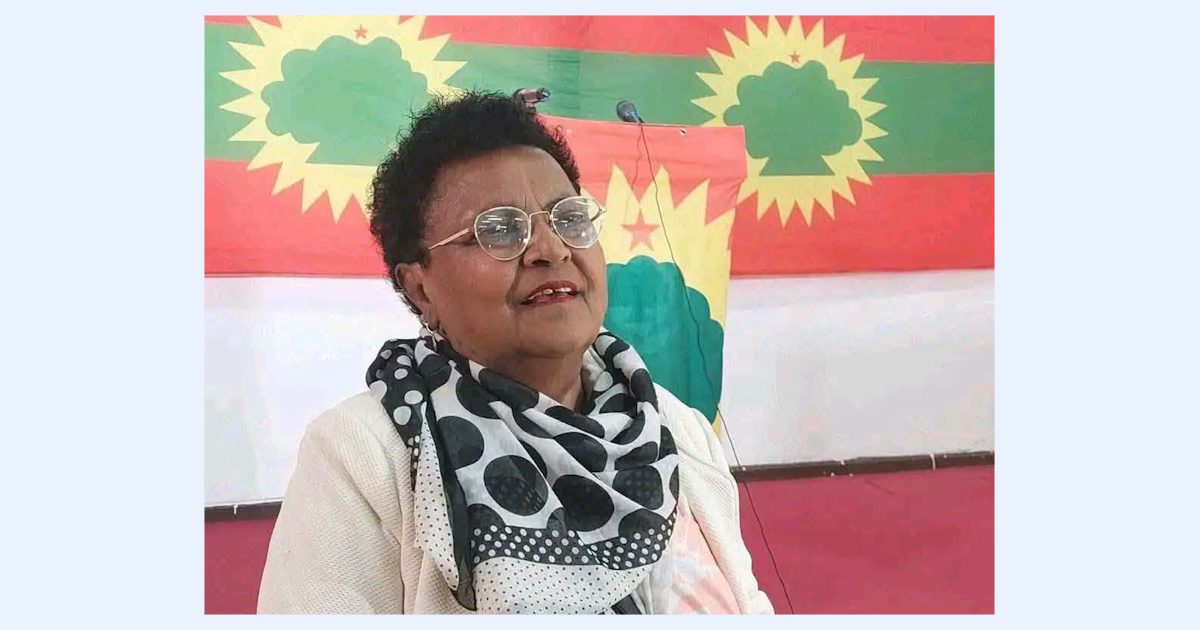
When Aaddee Ilfinash Qannoo died on September 6, 2026, at the age of 63, the scale of the reaction across Oromo communities was remarkable. Social media became awash with her photographs, recordings and memories. Artists, political organizations, community associations and ordinary people reached back across decades to retrieve songs and stories associated with a woman whose artistic career had become inseparable from the modern Oromo political experience.
The response continued beyond the digital world. Two days later, large numbers gathered first in Finfinnee and then in Ambo to bid farewell to a singer whose voice had accompanied generations of Oromo political awakening, repression, resistance and cultural revival. The funeral was not simply the departure of a celebrated performer. It became an occasion for collective remembrance.
Some mourners reached for the Oromo metaphor “Odaan jige” — “the Odaa has fallen.” Others called her Haadha Biyyaa, mother of the nation, or remembered her simply and affectionately as Ilfee. The expressions differed, but the sentiment behind them was remarkably consistent: something larger than an individual life had been lost.
Ilfinash was certainly an artist, but that description by itself is inadequate. She belonged to a generation for whom music became a means of preserving what political power attempted to suppress. She sang about identity, unity, history, place, oppression and liberation when doing so could carry serious personal consequences. Her songs became an alternative archive of Oromo experience, carried not principally in institutions or books but in voices, memories and eventually cassettes that passed from household to household and across borders.
Her life therefore deserves to be remembered not simply as a succession of songs, arrests and political episodes, but as part of the history through which modern Oromo political and cultural consciousness found its public voice.
From Rural Wallagga to the Cultural Stage
Ilfinash Qannoo was born in 1962 in rural East Wallagga, in the vicinity of Naqamtee. Emerging biographical accounts identify her birthplace more specifically with the Sibu Guutoo, Eebbaa Saxxoo area and name her parents as Obbo Qannoo Galdaasaa and Aadde Zartihuun Qananii.
What is much clearer is the environment from which she emerged. Ilfinash entered artistic life during a period of profound political upheaval in Ethiopia and growing Oromo cultural consciousness. She became associated with the Guddattuu Wallagga cultural troupe and belonged to a generation of performers who discovered that cultural expression could provide a public language for political grievances that had few other legitimate avenues of expression.
The distinction between artist and activist consequently becomes difficult to draw in her biography. Ilfinash did not first establish herself as an entertainer and subsequently acquire political convictions. Her artistry developed within the political and cultural awakening itself. Music was her profession, but it was also the language through which she understood and articulated the condition of her people.
That combination would eventually bring acclaim, imprisonment, torture, displacement and exile. It would also make her one of the most enduring female voices in modern Oromo cultural history.
1977: When the Stage Became a Political Space
One of the defining moments in that history came in January 1977, when Oromo cultural troupes from different regions converged on the Ethiopian National Theater in Finfinnee. Scholarly studies of Oromo cultural troupes describe an extraordinary gathering of performers from Wallagga, Arsi, Baalee, Hararghe, Jimma, Wallo, Shawa and Iluu Abbaa Booraa, bringing together singers, dancers and actors before an audience numbering in the thousands.
Presented formally as a cultural performance, the event carried significance far beyond entertainment. Oromo communities separated geographically and often identified through regional names encountered one another through a common language of music, dance, poetry and historical memory. Performances addressed the suppression of Oromo language and culture, political domination and the dignity of Oromo identity.
Ilfinash Qannoo was among the artists associated with this extraordinary generation of cultural resistance. The importance of the moment is difficult to reconstruct from the vantage point of the digital age. Today an artist can record a political song on a telephone and make it available across continents within hours. In the Ethiopia of the 1970s, publicly giving musical form to politically sensitive grievances, on a national stage and before thousands of people, required a different kind of courage.
The stage had become a political space, and Ilfinash was prepared to occupy it.
Ilmaan Haadha Tokko: A Song That Refuses to Become Old
Perhaps nothing demonstrates the enduring political significance of Ilfinash's music more clearly than Ilmaan Haadha Tokkoo — Children of One Mother. Listening to the song almost half a century later can be unsettling, not because its concerns sound antiquated, but because so many of them remain strikingly contemporary.
The song begins with separation and estrangement:
We lived apart; we waited many years.
Let me ask you this: how well have we known one another?Some they call Arsii, others they call Qottuu,
children of one mother, yet they divided us.
The song later invokes Gujii and Karraayyuu in the same spirit. Regional identities are acknowledged but placed within a larger conception of common Oromo kinship and historical experience. What emerges is not simply a celebration of unity but an anxiety about fragmentation: a people divided into constituent identities may eventually cease to recognize the depth of what binds them together.
The refrain then converts reflection into a political question:
Upon us fell this mighty weight;
what but struggle could set us free?
The song proceeds from the fragmentation of people to the transformation of their surroundings. Ilfinash turns specifically to the politics of naming, lamenting that even the names of places are changed. Adaamaa being called Nazareth becomes one example. The alteration of Oromo personal names becomes another. Then comes a line whose resonance in 2026 is impossible to miss:
Finfinnee they call Addis Ababa.
Whatever position one takes on the contemporary political controversies surrounding Finfinnee, the historical importance of that lyric should not be understated. Ilfinash was articulating the naming and identity of Finfinnee as an Oromo grievance almost half a century ago. The song therefore provides cultural evidence against the convenient assumption that the controversy was manufactured by contemporary ethnic federalism or suddenly appeared after 1991.
A song cannot settle a constitutional argument, nor should political lyrics be treated as neutral historiography. What the song can establish is that the grievance itself has a history. Ilfinash did not need the present constitutional order to tell her that Finfinnee mattered, nor did her generation need social media to discover that place names could encode political power and historical memory.
This is perhaps the most sobering aspect of listening to Ilmaan Haadha Tokkoo today. Questions that should have become matters of settled history remain subjects of political confrontation. Grievances that one generation hoped to resolve have instead been inherited by another. The singer grew older, but many of the questions in her song did not.
Dubartummaan Fafaa Ree? — Is Being a Woman a Flaw?
Ilfinash's challenge to established authority was not confined to the relationship between Oromo society and the Ethiopian state. Her career also challenged assumptions within Oromo society about the public and artistic roles available to women.
Historical accounts associate her with the performance of geerarsa, an expressive tradition overwhelmingly associated with men and historically connected with masculine ideas of courage, conflict and public assertion. For a woman to enter that space carried significance of its own, particularly when the content of the performance was itself politically charged.
One question attributed to Ilfinash captures the challenge beautifully:
Dubartummaan fafaa ree? — Is being a woman a flaw?
The question operated on more than one level. Ilfinash belonged to a people struggling against political and cultural marginalization, but she was also a woman claiming a voice within forms of public expression from which women had traditionally been restricted. Accounts of the period describe women responding enthusiastically to her performances, recognizing that something more than musical convention was being challenged.
The Oromo Community of Minnesota highlighted precisely this aspect of her legacy in its condolence statement, remembering Ilfinash as a pioneering Oromo woman artist who challenged both political repression and restrictive expectations of women in public life. Her courage, the organization observed, helped create space for generations of Oromo women and artists who followed.
The point is important because revolutionary histories are easily simplified. Liberation is rarely a single struggle against a single hierarchy. Ilfinash demanded that Oromo voices be heard, but through her own example she also insisted that women had every right to be among those raising them.
The Price She Paid for Refusing Silence
Political art under authoritarian regime is never merely an intellectual exercise. For Ilfinash, the consequences became painfully physical.
During the Derg era, she experienced detention, restrictions upon her artistic activities and displacement from Naqamtee. Repression followed her into the subsequent EPRDF period, during which she was imprisoned on multiple occasions. Accounts from fellow prisoners, Oromo human-rights documentation and later biographical material describe treatment of extraordinary brutality, including the shaving of her dry hair with broken glass.
Such details should not be repeated merely for their capacity to shock. Their significance lies in what they reveal about the political environment in which she worked. A song had become sufficiently threatening that the singer herself became an object of state coercion.
The consequences did not necessarily end when imprisonment ended. Ilfinash spoke in later life about the physical effects of the beatings she had suffered while younger, explaining that the weakness visible in her later years should not simply be attributed to age. Her body, in other words, continued to carry memories that her voice had survived.
Ilfinash died at only 63. It would go beyond the available evidence to assign her death medically to the torture she endured, and a serious tribute should resist making a causal claim that has not been medically established. What can be said with confidence is both more restrained and more powerful: Ilfinash herself testified that violence inflicted upon her in custody continued to affect her health many years later.
Torture does not necessarily end when the prison door opens. Sometimes the prisoner carries the prison away in her body.
Exile Could Remove Her From Oromia, but Not Oromia From Her
Continued persecution eventually drove Ilfinash abroad, and she spent many years living in Norway. Exile became another chapter in a life already shaped by political upheaval, but geographical separation did not end either her artistic work or her identification with the Oromo struggle.
Her music continued to circulate through recordings and through Oromo communities dispersed around the world. Accounts differ over the precise size of her recorded catalogue—some sources refer to more than ten albums, while Afran Qalloo International Organization puts the number above fifteen—and this is one of several areas where a proper Ilfinash Qannoo archive is urgently needed. The uncertainty itself illustrates how much Oromo cultural history remains scattered among private collections, ageing cassettes, memories and incomplete catalogues.
Long before digital platforms made cultural transmission almost effortless, those recordings performed an extraordinary function. A cassette could cross a border that its singer could not. A political lyric could be memorized after the physical recording disappeared. A song could travel from one household to another and eventually from one generation to another.
In that sense, Ilfinash's recordings became a traveling archive. Newspapers could disappear, organizations could be banned and public meetings could be prohibited, but a melody remembered by thousands was considerably more difficult to confiscate.
The technology has since changed dramatically. Cassettes have given way to digital files, YouTube and social media, but the human purpose remains recognizable. The remarkable proliferation of Ilfinash's recordings following her death demonstrated that continuity vividly: a voice once subjected to censorship can now travel beyond almost every geographical boundary that once attempted to contain it.
A Living Archive Across Generations
Ilfinash's importance becomes clearer when she is understood not as an isolated musical figure but as part of a longer genealogy of Oromo political art. Later generations encountered different regimes, technologies and political circumstances, yet music continued to perform many of the functions her generation had helped establish: preserving collective memory, articulating grievance, encouraging political consciousness and connecting geographically dispersed communities.
The generation of Qarree & Qeerroo did not invent political music. Nor did the generation of Haacaaluu Hundeessaa discover for the first time that an Oromo song could become a vehicle for mass political consciousness. Their circumstances and artistic forms were different, and it would be simplistic to draw a straight line between them, but there is an unmistakable inheritance.
One generation carried political song through censorship and analogue recordings; another carried it through mass protest, smartphones and global digital networks. What persisted was the recognition that music could say something which ordinary political language sometimes could not.
This is why describing Ilfinash as a living archive is more than memorial rhetoric. She personally connected periods of Oromo history that younger generations encounter largely through books, recordings and inherited memory. Her songs tell us what grievances animated her generation. Her imprisonment tells us what authorities considered threatening. Her challenge to gender convention tells us that Oromo liberation itself contained internal questions about equality and public voice. Her exile tells us about the human cost of political repression, while her continuing presence among younger Oromo activists showed how historical memory can be embodied in a person.
When such a person dies, a community loses something that no recording can completely replace: a witness.
When the State That Imprisoned Her Learned to Praise Her
There is considerable historical irony in the official response to Ilfinash's death. During her lifetime, Ethiopian regimes had imprisoned her, restricted her artistic activity and treated her political convictions as a threat. Yet by the time of her death, public institutions were themselves acknowledging the magnitude of her cultural contribution.
Officials of the Oromia regional administration praised her role in strengthening Oromo culture, language and unity. Finfinnee's mayor publicly remembered her contribution to human rights and equality. Official floral tributes were presented during the farewell ceremony at Finfinnee Stadium before her final journey to Ambo.
This does not erase the history of repression, nor should official recognition after death be allowed to depoliticize the person being honored. It does, however, demonstrate one of history's recurring reversals:
regimes can imprison a dissident during one period only for later institutions of the state to discover that the dissident has become too important to the nation's history to ignore.
Ilfinash had outlived regimes and political orders that once sought to silence her. Eventually, even official Ethiopia had to acknowledge the artist whose political identity had so often placed her in confrontation with it.
Why Ambo?
For all the political history contained in Ilfinash's life, perhaps its most moving chapter requires very little politics to understand.
Ilfinash was born in Wallagga, lived for many years in Norway and died in Finfinnee. Yet when considering where she wished eventually to be buried, she chose Ambo, approximately one hundred kilometers west of the capital.
The explanation reaches back to one of her periods of imprisonment during the EPRDF era.
According to accounts now emerging from people familiar with her history, including Obbo Lammii Beenyaa, Ilfinash spent a lengthy period imprisoned at Karchallee Ambo. She had been sent there as a detainee, but the people of Ambo responded in a way that transformed her relationship with the town. Residents brought food and provisions, encouraged her and supported her during imprisonment. Accounts remembered after her death describe an extraordinary degree of community care surrounding the imprisoned artist.
For someone deprived of liberty and subjected repeatedly to the coercive power of the state, such spontaneous kindness left a profound impression. The prison was supposed to isolate her. Instead, Ambo embraced her.
Ilfinash remembered.
She eventually made known her wish that, when her life ended, Ambo should become her final resting place.
There are stories that become weaker when a writer tries too hard to make them emotional. This one needs no assistance:
She was taken to Ambo in captivity.
Ambo received her in love.
And she chose Ambo for eternity.
The Final Journey Back to Ambo
On September 8, 2026, that wish was fulfilled. Following a public farewell ceremony in Finfinnee, Ilfinash began her final journey westward. The crowds that gathered along the way and in Ambo provided a measure of the affection that had accumulated around her during more than half a century of artistic and political life.
There was a profound symmetry in her return. Decades earlier, she had entered Ambo without freedom, confined by the authority of the state. The people of the town had responded by sustaining and encouraging her. Now she returned entirely by her own choice, accompanied not by the anonymity of imprisonment but by a multitude who had come to honor her.
Once, Ambo had helped sustain Ilfinash while she was alive and imprisoned. In death, the town received her permanently.
That circle—from captivity, through kindness, to a freely chosen resting place—may ultimately tell us as much about Ilfinash as any political slogan could. Her life was shaped by institutions of enormous power, but some of her deepest loyalties were created by ordinary human beings performing ordinary acts of solidarity.
A Political Life Should Not Be Sanitized in Death
The breadth of the mourning for Ilfinash creates another responsibility: admiration should not turn her into something politically neutral that she never was.
Death frequently sanitizes difficult historical figures. The revolutionary becomes a cultural icon, the dissident becomes a national treasure, and convictions that once made the person dangerous are gradually removed from the official memory of them. Ilfinash deserves better than that.
She was unapologetically associated with the Oromo struggle throughout her adult life. Her political commitments evolved through different periods, as did the organizations and circumstances surrounding Oromo nationalism, but resistance was not incidental to her artistic identity. It supplied much of its purpose.
Remembering this does not require every person honoring Ilfinash to share every political position she held. It requires only historical honesty. A tribute that praises her courage while removing the convictions for which she suffered would preserve the singer while erasing the woman.
Ilfinash spent too much of her life resisting erasure for us to perform one final act of it in her obituary.
The Uncomfortable Contemporary Voice of a 1970s Singer
This brings us again to the most remarkable feature of her legacy: the degree to which her songs refuse to remain safely in the past.
Nearly fifty years after Ilmaan Haadha Tokkoo, Oromo political discourse remains consumed by questions of unity and fragmentation. Finfinnee remains one of the most contested questions in Ethiopian politics. Historical memory remains disputed, place names remain politically charged, and Oromo political movements remain divided over the means by which self-determination, democracy, equality and coexistence should be pursued.
None of this proves that Ilfinash possessed the answers. The importance of an artist is not measured by whether every political proposition in her work survives historical scrutiny.
What is extraordinary is that she was asking the questions.
A woman singing in the 1970s identified issues that remain capable of producing political turmoil in 2026. This is simultaneously a testament to her political perception and an indictment of the inability of successive political systems to resolve fundamental grievances.
Her lyric about Finfinnee is therefore important not because it settles today's argument, but because it dates yesterday's grievance. Her appeal to Oromo unity matters not because Oromo society has ever been politically homogeneous, but because fragmentation was already perceived as a political problem by her generation. Her concern with cultural and personal names matters because naming remains one of the ways societies negotiate memory and belonging.
The unsettling conclusion is difficult to escape: Ilfinash became historical, but too many of the problems she sang about did not.
Her Work Must Now Become an Archive
The extraordinary attention following Ilfinash's death will eventually diminish. Social-media feeds will move on, funeral photographs will become less frequent and songs rediscovered this week may once again retreat into private collections. That is precisely why mourning must eventually become preservation.
Her recordings need to be located and catalogued. Analogue material should be digitized at archival quality before deterioration makes preservation impossible. Lyrics should be transcribed accurately in Afaan Oromo and carefully translated. Different recordings and altered versions of songs should be dated, particularly where lyrical changes illuminate political developments. Composers, musicians and cultural troupes should be identified. Interviews should be collected, and surviving contemporaries should be recorded while firsthand memories remain available.
The Oromo Community of Minnesota made this responsibility explicit in its condolence statement, calling for the preservation of the work and stories of those who carried Oromo cultural heritage through difficult times. It described Ilfinash's music as a vessel of memory and cultural continuity whose circulation across generations and continents preserves an important chapter of Oromo history.
The need extends beyond Ilfinash herself. Oromo cultural history remains dispersed across institutions, private cassette collections, diaspora households, old broadcasts, personal photographs and the memories of ageing participants. The death of an artist of Ilfinash's generation should therefore be understood not only as a loss but as a warning.
Memory cannot depend indefinitely upon memory.
Ilfinash spent much of her life opposing cultural erasure. Allowing her own artistic record to disappear through neglect would be an unbearable final irony.
The Messenger Has Gone; the Message Remains
There is a line in Ilmaan Haadha Tokkoo that acquires a different meaning now:
What has passed has passed; now let me leave you a message...
Ilfinash spent much of her life doing precisely that. The message traveled from the cultural stages of the 1970s through imprisonment, political upheaval, cassettes, exile and eventually the digital age. People who were not alive when she first sang can now hear the same voice within seconds on a telephone thousands of kilometers from Oromia.
Her death at 63 feels particularly cruel because the public record suggests that there was much more history still residing within her than has ever been properly documented. The recordings survive, but recordings cannot answer questions. Songs remain, but songs cannot reconstruct every circumstance in which they were written and performed. With Ilfinash has gone one of the people who could personally connect those fragments.
What remains is substantial enough to impose an obligation upon those who inherit it.
She demonstrated that art could preserve a history excluded from official narratives; that a woman could enter political and artistic spaces convention had reserved largely for men; that exile need not extinguish belonging; and that repression, however brutal, could fail in its ultimate objective when the voice being suppressed was taken up by thousands of others.
Her final journey to Ambo supplied an ending that no biographer could have invented without being accused of excessive sentimentality. A town to which she had once been taken as a prisoner became the place she freely selected for eternity because its people had shown her extraordinary kindness during captivity.
On September 8, they received her again.
This time there was no prison waiting.
There were people.
There were memories.
There were songs.
And there was Ilfee, finally home in the place she herself had chosen.
The woman has been laid to rest, but the extraordinary reaction to her death demonstrates that her voice has not disappeared with her. Somewhere a recording of Ilmaan Haadha Tokkoo is already playing again. Someone who never met Ilfinash is hearing it for the first time, discovering that a woman singing almost half a century ago was speaking about questions that still surround them today.
That may ultimately be the measure of Aaddee Ilfinash Qannoo's place in Oromo history.
The singer belonged to her generation. Her voice no longer does.
Rest In Power, Rest In Peace,
Artist Aaddee Ilfinash “Ilfee” Qannoo.
1962–2026.