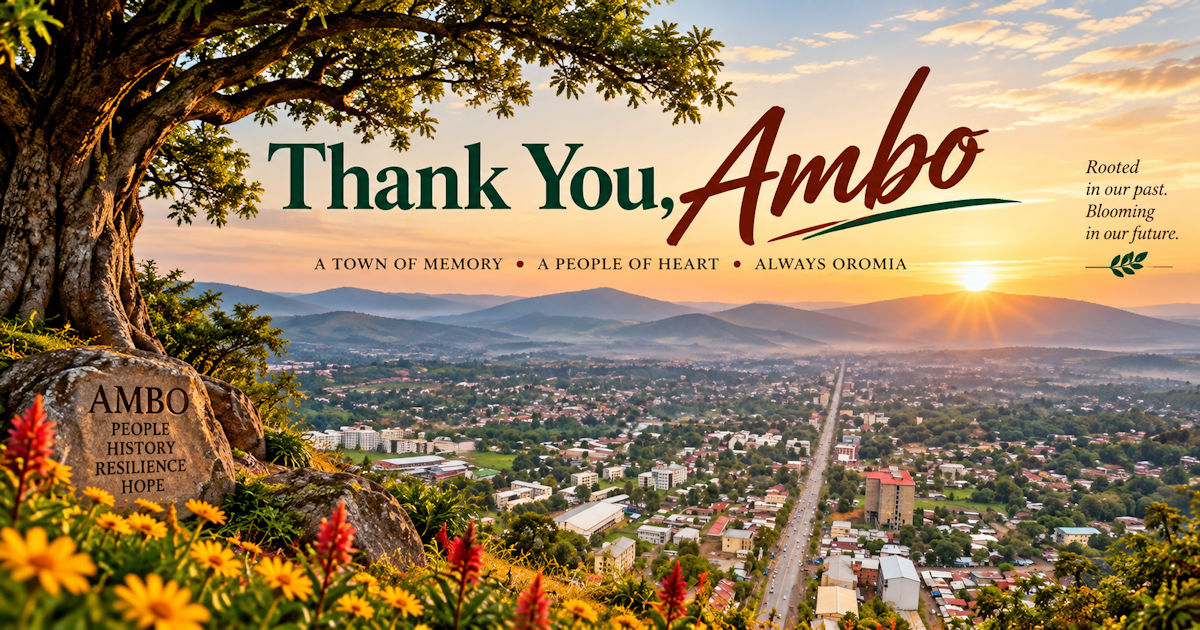
Thank You, Ambo
Excerpt
Thank You, Ambo. On 8 September 2026, Ambo opened its arms to receive Ilfinash Qannoo—Ilfee—Oromia’s beloved daughter. A town long defined by sacrifice, resistance and memory turned her final journey into a remarkable people’s farewell. Amid official coldness and conspicuous media absence, ordinary people supplied what politics could not: dignity, gratitude and love. On that day, Ambo itself became the monument.
When a Town Becomes an Embrace
There are moments when a town becomes more than streets, buildings and the people who happen to live within its boundaries. It becomes a people’s memory. It becomes a witness. Sometimes it becomes a sanctuary.
On 8 September 2026, Ambo became all three.
Oromia brought home one of its beloved daughters, Ilfinash Qannoo — Ilfee — and Ambo received her with an embrace worthy of the life she had lived and the people whose joys, sorrows and aspirations she had sung for decades.
There was grief, of course. There had to be. Ilfee had departed on 6 September at only 63, after a lifetime in which music, culture and political conscience had repeatedly crossed paths. But what unfolded in Ambo two days later was about something larger than death. The extraordinary crowds, the emotion, the dignity and the unmistakable sense of collective ownership of the occasion turned a farewell into an affirmation.
For that, Ambo deserves two very simple words:
A Town That Knows How to Remember
Perhaps there could hardly have been a more fitting place to receive Ilfee.
Ambo is famous throughout Ethiopia for something bottled and sold under its name: its naturally carbonated mineral water. It is known for its hot springs, its university and the beautiful landscape surrounding it.
But within modern Oromo history, Ambo carries another identity that cannot be bottled, branded or commercially appropriated.
It is a town of political memory.
Generations of Oromo political figures, students and activists have passed through Ambo, leaving behind a remarkable history of advocacy, resistance and sacrifice. Obbo Argaw Dinqaa, the prominent lawyer and pan-Oromo nationalist who was arrested under the Derg after becoming a vocal advocate on public affairs, was buried in Ambo in 1980. Obbo Darara Kafani, a highly respected Oromo elder and successful Ambo businessman in his sixties, is likewise remembered among the town’s political casualties; an OLF supporter, he was reportedly gunned down in broad daylight by uniformed government security forces in September 1994, a killing for which no one was brought to justice.
Professor Marara Gudina, one of the country’s most prominent Oromo academics and political leaders, is closely associated with Ambo and its intellectual and political life. Jaagamaa Badhaanee, an 11th-grade student, was killed during demonstrations in Ambo in November 2005 and became one of the young martyrs remembered by subsequent generations. Years later, Jawar Mohammed would symbolically walk barefoot into Ambo in recognition of the sacrifices made by its Qarree and Qeerroo.
The town’s roll call of notable politicians, activists, intellectuals and public figures is far too long to do justice to here, and extends well beyond the scope of this piece.
And then there is the son of Ambo whose name requires little introduction: Haacaaluu Hundeessaa.
Ambo gave Haacaaluu to Oromia. When an assassin's bullet silenced him in 2020, Ambo received its son back into its soil.
Six years later, the town opened its arms again.
This time, Oromia brought it a daughter.
Ilfee had come home.
The “New York” That Was Promised Much and Given Little
There is an uncomfortable irony in remembering Ambo's recent political history.
The protests that swept Oromia between 2014 and 2018 had one of their most important centers in Ambo. Young people paid dearly for political change, and the town consequently acquired enormous symbolic importance during the transition that eventually brought Abiy Ahmed to the premiership.
The symbolism was not lost on the new prime minister.
Soon after taking office, Abiy Ahmed traveled to Ambo and famously declared that this was where Ethiopia would build its “statue of liberty,” describing Ambo as “our New York.”
The rhetoric was enormous.
The walk that followed that talk was considerably shorter.
By early 2020, BBC reporting from Ambo was already asking what had become of the promised transformation. The same town that had been celebrated for helping usher in political change was experiencing repression, arrests and frustration over development that had failed to match the grandeur of the promises made to it.
There is something painfully familiar about that contradiction: celebrate sacrifice while it is politically useful; forget the place where the sacrifice occurred when the banners have been folded away.
Ambo deserved better.
One could reasonably ask where the promised “New York” is today. Where is the development commensurate with those declarations? Where is the political gratitude translated into infrastructure, institutions, opportunities and a city worthy of the importance politicians themselves assigned to it?
The statue of liberty promised to Ambo may never have become the monument imagined in those heady days.
But perhaps Ambo never needed somebody else to construct a monument to its character.
On 8 September, its people became one.
A Name Too Great for Petty Politics
Even Ambo's distinguished name has not escaped the indignities of contemporary politics.
Recent reports and commentary have associated figures within the ruling Prosperity Party establishment with the notorious label “Mafia 120,” dragging the name of a town synonymous with Oromo resistance and sacrifice into allegations and political controversy that could scarcely be further removed from what generations of its young people struggled for.
Yet regimes come and go. Political cliques acquire nicknames and eventually disappear. The history of a town belongs to something larger.
Ambo cannot be reduced to politicians temporarily occupying offices within it.
- The Ambo of Jaagamaa is still there.
- The Ambo of Haacaaluu is still there.
The Ambo that buried its children, challenged power, welcomed those returning from exile and carried the memories of Oromo resistance from one generation to another is still there.
And on September 8, that Ambo came out to receive Ilfee.
An Elder, a Spear and Geerarsa
Perhaps one of the most poignant commentaries on the day did not come from a politician, academic or television studio.
An elderly man stepped before the funeral crowd, spear in hand, chanting his words in poetry as he moved and gestured with the spear in the old Oromo tradition of public declamation.
What the old man was performing was geerarsa.
And suddenly the scene carried a significance beyond even the words he was chanting.
For this was precisely one of the cultural boundaries Ilfee herself had challenged. Geerarsa, that powerful Oromo tradition of poetic heroic expression, had historically been treated largely as a male domain. Ilfee questioned why it should remain so. Why should women be spectators to a form of cultural expression through which courage, defiance, accomplishment and collective memory were proclaimed?
Now consider the extraordinary symmetry.
At Ilfee's final farewell, an elderly Oromo man stood with his spear before thousands and reached for geerarsa to proclaim the greatness of the very woman who had challenged its restriction to men.
The tradition she challenged had come to mourn her.
And through the voice of that elder, it had something to say.
Ilfee, he proclaimed, was a heroine among heroes.
Then came his questions.
Was she less than Ali Birra?
Was she less than Tilahun Gessesse?
The comparison was not in any way an attack upon either artist. Ali Birra occupies an immense place in Oromo cultural history and beyond, while Tilahun Gessesse remains deeply loved across generations and communities. The elder's questions were directed elsewhere.
They were directed at the conspicuous absence of the regional and federal media establishment.
The old man was challenging the stark asymmetry between the pomp, ceremony and glittering send-offs the regime can summon when it chooses—sometimes approaching the grandeur of a state funeral, as it did for Tilahun Gessesse. On another occasion, the federal flag was even lowered in honour of an artist who had been notably vocal in support of the regime during the Tigray war.
Against such precedents, the near-total official indifference that marked the farewell to Artist Ilfinash “Ilfee” Qannoo becomes all the more conspicuous. The contrast inevitably raises the question at the heart of the old man’s protest:
by what measure does the state decide whose artistic greatness merits national honour and whose can be quietly passed over?
His questions were therefore not about diminishing one celebrated artist to elevate another, but about exposing the political selectivity that appears to determine whose greatness is publicly embraced as national and whose is quietly passed over.
The Cameras That Were Not There
The question becomes more uncomfortable when one considers how little mainstream institutional coverage appears to have accompanied such an extraordinary public event.
Even Oromia Broadcasting Network (OBN), the regional public broadcaster one might naturally have expected to document the farewell comprehensively, appears to have given it little more than passing attention. As far as could be established from following the event, there was no sustained OBN camera coverage accompanying Ilfee's remarkable final journey from Finfinnee to Ambo. There may have been limited recording of the Finfinnee Stadium ceremony for later broadcast, but certainly no live coverage. More conspicuously absent was anything resembling continuous coverage of the extraordinary events that subsequently unfolded along Ilfee’s final journey from Finfinnee to Ambo.
That absence matters because this was hardly an event struggling to find a story.
The story was everywhere.
People lined the route. Crowds gathered at successive locations. Ambo was overflowing with mourners. An artist whose career stretched across half a century was making the final journey to the town she had personally chosen as her resting place.
Yet the cameras one might ordinarily have expected were remarkably difficult to find.
The federal media establishment could perhaps shelter behind an especially convenient excuse: this was an Oromo artist, the Oromia regional authorities were handling the occasion, and therefore the region could cover it.
But what happens when the regional broadcaster barely does?
The result is an extraordinary media vacuum in which an event of enormous cultural importance risks becoming invisible except to the people physically witnessing it.
And this was occurring amid a political atmosphere so petty that even the flags covering Ilfee's coffin had become contested territory.
The episode might be called the Battle of the Flags.
The flag associated with the Oromo Liberation Front (OLF), the political movement with which Ilfee's history was deeply intertwined, was already draped over her coffin. As the procession prepared to leave Finfinnee, Ethiopian and Oromia regional flags appeared over the existing colors.
For a moment, the few square meters covering a dead woman's coffin seemed to encapsulate the political nervousness of the living.
That symbolism helps explain the chill surrounding the official response. Ilfee could be honored — but apparently only with great care over what her life, politics and symbols might be allowed to say.
The federal establishment could keep its distance.
The regional establishment could do the minimum necessary to avoid the monumental embarrassment of appearing to ignore one of Oromia's most celebrated daughters altogether.
And between those calculations stood an enormous public that required neither permission nor political calibration to mourn her.
When One Small Camera Becomes the National Broadcaster
Which makes another thank-you necessary.
Sofumer Media, a Finfinnee-based YouTube channel usually fronted by an Oromo woman conducting interviews, stepped into a space that institutions with incomparably greater resources should have occupied.
From what could be observed of the coverage, this was hardly a television operation commanding fleets of camera crews and satellite trucks. At times it appeared to be operating with perhaps one camera, at most a very small team, attempting to follow an event simultaneously unfolding across locations and over a long journey.
Yet it kept going.
While institutional broadcasters possessed the personnel, equipment and public mandates to record history, a small independent media operation found itself doing much of the work.
The significance of that effort became even clearer when other outlets, including broadcasters outside the country, drew upon the material coming from the channel.
Think about the inversion.
A historic public farewell was unfolding in the capital, along the road west and finally in Ambo. The institutions created and funded to document the life of the country were absent from the journey, while a small YouTube channel strained its resources trying to ensure that the occasion would not disappear undocumented.
There is something both admirable and deeply troubling about that.
Sofumer Media deserves gratitude for being there.
But it should never have been left carrying so much of the burden of being there.
History sometimes survives because great institutions preserve it.
And sometimes history survives because somebody with a camera simply refuses to turn it off.
When the People Become the State Funeral
There is something particularly moving about a farewell that does not wait for official grandeur.
A state funeral has motorcades, protocols, uniforms, carefully arranged seating and television cameras. It tells us whom the state has decided to honor.
A people's funeral tells us something different.
It tells us whom the people have already honored.
That is what made September 8 so powerful.
No decree could have manufactured those emotions. No ministry could have ordered that affection into existence. No broadcaster could have created the relationship between Ilfee and generations who had heard themselves in her music.
And the absence of a broadcaster could not make that relationship disappear.
Perhaps this is where the old man performing geerarsa understood something more profound than all the political calculations surrounding the occasion.
He was not really asking the state to make Ilfee important.
He already knew she was.
He was asking why the state apparently did not know.
Ilfee's stature was not waiting for official certification.
- Ambo supplied the answer.
- The thousands who gathered supplied the answer.
- The grief visible on people's faces supplied the answer.
- And a little independent camera struggling to keep up with them helped ensure that the rest of us could see that answer.
Regimes can decide their protocols, but they cannot allocate love.
And Thank You, Wallaga
In this sombre yet monumental story, it would be easy to overlook Wallaga, Naqamtee and the rural community near Naqamtee where Ilfee was born. You gave her to the world. You nurtured and educated her through those formative years, and however far life subsequently carried her, she never severed that bond with the land and people from which she came.
Thank you for that gift.
There is also a beautiful symbolism in the geography of her life and final resting place. Ilfee sang of Oromo unity in her celebrated “Ilmaan Haadha Tokkoo”—children of one mother. She was born and formed in Wallaga, yet chose to rest in Ambo, Tuulama (aka Shawa). In death, as in song, she crossed the internal border of colonial creation of Oromia without ceasing to belong to any part of it.
Wallaga gave her her beginnings; Ambo received her at the end. Between them lies an Oromo story larger than either place. The unity Ilfee sang about in life has acquired an extraordinary physical symbolism in death. Future historians looking back upon her life may find that geography itself became part of her final testimony: a daughter of Wallaga laid to rest in Tuulama, embraced as a daughter of Oromia.
Thank You!
So this is not primarily an article about regimes.
Nor should a tribute to what happened in Ambo be surrendered to the politicians who disappointed the town, the officials who neglected it, the broadcasters who looked elsewhere, or those who may lately have brought its famous name into disrepute.
They are side stories.
Ambo is the story.
- The people who stood for hours are the story.
- The elders are the story.
- The young people are the story.
- The women who mourned are the story.
- The enormous human embrace into which Oromia delivered one of its daughters is the story.
Ambo has already given much.
- It gave blood when freedom demanded a price.
- It gave generations of students and activists who refused to accept silence as their allotted political condition.
- It gave Oromia Haacaaluu Hundeessaa, whose voice traveled far beyond the hills surrounding the town.
And when another great Oromo voice fell silent, Ambo gave something again.
- It gave Ilfee a homecoming.
Perhaps there is an especially beautiful symmetry in that.
The town that gave Oromia one of its most cherished musical sons became the town that received one of Oromia's most cherished musical daughters.
- Haacaaluu rests there.
- Now Ilfee rests there.
Between them stands Ambo — bruised by history, flattered by politicians, neglected by regimes, occasionally burdened by people unworthy of its name, but still capable of showing, when the occasion demands it, exactly what that name represents.
No Statue of Liberty could say it better.
On 8 September 2026, Ambo itself was the monument.
Thank you, Ambo.
For receiving her.
For honoring her.
For remembering.
And thank you to those who pointed a camera when others apparently preferred to look away.
Above all, thank you Ambo for reminding us that there are things politics can neither bestow nor take away.