The 1976 OLF Political Program at Fifty: Are We Nearly There Yet? History, Liberation, and the Unfinished Oromo National Question
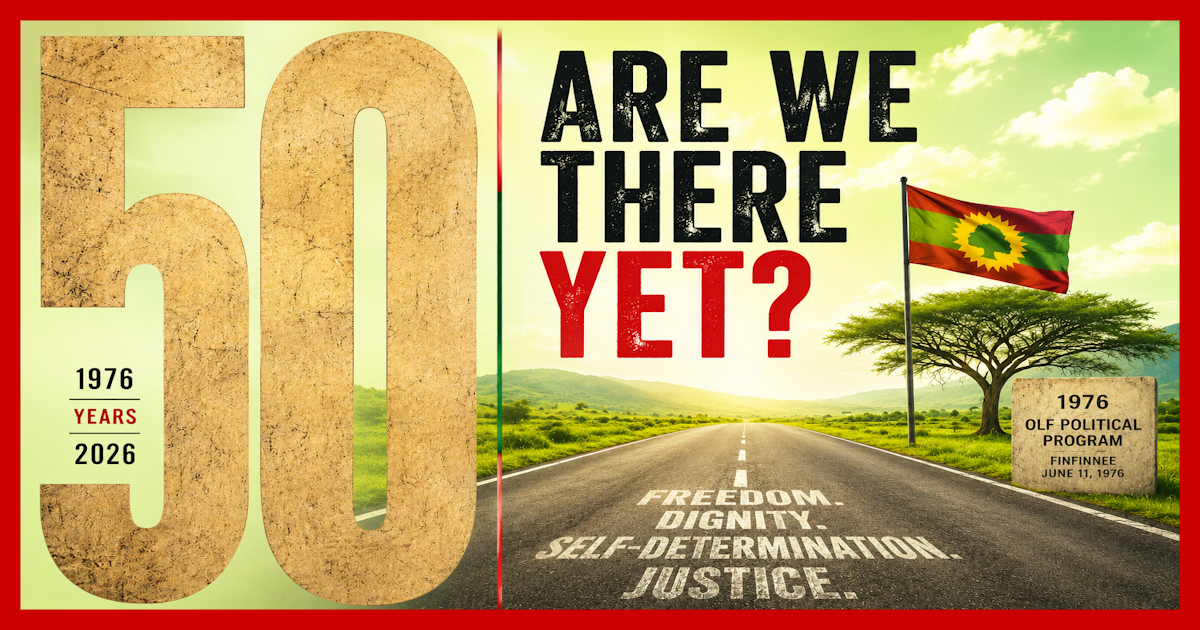
Excerpt
Fifty years after the 1976 OLF Political Program declared Oromo national self-determination through an independent democratic republic of Oromia as its fundamental objective, the Oromo national question remains unresolved. This reflection revisits the program’s historical force, psychological achievement, constitutional echoes in Article 39, and the strategic ambiguity that still shapes Oromo politics today.
Introduction: Fifty Years of an Unfinished Question
Fifty years is a long journey for any liberation movement. The Oromo Liberation Front was formed in 1973. Its first congress, often referred to by many as the founding congress, was held clandestinely on June 11, 1976, in Finfinnee. That congress revised the earlier program and bylaws, and formally ratified The OLF Political Program.
Fifty years is long enough for generations to be born into struggle and die before witnessing its conclusion. Long enough for slogans to become institutions, revolutionaries to become politicians, and dreams once whispered in forests, prisons, student circles, and exile communities to become ordinary public language.
Yet fifty years later, one uncomfortable question continues to linger over Oromo politics:
Are we nearly there yet?
In 1976, the OLF Political Program articulated its objective with remarkable clarity. At the center of the program stood a political goal that left little room for ambiguity:
“The fundamental objective of the struggle is Oromo national self-determination to achieve a total liberation by the establishment of independent democratic republic of Oromia.”
Half a century later, it may be time for Oromo politics to confront a difficult but necessary reflection:
What exactly happened to that objective?
Was it abandoned? Deferred? Reinterpreted? Constitutionally absorbed? Strategically diluted? Or does it remain unfinished?
These are not merely partisan questions. They are historical questions. And history has a habit of returning unfinished questions back to the living.
A Program Born From Historical Rupture
To understand the emotional and political force of the 1976 program, one must return to the historical atmosphere from which it emerged.
The program was not written in comfort. It was born out of conquest memories, political exclusion, cultural suppression, land dispossession, imprisonment, exile, and accumulated historical humiliation.
For generations, Oromo identity itself had been politically marginalized within the Ethiopian state. Afaan Oromo was excluded from formal institutions. Indigenous systems such as Gadaa were dismissed as primitive. Oromo political organization was criminalized. Peaceful civic mobilization, such as the Macha-Tulama Self-Help Association, faced repression and dismantlement.
By the 1970s, many Oromo intellectuals, students, activists, and nationalists had arrived at a radical conclusion: the Oromo problem was not simply a lack of reform, representation, or development. It was structural domination.
Thus the program framed Ethiopia not as a consensual nation-state, but as an empire built through conquest under Menelik II and sustained through political centralization, cultural hierarchy, and coercive assimilation.
Whether one agrees with this interpretation or not, its political consequences were enormous.
Because once a people begin interpreting themselves as colonized rather than merely marginalized, the political horizon changes fundamentally.
The question ceases to be:
“How do we gain inclusion?”
It becomes:
“How do we regain sovereignty?”
The Lost Sharpness of Political Language
One striking feature of the 1976 program is its political sharpness.
It did not speak vaguely about empowerment, inclusion, diversity, participation, or good governance. It spoke the language of liberation.
Its declared objective was not administrative decentralization. Not cultural recognition alone. Not symbolic participation within existing power structures. Not merely a better share in a state whose foundations it questioned.
It was explicit: an independent democratic republic of Oromia.
Today, however, Oromo political discourse often appears suspended between incompatible destinations.
Independence is invoked emotionally but rarely operationalized politically.
Federalism is defended pragmatically but often without trust in the federal state itself.
Autonomy is celebrated symbolically while coercive realities persist on the ground.
Democratization of Ethiopia is proposed as a solution, yet the history of repeated centralizing reversals makes many skeptical.
The result is a profound ambiguity within contemporary Oromo politics:
Is the struggle seeking sovereignty, meaningful federation, confederation, democratic restructuring of Ethiopia, or merely survival within recurring cycles of Ethiopian state crisis?
The younger generation increasingly inherits slogans without clarity about destination.
And movements without clarity eventually exhaust themselves.
The Psychological Achievement of the Program
Yet reducing the program merely to the question of statehood would miss its deeper historical significance.
Its greatest achievement may have been psychological.
The program restored Oromo political selfhood.
Before the rise of modern Oromo nationalism, many Oromos lived within fragmented regional, clan, religious, and local identities without a unified political consciousness. The program helped transform “Oromo” into a collective national imagination.
This was revolutionary.
Today, millions openly speak Afaan Oromo, celebrate Oromo identity, study Oromo history, invoke Gadaa, organize politically as Oromos, and understand Oromia as a living homeland rather than a suppressed historical memory. Such realities would have been almost unimaginable under earlier Ethiopian regimes.
In this sense, the program succeeded beyond what many of its founders may have imagined.
It helped awaken a nation.
But psychological liberation creates a second challenge:
What comes after awakening?
Political consciousness alone does not resolve questions of governance, economics, diplomacy, security, democratic culture, institutional design, or state-building.
Liberation movements are often powerful at mobilizing resistance. History shows they are sometimes less prepared for managing victory, negotiating compromise, or governing complexity.
The OLF Did Not Remain Frozen in 1976
It is important, however, not to treat the OLF itself as though it remained ideologically frozen in 1976.
Movements are shaped by history, and the OLF was shaped by half a century of armed struggle, exile politics, changing regional alliances, state repression, internal disagreements, peace initiatives, factional splits, ideological debates, and shifting global norms.
The collapse of the Derg, the emergence of multinational federalism, the recognition of Oromia as a regional state, the legalization and criminalization of different political actors at different times, the rise of electoral politics, and the recurring return of armed conflict all forced Oromo politics to adapt.
Some interpreted adaptation as realism. Others saw it as retreat. Some viewed participation in Ethiopian political structures as tactical necessity. Others saw it as ideological compromise.
This is why the question “What happened to the 1976 objective?” cannot be answered simplistically.
It was not merely abandoned by one decision or preserved unchanged by memory. It was contested, reinterpreted, deferred, divided, and carried differently by different political generations.
Article 39: Fulfillment, Compromise, or Containment?
No serious reflection on the 1976 program can bypass Article 39 of the FDRE Constitution.
For many Oromo nationalists, Article 39 represented perhaps the closest constitutional expression of principles once articulated in liberation discourse. The constitutional recognition of nations, nationalities, and peoples, including the right to self-determination up to secession, appeared to institutionalize questions that liberation movements had forced into Ethiopian political life decades earlier.
In this sense, Article 39 can be seen as a constitutional echo of struggles that predated the federal order itself.
Yet whether Article 39 became fulfillment, compromise, or containment remains deeply contested.
To some, it was a historic breakthrough: the first formal recognition that Ethiopia was not a single homogeneous nation, but a multinational state whose peoples possessed collective political rights.
To others, it became a promise without practical sovereignty, a constitutional safety valve kept on paper while real power remained vulnerable to centralization, party control, military coercion, and elite manipulation.
This is the paradox of Article 39.
It recognized the right to self-determination, yet the exercise of that right remained trapped within political conditions controlled by the very state whose legitimacy was being questioned.
It named the principle, but did not necessarily guarantee the power.
Did Federalism Resolve the Oromo Question?
The introduction of multinational federalism in the 1990s fundamentally altered Ethiopia’s political landscape.
For the first time, Oromia existed officially within state structures. Afaan Oromo entered schools, media, and administration. Oromo elites gained unprecedented access to state institutions. Oromo identity moved from criminalized existence into public visibility.
To some, this represented partial fulfillment of the aspirations articulated in 1976.
To others, federalism merely reconfigured domination without transferring genuine sovereignty.
This tension remains unresolved.
Can genuine Oromo self-determination exist within the Ethiopian state?
Or does the structure of the state inevitably recentralize power during moments of crisis?
The events of recent decades — political imprisonments, militarization, internal displacement, assassinations, mass protests, contested elections, and recurring armed conflict — have deepened these questions rather than settled them.
The central dilemma remains hauntingly alive:
How much autonomy is enough before autonomy ceases to be autonomy?
The Burden of Historical Continuity
Another uncomfortable reality shadows Oromo politics today.
The original program emerged from extraordinary sacrifice. Thousands were imprisoned, disappeared, exiled, tortured, displaced, or killed over decades of struggle.
Yet contemporary Oromo politics often appears fragmented, distrustful, and internally antagonistic.
One must therefore ask:
Has Oromo politics collectively developed a shared political ethic capable of governing power, not merely resisting oppression?
National liberation movements frequently unite effectively against external domination. Maintaining unity after political opening proves far harder.
Internal fragmentation has become one of the greatest vulnerabilities within Oromo politics.
And fragmentation carries historical consequences.
A movement uncertain about its destination becomes vulnerable to elite co-option, ideological confusion, generational fatigue, opportunistic alliances, emotional slogans, and endless tactical improvisation.
The danger is not only external domination. It is also the gradual exhaustion of purpose.
From Liberation to Statecraft
The 1976 program was clear about liberation. But every liberation project eventually faces the harder question of statecraft.
What kind of economy would sustain freedom?
What institutions would protect citizens from new forms of domination?
How would democracy be practiced internally?
How would minorities within Oromia be protected?
How would relations with neighboring peoples be managed?
How would security, diplomacy, trade, natural resources, urbanization, land rights, and regional interdependence be handled?
These are not arguments against self-determination. They are the responsibilities that come with taking self-determination seriously.
A liberation program can awaken a people. But a governing vision must organize the future.
This is where contemporary Oromo politics must move beyond memory alone.
The task is not simply to ask whether the 1976 objective was right or wrong. The deeper task is to ask what institutional, democratic, economic, and diplomatic architecture can finally answer the Oromo national question with dignity, stability, and justice.
After Fifty Years: What Are the Possible Destinations?
After fifty years, Oromo politics appears to stand before several possible destinations.
One path continues to imagine an independent Oromia as the final realization of national self-determination.
Another seeks a genuinely democratic multinational federation in which Oromia exercises meaningful autonomy within a transformed Ethiopian state.
A third imagines some form of confederal arrangement, balancing shared interests with deeper sovereignty.
A fourth prioritizes democratization of Ethiopia as a whole, arguing that Oromo freedom cannot be secured without restructuring the entire state.
A fifth, more pessimistic path, is not really a destination at all: permanent crisis management, where Oromo politics moves from repression to resistance, from resistance to negotiation, from negotiation to betrayal, and from betrayal back to repression.
The question is not whether these options exist. They do.
The question is whether Oromo politics has developed the collective clarity, institutional capacity, and democratic maturity to debate them honestly.
Which destination commands social consensus?
Which path protects Oromo national dignity?
Which path prevents future generations from inheriting the same unresolved question?
Are We Nearly There Yet?
The title question is intentionally uncomfortable.
Because after fifty years, perhaps Oromo politics must confront the possibility that the journey itself has become normalized.
Liberation movements can sometimes become permanently transitional — always mobilizing, always resisting, always commemorating sacrifice, yet never fully arriving.
The 1976 program at least possessed one quality that contemporary politics often lacks: clarity of means and destination.
Whether one supported or opposed its vision, one could not easily misunderstand it.
Today, however, the Oromo political landscape is crowded with competing interpretations:
independence, multinational federalism, confederation, democratization of Ethiopia, regional autonomy, armed struggle, electoral participation, negotiated settlement, pan-Ethiopian reformism, and constitutional restoration.
Perhaps this diversity reflects political maturity.
Or perhaps it reflects a movement still uncertain whether it seeks transformation of the Ethiopian state or departure from it.
That unresolved contradiction sits quietly beneath much of contemporary Oromo politics.
Conclusion: The Question History Still Awaits
The enduring power of the 1976 OLF Political Program lies not simply in its ideology, but in the historical question it forced into existence.
Who has the right to determine the political future of Oromia?
Fifty years later, that question remains unresolved.
The answer has been postponed repeatedly by revolution, military rule, transitional governments, federal restructuring, constitutional promises, political reforms, authoritarian reversals, elite bargains, and war.
But unresolved historical questions rarely disappear permanently. They simply re-emerge in new generations, new vocabularies, and new political conditions.
Perhaps that is why the 1976 program still matters.
Not because history can move backward.
Not because societies must remain frozen in liberation-era ideology.
Not because every sentence written in 1976 must become a permanent political commandment.
But because unfinished political questions continue to shape the future long after the original generation is gone.
The task before Oromo politics, therefore, is not merely to commemorate the 1976 program. It is to recover its courage of clarity while developing the maturity of statecraft.
After fifty years, the question is no longer only whether Oromo politics remembers where it came from.
It is whether it knows where it is going.
And so the question remains:
After fifty years of struggle, sacrifice, awakening, reform, repression, resistance, constitutional promise, fragmentation, and political transformation —
Are we nearly there yet?
Selected References
- The OLF Political Program. Finfinnee, June 1976.
- Yadessa Guma, Cui Bono? The Political Economy of Conflict and the Oromo Question, 20 April 2026, OROMIA TODAY.
- Elemoo Qilxuu, ETHIOPIA WILL NEVER BE AT PEACE WITHOUT RESOLVING THE OROMO QUESTIONS, 2 December 2024, OROMIA TODAY.