The Cosmetics of Representation: Systemic Continuity, Managed Federalism, and the Oromo Struggle in Contemporary Ethiopia
You can listen to the audio of this article.
Excerpt
The Cosmetics of Representation examines the paradox of Oromo political representation within an Ethiopian state whose underlying structures of centralized power remain largely intact. From managed federalism and elite co-optation to fiscal control, Tsegaye R. Ararssa argues that changing the identity of those who govern does not necessarily change the system through which they govern. The analysis then turns its lens on the recent fast-tracked “clusterization” of Oromia, asking what the sweeping restructuring—and its remarkably swift approval by Caffee Oromiyaa—may reveal about the direction of Oromo self-rule.
Abstract
Political transitions in multinational states often create the illusion of systemic change, particularly when leadership passes to individuals from historically marginalized groups. However, the core nature of a centralized, imperial-style state apparatus does not automatically shift simply because native actors occupy the apex of power. This essay examines this phenomenon through the lens of the contemporary Ethiopian state and the ongoing Oromo national struggle. It argues that the current administration represents a continuation, rather than a dismantling, of historical imperial-statist paradigms.
Furthermore, it analyzes how Ethiopia’s multinational federal structure—initially conceived as a mechanism for national self-determination—has been subtly leveraged to pacify, regulate, and discipline the Oromo and other southern peoples of Ethiopia in the absence of genuine democratic practice. Instead of invigorating local self-rule, the institutional architecture of federalism has been repurposed as a sophisticated instrument of administrative co-optation, fiscal extraction, and colonial divide-and-rule balkanization to maintain centralized control over the Oromo and the country’s diverse nationalities.
Keywords: Oromo Struggle; Multinational Federalism as a Pacification Tool; Managed Multinational Federalism; Elite Co-optation; Balkanization; Prosperity Party; Ethiopia.
1. Introduction: The Paradox of the Native Ruler
One of the most enduring illusions in modern political transitions is the belief that representation at the highest levels of government equates to the emancipation of the group from which those leaders emerge. When an individual from a historically marginalized community ascends to the head of state, it is frequently heralded as a watershed moment—a symbolic and practical end to systemic oppression.
Yet political theory and historical precedent suggest a more cautionary truth: the colonial-imperial—or highly centralized—nature of a state system does not fundamentally change merely because native elites are at the helm of power. If the underlying state-society relations, institutional architecture, bureaucratic incentives, and security apparatus remain unreformed, the state will continue to function according to its historical logic of extraction, assimilation, and subjugation. The identity of the administrator changes, but the mechanics of administration remain intact.
In the Horn of Africa, post-2018 Ethiopia serves as a potent case study of this paradox. For over a century, the Oromo national struggle has sought to challenge and deconstruct the imperial state model established during the colonial-imperial expansions of the late nineteenth and early twentieth centuries.
As John Markakis (2011) observes, this historical state structure was built on the asymmetric centralization of power, the suppression of distinct indigenous identities, the imposition of a singular cultural hegemony, and the economic exploitation of peripheral regions, most notably Oromia. The political shifts of 2018, which brought an administration led by politicians of Oromo descent to the apex of federal power, were initially viewed by many as the culmination of decades of popular resistance. This was partly because the changes were forced upon the state by the relentless series of protests led by Oromo youth (Qeerroo and Qarree) between 2014 and 2018.
However, the subsequent trajectory of the contemporary Ethiopian state reveals a profound continuity in historical governance patterns (Jalata 2025). Rather than dismantling the centralized state paradigm, the current administration has inherited and fortified it. It seeks to restore and retrench the pre-1974 imperial dispensation. Furthermore, the multinational federal structure—originally designed under the 1995 Constitution to offer a blueprint for national self-determination—has been subtly manipulated.
In the absence of genuine democratic practice, competitive elections, and institutional checks, federalism has been transformed from a vehicle of local empowerment into a bureaucratic mechanism for pacifying, regulating, and containing regional dissent. This essay explores how the current Ethiopian regime embodies the continuity of a centralized state system and examines the precise institutional maneuvers through which federalism and its economic networks are weaponized to stall, rather than facilitate, genuine Oromo self-determination.
2. The Imperial Blueprint and the Continuity of the Statist Machine
To understand why native leadership has failed to alter the foundational dynamics of the Ethiopian state, one must first understand the structural blueprint of that state. Modern Ethiopia was consolidated through a process of imperial expansion under Emperor Menelik II and further consolidated under Emperor Haile Selassie. This process was not a voluntary union of equal polities; it was a military and administrative conquest that absorbed various sovereign nations into a highly centralized matrix.
For the Oromo, who constitute the largest ethno-national group in the country, this integration meant the systematic expropriation and dispossession of ancestral lands; the displacement of the indigenous population by settlers; the suppression of indigenous governance systems such as the Gadaa system; the erasure and distortion of Oromo history; the vilification of Oromo identity, knowledge, and cosmogony; the plunder of natural resources and the savage destruction of the environment in the process; and the institutionalization of a cultural and linguistic hierarchy—in the order of Amhara-Galla-Gudella-Shanqilla, or Christian-Islam-Falasha-Aremenie—that relegated Oromo identity to the margins.
While subsequent regimes—the Marxist military Derg (1974–1991) and the multinational coalition of the Ethiopian People’s Revolutionary Democratic Front (EPRDF, 1991–2018)—altered the ideological language of the state, they left the core statist machine largely untouched. In fact, they changed the language for the very purpose of preserving the imperial-colonial order, using the mottos “Ethiopia-weym-mot!” or “Ethiopia-Tiqdem!” and “building one political and economic community” toward an “Ethiopian Renaissance,” respectively.
Both the socialist language of the “National Democratic Revolution” (NDR) under the Derg and the multiculturalist, federalist language of the EPRDF were meant to redeem and restore the empire to “wholeness” by correcting its diversity deficit rather than empowering and freeing the nations trapped in what student revolutionaries termed the “prison house of nations” that the empire had become (e.g., Walellign 1969).
Writing from a largely liberal political perspective, Merera Gudina (2003) has forcefully argued that these successive regimes merely adapted the tools of state survival, relying on the co-optation of regional elites to protect an essentially monopolistic center. Power remained concentrated in a select vanguard, decision-making flowed strictly from the top down, and the security apparatus served primarily to protect the ruling elite from the population rather than to protect the population from harm.
When the current administration assumed power in 2018 on the back of massive, youth-led Oromo protests (Qeerroo and Qarree), it faced a critical structural choice: deconstruct the historical imperial-statist architecture to build a genuinely consensual, democratic commonwealth, or utilize the existing machinery to consolidate its own authority. It chose the latter and, from there, began working its way back toward what the Prime Minister termed “the glories of olden days.” The tottering empire seemed to return—and to return with a vengeance.
When native leaders step into an unreformed, deeply entrenched state apparatus, they quickly become hostage to its institutional momentum. As the Ethiopianist scholar Christopher Clapham (1990) notes, the Ethiopian state exhibits a profound cultural and bureaucratic preference for centralization, in which the political center instinctively views strong regional autonomy as an existential threat and a precursor to state collapse. The state bureaucracy, military hierarchy, and economic distribution networks are all wired to maintain centralized control.
For an administration to survive within such a system without fundamentally changing it, it must adopt the very tools of its predecessors. Consequently, the current regime has progressively revived a neo-imperial narrative of state grandeur, often romanticizing historical monarchs while simultaneously cracking down on regional autonomy movements. In this, the Ethiopian empire, now presided over by Abiy Ahmed, an Oromo, has come into its own.
For the average citizen in Oromia, the everyday reality of governance has not shifted in tandem with the ethnic profile of the Prime Minister. The presence of command posts, arbitrary detentions, military operations in rural areas, and the stifling of independent political parties mimics the coercive strategies deployed by previous regimes. The state continues to view demands for genuine autonomy not as legitimate democratic expressions, but as existential threats to its territorial and administrative integrity and as obstacles to imperial-colonial retrenchment.
Thus, the current administration demonstrates that when a system’s core logic remains one of elimination (à la Wolfe 2006; Veracini 2013), dispossession and displacement, extraction, and centralized domination, the ethnicity of the ruler serves merely as a cosmetic update to a century-old imperial-colonial machine.
3. Managed Federalism: The Illusion of Self-Rule
The primary institutional battlefield for this systemic continuity is Ethiopia’s system of multinational federalism. Established in the early 1990s, the federal model explicitly recognized the rights of the country’s diverse “Nations, Nationalities, and Peoples,” granting them, on paper, the right to self-determination, local self-rule, and even secession under Article 39 of the federal Constitution. For the Oromo, the creation of the Oromia Regional State (Mootummaa Naannoo Oromiyaa) in 1991, and its confirmation in the 1995 Constitution, was a significant symbolic victory. It established a defined territorial entity in which the Oromo language (Afaan Oromoo) became the official working language of administration and education.
However, the efficacy of any federal system relies entirely on the democratic context in which it operates. Lovise Aalen’s (2011) research on the limits of provincial autonomy in Ethiopia demonstrates that federal structures are effectively hollowed out when they are operated by a dominant, highly centralized vanguard party. Under the pre-2018 EPRDF regime, federalism was strictly managed through a disciplined coalition-party structure. While regions appeared autonomous on paper, the central party apparatus dictated policy, selected regional leaders, and suppressed dissent.
The absence of genuine democracy, coupled with the persistent undermining of the quest for self-determination through a popular referendum, obstructed the exercise of collective agency. The figure of the Oromo—who had been the “primitive, uncivilized pagan” waiting to be civilized or baptized during the monarchy, and the “backward and underdeveloped/oppressed peasant” waiting to be developed or emancipated during the Derg—now became the “terrorist” to be watched, securitized, disciplined, and tamed.
With their identity securitized, the Oromo became the primary targets of the EPRDF’s lawfare and warfare from 1992 to 2017, while also being subjected to “developmental attacks” that dispossessed them of their land in the name of a development project called the “Addis Ababa Master Plan” (otherwise known as the Regional Integrated Development Plan).
In the hands of an authoritarian developmental state, multinational federalism became a means of managing a largely unwanted diversity seen as a nuisance to the state’s developmental endeavors and an obstacle on the road to the “Ethiopian Renaissance.” Multinational federalism was thus weaponized to manage and discipline the Oromo and other peoples of the wider South in order to pacify, preserve, and “develop” the empire.
The current administration has refined this approach into “managed federalism” in an even more subtle and pervasive manner. In the absence of robust democratic practice—characterized by fair elections, an independent judiciary, a free press, and an unhindered civil society—the federal structure has been systematically stripped of its empowering potential. Instead of being an incubator for self-rule, as promised in the Constitution, it has been used to accomplish four primary authoritarian functions: pacification, regulation, elite co-optation, and structured fiscal extraction.
3.1 Pacification Through Fragmented Autonomy
The state utilizes the regional boundaries of the federal system to compartmentalize and contain political grievances. By granting local communities a nominal degree of cultural visibility—such as the use of local languages in schools and regional flags on government buildings—the state creates an illusion of cultural emancipation. This superficial concession is designed to pacify the immediate emotional demands of the population while withholding substantive political and economic sovereignty.
When regional discontent boils over, the federal government uses the state administration as a buffer zone. Federal authorities can blame local regional officials for governance failures, corruption, or security lapses, thereby shielding the central executive from direct accountability. If a state government fails to contain local protests, the federal government can step in under the guise of “restoring constitutional order,” deploying federal military forces to pacify the state while maintaining that it is respecting the federal framework.
3.2 Regulation and Surveillance of the Periphery
The federal structure provides a highly organized, capillary network of governance that extends from the federal capital down to the state, zonal, district (woreda), and village (kebele) levels. In a genuine democracy, this chain allows local needs to be communicated upward to policymakers. In an authoritarian system lacking democratic accountability, this chain operates in reverse: it functions as a highly effective surveillance and regulatory apparatus.
Through the state administrations, the federal government can monitor local populations, track political dissidents, and regulate civil society. In Oromia, the local state machinery—staffed by native Oromo officials loyal to the central ruling party—is tasked with enforcing directives issued from Finfinnee. These native officials are uniquely positioned to navigate local social networks, identify nodes of resistance, and neutralize them more effectively than an external, non-native military force could do alone. The federal system thus provides the administrative infrastructure required to execute a policy of granular social control under the banner of local representation.
3.3 Co-optation of the Native Elite via the Prosperity Party Merger
The most sophisticated institutional mechanism of managed federalism is its capacity to co-opt native elites. The administrative turning point in the current administration’s re-centralization project occurred with the consolidation of regional ruling parties into a single, unified entity: the Prosperity Party (PP).
Under the previous EPRDF model, despite its severe democratic deficits, the ruling apparatus was structured as a coalition of distinct regional parties, such as the Oromo People’s Democratic Organisation. This architecture meant that there was a formal, structural table at which regional elites had to bargain as representatives of their specific regional blocs. The merger into the Prosperity Party in 2019 dissolved these separate bargaining units into a single corporate structure governed by a highly centralized executive committee.
By unifying the parties, regional branches were stripped of their programmatic autonomy. An Oromo official within the Prosperity Party no longer answers to a regional platform or a local constituency; they answer directly to the central party leadership. The fact that the Prime Minister runs the party and state power machine in a personalized, autocratic manner has denuded the state authorities of any semblance of autonomous decision-making or accountability to the peoples of their states.
Managed federalism thus creates a class of native administrators who enjoy immense personal status, salary, and authority, but whose career survival requires them to act as the primary enforcers of the Prime Minister’s diktats. They are trapped in a system in which they must suppress the very self-determination movements their constituents demand.
3.4 The Fiscal Illusion and Wealth Extraction
The hollowing out of state autonomy is further reinforced by a profound structural fiscal imbalance built into the state’s political economy. While the Constitution grants states nominal authority over local economic governance, the federal government retains exclusive control over the most lucrative and elastic tax bases, such as import/export customs, corporate taxes, and major industrial ventures. Regional states like Oromia are left to rely on inelastic, difficult-to-collect local revenues such as land-use fees and agricultural income taxes (Arts. 50–52 of FDRE 1995).
A vast portion of Oromia’s resources is structurally dependent on the federal government’s politicized budget-subsidy allocation. If regional bureaucrats push too hard for genuine self-determination or land rights, the federal center can subtly tighten the state’s financial leash. Oromia represents the primary economic engine of the country, generating a massive portion of its agricultural wealth, coffee exports, and mineral extraction. Yet, under this managed framework, this wealth is funneled directly into the central treasury to fund mega-projects and urban renewal in the capital city. This perpetuates the historic imperial pattern: the peripheral regions produce the raw wealth, while an unaccountable center decides how it is spent.
4. Administrative Balkanization: Clusterization as a Colonial Divide-and-Rule Strategy
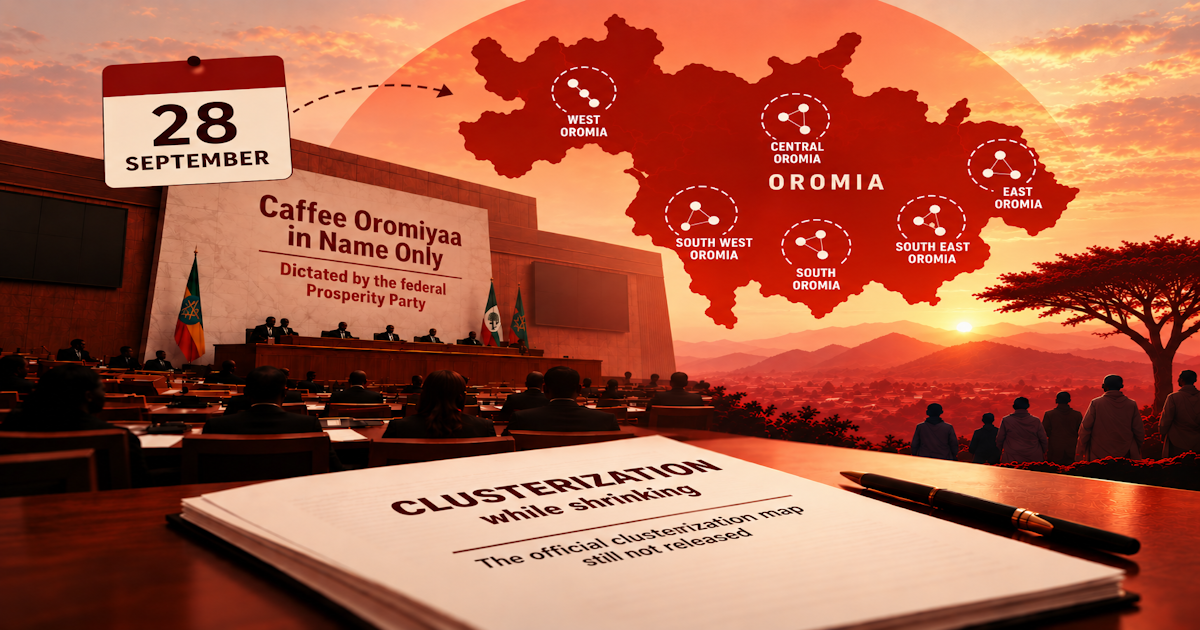
The conceptual limits of managed federalism have culminated in an overt structural intervention: the administrative restructuring of Oromia into six separate regional clusters. Approved on 28 September 2026 under the guise of bureaucratic streamlining by the Oromia Regional State Council (Caffee Oromiyaa), this measure collapsed Oromia’s long-standing 21-zonal system into six monolithic governance blocs: Eastern, Central, Southern, Southeastern, Western, and Southwestern Oromia (OROMIA TODAY Editorial). While state technocrats and party media frame this reorganization in the benign, modern language of “administrative efficiency,” “institutional capacity,” and “bringing public services closer to the periphery,” an interrogation of this policy through the lens of colonial history reveals a far more calculated motive: the deliberate, systematic territorial balkanization of the Oromo nation.
In the classical literature on imperialism and indirect rule—most notably Mahmood Mamdani’s (1996) analysis of the “bifurcated state”—territorial carving and the institutional enforcement of tribalized or sub-regional boundaries serve as foundational technologies of population management. As historical empires from the British Raj to French West Africa demonstrated, a centralized metropole cannot easily control a large, demographically dominant, and territorially contiguous native population if that population possesses a unified consciousness and a singular administrative form.
To forestall collective resistance and top-down challenges, the imperial state must systematically fracture the native landmass into smaller, compartmentalized administrative components. Mamdani highlights how colonial regimes rule through a structure of “decentralized despotism,” utilizing native authorities to enforce geographic fragmentation, thereby turning potential national movements into fractured, localized enclaves. By slicing Oromia—Ethiopia’s largest, wealthiest, and most populous federal region—into six distinct mini-jurisdictions, each placed under a specific central supervisor, the current administration has executed a classic colonial script designed to achieve three primary objectives:
4.1 The Neutralization of Collective Bargaining Leverage
Oromia’s immense geographic footprint, spanning over 350,000 square kilometers, and its massive demographic weight historically—and theoretically—granted it a practical-existential veto over the central Ethiopian state machine. Under a unified regional framework, the collective political and economic leverage of the Oromo nation represented a permanent structural check on any authoritarian center.
By dividing this vast territory into six distinct administrative silos, the state dilutes Oromia’s capacity to negotiate or resist as a single, unified political entity. It reduces a geopolitical giant to six localized, competing administrative dependencies. This dilution mirrors what colonial theorists describe as the systematic containment of native majorities: by dismantling the administrative continuity of the landmass, the center effectively neutralizes the region’s collective power at the federal bargaining table before it can even be articulated.
4.2 The Institutionalization of Sub-National Friction
Every large nation possesses natural internal regional, religious, and economic diversity. In a genuine democracy, these internal differences are harmonized through bottom-up dialogue and civic institutions. In a colonial framework, however, these internal fault lines are intentionally institutionalized to foster horizontal conflict, transforming what Mamdani terms “citizens” of a broad political project into separate “subjects” bound to localized regional administrations.
By creating explicit administrative boundaries around distinct sub-regions—such as separating the predominantly Muslim Hararghe zones in the East from the distinctly agricultural and Protestant Wallagga zones in the West, or isolating the historical political center of Shewa—the state gives sub-national regional identities an official, rigid institutional form. This cluster arrangement is structurally designed to convert a shared national consciousness into localized competition over federal resource allocation, border demarcations, and central patronage. By forcing Oromo sub-regions to compete against one another for federal subsidies, the center masterfully shifts the focus of political frustration away from the imperial center and redirects it inward. Horizontal friction replaces vertical accountability.
4.3 The Final Undoing of the Multinational Principle
The 1995 Constitution’s recognition of the “right of nations, nationalities, and peoples to self-determination” was always a hesitant, tightly managed concession under the previous regime. Yet its formal existence preserved the foundational principle that sovereignty within the constitutionally promised Ethiopian commonwealth originates from distinct, historically recognized nations rather than from an arbitrary administrative grid.
The move to clusterization represents the administrative weapon used to quietly dismantle this multinational principle without having to formally rewrite or repeal the Constitution. By replacing a nation-based federal model with a geography-based “cluster” model, the state subtly shifts the locus of identity from the nation to the administrative sector. It marks the final transition from a federation of semi-sovereign peoples to a highly centralized state managed through corporate regional departments. This, in turn, marks the completion in Oromia of Ethiopia’s “creeping return” to the era of imperial provinces known as Teqlay-Gizat during the monarchy or Kifle-Hager during the Derg.
5. The Weaponization of Representation
This territorial deconstruction—or undoing—of Oromia as a state leads us directly to what can be termed the “weaponization of representation.” In international arenas and national broadcasts, the current administration can point to its diverse leadership roster—including an Oromo Prime Minister and numerous Oromo ministers, generals, and ambassadors—as absolute proof that the historic grievances of the Oromo people have been resolved. This representation is used as a diplomatic and rhetorical shield against Oromo criticism of authoritarianism or state-sponsored violence, including allegations of crimes against humanity and genocide.
However, representation without structural transformation is a hollow victory. When the institutional incentives of the state remain focused on maintaining an uncompromised center, native leaders are forced to prioritize state survival over community liberation. To prove their loyalty to the overarching state project and to reassure nervous urban elites or international partners that they are not “narrow nationalists,” native rulers often overcompensate by pursuing re-centralization policies with greater intensity than non-native rulers might dare.
In this environment, the Oromo struggle faces an exceptionally complex landscape. Historically, the adversary was easily identifiable: a state apparatus dominated by a distinct, culturally alien elite that openly dismissed Oromo identity and language. Today, the adversary is structurally identical but visually familiar. Orders to deploy the brutal security committee (Koree Nageenyaa) and military units into Oromia to terrorize the public into submission; assassinate prominent Oromo leaders, abbaa gadaas, intellectuals, artists, and cultural icons; arrest Oromo politicians, businesspersons, and journalists; or displace rural Oromo communities often bear the signatures of Oromo officials, are written in Afaan Oromoo, and are justified under the rhetoric of national development and the maintenance of law and order.
This configuration fragments the national movement. It creates deep internal divisions between those who are seduced by the aesthetics of representation and those who analyze the underlying realities of structural power. The state’s economic imperative to commodify Oromo land for central revenue has not changed, but it is now executed by native elites. The state actively exploits these fractures, labeling Oromos who demand genuine self-determination as extremists, lawless elements, or impediments to a unified Ethiopian prosperity.
6. Contemporary Case Studies of Local Enforcement and Escalating State Coercion
To anchor these theoretical claims in empirical reality, recent investigations and field reports highlight how the Oromia regional apparatus functions explicitly as an instrument of central state enforcement and pacification.
6.1 The Shaggar City Megacity Project and Peripheral Displacement
A stark example of state economic extraction and forced regulation is the creation of Shaggar City. By administratively merging several districts surrounding Finfinnee, the regional government executed a massive territorial reconfiguration.
While presented by Oromo regional officials as an assertion of the Oromo administrative footprint over the periphery, independent documentation from global human rights monitors indicates that the project resulted in widespread arbitrary demolition of residential homes, the displacement of rural Oromo residents, and the centralized reallocation of land. The regional administration acted not as a protector of local land rights, but as an instrument of a centrally driven development model, deploying regional security forces to suppress grassroots resistance. Some aspects of these developments have also been reported by Amnesty International (2024, 2025).
6.2 Escalating Extrajudicial Purges and Judicial Hollowing
The internal regulatory hollowing of the regional state has accelerated through cyclical, targeted political purges. Human rights reports document cases in which high-ranking Oromo judges, municipal workers, or regional officials who express internal concern regarding military excesses, civilian casualties, or the lack of due process in rural Oromia are removed from their positions (Ethiopian Human Rights Commission [EHRC], 2025). The subordination of the regional judiciary to central party security mandates has severely weakened local legal checks. This constant regulatory policing ensures that only the most uncritical enforcers of central policy remain in power, demonstrating the extent to which the regional structure is subordinate to the central executive (Nte 2022).
6.3 Command Posts and the Bureaucratization of Counter-Insurgency
In large swaths of western and southern Oromia, such as the Wollega, Guji, and Borana zones, the civilian federal framework has been superseded by military command posts. Under these structures, local administrators—district administrators and village heads—are directly integrated into military operational chains of command. Independent monitors indicate that, rather than serving as representatives of the local electorate, these native Oromo administrators are weaponized to gather intelligence, restrict freedom of movement, and enforce conscription quotas for the federal military. The federal architecture is thus converted into a granular counter-insurgency net, in which the local language and social familiarity of the native administrator are used to police the population.
7. The Structural Deadlock: Why the System Resists Reform
Why is an unreformed state system so resilient, even when its leadership changes? The answer lies in the structural deadlock embedded within the political economy of Ethiopia. The Ethiopian state has historically been, and remains, a primary source of economic accumulation, land allocation, and social mobility (Clapham 1975; Markakis 2011). In a country where private enterprise is tightly regulated or dependent on state patronage, controlling the state apparatus becomes an all-or-nothing proposition (Clapham 2017).
For the current administration, granting genuine self-determination to regions like Oromia would mean surrendering direct central control over vital economic flows. True federalism requires fiscal federalism: allowing regions to retain a significant portion of their wealth, manage their natural resources, and determine their land-use policies (Fiseha 2005).
A centralized state machine cannot tolerate such a devolution of power because it threatens the economic survival of the federal center. Therefore, even an administration led by native Oromos will instinctively protect federal control over land and resources (Jalata 2025). When local communities protest against land displacement or demand an equitable distribution of federal revenues, the native-led central state responds with the same coercive violence employed by historical regimes (Gudina 2011). The economic imperatives of state survival override any cultural or ethnic solidarity the leadership might claim to possess.
8. Broader Geopolitical Implications for the Horn of Africa
The internal consolidation of a centralized state machine in Ethiopia does not occur in a vacuum; it profoundly reshapes the geopolitical equilibrium of the entire Horn of Africa.
8.1 The Exportation of Instability
Because the contemporary administration relies on coercive pacification to suppress deep-seated demands for regional autonomy within Oromia and other peripheral regions, it must maintain a massive, highly militarized domestic security posture. When a state is engaged in high-intensity internal conflict, its borders become highly porous. Regional insurgencies and state counter-insurgency operations frequently spill over into neighboring countries, particularly Kenya and Somalia (Armed Conflict Location & Event Data [ACLED] 2023). The internal systemic deadlock within Ethiopia thus acts as a permanent driver of regional instability, complicating cross-border security cooperation and displacing thousands of refugees across East Africa.
8.2 The Geopolitics of State Prestige and the Red Sea
To sustain the domestic narrative of a unified, powerful, and historically grand Ethiopian state—a narrative essential to legitimizing re-centralization—the administration has increasingly pursued an assertive, nationalist foreign policy. This is most vividly reflected in its diplomatic and economic maneuvers to secure direct, sovereign maritime access to the Red Sea, including controversial agreements with regional actors (Coc 2025).
By utilizing a neo-imperial rhetoric of historical destiny and economic necessity, the Ethiopian state attempts to divert attention away from domestic structural fractures, such as the Oromo struggle, toward grand external objectives. This pursuit of maritime prestige directly alters the security architecture of the Red Sea arena, escalating tensions with traditional littoral states such as Somalia and with regional powers such as Egypt (ICG 2026).
8.3 Asymmetric Alignments and Regional Autocracies
The preservation of an authoritarian, centralized state apparatus requires international partners that prioritize state sovereignty and elite survival over human rights and democratic reform. Consequently, Ethiopia’s domestic political configuration has accelerated its alignment with non-Western global powers and highly centralized regional autocracies. These alliances provide the central government with the financial capital, surveillance technology, and military hardware required to maintain its domestic networks of regulation and surveillance (The Citizen Lab 2024). By locking itself into these networks of transactional authoritarianism, the contemporary administration ensures that the internal suppression of self-determination movements such as the Oromo struggle is structurally reinforced by external geopolitical architecture.
9. Conclusion: Toward True Deconstruction
The contemporary Ethiopian political landscape offers a powerful lesson for global struggles against systemic oppression: true emancipation requires the deconstruction of institutional systems, not merely the diversification of their personnel. The Oromo struggle is not, and has never been, a simple quest to replace a non-Oromo ruler with an Oromo ruler. It is a fundamental critique of a highly centralized imperial-colonial state model that prioritizes top-down control over grassroots democracy, extraction over equitable development, and bureaucratic regulation over genuine self-determination.
The current administration’s use of managed federalism and administrative clusterization demonstrates that an authoritarian system can easily adapt to changes in leadership identity. By transforming a constitutional framework designed for self-rule into a network for pacification, regulation, and elite co-optation, Abiy Ahmed’s Ethiopia has managed to preserve its core centralized logic while wearing the mantle of representation. The identity of the oppressor has shifted, but the structural violence of the state remains a day-to-day reality for the population.
For the Oromo national struggle, and indeed for all marginalized nationalities within multiethnic states, the path forward lies in looking beyond the cosmetics of native representation. Genuine liberation cannot be achieved by working within the confines of an unreformed statist machine. It requires a fundamental restructuring of the state itself—a process that moves away from managed federalism and toward a consensual, democratic configuration in which institutions are built from the bottom up. Only when the system is structurally transformed to honor the authentic self-determination and equal sovereignty of all its constituent peoples will the lingering shadows of the historical imperial state finally be dispelled.
Tsegaye R. Ararssa is an Oromo scholar, legal analyst, and public intellectual specializing in constitutional law/theory, human rights, and comparative federalism. His work focuses extensively on indigenous resistance, democratic renewal, and the political geography of the Horn of Africa.
10. References
- Armed Conflict Location & Event Data (ACLED). 2023. Kenya-Somalia Border: Rising al-Shabaab Threat in the Wake of ATMIS Drawdown. Special report on the rising al-Shabaab threat along the Kenya-Somalia border amid ATMIS troop drawdown and cross-border operations.
- Aalen, Lovise. 2011. The Politics of Ethnicity in Ethiopia: Actors, Power, and Mobilization Under Ethnic Federalism. Leiden: Brill.
- Amnesty International. 2024. Ethiopia: Widespread Forced Evictions and Home Demolitions in Sheger City. Amnesty International Secretariat.
- Amnesty International. 2025. Ethiopia: Stop Mass Forced Evictions. Amnesty Canada.
- Clapham, Christopher. 1990. Transformation and Continuity in Revolutionary Ethiopia. Revised ed. Cambridge: Cambridge University Press.
- Clapham, Christopher. 1975. “Centralization and Local Response in Southern Ethiopia.” African Affairs 74 (294): 72–81.
- Clapham, Christopher. 2017. The Horn of Africa: State Formation and Decay. London: Hurst & Co.
- Coc, Corrado. 2025. “A Security-Development Mission: How Europe Can Support the Ethiopia-Somalia Trade Corridor.” European Council on Foreign Relations (ECFR).
- Ethiopian Human Rights Commission (EHRC). 2025. Annual Report on Human Rights Conditions in Ethiopia. EHRC Publications.
- Federal Democratic Republic of Ethiopia (FDRE). 1995. “Proclamation of the Constitution of the Federal Democratic Republic of Ethiopia.” Federal Negarit Gazeta, Proclamation No. 1/1995.
- Fiseha, Assefa. 2005. Federalism and the Accommodation of Diversity in Ethiopia: A Comparative Study. Nijmegen: Wolf Legal Publishers.
- International Crisis Group (ICG). 2026. Ethiopia, Eritrea and Tigray: A Powder Keg in the Horn of Africa. Africa Briefing No. 210. Nairobi/Brussels: International Crisis Group.
- Jalata, Asafa. 2025. “The Journal of Oromo Studies: An Intellectual Platform for Developing Oromo Liberation Knowledge.” The Journal of Oromo Studies 29 (2): 1–23.
- Mamdani, Mahmood. 1996. Citizen and Subject: Contemporary Africa and the Legacy of Late Colonialism. Princeton: Princeton University Press.
- Markakis, John. 2011. Ethiopia: The Last Two Frontiers. London: James Currey.
- Merera Gudina. 2003. Ethiopia: Competing Ethnic Nationalisms and the Quest for Democracy, 1960–2000. Shaker Publishing.
- Merera Gudina. 2011. Ethiopia: From Autocracy to Revolutionary Democracy, 1991–2011. Chamber Printing House.
- Nte, Timothy. 2022. “The Ethnic Federalism Paradox of the Civil War in Ethiopia (2020–2022).” International Journal of Political Science (IJPS) 8 (2): 51–60.
- The Citizen Lab. 2024. Digital Pacification: State Surveillance Infrastructure and Telecommunications Tracking in East Africa. Munk School of Global Affairs, University of Toronto.
- Veracini, Lorenzo. 2013. “Settler Colonialism: Career of a Concept.” The Journal of Imperial and Commonwealth History 41 (2): 313–333.
- Walellign Mekonnen. 1969. “On the Question of Nationalities in Ethiopia.” Struggle 5 (2).
- Wolfe, Patrick. 2006. “Settler Colonialism and the Elimination of the Native.” Journal of Genocide Research 8 (4): 387–409.
- OT Editorial, Caffee Oromiyaa Opens—and Oromia Suddenly Shrinks, 28 September 2026, OROMIA TODAY.