When the State Harvests Its Citizens Through Forced Recruitment Child Conscription, Coercive State Predation and the Normalization of the Unthinkable in Ethiopia
You can listen to the audio of this article.
Excerpt
Forced recruitment in Ethiopia is turning citizens into resources to be harvested for unresolved internal wars. Children are reportedly seized, parents hide their sons, families face coercion and money may buy freedom for those who can afford it. When a state recruits citizens to fight fellow citizens instead of resolving the political conflicts driving war, the protector becomes the predator—and the abnormal begins to look ordinary.
When the Unthinkable Becomes Ordinary
There are scenes that should never become ordinary.
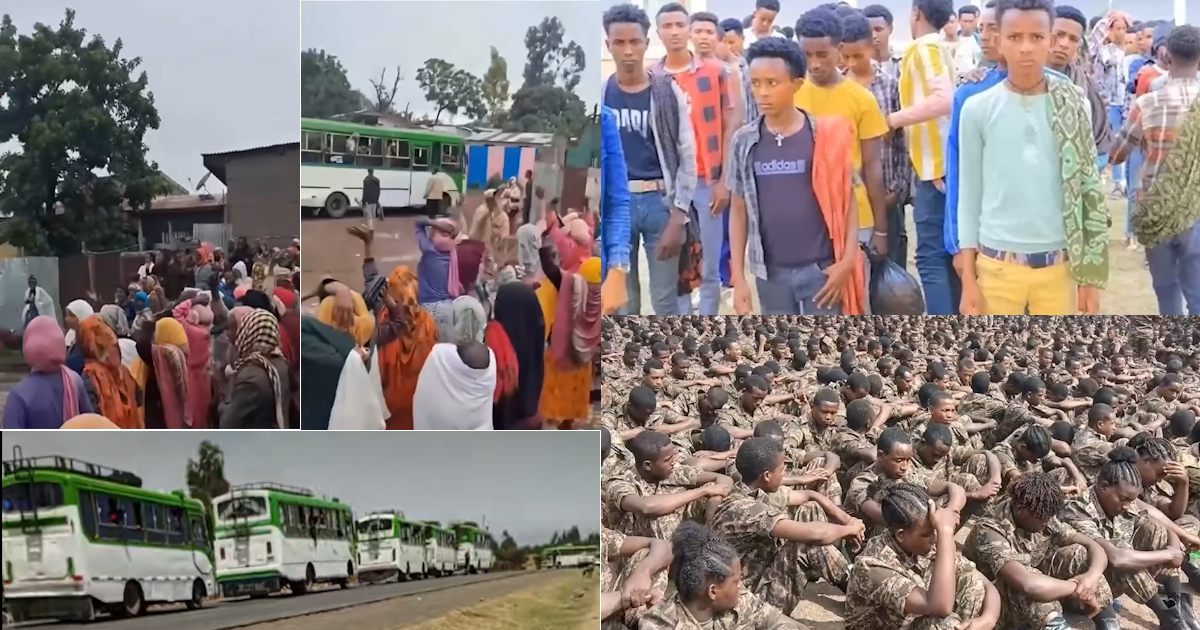
A child is playing football in a field. Another is walking between home and school. Young men are talking beside a road or going about the unremarkable business of an ordinary day. Then armed men arrive. Young people are stopped, rounded up and taken away. Somewhere else buses are waiting—sometimes reportedly fleets of them—to carry the captured youth toward collection points and military training.
What should shock a nation is becoming part of its landscape.
In Oromia, accounts of forced recruitment have become increasingly difficult to dismiss merely as social-media rumor. Mothers appear on Facebook, TikTok, and YouTube crying for children snatched from them by militia. Some families hide their sons. There are accounts of parents being detained or threatened when they cannot produce children sought for recruitment. There are also reports of families paying substantial sums to secure the release of those detained or let go those hidden away.
The precise ages, amounts paid and circumstances of individual cases naturally require verification. But the underlying phenomenon has received remarkably serious independent corroboration.
The U.S. Department of Labor's 2024 Findings on the Worst Forms of Child Labor gave Ethiopia an assessment of "No Advancement – Efforts Made But Complicit in Forced Child Labor." More specifically, it reported at least 14 cases in Oromia in which children were arbitrarily detained by armed forces for military training, with one reportedly only 11 years old. That was several years ago; today, accounts of militia rounding up young people in broad daylight have become disturbingly commonplace. So widespread is the fear that some young people have turned to TikTok to advise others on how to evade recruitment sweeps—at times sharing warnings in real time as militiamen reportedly move through particular areas.
It further reported cases in which families were required to pay substantial sums to obtain their children's release, including a documented case involving a 15-year-old boy whose family was told to pay 20,000 Birr or he would undergo military training. That figure nowadays is in the region of 500,000 Birr or more. The US Department called on Ethiopia to cease forcibly detaining children for military training and recruitment and to investigate military officials involved.
This is therefore not a matter that can responsibly be waved away as opposition propaganda.
Nor is the concern new. The U.S. Department of State's 2022 human-rights report on Ethiopia recorded reports of unlawful recruitment and use of child soldiers by government forces and armed groups and specifically cited a report that the government had forcibly recruited child soldiers from southern Oromia to fight the TPLF. The Ethiopian government denied those allegations, maintaining that youths of legal age joined voluntarily.
The qualification matters. Allegations should be investigated, evidence should be tested and governments are entitled to answer accusations against them.
But so does the accusation.
And when children are involved, looking away is not neutrality.
When the Protector Becomes the Predator
The state possesses extraordinary powers because it assumes extraordinary responsibilities. It can legislate, tax, police, arrest under law and, in defined circumstances, impose lawful obligations upon its citizens. But beneath those powers lies the fundamental justification for the state itself: it exists to protect its citizens.
Something profound therefore happens when parents begin hiding their children not from criminals, traffickers or kidnappers, but from people exercising state authority.
The relationship has been inverted.
The protector has become the predator.
A young person is no longer primarily somebody's son or daughter, a student with an unfinished education, a worker, a farmer, a friend, a football player, or simply a human being entitled to imagine tomorrow.
He becomes manpower—a vacancy in a military formation waiting to be filled.
The citizen has become a resource to be harvested.
And when children enter this machinery, the moral line becomes unmistakable. The U.S. government itself describes recruitment or use of children as soldiers as one of the UN-defined "grave violations" against children in armed conflict. A child of eleven or twelve belongs in school, at home or playing with friends. No political dispute transforms that child into legitimate military inventory.
This is more than forced recruitment. It is what might properly be called coercive state predation: the machinery entrusted with protecting citizens turning its coercive power upon them and extracting what it needs—obedience, money, bodies and ultimately lives.
The young become recruits. Recruits become cannon fodder. Parents become leverage. Detention becomes monetizable. Poverty may determine who remains captive when another family can afford release. Once coercion becomes profitable, abuse can even acquire its own economy: somebody captures, somebody negotiates, somebody pays and somebody pockets the money.
A system originally justified as supplying manpower for war can begin feeding itself.
But Whose War Is This?
There is a political obscenity underneath all of this that deserves far more attention.
Ethiopia is not defending itself against a foreign invading army.
The wars consuming Ethiopian lives are overwhelmingly wars among Ethiopians, rooted in political conflicts that Ethiopia's successive governments and political forces have repeatedly failed to resolve through durable political settlements.
That changes the moral picture dramatically.
The state is not merely accused of coercing its citizens into becoming soldiers. It is coercing citizens to fight other citizens.
One Ethiopian is recruited to fight another Ethiopian. Somewhere on the opposing side stands another young person, perhaps equally poor, equally frightened and equally convinced—or coerced—that survival requires taking the life of the person approaching him.
The image that comes to mind is grotesque: a gigantic stadium in which Ethiopia's political authorities occupy the seats while citizens are sent onto the stadium field to slaughter one another.
When one group of citizens rebels because a political grievance has become armed conflict, the enduring answer cannot simply be to harvest another group of citizens to suppress them. The next rebellion then requires another recruitment drive, another convoy of buses, another generation of frightened parents and another cemetery.
That is not conflict resolution.
It is the recycling of unresolved politics through human bodies.
This is precisely why the political question cannot be separated from the human-rights question. If Ethiopia seriously addressed its entrenched disputes—questions of political representation, national rights, territory, governance, equality, security and the distribution and limits of state power—the demand for endless internal warfare would diminish with them.
Political problems do not disappear because enough young people have been fed into them.
They merely acquire graves.
The Mother at the Bus Station and on the Screen
Perhaps nothing illustrates the normalization more painfully than the mothers.
A mother crying while watching their children being snatched away, crying into her phone on social media because her child has been taken should stop a society in its tracks. Instead, there is a danger that she becomes another piece of content in an endless social-media feed.
We watch. We feel terrible. We scroll.
Tomorrow another mother appears.
We scroll again.
This is how sustained cruelty alters a society. Not necessarily by persuading people that cruelty is acceptable, but by making its repetition so familiar that the capacity for shock gradually disappears.
That is why the buses matter.
A bus ordinarily carries children to school, workers to their jobs and travelers home. Put forcibly recruited young children behind its windows and its meaning changes. Inside are not recruitment statistics. There are names, families, unfinished educations, mothers waiting for telephone calls and young people being transported toward a future they may never have chosen.
A society should never look at such buses and see traffic.
And it should never accept a system in which everyone can exercise authority but nobody ultimately answers for what happens: not the person who seized the child, not the official who threatened the parent, not the person who demanded money, not the commander requiring recruits, and not the political authority above them who knew—or should have known—how manpower was being obtained.
For at the top of this chain lies the most disturbing question of all: how long can political power sustain senseless internal wars by continually harvesting the very citizens it claims to govern? So long as fresh bodies can be coerced into replacing those consumed by yesterday's fighting, unresolved political conflicts can be prolonged rather than solved—and the human cost passed endlessly from one family to the next.
Impunity does more than protect yesterday's abuse. It licenses tomorrow's.
A state cannot hunt its young people in the morning, imprison or intimidate their parents in the afternoon, extract money for their release in the evening, send those who cannot escape toward war, and continue calling itself their protector the following morning. Somewhere along that chain, government has ceased merely to fail its citizens.
It has begun to prey upon them.
When Opportunity Closes and the Battlefield Opens
At times, Ethiopia seems almost entitled to the grim description the land of absurdity and the unthinkable. If that sounds like unjustified hyperbole, consider how often statements and actions that would ordinarily be regarded as politically obscene enter the public record and then simply pass into the background. Two examples illustrate the point.
- The head of the Prosperity Party regime Abiy Ahmed has been widely attributed with an extraordinary boast: that, given Ethiopia's abundance of unemployed youth, he could continue fighting indefinitely and remain in power. Whether every word of the quotation can be independently authenticated matters, and it should therefore be presented as an attributed statement rather than unquestioned fact. Yet the disturbing significance of the remark lies in the political mentality it expresses: unemployed young citizens imagined not as lives requiring opportunity, but as an almost inexhaustible reservoir of manpower for war. More troubling still, the record of repeated internal warfare and continuing recruitment gives the sentiment a resonance that the quotation alone never could.
- There is an even darker joke circulating around Ethiopia's catastrophic high-school examination results: "What Birhanu Nega faileth, Berhanu Jula taketh." Behind the wordplay—contrasting Education Minister Birhanu Nega with military Chief of General Staff Berhanu Jula—lies an accusation too serious to dismiss with laughter. When high-school pass rates collapse to extraordinarily low levels, vast numbers of young people suddenly find the road to higher education closed. Employment prospects are already desperately narrow. Add coercive recruitment to that landscape and an unsettling progression emerges: first opportunity disappears, then the military appears.
This does not by itself prove that educational failure was deliberately engineered to manufacture recruits; such an allegation would require evidence of intent. But deliberate design is not necessary to recognize the grotesque convergence. A political system that fails to educate its young, fails to create sufficient opportunities for them, continues fighting wars against its own citizens, and then draws military manpower from that same stranded generation has created something dangerously close to a human harvesting pipeline. The harvesting does not begin only when a militiaman grabs a young person from the street. It begins much earlier whenever the pathways toward education, employment and an independent future are allowed to close while the pathway toward the battlefield remains conspicuously open.
Concluding Remark
Perhaps another editorial will not stop another bus. But there are times when writing is not about pretending that words alone can stop the machinery. It is about refusing to become accustomed to the machinery—and insisting that political disputes capable of political solutions must not continue consuming generations of human beings.
Above all, it is about leaving a record that somebody noticed.
If nothing else, let this editorial stand as a marker: we saw the abnormal becoming ordinary, and we refused to call it normal.