Dr Birhanu M Lenjiso: Another Political Gaffe, This Time About Dialogue
You can listen to the audio of this article.
Excerpt
Dr Birhanu M Lenjiso is no stranger to public policy or political commentary. He is now also a parliamentary elect for Kuyyuu constituency in the Salaalee Zone of Oromia, subject, of course, to the broader questions surrounding the credibility of Ethiopia's June 2026 election. His transition from "public intellectual" to electoral politician therefore deserves scrutiny—not least because some of his recent political interventions have been remarkably difficult to reconcile with the very constituency and history from which he comes.
1. The Finfinnee Gaffe That Would Not Go Away
During the 2026 election campaign, Dr Birhanu produced what may prove to be his most memorable political gaffe when confronted with the question of Finfinnee. Rather than unequivocally acknowledging Finfinnee as an Oromo city, he resorted to the familiar formulation that the city belongs to all Ethiopians. The episode was already discussed in OROMIA TODAY [1] precisely because of what it revealed: an Oromo politician seeking election in Oromia apparently unable—or unwilling—to articulate clearly the historical and territorial relationship between Finfinnee and Oromia.
The irony is especially difficult to overlook in Dr Birhanu's case. His own ancestral community belongs to the Oromo population directly touched by the historical dispossession associated with Finfinnee and its environs, including displacement southward from Salaalee into other parts of Oromia. One might therefore have expected historical proximity to produce greater clarity rather than political equivocation. Instead, when confronted with one of the defining Oromo questions of the modern era, Dr Birhanu appeared to reach for the safer Ethiopianist formulation.
That intervention proved difficult to live down. More recently, he has been highly active with televised interviews and on social media, particularly LinkedIn and Facebook, as if to make amends, writing extensively about national dialogue, constitutionalism, Ethiopian unity, nation-building, and the country's political future. His public writings repeatedly present dialogue as an instrument for constructing a shared Ethiopian political identity, while his commentary has increasingly emphasized national cohesion and nation-building. Indeed, Dr Birhanu has previously described national dialogue as requiring an inclusive, transparent, and courageous process capable of confronting Ethiopia's historical and contemporary divisions. He has also written extensively about the role of political and intellectual elites in nation-building.
Whether this recent burst of public engagement represents an attempt to repair the political damage caused by the Finfinnee episode is ultimately for readers to judge. But the timing and political direction are certainly noticeable. So too is his conspicuous kowtowing with undeserved praises for the Chief Commissioner of the Ethiopian National Dialogue Commission as a nation-builder—an interesting political embrace given the serious questions surrounding both the design and conduct of the dialogue itself. Furthermore, his endorsement of Dr Dachasa Abebe's book—ዳግማዊ ምኒልክ እና የታሪክ ፖለቲካ [2]—is also very telling.
2. Another Gaffe, Somewhat Dressed as Philosophical
Then comes another extraordinary intervention:
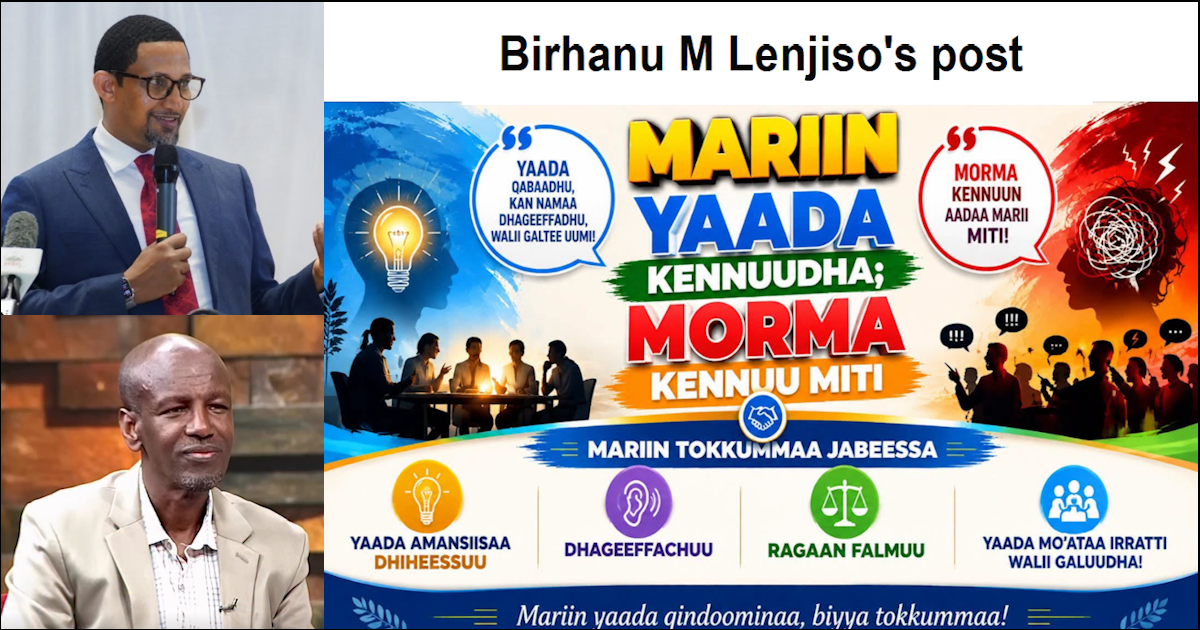
“Dialogue is about giving ideas. It is not about giving objections.” [3]
Worse still, this is not merely an unfortunate sentence disappearing into the endless stream of social-media commentary. The Ethiopian National Dialogue Commission has apparently adopted the formulation sufficiently enthusiastically for it to appear conspicuously around the conference hall.
For someone attempting to establish himself as a politician and public thinker on dialogue, this is not a minor semantic slip. It betrays a fundamental misunderstanding of what genuine political dialogue requires.
One begins to wonder whether politics really is Dr Birhanu's natural habitat. Academia, reportedly his self-declared forte, is forgiving of propositions: they can be reconsidered, qualified, revised, and tested against criticism. Politics is considerably less forgiving because words acquire constituencies, consequences, and memories. After the Finfinnee episode, this latest excursion into the philosophy of dialogue suggests that a strategic retreat to "non-political scholarship" might not be the worst career advice anyone could offer him.
3. An Objection Is Part of Dialogue
The proposition itself is deeply flawed.
A constructive dialogue cannot meaningfully separate ideas from objections. An objection is itself an idea: it identifies something a participant believes to be false, unjust, unacceptable, dangerous, or based on a mistaken premise. In a political dialogue—especially one dealing with contested history, constitutional arrangements, identity, territory, war, and competing national aspirations—the right to say “I reject that proposition” is indispensable.
There is, admittedly, a charitable interpretation. Dr Birhanu might simply mean that participants should not engage in obstruction for obstruction's sake: do not merely say no; explain why, provide reasoning and, where possible, propose an alternative.
If that is what was intended, there is nothing objectionable about it. Indeed, it could have been expressed quite constructively:
“Dialogue should go beyond objection: explain your disagreement and offer alternatives where possible.”
But that is emphatically not what the slogan says.
“Dialogue is not about giving objections” converts a useful encouragement toward constructive participation into an instruction against dissent.
And therein lies the larger problem.
4. Proposal, Agreement—and Objection
A genuine national dialogue must permit at least three forms of participation: proposal, agreement, and objection.
Sometimes objection is actually the most important of the three.
A participant may believe that a question should not be on the agenda at all. A community may reject the jurisdiction of the conference to determine a particular question. Participants may believe that the premise upon which a proposed settlement rests is historically false or constitutionally illegitimate. A nation or people may object that a supposed national consensus trespasses upon rights that an external majority has no authority to dispose of.
In all those circumstances, the objection is not an impediment to dialogue.
The objection is the dialogue.
This becomes especially important in the context of the Ethiopian National Dialogue Conference.
If participants are invited to discuss predetermined questions but discouraged from challenging the legitimacy, assumptions, framing, or jurisdiction underlying those questions, they are not participating freely in a national dialogue.
They are being invited to contribute within an intellectual enclosure whose boundaries have already been established for them.
Requiring such participants to convert fundamental objections into conveniently “positive ideas” changes the nature of the exercise.
There is an important difference between Dr Birhanu posting this proposition on social media and the Ethiopian National Dialogue Commission using it conspicuously at the conference, Dr Birhanu himself being a participant.
Once institutionalized in that setting, it ceases to be merely one man's questionable theory of dialogue. It becomes part of the psychological environment in which participants are expected to speak.
The message becomes difficult to miss:
Come here to contribute within the framework presented to you; do not challenge the framework itself.
That distinction is enormous.
The concern is reinforced by the Chief Commissioner of the ENDC's recent invocation of “Ethiopia at the center” [4] during a media appearance while the National Dialogue Conference was in session. Taken alongside the message that dialogue is for offering ideas rather than objections, the two formulations raise an uncomfortable question about the boundaries of the exercise itself. If “Ethiopia at the center” establishes the political frame within which ideas are expected to be generated, while objections to that frame are discouraged, then participants may effectively be invited to debate how the existing state should be repaired rather than whether its underlying political architecture should itself be questioned. For a genuine national dialogue confronting historical injustice, competing national aspirations, self-determination, and contested conceptions of the state, the framework itself must remain open to scrutiny. Otherwise, what is presented as open dialogue risks becoming a search for acceptable ideas within an already preferred political destination.
In conflict-resolution terms, constructive dialogue does not require participants to suppress objections. It requires objections to be expressed peacefully, respectfully, intelligibly, and with reasons. The appropriate rule is therefore not no objections, but no intimidation, abuse, deliberate disruption, or silencing of others.
Vigorous disagreement belongs inside dialogue.
Coercive conduct does not.
5. From Dialogue to Managed Consultation
There is consequently a simple test that the Ethiopian National Dialogue Commission would do well to consider:
If participants may give ideas acceptable for consideration but may not object to ideas, assumptions, procedures, agendas, or proposed outcomes they reject, the process ceases to be dialogue and begins to resemble managed consultation.
This becomes particularly troubling when considered alongside reports and observations that participants have undergone preparation before appearing at the conference and the striking recurrence of similar formulations about Ethiopian unity among arriving discussants. None of this, standing alone, proves that outcomes have been predetermined. Nor does Dr Birhanu's slogan prove that participants are being prevented from dissenting.
But the combination raises a perfectly legitimate question.
The issue is no longer merely what participants are being encouraged to say.
It becomes equally important to ask what they are being discouraged from saying.
That question goes to the heart of whether this exercise constitutes national dialogue at all.
6. A Slogan That Objects to Objection
And there is one irony that almost writes itself:
“Dialogue is not about giving objections” is itself an objection—to giving objections.
The slogan therefore manages the remarkable feat of violating its own principle in the very act of stating it.
But there is a deeper irony still—one that becomes particularly striking when this proposition comes from an Oromo scholar.
7. When Education Does Not Liberate Political Thought
Dr Birhanu M Lenjiso is unquestionably a highly educated man, having progressed through tertiary education to the doctoral level. Academic attainment does not, of course, automatically confer political wisdom, moral courage, or sound judgment. Yet one might reasonably hope that education—particularly at its highest levels—would broaden intellectual horizons, sharpen the ability to interrogate assumptions, and cultivate a deeper appreciation of freedom, justice, dissent, and the contestability of ideas.
Oromo history provides an especially instructive reminder that modern education and democratic wisdom are entirely different things.
8. Gadaa Understood What Modern Scholars Can Forget
Long before universities, doctoral degrees, modern parliaments, or imported theories of deliberative democracy arrived in Oromia, the Gadaa system had developed sophisticated institutions for collective deliberation. Within the Gumii—the assembly—dissent was not treated as an embarrassment to proceedings or an impediment to consensus.
It was something to be heard.
There is a well-known expression associated with such deliberation:
“Ani gumgumee.”
In essence, roughly translates into:
“I dissent. I object.”
The declaration is not an invitation to disorder. Quite the opposite. It signals that someone has a serious objection requiring full attention of the assembly. The dissenter is heard without any interruption as the Gadaa discipline demands. The objection becomes part of the deliberative process rather than something that must first be repackaged as an agreeable “idea.”
There is profound democratic wisdom in that practice.
A political culture capable of giving solemn attention to dissent understood an elementary principle of deliberation: consensus has little democratic value if objections cannot first be expressed, examined, answered, accommodated where possible, or consciously rejected after consideration.
The longevity of Gadaa cannot necessarily be attributed to any single institutional feature, but its capacity to provide structured space for disagreement surely deserves attention when considering how such a system sustained political deliberation across generations.
9. From “Ani Gumgumee” to “No Objections”
That historical contrast makes the contemporary proposition—
“Dialogue is about giving ideas. It is not about giving objections.”
—all the more extraordinary.
Here we encounter a peculiar reversal. A traditional Oromo democratic institution, developed without the benefit of modern universities, recognized the political importance of objection; yet a contemporary Oromo scholar educated to doctoral level advances a slogan effectively telling participants in a supposed national dialogue that objections have no place.
The contrast could hardly be more instructive.
It also cautions against confusing credentials with political wisdom. Modern education can provide analytical tools, theoretical vocabulary, professional expertise, and access to enormous bodies of knowledge.
It cannot guarantee independence of thought, democratic instinct, historical consciousness, or the courage to dissent from prevailing power.
Indeed, education that does not liberate the mind from received political assumptions can sometimes do little more than provide increasingly sophisticated language with which to defend them.
Gadaa did not need a PhD to discover that democracy begins by listening to the person who says no.
10. What Hope for the Politics of Lasting Settlement?
That is precisely why the proposition that “dialogue is about giving ideas, not objections” is so troubling. If an educated public figure cannot recognize that reasoned objection is itself an indispensable component of genuine dialogue, the problem is more consequential than an unfortunate choice of words. It raises a larger question about the quality of political thought being carried into institutions entrusted with resolving Ethiopia's deepest disputes.
The concern becomes greater still when such individuals take parliamentary seats representing constituencies whose histories, grievances, and political aspirations require considerably more than routine representation. What prospect is there for helping to heal a deeply fractured empire if its political representatives remain unable—or unwilling—to question the assumptions that have repeatedly failed it?
Ethiopia's predicament does not suffer from a shortage of educated people. Nor has it historically suffered from a shortage of eloquent appeals to unity. What it has repeatedly lacked is the political courage to ask whether the inherited conception of that unity is itself part of the problem.
11. Patching the Empire or Questioning Its Architecture?
A fractured multinational state cannot be permanently repaired by patching its imperial architecture whenever another crack appears. Lasting political settlement requires the willingness to interrogate the architecture itself: historical injustice, contested sovereignty, national self-government, territorial rights, unequal power relations, and ultimately the terms upon which different peoples consent to live together.
That requires politicians capable not merely of generating ideas within the permitted framework, but of entertaining objections to the framework itself.
Otherwise, highly educated representatives may simply become highly articulate custodians of the same political assumptions that produced the crisis they are supposed to resolve.
This distinction matters enormously for Ethiopia. The country has repeatedly attempted to preserve unity by repairing the political structure sufficiently to survive the crisis immediately before it. Yet a patch-up is not necessarily a settlement, and survival of the state in its inherited form is not necessarily evidence that the underlying political questions have been answered.
A lasting settlement may require precisely those radical questions that defenders of the existing order find most uncomfortable.
- What historical injustices remain unresolved?
- Which political relationships continue by genuine consent and which survive principally through inherited structures of power?
- What rights belong to nations and peoples that cannot legitimately be subjected to an external majority?
- And what would a political union look like if justice, rather than preservation of the inherited state at almost any cost, became its organizing principle?
Those are not questions that can be answered by telling participants to bring ideas but leave their objections at the door.
12. Perhaps the Old Gadaa Gumii Knew Better
Perhaps the old Oromo Gadaa Gumii understood the matter more clearly.
When someone rose and declared “Ani gumgumee,” the democratic response was not:
There is no place here for objections.
The assembly listened intently.
That simple institutional instinct contains a lesson worthy of considerably more attention from Ethiopia's modern political class. Dissent need not threaten dialogue. Properly accommodated, dissent can protect dialogue from becoming conformity masquerading as consensus.
And therein lies the uncomfortable question raised by Dr Birhanu's slogan: if even those equipped with the privileges of modern higher education can lose sight of a democratic principle understood and practiced by their forebears generations ago, how confidently can they be entrusted with the far harder task of distinguishing genuine political settlement from yet another patch-up of an empire that has spent generations mistaking enforced unity for lasting peace?
13. Perhaps Politics Is Not Dr Birhanu M Lenjiso’s Calling
After Finfinnee, Dr Birhanu might reasonably have hoped that his next memorable contribution to Ethiopian political discourse would repair some of the damage.
This one does not.
His Finfinnee equivocation concerned one of the most historically consequential political questions confronting the Oromo. His latest proposition concerns something even more elementary: whether people participating in a dialogue are entitled to object.
There is no shame in being an academic, a scholar. There is no shame in discovering that one's talents are better suited to scholarship than electoral politics. Politics, however, carries responsibilities that academic commentary does not. A parliamentarian representing an Oromo constituency must ultimately do more than master the vocabulary of nation-building and national dialogue. He must be capable of recognizing when the political framework itself deserves to be challenged.
Dr Birhanu M Lenjiso may yet prove otherwise.
But two monumental political gaffes in relatively quick succession suggest some friendly, if cheeky, career advice:
Perhaps Dr Birhanu M Lenjiso would be better advised to leave politics alone and return to ...
Postscript: When an Oromo Parliamentarian Is Used to Validate Dispossession
Talking of parliamentary representation, here is a shocker.
A video clip currently circulating in Amhara media reportedly shows an Oromo parliamentarian (Ato Yaeqob Likki) from the Emperor Haile Selassie era attempting to justify the historical seizure of Finfinnee by the Amhara [5]. The argument attributed to him appears astonishingly crude: essentially, whoever captured the territory first acquired the right to keep it.
In other words: capture becomes title, and conquest becomes ownership.
More remarkable still is the apparent contemporary purpose for which the old clip is being circulated. The implied argument seems to be that because an Oromo parliamentarian once said it, today's Oromo must somehow accept his judgment on Finfinnee.
That logic deserves to be rejected outright.
Historical truth does not change according to the ethnicity of the person speaking. Neither does justice. An Oromo who rationalizes dispossession does not make dispossession just, any more than an Amhara who condemns it makes the Oromo case stronger merely because he is Amhara.
An Oromo voice does not authenticate an anti-Oromo argument simply because the voice happens to be Oromo.
Indeed, that principle is being demonstrated in this very editorial. We are not sparing Dr Birhanu M Lenjiso because he is Oromo. We are challenging his ideas because we consider them misguided. His Oromoness neither shields him from criticism nor aggravates the criticism. It is irrelevant to the validity of the argument.
The same standard must apply retrospectively.
There have always been Oromo individuals who served political systems, defended policies, or advanced ideas contrary to Oromo interests to the extent of co-architecting Oromo subjugation. Their existence proves neither the legitimacy of those systems nor the justice of those policies. They must be judged by the same standards of historical truth, justice, freedom, and political rights that should be applied to Ethiopian Restorationist Ideologues– ERI [6] in general or Ethio-Amhara intellectuals promoting nostalgic interpretations of empire, or indeed anyone else.
Justice cannot be ethnically outsourced.
Nor can historical dispossession be retrospectively legitimized by locating a convenient Oromo who once defended it.
If anything, the old video reinforces the larger point of this article. Merely occupying a parliamentary seat does not confer political wisdom. Representation is only as valuable as the judgment, integrity, and principles exercised by the representative.
The history of Ethiopia provides ample reason to take that distinction seriously. Legislatures populated by representatives willing to rationalize conquest, dispossession, political domination, or oppressive laws do not become just institutions merely because those representatives come from diverse ethnic backgrounds. Diversity of faces cannot redeem injustice of substance.
And that brings us straight back to Dr Birhanu M Lenjiso.
The comparison is not that the two men necessarily hold equivalent political positions; they belong to entirely different periods and must be judged in their respective contexts. The lesson is narrower—and more important:
Being Oromo does not make an Oromo politician right about Oromia. Being elected does not make a politician wise. And sitting in a legislature does not transform a bad argument into a good one.
That is precisely why the quality and independence of parliamentary representation matter.
When individuals carrying poorly examined ideas pass through the gates of a lawmaking assembly, the consequences extend far beyond an embarrassing speech or an unfortunate slogan. They acquire the power to help shape laws, institutions, territorial arrangements, and political settlements affecting millions of people.
Ethiopia has already paid dearly for laws and political arrangements that preserved domination while presenting themselves as legitimate governance. It can scarcely afford another generation of lawmakers whose principal instinct is to rationalize inherited injustice rather than interrogate it.
The old parliamentarian in the circulating video therefore offers a warning from history.
The danger is not that an Oromo can be wrong about Oromo rights. Of course he can. The danger begins when his ethnicity is presented as evidence that the wrong itself must therefore be right.
References
- Kumaa Daadhii, Much Ado About Nothing—The Illusion of Elections in Oromia and Ethiopia, 23 March 2026, OROMIA TODAY.
- A Video Clip Showing Dr Birhanu M Lenjiso's endorsement of Dr Dachasa Abebe's book, Facebook Reels, Facebook.
- Birhanu M Lenjiso's [Facebook] Post: Mariin Yaada Kennuudha; Morma Kennuu Miti, 16 August 2026, Facebook Inc.
- OT Editorial, When the Center Is Chosen Before the Dialogue Ends, 13 August 2026, OROMIA TODAY.
- Adugnaw Zelalem's Reels: "What [Parliamentarian] Ato Yeqob Likki Once Said About Addis Ababa", FaceBook Reels, Facebook Inc.
- OT Editorial Team, Ethiopian Restorationist Ideologues (ERI), 15 August 2026, OROMIA TODAY.