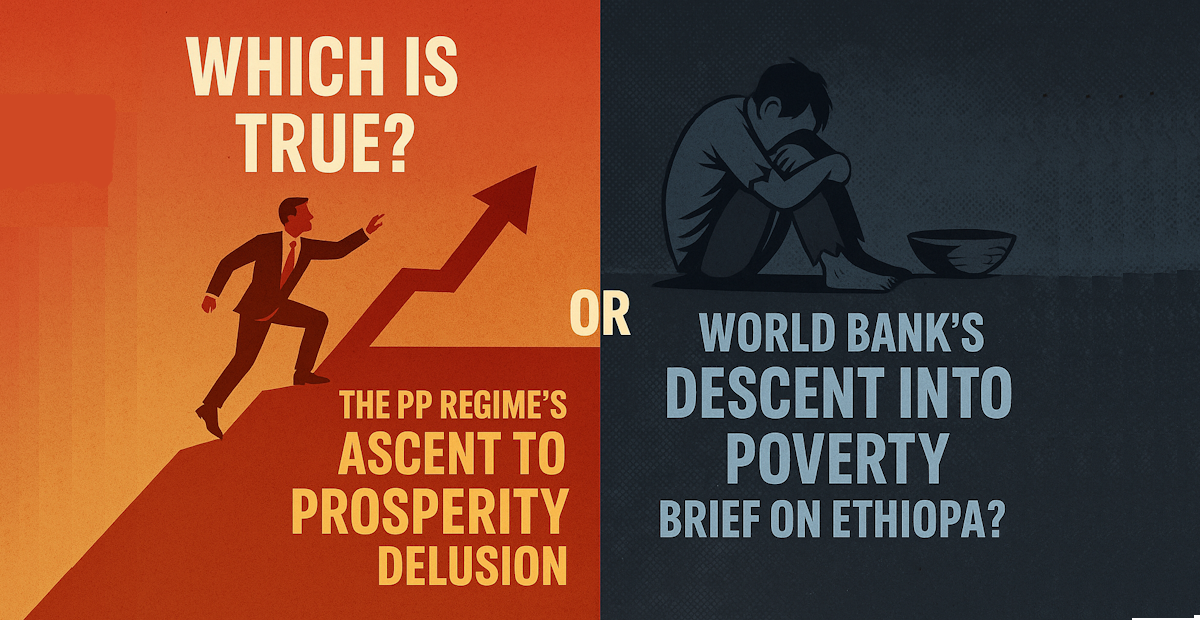
Which Is True? The PP Regime’s “Ascent to Prosperity” — or the World Bank’s “Descent into Poverty”?
Excerpt
The Prosperity Party’s “ascent to prosperity” slogan collapses under the weight of World Bank data showing Ethiopia’s poverty rate rising from 33% in 2016 to 39% in 2021 — and projected to hit 43% by 2025. Far from climbing, the country is sinking deeper into deprivation, with over 67% of citizens multidimensionally poor. The regime’s recent “credit cap” gimmick and nuclear-energy fantasies expose its confusion — a delusion of progress masking a painful descent into poverty.
Overview
In a country where official propaganda now passes for national vision, truth has become a casualty of political marketing. The Prosperity Party (PP) regime’s slogan of an “ascent to prosperity” might have once carried rhetorical charm, but the latest World Bank Poverty & Equity Brief (October 2025) [1] exposes a reality that no amount of spin can hide: Ethiopia is not climbing; it is slipping — and fast.
From Ascent to Descent
According to the World Bank, Ethiopia’s poverty rate — measured at the US $3/day (2021 PPP) threshold — has risen from roughly 33% in 2016 to nearly 39% in 2021, and is projected to reach 43% by 2025. That is not prosperity. That is regression. For a country once touted as a development model, this reversal signals something profoundly broken.
The brief attributes the downturn to a combination of:
- COVID-19 pandemic,
- climate shocks,
- runaway inflation,
- conflicts [by design], and
- poor macroeconomic management.
Yet the deeper problem lies in governance itself — a leadership that mistakes slogans for strategy and optics for outcomes.
The Illusion of Prosperity
The PP regime flaunts big infrastructure, luxury towers in Addis Ababa, and shiny digital initiatives in name only as proof of transformation. But for the majority rural population — roughly three-quarters of all Ethiopians — prosperity is a ghost word.
- 86% of rural adults have not completed primary education.
- Child stunting remains alarmingly high.
- Access to electricity, sanitation, and basic assets is concentrated in the top income quintile (i.e., top 20%).
- Over two-thirds of Ethiopians are multidimensionally poor, deprived not only of income but also of services and opportunities that define a dignified life.
Who Is Rising — and Who Is Sinking?
Ethiopia today is witnessing a divergent prosperity — an urban-elite mirage amid rural despair. While officials announce a new economic dawn, the majority faces soaring food prices, collapsing purchasing power, and evaporating savings. Reforms such as exchange-rate liberalization and fuel-subsidy removal may improve efficiency over the long run, but in the short term they exacerbate hardship for households already at breaking point. Economic sentiment remains negative despite official optimism — a polite way of saying people are losing hope.
The Anatomy of a Delusion
The “ascent to prosperity” slogan has morphed into a delusion of grandeur — a narrative sustained by selective data, state-aligned media, and choreographed public relations. When the World Bank’s poverty model shows widening deprivation, one must ask: Whose prosperity? Not the millions pushed below the poverty line since 2020. Not farmers who can no longer afford inputs. Not the youth migrating in despair, nor civil servants whose salaries are swallowed by inflation.
The System of Financial Futility
Even the regime's monetary and credit moves betray panic rather than prudence. The recent expansion of the credit cap to 24% — which OROMIA TODAY’s fact-checking series [2,3] has shown to be economically meaningless amid punishing interest rates and continued rationing — underscores a system running on optics. When credit is scarce and expensive, tinkering with caps is cosmetic. It signals an economy where the financial engine has stalled while the dashboard lights are being rearranged.
A Regime in Disarray
To distract from economic free fall, the regime now indulges in technological fairytales: erecting a Commission for Nuclear Energy [4], touting EV production ventures with local minerals [5], water transport initiative [6] with no viable waterways identified for transportation, and promising futures with no fiscal, regulatory, or institutional foundation. These are grandiose distractions — the antics of a regime appearing busy while having no handle on an economic wheel whose engine is dead.
God spare the empire from an Orwellian propaganda redux dressed up as “prosperity.”
The True Measure of a Nation
Prosperity is not built on announcements but on outcomes — on the number of children nourished, households electrified, and citizens empowered. By that measure, Ethiopia’s so-called ascent is a statistical mirage: a climb for the privileged few, standing on the shoulders of the many who are sinking.
Conclusion: The Empire of Optics
The World Bank’s numbers are not political; they are empirical — and their verdict is unambiguous: poverty is rising, inequality deepening, and optimism evaporating. The regime’s high-interest, low-credit trap and its meaningless credit-cap theatrics reveal policy bankruptcy; the nuclear-energy and EV factory promises reveal a distraction economy. Ethiopia does not need bigger slogans; it needs better outcomes.
If prosperity is truly on the horizon, it is visible only from the balconies of power — not from the empty plates of those left behind.
References
- World Bank Poverty & Equity Brief (October 2025), The World Bank.
- OT Editorial Team, When Credit Capping Hits 24% — and Logic Hits Zero, 14 October 2025, OROMIA TODAY.
- OT Editorial Team, Math Meets PP Regime Myth: Prosperity at 18-20% or More Interest Rate , 12 October 2025, OROMIA TODAY.
- PM Abiy appoints Mr. Sandokan Debebe as Chief Commissioner of Ethiopian Nuclear Energy Commission, 14 October 2025, Fana Media Corporation.
- Ethiopia to Produce Electric Vehicles Using Local Minerals in New Factory, 11 October 2025, Ethiopian Business Review on LinkedIn.
- Water Transport Initiative: የውሃ ትራንስፖርትን ማስፋፋት እና በዘርፋ የሚሰሩትን ማበረታታት, Facebook Reels, Facebook.