Four Thousand Voices, One Script: The Political Logic Behind Ethiopia’s National Dialogue
Opinion Essay by Invitation
An independent analytical assessment of the motives, limitations and probable outcomes of Ethiopia’s national dialogue conference of 4,000 discussants.
Excerpt
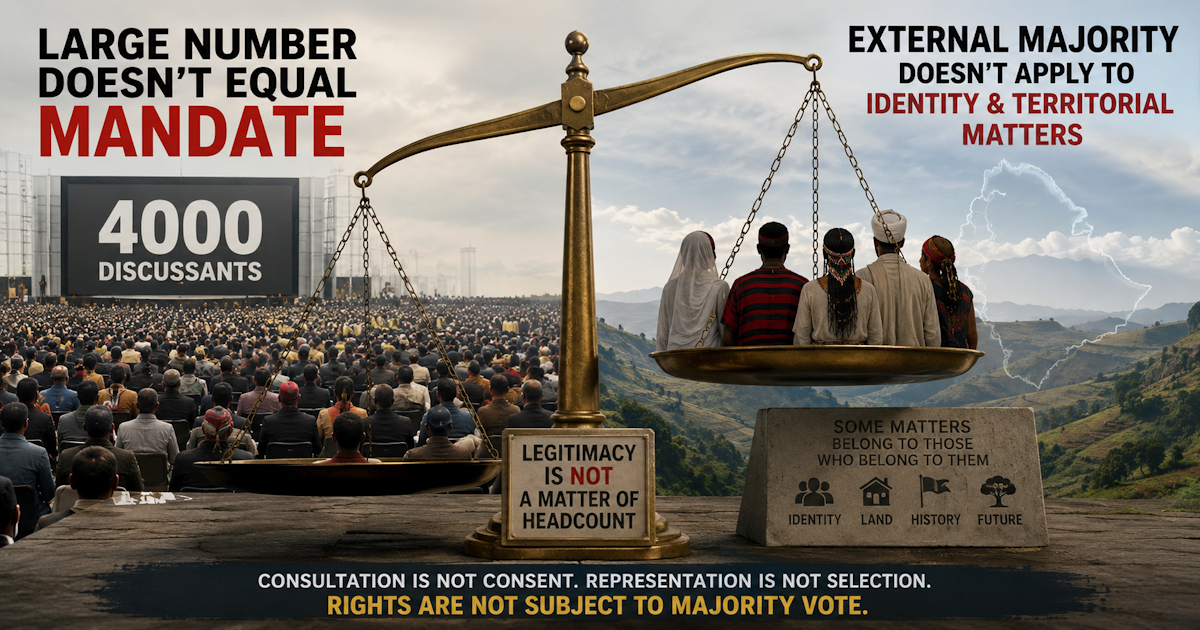
The spectacle of four thousand discussants may create the appearance of nationwide participation, but legitimacy cannot be manufactured through numbers alone. This analysis examines why representation is not the same as selection, why constitutional rights cannot be overridden by external majorities, and why a dialogue conducted on flawed premises risks formalizing, rather than resolving, Ethiopia's enduring constitutional crisis.Overview
Ethiopia’s National Dialogue Conference has assembled 4,000 discussants in Finfinnee/Addis Ababa to consider eight sprawling agenda areas touching almost every contested foundation of the Ethiopian empire state.
The gathering is physically enormous. Its supposed "mandate" is even larger.
Participants are expected to deliberate on nation-building, history, national identity, language, federalism, systems of government, electoral representation, land ownership, the constitutional status of Finfinnee/Addis Ababa and Dirree Dhawa, religion, human rights, economic development, corruption, peace-building and national reconciliation.
That is not merely an agenda for a conference. It is almost an agenda for refounding the empire state.
The central question, therefore, is unavoidable:
Can several thousand regime-selected discussants, many without independent political mandates or specialist knowledge of constitutional statecraft, resolve conflicts that Ethiopia’s political organizations, armed movements, scholars, governments and national communities have contested for generations?
The analytical answer is: not through this structure, and not under these political conditions.
The problem is not that ordinary people are incapable of political judgement. Nor is it that constitutional affairs must be monopolized by lawyers and professors. The deeper problem is that a national dialogue derives legitimacy not from the number of people seated inside a conference hall, but from the relationship between those people and the political constituencies whose futures are being negotiated.
Four thousand participants can constitute an audience. They can constitute a consultation. They can even constitute a valuable citizens’ assembly under carefully designed conditions.
But they do not automatically constitute the nations, political forces and conflicting parties of Ethiopia.
Four Thousand People Are Not Four Thousand Mandates
The spectacle of numbers conceals a fundamental distinction between attendance and representation.
A participant becomes politically representative through some credible chain of authorization. That person may be elected, nominated by a recognised organization, delegated by a community, selected through a transparent random process or entrusted through another procedure accepted by the constituency concerned.
Without such a chain, the participant speaks principally as an individual.
This distinction matters because Ethiopia’s foundational disputes are not merely disagreements among individuals. They are disputes involving organized political communities, contending national projects, regional governments, opposition parties, armed movements, displaced populations, victims of state violence and communities with competing historical claims.
A farmer, civil servant, religious leader or local elder may contribute valuable knowledge. But no individual, however sincere, can independently surrender or renegotiate the constitutional rights of a nation, redefine the federal compact, alter territorial arrangements or settle the political status of Finfinnee without an identifiable mandate from those whose rights are affected.
The conference therefore faces a problem that numerical enlargement cannot cure:
A thousand unmandated participants do not become representative merely because another three thousand are added to the hall.
Representation is not created by multiplication.
Selection Is the Hidden Constitution of the Conference
In every managed political forum, the most consequential decisions are often made before the first speech is delivered.
They are made through participant selection.
- Who qualifies to attend?
- Who selects them?
- Who is excluded?
- Which political organizations may nominate their own representatives?
- Can communities reject unsuitable delegates?
- Are dissidents protected?
- Are participants accountable to constituencies after the conference?
- Can the selectors be challenged?
These are not administrative details. They constitute the hidden constitution of the dialogue.
When the state, its commission or administrative structures exercise decisive influence over participant selection, the process acquires a built-in asymmetry.
The regime does not need to instruct every participant how to vote. It needs only to create a selection environment in which dependable, cautious or politically compliant voices greatly outnumber organized challengers.
This is subtler than ballot-rigging. It is deliberative pre-selection.
The eventual outcome can then be described as the freely expressed consensus of thousands, although the range of likely opinion was narrowed before deliberation began.
The relevant question is therefore not simply whether the participants come from different districts, occupations, religions, genders or age groups. Demographic diversity may be genuine while political diversity remains severely restricted.
A hall can contain every costume, language and locality in the country and still exclude the principal centers of political dissent.
That would be diversity of appearance without plurality of power.
The Missing Parties Matter More Than the Occupied Seats
National dialogue is most necessary precisely because the principal actors do not agree.
Its purpose is not to gather those already willing to cooperate with the regime.
Its purpose is to create a protected political arena in which adversaries who distrust one another can negotiate rules for coexistence.
Consequently, the legitimacy of such a process depends heavily upon the presence of difficult actors: major opposition parties, insurgent organizations, representatives of conflict-affected regions, displaced communities, political prisoners and national movements whose objectives challenge the state’s preferred narrative.
Their absence cannot be compensated for by inviting additional local administrators, professionals, elders or civic representatives.
This is the central paradox of the conference:
The people easiest for the regime to assemble are not necessarily the people whose agreement the country most urgently needs.
If major protagonists remain outside, the conference may produce recommendations, communiqués and carefully worded declarations. What it cannot produce is a political settlement binding upon parties that neither participated in nor authorized the proceedings.
A regime may gather 4,000 agreeable discussants. It cannot use them to manufacture the consent of absent adversaries.
Consultation Is Not Negotiation
The terms dialogue, consultation, deliberation and negotiation are frequently used as though they mean the same thing.
They do not.
- Consultation allows people to express opinions.
- Deliberation permits participants to weigh alternatives.
- Negotiation occurs when actors possessing power, competing claims and recognised constituencies bargain over an outcome.
A constitutional settlement requires the third.
Participants in a genuine negotiation must possess something the other parties require: political legitimacy, territorial authority, popular support, military capacity, institutional power or the ability to accept and implement a settlement on behalf of a constituency.
Most invited discussants possess no such authority. They cannot guarantee that political organizations will disarm, that national communities will accept constitutional revision, that regional states will surrender powers or that populations will regard the resulting settlement as legitimate.
- The 4,000 may discuss Ethiopia’s conflict.
- They are not necessarily empowered to settle it.
That difference is decisive.
An Agenda Vast Enough to Conceal the Intended Destination
The eight agenda pillars encompass virtually the entire constitutional, political, economic and historical life of the country. Many descend into multiple levels of subheadings and subsidiary questions.
Such comprehensiveness can be defended as evidence that the Commission listened widely. Yet extreme breadth creates another danger: the agenda becomes so expansive that participants cannot meaningfully master it, prioritize its components or anticipate the legal consequences of apparently simple recommendations.
Complex language does not always reflect intellectual depth.
Sometimes it reflects unresolved thinking. Sometimes it results from combining thousands of submissions without establishing a coherent hierarchy. Sometimes bureaucratic language turns familiar political conflicts into dense technical formulations, placing interpretive power in the hands of those who drafted the document.
This creates an imbalance between the authors of the process and its participants.
The drafters know:
- why each item was worded in a particular manner;
- which constitutional provisions it may eventually affect;
- how recommendations will be aggregated;
- who will interpret ambiguous conclusions;
- and which institution will convert the discussion into policy.
The ordinary discussant sees an enormous document, receives an orientation and is asked to deliberate within a limited period. The more complicated the agenda becomes, the greater the participant’s dependence upon facilitators.
Complexity, in this setting, is not politically neutral. It transfers power from the discussant to the interpreter.
The People Know the Problems; the State Avoids the Decisions
The Commission’s four-year agenda-collection process is presented as evidence of patience, national reach and institutional seriousness.
But Ethiopia’s principal political disputes were not hidden discoveries awaiting four years of excavation.
The disputes are well known:
- Who owns the state?
- Is Ethiopia a single nation containing cultural groups, or a multinational federation constituted by distinct nations, nationalities, and peoples?
- Where does sovereignty reside?
- Should multinational federalism be preserved, reformed or dismantled?
- What constitutional relationship should exist between Oromia and Finfinnee? But pause for a moment—why is that even a national dialogue question?
- How should territory, language, historical injustice, political representation, land and self-determination be addressed?
- What restraints should be imposed upon central power?
- How can communities obtain justice for mass violence?
- How will historical injustices and indigenous dispossessions be addressed and resolved?
These questions have been articulated for decades through political programmes, constitutional debates, armed struggles, scholarship, elections, protests, peace negotiations and public discourse.
Sadly for Ethiopia, these debates have too often been anchored in fundamentally flawed premises, ensuring that each new generation revisits the same unresolved questions while mistaking repetition for progress.
The obstacle has not primarily been a shortage of agenda items. It has been the absence of sufficient political willingness to negotiate with actors whom successive regimes would rather defeat, divide, imprison, co-opt or exclude.
Four years and as many billions of Birr spent collecting descriptions of an already visible crisis can therefore serve another purpose: postponement.
The process creates movement without requiring the ruling power to make concessions. Consultations are conducted. Reports are produced. Mandates are extended. Budgets are consumed. Conferences are convened.
The machinery remains in motion while the underlying distribution of power remains untouched.
This is dialogue as political deferral.
The stronger criticism of the ENDC concerns the independence of the Commission and institutional competence as a whole.
- Does it contain sufficient constitutional, historical, federal, electoral and peace-negotiation expertise?
- Was it established through agreement among the principal contending forces?
- Do excluded parties regard its members as neutral?
- Can it act independently of the regime that created it?
- Does it possess authority to compel implementation, or will its recommendations ultimately return to institutions controlled by the ruling party?
A commission’s legitimacy does not come from the titles attached to its members. It comes from the confidence placed in it by adversaries. A body trusted only by the regime and its supporters cannot mediate a foundational conflict between the regime and its opponents.
It's this lack of institutional independence that attracts the more fitting name: PPDC for Prosperity Party Dialogue Commission, which I came across in a recent article.
The Theater of Participation
Large political gatherings perform a visual function.
Four thousand people assembled beneath national symbols create an image of comprehensiveness. Television cameras sweep across rows of participants. Speakers invoke history, peace and future generations. Regional dress, multiple languages and demographic variety communicate the message that the country has arrived to speak to itself.
The image is powerful.
It can also be misleading.
A national dialogue should be judged by the political forces incorporated into its negotiating structure, not by the number of chairs visible on television.
The conference may therefore be understood as a form of participatory theater: a process in which the appearance of public authorship is created without transferring meaningful control over the outcome to the public.
- The participants supply faces, voices and applause.
- The Commission supplies the categories.
- The regime supplies the political boundaries.
- The eventual report supplies retrospective legitimacy.
This does not mean every contribution is insincere or that nothing valuable can emerge. Participants may express genuine grievances and produce useful recommendations.
The question is who possesses the authority to select, interpret, discard and implement those recommendations.
If that authority remains concentrated in the same ruling structure, participation becomes advisory while power remains executive.
The Infant Named “Commission”: A Metaphor Almost Too Perfect
As an interesting aside, reports circulating around the conference say that a woman gave birth while attending and that the baby was named “Commission”, an event reportedly celebrated by the chairman of the Commission as a favorable sign.
Seriously?
Yet as political symbolism, the episode is almost too perfect. A conference convened to resolve a state’s accumulated constitutional crisis discovers its great omen in the naming of a newborn child after the institution itself.
Again, seriously?
Humanly, a safe birth is a joyful event and the mother and child deserve every good wish. Politically, however, turning it into evidence of the dialogue’s fruitfulness risks revealing the unseriousness beneath the ceremony.
A successful delivery is not a successful national settlement. A baby may be named Commission, Consensus or Constitution. None of these names supplies the missing representation, independence or political agreement.
The anecdote is not a ridicule of the story nor the mother or child by any means, but as a miniature of the larger spectacle: symbolism substituted for institutional substance.
What Is the Conference Actually Designed to Produce?
If the conference is structurally incapable of negotiating a binding settlement among Ethiopia’s principal contending forces, why convene it?
Several possible political functions emerge.
1. To manufacture consultative legitimacy
Controversial reforms can later be presented not as initiatives of the Prosperity Party regime but as conclusions emerging from an unprecedented nationwide dialogue.
The phrase “the people recommended” becomes a shield behind which executive preferences can travel.
2. To convert party cadres into “the public”
Local administrators and politically dependable community figures can be relabeled as representatives of society.
This launders organized party influence through the language of civic participation.
What begins as administrative mobilization emerges as national consensus.
3. To dilute organized political claims
A national movement may present a precise constitutional demand backed by a political organization and a historical constituency.
Inside a gathering of thousands, that organized claim can be reduced to one opinion among many.
The process thus converts conflicts between political communities into a survey of individual preferences.
Collective rights are dissolved into discussion points.
4. To legitimize decisions after the election
The sequencing is politically important.
If the ruling party first claims a new electoral mandate and subsequently presents constitutional restructuring as the recommendation of a national dialogue, the two processes can be made to reinforce one another.
- The election supplies formal governmental authority.
- The dialogue supplies the appearance of popular consultation.
Together, they may be invoked to legitimize changes that neither process could credibly authorize on its own.
Sadly, however, this logic falters if neither pillar commands genuine legitimacy in the first place.
- The June 2026 general election itself cannot credibly be presented as an unqualified national mandate when one regional state, Tigray, was entirely absent from the electoral process and significant parts of Oromia and Amhara were unable to participate meaningfully because of ongoing conflict and insecurity.
- Nor does the National Dialogue overcome that deficit. Its discussants possess no independently verifiable representative mandate, its participant selection has been widely questioned, and its procedures permit individuals from outside affected constitutional jurisdictions to deliberate on matters that properly belong to the peoples whose rights are directly at stake.
Constitutional rights do not derive their legitimacy from external majorities.
They cannot be voted away by those who do not hold them, nor can representation be manufactured through administrative selection.
In constitutional democracies, majorities govern within constitutional limits; they do not redefine the constitutional ownership of rights belonging to others.
Two processes burdened by contested legitimacy cannot, by reinforcing one another, produce the legitimacy that each lacks individually.
Rather than curing the state's constitutional deficit, such an approach risks institutionalizing it.
5. To impress external partners
International partners often favor the vocabulary of dialogue, reconciliation, inclusion and institution-building.
A large conference provides diplomatic imagery and administrative evidence that a peace process is under way.
The existence of a process can then become more visible internationally than the absence of indispensable participants.
6. To disperse responsibility
Should future reforms provoke resistance, the regime can deny sole authorship.
It may insist that the recommendations came from citizens across the country.
Responsibility is distributed among thousands; decision-making remains concentrated among a few.
7. To identify and manage opinion
The process also provides the state with extensive knowledge of local grievances, influential personalities, emerging demands and possible centers of resistance.
Dialogue can listen.
A powerful state can also use what it hears to classify, anticipate, co-opt or contain.
8. To declare the foundational argument closed
The final and perhaps most consequential objective may be to produce an official narrative that the country has now discussed its historical and constitutional disagreements.
Once the conference concludes, continued opposition can be depicted not as evidence that the process failed, but as extremism by actors refusing to accept the national consensus.
The dialogue then ceases to be an invitation to disagreement.
It becomes an instrument for delegitimizing disagreement.
Consensus Cannot Be Manufactured by Procedure
No voting rule can overcome the absence of the parties whose consent is required.
Suppose a large majority of the 4,000 participants favors changing the multinational federation, weakening national self-government or redefining constitutional sovereignty.
What would that vote establish?
It would establish the preference of those selected, present and permitted to vote under the procedures devised for the conference.
It would not automatically establish the consent of the Oromo, Tigrayan, Somali, Sidama or other peoples as constitutional collectives.
National rights cannot legitimately be extinguished through a conference in which the affected nations have no independently authorized representation and no recognised right of refusal.
This is especially important where the subject is the constitutional compact itself.
A regime cannot invoke the institutions created by an existing compact to abolish the foundational rights of its constituent peoples without obtaining their authentic consent.
Otherwise, constitutional reform becomes constitutional appropriation.
The Likely Outcome: Recommendations Without Reconciliation
The most probable product of the conference is not a negotiated constitutional settlement but a voluminous set of recommendations broad enough to permit selective interpretation.
- Areas of apparent agreement will be highlighted.
- Fundamental disagreements will be compressed into general language.
- Recommendations compatible with the regime’s programme may be advanced.
- Those requiring a surrender of central power, independent investigations, transitional authority or negotiations with armed and exiled opponents may be deferred, softened or omitted.
The result may be called consensus even where it is merely the absence of visible dissent within a controlled forum.
This is the advantage of a highly complex agenda: almost any subsequent policy can be traced to some sentence, concern or recommendation within the final report.
The document becomes a warehouse of retrospective justifications.
The Measure of a Genuine National Dialogue
A credible national dialogue would look markedly different. Its governing framework would be negotiated with major political adversaries before the main conference.
- Its commissioners or mediators would be accepted across the principal divisions.
- Political prisoners would be released or their participation secured.
- Armed and non-armed opposition forces would receive guarantees enabling participation.
- Communities would choose their representatives through transparent procedures.
- The relationship between recommendations, constitutional amendment and popular ratification would be defined in advance.
- Participants would know which decisions were advisory, which required consensus and which would be referred to the public.
- Independent experts would explain competing constitutional options without controlling the political choices.
- Most importantly, the regime would participate as one party to the crisis—not preside over the process as though it stood above it.
A national dialogue cannot be genuinely national when the state acts simultaneously as convenor, selector, security provider, agenda manager, participant, interpreter and eventual implementer.
That is not mediation.
It is an executive process with public participation.
Four Thousand Voices, but Whose Script?
The 4,000 discussants may be intelligent, patriotic and sincere. Many undoubtedly carry real experiences of conflict, poverty, displacement and administrative failure.
They should not be personally demeaned. But sincerity cannot repair a defective institutional design.
The decisive questions remain:
- Who authorized them?
- Whom can they bind?
- Which absent forces will accept their conclusions?
- Who controls the agenda?
- Who defines consensus?
- Who interprets the final report?
- Who possesses the power to implement only the recommendations it prefers?
Once these questions are asked, the political logic of the spectacle becomes clearer.
The conference appears less capable of discovering a new national settlement than of attaching public faces to a settlement developed elsewhere.
Its primary output may not be agreement.
Its primary output may be legitimizing material.
Conclusion: Formalizing the Conditions for Fragmentation
Ethiopia’s crisis cannot be solved by enlarging the audience while excluding or subordinating the principal parties to the conflict.
Nor can an abundance of agenda items substitute for the absence of trust.
A national settlement requires an honest negotiation over power, sovereignty, territory, history and constitutional guarantees. It requires the participation of forces the regime dislikes, constituencies it cannot appoint and outcomes it cannot predetermine.
The empire state does not lack people willing to talk.
It lacks a political structure in which contending peoples and organizations believe that talking can alter the distribution of power. The danger is therefore greater than the waste of four years and billions of Birr.
The danger is that a procedurally impressive but substantively controlled process will be invoked to justify irreversible constitutional changes.
If the 2026 election and the conference of 4,000 discussants are used together to legitimize the dismantling of multinational federalism, the state will not be curing its fragmentation.
It may be formalizing the conditions for its fragmentation.
Four thousand voices may fill a conference hall.
But when the selector, agenda-setter, interpreter and ultimate decision-maker belong to the same political establishment, the country is entitled to ask whether those voices are shaping the script—or merely reading from it.