The Last Frontier of Decolonisation: Why the Oromo Struggle Is Africa’s Unfinished Liberation
Excerpt
Africa's unfinished decolonisation: Tsegaye R. Ararssa challenges Ethiopia's celebrated anti-colonial exceptionalism, arguing that Oromo representation at the highest levels of state power has not translated into collective liberation. Tracing the continuity of imperial domination from historical conquest to contemporary governance, he makes the case for Oromia's sovereignty as an unfinished chapter of African decolonisation.
Representation Is Not Liberation
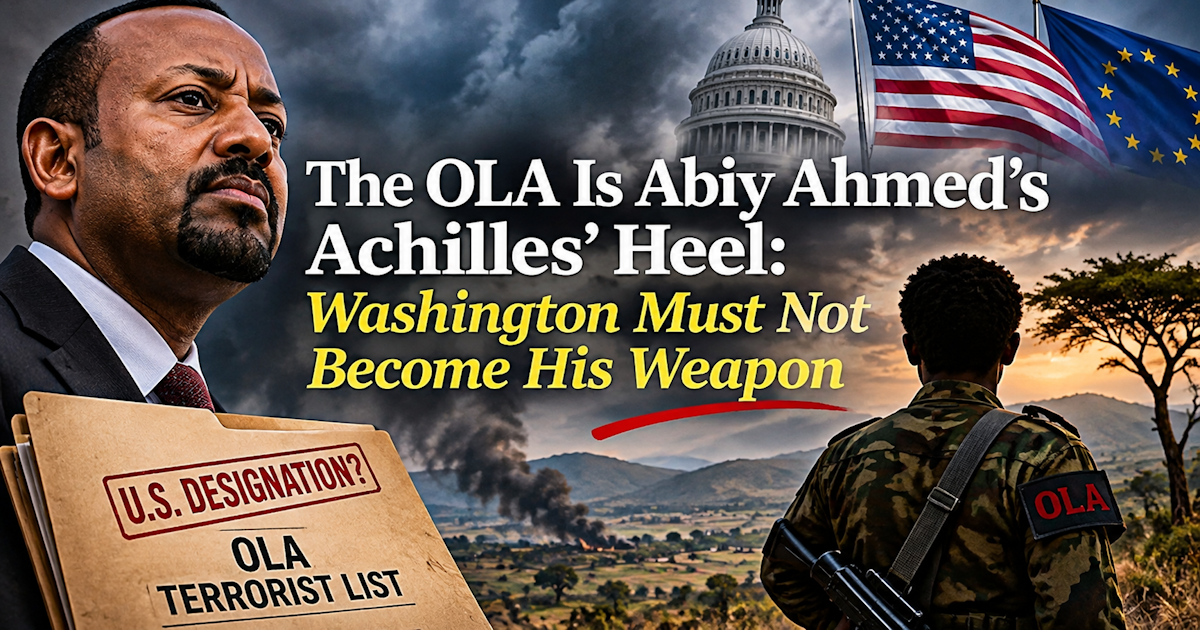
Contrary to the superficial assertions of some contemporary commentators—who argue that the anti-colonial Oromo struggle has been rendered superfluous simply because individuals of Oromo descent occupy the highest echelons of the Ethiopian state, including the premiership, the position of Chief of General Staff of the armed forces, and the leadership of the National Intelligence and Security Service (NISS)—the struggle for Oromia’s sovereignty is, in fact, gaining unprecedented momentum as the empire descends into the violent chaos of genocidal wars under Abiy Ahmed.
Indeed, the rapid, unvarnished reversion of the Ethiopian state to its foundational imperial-colonial paradigms since 2018—visible in its execution of genocidal campaigns, pursuit of expansionist military conquests, personalization of autocratic power, and systematic dismantling of the constitutional promise of national self-determination—demonstrates that anti-colonial liberation can only be realized through a definitive struggle for independence.
The abject failure of contemporary Ethiopia to deliver structural justice for the Oromo and its other subjugated nations, despite the native identity of its ruling elites, exposes the fatal limitations of a colonial-imperial state apparatus that cannot transcend its past or transform itself through peaceful democratic reform. Nothing exposes the structural irredeemability of the Ethiopian empire more starkly than its headlong plunge into a genocidal abyss at precisely the historical moment when Abiy Ahmed and his co-opted Oromo cohorts ascended to the pinnacle of state power.
The Uncolonized Colonizer: Ethiopia’s Historical Paradox
To speak of an anti-colonial liberation struggle within Ethiopia often sounds jarring to global observers, particularly to our African brethren, many of whom remain captive to the powerful myth of Ethiopia as the only uncolonized Black African nation, a pristine symbol of sovereign African independence, and a historical beacon of Pan-African anti-colonialism.
Far less widely understood is the historical reality that modern Ethiopia was itself a brutal colonizer of fellow Africans, having functioned as a dependent, junior partner in Europe's late 19th-century "Scramble for Africa" (Holcomb & Ibsa, 1990).
The foundational legitimacy of the modern Ethiopian state rests upon a globally celebrated exceptionalism: the pristine narrative of an African empire untouched by colonial domination. Yet, viewed through an uncompromising anti-colonial lens, this narrative reveals itself as a profound historical distortion. See also "The Myth of Ethiopia’s Historical Continuity: A Political Invention Disguised as Legacy", Oromia Today, 2025.
The geopolitical map of contemporary Ethiopia was not drawn by ancient destiny. It was forged when the Abyssinian kingdom, under Emperor Menelik II, became an active participant in regional empire-building. Through strategic alliances with European powers that secured access to modern weaponry, Abyssinia carried out a brutal military conquest of the south, subjugating sovereign indigenous nations and initiating a settler-colonial process whose consequences have never been fully dismantled.
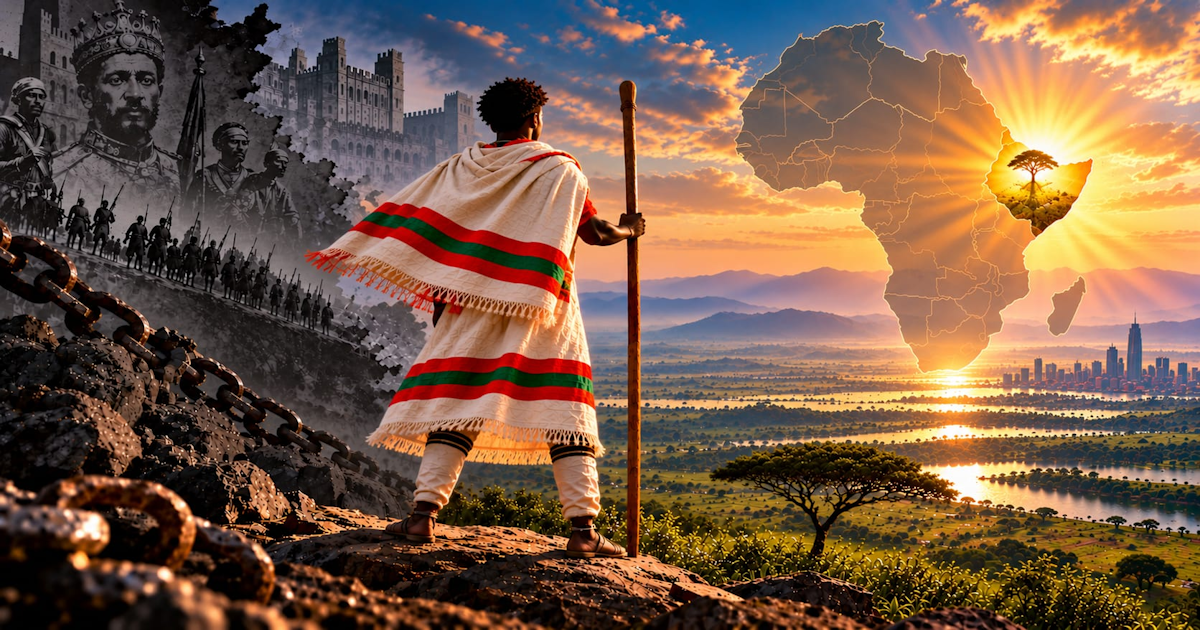
More than half a century after the first formal articulation of this critique, the struggle for an independent Oromia stands as the last great act of decolonization on the African continent.
Conquest Was Not Enough: The Architecture of Subjugation
To dismantle the structures of Oromo subjugation, we must first identify the structural mechanisms of Abyssinian settler colonialism.
Unlike extractive commercial enterprises that merely plundered raw materials from afar, the Abyssinian state implemented a comprehensive system of land dispossession, demographic engineering, and cultural erasure (Tedla Haile, as cited in Zewde, 2002).
The invasion of Oromia was institutionalized through the predatory nafxanyaa-gabbaar system, under which armed imperial settlers (nafxanyaas) were granted vast tracts of Oromo territory, reducing the indigenous population to landless serfs (gabbaars) on their own ancestral lands.
This physical dispossession was accompanied by deliberate, state-sponsored epistemicide: the violent suppression of our egalitarian and democratic Gadaa system, the criminalization of Afaan Oromoo, and what the renowned historian Dr. Mohammed Hassen (1990, 2015) documents as the systematic destruction of Oromo institutions, intended to bury our collective memory and proclaim our historical "absence" from the very lands the conquerors had come to occupy. (See also Megerssa 1993; Megerssa and Kassam 2020).
As pioneering Oromo intellectuals articulated in their "undeclared manifesto"—the historic The Oromo: Voice Against Tyranny (1971; reprinted in 1980)—which helped lay the ideological foundations for the Oromo Liberation Front (OLF), our struggle was fundamentally about dismantling an institutionalized colonial economy. Their revolutionary framework exposed how the Oromo were subjected to disproportionate taxation while our collective wealth was systematically siphoned away to sustain an empire that denied us basic dignity, survival, and legal personhood. Beyond this economic critique, the manifesto explicitly postulated that the Oromo movement is inherently an anti-colonial national liberation struggle designed to dismantle the Abyssinian-colonial empire and secure a sovereign, independent Oromia—thereby guaranteeing the unalienable right to self-determination for all colonized nationalities trapped within its matrix.
Colonialism Never Retired: It Changed Its Uniform
This settler-colonial process did not end with the collapse of the imperial monarchy or the eventual dismantling of the nafxanyaa-gabbaar system. Instead, it evolved into an increasingly sophisticated "neo-nafxanyaa" framework under successive regimes.
Today, aggressive displacement is enforced through the lethal apparatus of state-backed corporate capital and predatory urban expansion.
The unconstitutional excision of Addis Ababa (Finfinnee) from the jurisdiction of Oromia and its illegal, systematic expansion into surrounding Oromo farmlands—the very process that helped ignite the historic Qeerroo and Qarree protests—represent a modern iteration of the same 19th-century land grab (Ararssa 2015; 2016; 2017).
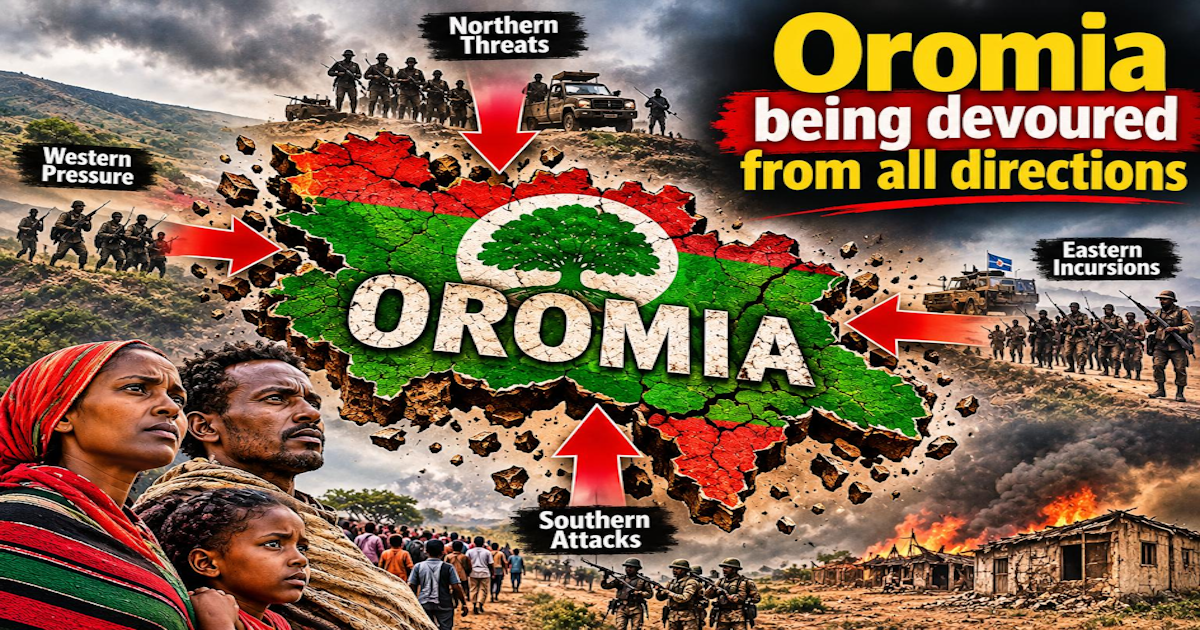
The contemporary regime's attempt to institutionalize and constitutionalize this dispossession has been forcefully reiterated in the recent proceedings of the state-managed National Dialogue Forum (Oromia Today 2026). This forum functions, in effect, as a dress rehearsal for an unconstitutional process of constitutional amendment designed to produce far-reaching and catastrophic consequences: the definitive dismantling of the multinational federal arrangement; the dissolution of the existing national regional states, including Oromia; the balkanization of Oromia through clusterization; and the ultimate erasure of a cohesive, pan-Oromo political identity.
Gold for the Treasury, Poison for the People
Nowhere is modern Ethiopian colonial extractivism more vividly illustrated than at the Laga Dambii gold mines in southern Oromia.
For decades, successive Ethiopian administrations have exploited Oromo natural resources at will, in flagrant disregard of the fundamental principles of Free, Prior, and Informed Consent (FPIC) applicable to the indigenous Gujii Oromo.
While billions of dollars' worth of gold have been extracted to bolster the foreign currency reserves of the central treasury and enrich private corporate elites, the local Oromo population has been left to bear the devastating environmental consequences.
Investigations and interventions by international bodies and human rights organizations, including the United Nations Committee on the Rights of the Child (2019, 2026) and Human Rights Watch (2023, 2026), have drawn attention to the grave human and environmental consequences associated with mining pollution, including concerns about contamination of local water systems and agricultural soils by hazardous substances such as mercury, arsenic, and cyanide.
Communities have reported miscarriages, stillbirths, and children born with severe congenital abnormalities—devastating outcomes that demand rigorous investigation, accountability, and effective remediation.
Yet when Oromo communities rise to protest what they regard as state-sponsored ecological violence, they are met not with environmental remediation and meaningful protection, but with the barrel of a gun and the deployment of militarized counterinsurgency "Command Posts."
When the State Becomes the Instrument of Fear
The contemporary political reality has shattered any lingering illusion that structural reform from within the institutional matrix of the Ethiopian state is achievable.
The current regime, despite its superficial veneer of Oromo representation, has unleashed unprecedented and exceptionally brutal acts of state terrorism under the pretext of counterinsurgency campaigns across Oromia.
The region has been systematically divided into militarized "Command Posts," where mass extrajudicial killings, targeted drone strikes affecting civilians and civilian infrastructure, and the arbitrary detention of political dissidents have become defining features of daily life (ACLED, 2021).
This state-sanctioned terror reinforces the enduring thesis advanced by sociologist Dr. Asafa Jalata: that the Ethiopian state is inherently and structurally incapable of genuine democratization because its institutional survival depends upon the violent subjugation of the peoples confined within its borders (Jalata, 2023a, 2023b, 2025).
Changing the Rulers Is Not Changing the System
Inevitably, defenders of the imperial status quo offer familiar, deeply conservative counterarguments.
They assert that an independent Oromia would irreparably fracture the Horn of Africa, plunging the entire region into a chaotic political and security vacuum. They further claim that the post-1991 constitutional framework of multinational federalism, or the subsequent ascendancy of individual Oromo politicians to the apex of federal power, has already resolved the historical injustices at the heart of the Oromo struggle.
However, these defensive arguments closely resemble the paternalistic rhetoric employed by European colonial authorities during the mid-20th century to delay the liberation of African nations. European powers similarly warned that African independence would inevitably produce tribal chaos, economic ruin, and administrative collapse.
Furthermore, the political co-optation of Oromo elites does not constitute systemic emancipation. Rather, it mirrors the classic colonial tactic of cultivating an indigenous collaborating class (balabbaat) to administer imperial rule on behalf of the dominant power.
True freedom is not a cosmetic concession granted by a centralized, monopolistic authority. It requires the complete dismantling of the colonial relationship itself and the restoration of the collective agency of the subjugated peoples.
Genuine geopolitical stability can never be built upon the structural violence of an empire that remains fundamentally undecolonized.
Liberation Cannot Be Bargained Away
The Oromo national movement is not a destabilizing or reactionary impulse. It is an egalitarian and restorative necessity.
Just as Algeria's liberation from French settler-colonial rule and South Africa's victory over apartheid were essential milestones in restoring continental dignity, the liberation of Oromia represents, in this historical understanding, the final unfinished milestone of African self-determination (African Union Commission, 2025; Boumedin, 2025).
The core thesis developed by Oromo visionaries in the 1970s remains as compelling today as it was then: true liberation cannot be bargained for within the structures that perpetuate subjugation. It requires the complete deconstruction of the empire-state and the full restoration of a sovereign, independent Oromia.
Whose Borders, Whose Sovereignty? The Unfinished Question of 1964
Some observers, particularly those working within the African Union Commission (AUC), raise questions about the limitations imposed by the Organization of African Unity's 1964 Cairo Resolution (OAU, 1964), which affirmed the principle of respecting the borders existing at the time of African independence.
What does that resolution mean for stateless peoples such as the Oromo? Does the Cairo Resolution even apply to sub-state peoples living within the internationally recognized boundaries of Ethiopia? And can a resolution intended to protect newly independent African states from interstate territorial conflict legitimately be invoked to foreclose the right of colonized peoples within those states to pursue self-determination?
These questions deserve careful legal, historical, and political examination. I will address them in a separate essay, to be published as the next installment of this series here at OROMIA TODAY.
References
- ACLED. (2021). Oromia conflict risks (report dated December 10, 2020).
- African Union Commission. (2025). Message of the Chairperson of the African Union Commission on Algeria's Independence Day. African Union Archives.
- Ararssa, T (2015). “Why Resist the Addis Ababa Masterplan? A Constitutional Legal Exploration,” Addis Standard (August 20/2015).
- Ararssa, T (2016). “The Interest that was not so Special: Affirmation of Denial,” Addis Standard 18 January 2016).
- Ararssa T (2017). “The Interest that was not so Special,” Advocacy for Oromia.
- Boumedin, A. (2025). Echoes and manifestations of the Algerian revolution in African literature. Journal of Namibian Studies, 44, 128–150.
- Hassen, M. (1990). The Oromo of Ethiopia, 1570–1860. Cambridge University Press.
- Hassen, M. (2015). The Oromo and the Christian Kingdom of Ethiopia, 1300–1700. James Currey.
- Holcomb, B., & Ibsa, S. (1990). The Invention of Ethiopia: The Making of a Dependent Colonial State in Northeast Africa. Red Sea Press.
- Human Rights Watch. (2023). Ethiopia: Companies long ignored gold mine pollution.
- Human Rights Watch. (2026). Children affected by Ethiopia mine pollution need justice.
- Human Rights Watch. (2026). UN urges Ethiopia to tackle pollution at gold mine.
- Jalata, A. (2023a). The neo-Nafxanyaa government of Abiy Ahmed, terrorism and gross human rights violations in Oromia and Ethiopia. Sociology Mind, 13, 63–83.
- Jalata, A. (2023b). Baro Tumsa's contribution to the Oromo national movement. Social Identities, 29(1), 95–121.
- Jalata, A. (2025). Chasing Menelik's ghost: Why Abiy Ahmed has failed the Oromo people. Athens Journal of Political Science and International Affairs, 1(4), 255–280.
- Megerssa, G (1993). Knowledge, Identity, and the Colonizing Structure: The Case of the Oromo in East and Northeast Africa (unpublished PhD Thesis, University of London, SOAS).
- Megerssa, G and Kassam, A (2020). Sacred Knowledge Traditions of the Oromo of the Horn of Africa. Fifth World Publications.
- Organisation of African Unity (OAU). (1964). Border disputes among African states (Resolution AHG/Res. 16(I)).
- Oromia Today (July 28/2026), “Finfinnee: Decolonisation or colonisation by another name?”.
- Oromia Today (March 17/2025), "The Myth of Ethiopia’s Historical Continuity: A Political Invention Disguised as Legacy".
- The Oromo: Voice Against Tyranny. (1980). (Original work published 1971).
- United Nations Committee on the Rights of the Child. (2019). Concluding observations on the combined fifth and sixth periodic reports of Ethiopia (CRC/C/ETH/CO/5-6). United Nations.
- United Nations Committee on the Rights of the Child. (2026). Concluding observations on the combined sixth and seventh periodic reports of Ethiopia (CRC/C/ETH/CO/6-7).
- Zewde, B. (2002). Pioneers of Change in Ethiopia: The Reformist Intellectuals of the Early Twentieth Century. Ohio University Press.