Stop Confusing the Oromo People with Abiy Ahmed and His Prosperity Party Regime
Excerpt
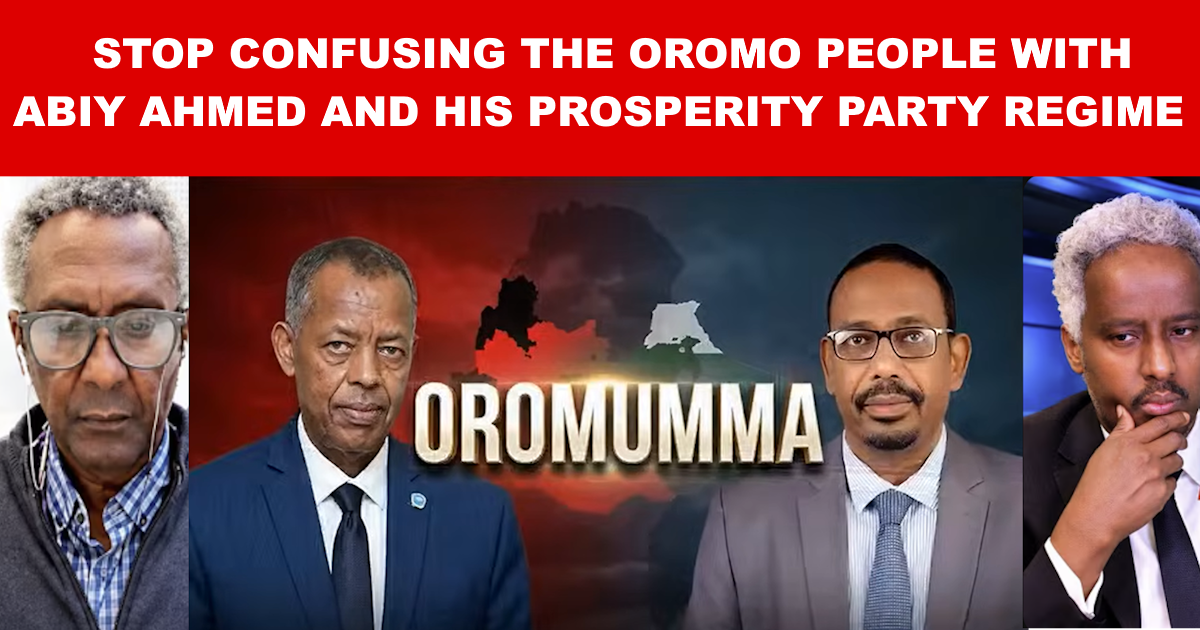
Stop Confusing the Oromo People with Abiy Ahmed and His Prosperity Party Regime. Those who attack the Oromo people in the name of opposing Abiy Ahmed risk strengthening the very political narrative that sustains his rule. Oromummaa is not the Prosperity Party, nor is Oromo identity a license for collective blame. As political opportunists exploit ethnic divisions and territorial disputes, this impassioned appeal exposes the dangerous conflation of a people with their rulers — and calls for justice, accountability, and solidarity among neighboring nations.
The dangerous politics of collective blame, the misrepresentation of Oromummaa, and the tragedy of turning neighboring peoples against one another.
1. The Dangerous Deception: An Oromo Prime Minister Is Not an Oromo Government
There is a deeply troubling narrative taking hold across Ethiopia and the wider Horn of Africa and beyond. Politicians, commentators and political opportunists who oppose Prime Minister Abiy Ahmed are increasingly directing their hostility not merely towards his government, but towards the Oromo people themselves.
Some may be acting out of ignorance. Others appear to be exploiting a convenient political fiction. Whatever their motives, the consequence is the same: an entire nation is being made answerable for the actions of a government simply because the man who heads it claims to be Oromo.
This is not merely an intellectual failure. It is a dangerous political deception.
Abiy Ahmed is not the Oromo people. His Prosperity Party is not Oromummaa. And his government is not the political embodiment of the Oromo nation's collective aspirations. [1,2,3,4,5,6,7]
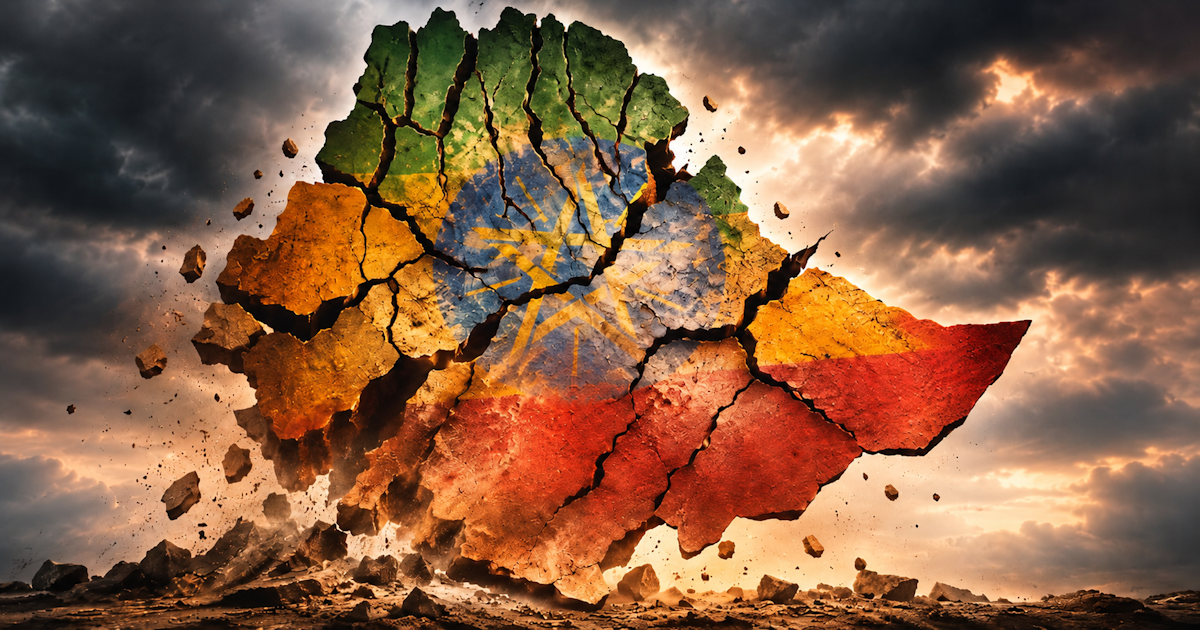
To confuse these distinctions is to misunderstand Ethiopia's contemporary political tragedy. To deliberately erase them is to participate in that tragedy.
The irony is extraordinary. Some of Abiy Ahmed's fiercest critics have adopted precisely the narrative that can serve his political interests: that his government represents Oromo power, that his actions express Oromo ambitions, and that opposition to his rule must therefore become opposition to the Oromo people.
Nothing could be more politically convenient for a leader seeking to present himself as the indispensable defender of an ethnic constituency.
“Those who attack the Oromo people in the name of opposing Abiy Ahmed may be strengthening the very political narrative that Abiy Ahmed needs for his survival.”
And nothing could be more damaging to the prospects of solidarity among peoples who have every reason to oppose authoritarianism together.
The Oromo people must not be turned into the human shield of a government they did not collectively authorize, do not collectively support, and cannot collectively be held responsible for.
2. The War That Exposes the Fiction
If Abiy Ahmed's government were the political expression of Oromo collective power, how does one explain the war that his own administration has waged in Oromia?
The chronology alone should give serious observers reason to reconsider their assumptions.
Abiy Ahmed became prime minister in April 2018. By January 2019, federal military operations against the emerging Oromo Liberation Army (OLA) [8] had begun in western Oromia. This was nearly two years before the outbreak of the devastating Tigray war in November 2020.
The conflict in Oromia was not an incidental footnote to Abiy Ahmed's premiership. It became one of its defining features.
United Nations reporting documents the federal counterinsurgency launched in January 2019, while subsequent investigations describe killings, displacement and grave abuses affecting civilians in Oromia.
The war has involved federal forces, Oromia regional security institutions, the OLA and other armed actors operating across a complex and increasingly fragmented conflict landscape.
The 2021 election exposed another dimension of this political reality. With major Oromo opposition parties, including the Oromo Liberation Front (OLF) and Oromo Federalist Congress (OFC), effectively excluded from electoral competition amid arrests, intimidation, and severe political repression, the Prosperity Party faced no meaningful Oromo opposition at the ballot box in Oromia. Opposition figures were imprisoned, others faced persecution, and some were forced into exile. What was presented as an electoral contest thus became, in Oromia, an exercise in political exclusion. The political purpose was difficult to miss: eliminate meaningful competition, monopolize Oromo political representation, and manufacture an electoral mandate that the people had been denied a genuine opportunity to contest.
It has brought suffering to Oromo civilians, as well as to members of other communities living in Oromia. Allegations of atrocities against civilians must be investigated regardless of the perpetrators' identities or political affiliations.
- Consider the revelations of the Reuters investigation [9] into Koree Nageenyaa, the shadowy security committee implicated in extrajudicial killings, arbitrary detentions, and the systematic suppression of suspected Oromo dissidents. Its reported operations, conducted under the authority of senior officials within Oromia's own regional administration, expose a chilling contradiction: the very institutions supposedly representing the Oromo people have been implicated in persecuting them. What greater indictment of the fiction of an "Oromo government" could there be?
- Consider the fourteen Karrayyuu Abbaa Gadaas [9,10], summarily executed in cold-blood by regime security forces in December 2021, as documented by human rights investigators. These were custodians of an ancient Oromo institution, men entrusted with preserving the cultural and moral heritage of their people. Their killing was not merely the destruction of fourteen lives; it was a devastating assault upon a community and its revered traditional leadership. What more compelling evidence is needed to expose the gulf between Oromo identity and the conduct of those who govern in its name?
- And consider the loss of prominent Oromo voices: the beloved artist Haacaaluu Hundeessaa [11,12], the influential human rights activist Abduljabbar Hussein [13], the outspoken political figure Battee Urgeessaa [14,15,16], and too many to list all here, and whose circumstances and experiences of persecution and repression must be distinguished rather than indiscriminately attributed to a single perpetrator. Their names evoke different chapters of Oromo political and cultural struggle, and the profound vulnerability of voices that challenge established power. How many more tragedies, how many more silenced voices, how many more shattered families must be recalled before the distinction becomes impossible to ignore?
A government does not become the embodiment of a people merely because its leaders share their ancestry. Not when those people endure its prisons. Not when their traditional leaders fall to its security forces. Not when their political voices are suppressed and their communities live under the shadow of war.
The question is no longer whether Abiy Ahmed is Oromo. The question is whether his government's deeds justify the claim that it represents the Oromo people. And the evidence demands that the two be distinguished.
Yet the fundamental political question remains unavoidable.
How can a government engaged in a prolonged military confrontation with an Oromo insurgency, with custom security institutions to eradicate Oromo dissidents — and by extension Oromummaa — and while restricting Oromo political opposition, be casually presented as the government of the Oromo people?
The answer is that it cannot — at least not without confusing the ethnicity of its leadership with the political consent of the population.
Abiy Ahmed's Oromo ancestry may be a biographical fact. It is not a democratic mandate from the Oromo nation.
His administration's political conduct, not his ethnic origin, must determine how that administration is judged.
3. Oromia’s Own Political Leadership and the Crisis of Representation
The same distinction applies to Oromia's regional administration.
Shimelis Abdissa, the president of the Oromia Regional State, is not synonymous with the Oromo people. His political authority derives from the institutional structure within which he governs, not from an inherent right to speak for every Oromo. [17,18,19,20,21]
Nor should the presence of Oromo officials within the Prosperity Party be mistaken for proof that the party embodies the Oromo national movement.
Indeed, one of the central contradictions of Ethiopia's current political order is that the state institutions nominally responsible for protecting Oromo interests have themselves been deeply implicated in the conflict with Oromo opposition movements.
This is precisely why political representation must be distinguished from political identity.
The Oromo people are not a political monolith. They include supporters and opponents of the government, advocates of different constitutional arrangements, proponents of peaceful reform, and supporters of competing liberation movements.
Their political disagreements do not diminish their shared identity. Nor does their shared identity oblige them to support a particular leader.
To claim that Abiy Ahmed speaks for the Oromo nation simply because he is Oromo is to deny that nation the very political agency that democratic self-determination requires.
There is an additional irony here.
The Ethiopian government entered formal negotiations with the OLA in Tanzania in April–May 2023 and again in November of that year. Both rounds ended without a political settlement.
Those negotiations themselves demonstrate the existence of a serious political conflict over the governance and future of Oromia.
A government cannot simultaneously acknowledge a profound political dispute with an Oromo movement and reasonably claim that its own political agenda represents the uncontested will of the Oromo people.
4. The Convenient Invention of an Oromo Expansionist Government
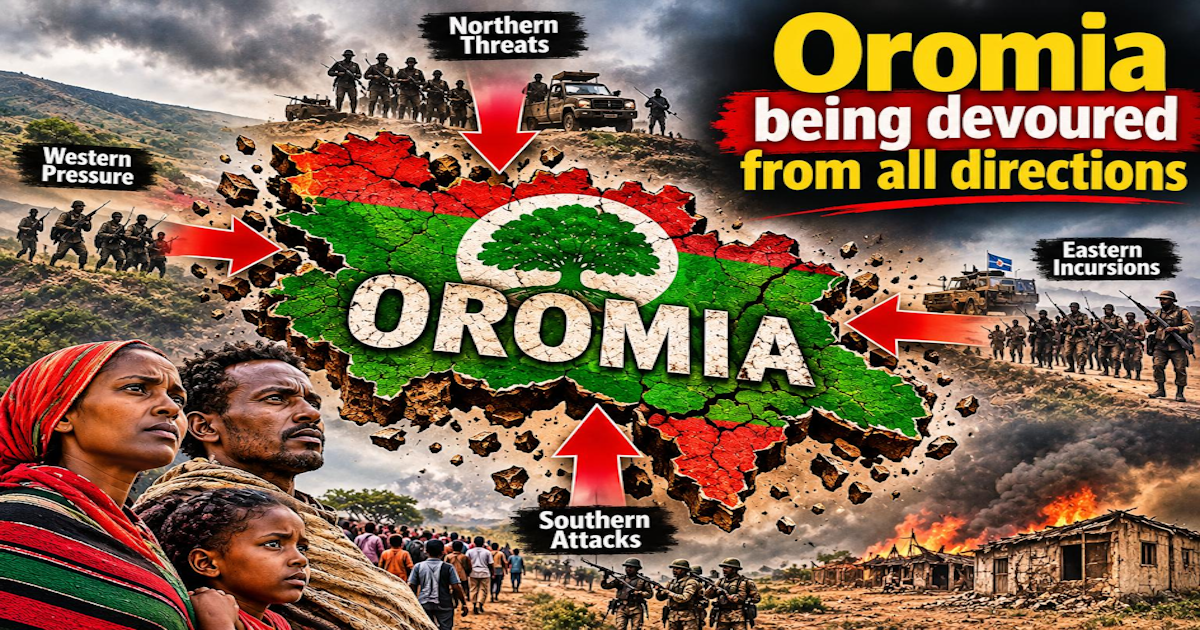
The distortion becomes particularly dangerous when political disputes over territory are presented as evidence of an alleged Oromo expansionist project directed from Finfinnee (aka Addis Ababa).
Across parts of the Horn of Africa, competing historical claims, administrative boundaries, resource interests and political ambitions have generated tensions between neighboring communities.
These disputes are real. Some have deep historical roots. Others have been intensified by successive governments, administrative decisions and the instrumentalization of ethnic identity.
But there is a fundamental difference between defending a legitimate territorial claim and portraying an entire neighboring people as an expansionist enemy.
Certain Somali political commentators, advocates of competing territorial claims and Amhara nationalist actors have increasingly framed Oromia through the language of territorial threat.
In some instances, criticism of Abiy Ahmed becomes indistinguishable from criticism of Oromo identity itself.
The logic is politically convenient: identify Abiy Ahmed as the representative of Oromo ambitions, describe those ambitions as expansionist, and then treat opposition to the Oromo people as a legitimate form of resistance to his government.
This is a profound inversion of political reality.
A conflict over territory does not establish the collective guilt of a population. Nor does the existence of Oromo political nationalism establish that every Oromo nationalist seeks to dispossess neighboring communities.
Claims over disputed territories must be examined through history, law, legitimate local grievances, the rights of residents and credible processes of resolution.
They cannot be settled by ethnic vilification.
Oromia's land, resources and political future must not become prizes in a competition to demonize the people who inhabit it.
The fertile lands and strategic position of Oromia undoubtedly make territorial questions politically consequential. But economic or territorial motives should be attributed to identifiable actors on the basis of evidence, rather than presumed to explain the conduct of entire ethnic communities.
That distinction is not a concession to political correctness. It is a requirement of intellectual integrity.
5. Oromummaa Is Not Abiy Ahmed’s Political Ideology
Perhaps the most alarming development is the attempt to transform Oromummaa itself into an object of suspicion.
Some commentators have gone beyond criticizing Oromo political movements or particular territorial claims. They portray Oromummaa as an inherently dangerous ideology, a threat not merely to Ethiopia but to the wider East African region.
Such claims demand serious scrutiny.
What, precisely, is being condemned?
- Oromummaa refers, at its most fundamental level, to Oromo identity, belonging, culture, historical consciousness and the experience of being Oromo.
- It encompasses language, heritage, collective memory, social relationships and a sense of shared peoplehood.
- It also has an intellectual and political dimension, developed by Oromo scholars and activists seeking to articulate historical experiences of marginalization, cultural suppression and struggles for recognition.
Like other forms of national consciousness, it is neither intellectually static nor politically uniform. Its interpretations vary, and particular political applications remain open to legitimate criticism.
But none of this makes Oromo identity inherently threatening.
An English person does not become a threat to Europe by embracing Englishness. A Somali does not become a threat to the Horn of Africa by affirming Somalinimo. An Amhara does not become an enemy of Ethiopia by celebrating Amhara identity.
Why, then, should an Oromo become a political suspect merely by embracing Oromummaa?
The answer cannot be that Oromo identity has political implications. Every national identity has political implications when questions of recognition, sovereignty, representation and historical injustice arise.
Nor can the answer be that some individuals invoke Oromummaa to justify questionable conduct. The misuse of an identity does not establish the moral illegitimacy of that identity.
To condemn an entire people's consciousness because of the conduct of particular politicians is not political analysis. It is collective stigmatization dressed up as analysis.
Oromummaa did not begin with Abiy Ahmed. It does not belong to his Prosperity Party. And it will not disappear when his government eventually exits office.
Indeed, the Oromo struggle for cultural recognition, political representation and self-determination long predates his rise to power.
To identify Oromummaa with Abiy Ahmed is therefore not only politically misleading. It is historically absurd.
6. The Moyale Tragedy and the Politics of Misattribution
The recent violence and competing accusations surrounding Moyale bring these contradictions into particularly sharp focus. [22,23]
Moyale occupies a sensitive geographical and political position. It is a place where Oromo and Somali communities, administrative boundaries, cross-border relationships and longstanding disputes intersect.
Recent allegations involving armed actors associated with the Somali Regional State have revived fears about the vulnerability of communities living along disputed boundaries.
The precise responsibility for individual incidents requires independent investigation. Conflicting claims cannot be resolved merely by repeating the accusations of whichever side speaks most loudly.
But there is a broader political issue that should not be obscured by disputes over immediate culpability.
When violence occurs along the Oromia–Somali boundary, the federal government's responsibility is not optional. It has a duty to protect civilians, prevent the escalation of armed confrontation, investigate violations and ensure that regional authorities do not act with impunity.
The Oromia regional administration carries corresponding responsibilities towards the communities it is entrusted to protect.
If either administration fails to discharge those responsibilities, the criticism should be directed towards the institutions and officials concerned.
That includes Abiy Ahmed, Shimelis Abdissa and Somali Regional President Mustafe Omar, each within the scope of their respective powers and decisions.
It does not justify treating ordinary Oromo or Somali civilians as collective perpetrators.
Nor should any unresolved allegation of federal orchestration be presented as an established fact without evidence.
There is, nevertheless, a legitimate and urgent question concerning the apparent selectivity of federal intervention: why does the Ethiopian state demonstrate decisive military capacity in some circumstances while appearing unable or unwilling to provide comparable protection in others?
That question deserves a documented answer, not an ethnic scapegoat.
And it is particularly perverse when Oromo communities affected by insecurity are portrayed as beneficiaries of the very government whose protection they question.
7. To Our Somali Neighbors: Why Turn a Friend into an Enemy?
Of all the consequences of this political distortion, perhaps the saddest is the damage it threatens to inflict upon relations between Oromo and Somali peoples.
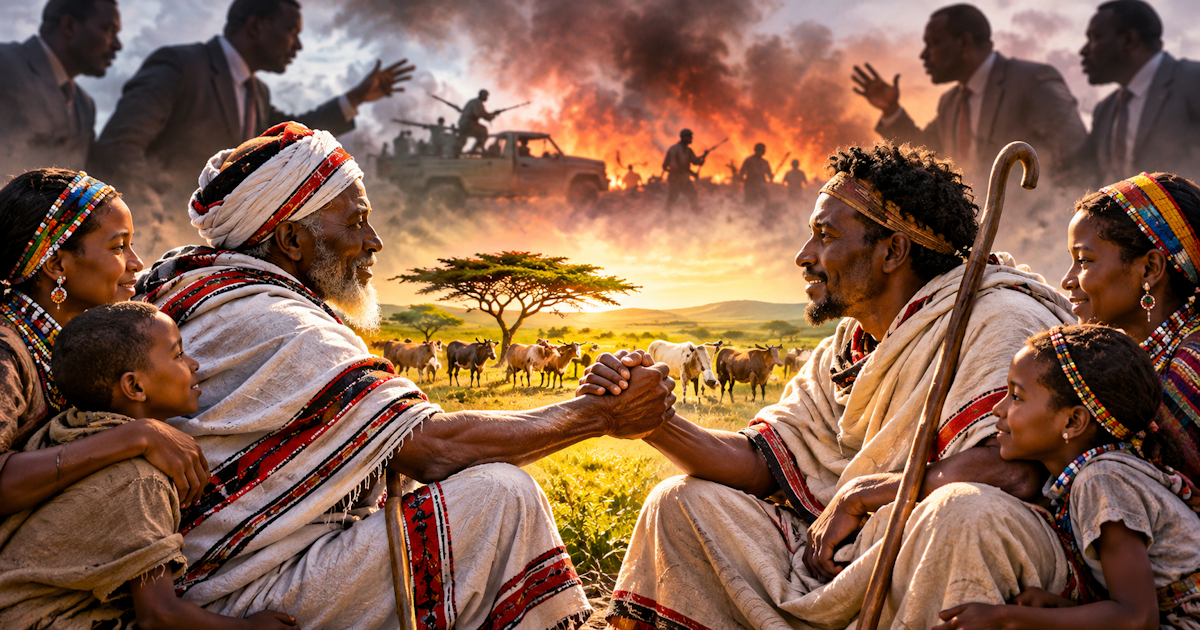
These are neighboring communities whose histories are intertwined through geography, commerce, migration, shared livelihoods and, in many places, generations of coexistence.
Their relationship has not always been free of conflict. Historical territorial disputes and local competition must not be romanticized away.
Yet many of these conflicts must also be understood against the backdrop of a common experience of oppression and marginalization suffered by both Oromo and Somali communities.
Worse still, successive regimes throughout modern Ethiopian history have exploited these grievances, manipulating communal differences and sustaining inter-ethnic tensions through the familiar politics of divide and rule.
To ignore this shared history of oppression and political manipulation is to mistake the consequences of deliberate division for an inherent hostility between the peoples themselves.
But neither should those disputes erase the profound human connections that have existed across generations.
Both communities have extended refuge and hospitality to one another in times of hardship. Oromo families fleeing persecution and insecurity have found shelter in Somalia, just as Somali families escaping conflict, displacement and hardship have found sanctuary among Oromo communities in Oromia.
Significant numbers of Somalis have also made their homes and livelihoods in Finfinnee, living and working alongside Oromo residents and other communities in peace. These reciprocal acts of refuge, generosity and coexistence are not incidental footnotes to their shared history. They are enduring reminders that, beyond the political disputes and manufactured antagonisms, ordinary Oromo and Somali people have repeatedly recognised one another's humanity when it mattered most.
These experiences deserve recognition rather than erasure.
There is a fundamental truth that readers must keep firmly in mind throughout this editorial: this is not a conflict between the Oromo and Somali peoples, nor is it a conflict that should be understood as an inevitable confrontation between neighboring communities anywhere in Ethiopia. It is a tragedy in which political elites including those of the Prosperity Party regime, territorial opportunists of Somali and Amhara regions, and those who manipulate ethnic loyalties have too often turned neighboring peoples against one another in pursuit of interests that ordinary citizens neither share nor stand to benefit from. The grievances may be real, the territorial disputes may be longstanding, and the suffering on all sides is undeniable. But these realities must never obscure the role of those who exploit such divisions, inflame communal hostility, and turn political disagreements into deadly confrontations.
And therein lies perhaps the cruelest injustice of all: those who fan the flames of conflict are rarely the ones consumed by them. It is not the politicians trading accusations, the commentators manufacturing ethnic hostility, or the powerful figures maneuvering for territorial and political advantage who ordinarily pay the ultimate price. It is the farmer tending his land, the mother raising her children, the trader earning an honest living, and the families who have lived alongside one another for generations. They lose their homes, their livelihoods, their loved ones, and sometimes their lives, while those who helped ignite the hostility remain comfortably removed from its devastating consequences.
The tragedy is not that Oromo and Somali peoples are destined to be enemies. It is that people who have every reason to live as neighbors are repeatedly made to suffer as enemies, while those who stand to gain from their division seldom share the suffering they unleash.
It is therefore deeply disheartening to encounter political commentary that portrays Oromo identity itself as a menace to Somali interests.
What conceivable future does such rhetoric promise?
- Can Somali security be advanced by teaching Somali communities to regard their Oromo neighbors as enemies?
- Can Oromo rights be secured by treating ordinary Somalis as accomplices of political actors who claim to speak in their name?
- Can either people flourish while their political elites compete to manufacture collective grievances and permanent suspicion?
The answer should be obvious.
Somali political leaders and commentators have every right to challenge Abiy Ahmed, contest territorial claims and criticize the policies of the Oromia regional administration.
But that right does not extend to the wholesale defamation of Oromo identity.
The same principle applies in reverse. Oromo political advocacy must never descend into the collective condemnation of Somali people for the conduct of Somali officials, armed actors or media personalities.
The Oromo people are not the enemies of the Somali people. Nor should the Somali people be made enemies of the Oromo.
Those who profit politically from turning neighbors into adversaries should not be allowed to define the relationship between the communities themselves.
8. The Responsibility of Somali Political Voices in Kenya and Beyond
The distinction becomes particularly important when examining commentary emerging from Kenya, Somalia, Ethiopia's Somali Region and diaspora media.
It would be a mistake to treat Kenyan political opinion as uniformly hostile towards Oromo interests.
Kenya's political landscape is diverse. Kenyan parliamentarians and civic actors, including representatives of Oromo heritage, have at various times demonstrated concern for the rights and security of Oromo communities. The Oromo people no doubt are grateful for their support.
The political conduct of particular ethnic Somali parliamentarians or commentators in Kenya must therefore not be confused with the position of the Kenyan people or the Kenyan state.
Nor should Somali commentators in the diaspora be presumed to speak for all Somalis.
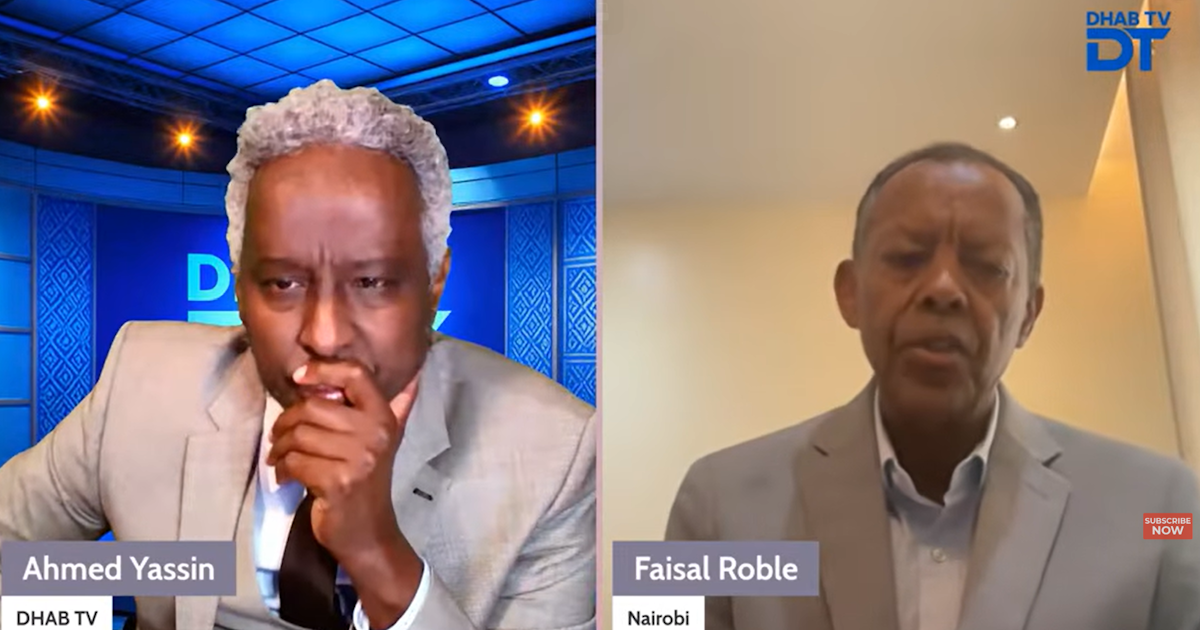
Media platforms, including Dhab TV, have an important responsibility in this regard. [22,24,25,26,27]
When journalists and commentators discuss territorial disputes, Oromo political movements or the conduct of the Ethiopian government, their language matters.
To criticize an organisation is legitimate. To challenge a political doctrine is legitimate. To examine competing historical claims is legitimate.
But to suggest that Oromo identity itself constitutes a regional security threat requires an entirely different standard of evidence.
It is an extraordinary accusation against an entire people.
Those making it should be required to explain precisely what they mean, identify the conduct they are condemning, and distinguish the actions of particular political actors from the identity of millions of people.
Without such distinctions, political commentary risks becoming a vehicle for ethnic prejudice.
And prejudice, once normalized in political discourse, has a habit of escaping the control of those who initially encouraged it.
9. The Strange Convergence of Political Adversaries
There is a further irony that deserves attention.
Political actors whose broader interests are sharply opposed can nevertheless find themselves repeating remarkably similar accusations against Oromo identity and political aspirations. [28]
Some Amhara nationalist voices, certain Somali territorial advocates and opponents of Abiy Ahmed from other political constituencies have, for different reasons, portrayed Oromo nationalism as a threat.
Their disagreements with one another can be profound. Their historical grievances may be mutually incompatible. Their preferred political futures for Ethiopia may be irreconcilable.
Yet they can converge upon a convenient common target: Oromummaa.
Why?
One possible explanation lies in competing claims over territory, resources, political influence and the constitutional future of Ethiopia.
For those seeking a greater share of Oromia's territory or political authority, delegitimizing Oromo national consciousness may appear useful.
If Oromo demands for self-determination can be characterized as extremism, then opposition to those demands can be presented as a defense of peace, unity or regional security.
If Oromo political identity can be portrayed as synonymous with Abiy Ahmed's government, then legitimate anger against his administration can be redirected towards the Oromo people.
The political advantage is apparent.
But the underlying motives of particular actors must be established individually. Similar rhetoric does not, by itself, prove coordination or a common expansionist agenda.
What can be said is that the cumulative effect of these narratives threatens to delegitimize Oromo political aspirations regardless of who advances them or why.
This is the danger.
A people whose historical struggle has centered on recognition, equality and self-determination risk being recast as the principal threat to the rights of others.
The victim of historical marginalization becomes the alleged architect of regional domination.
The population confronting its own government's coercive power becomes the supposed beneficiary of that power.
And the very identity through which a people articulate their historical experiences becomes evidence against them.
It is a remarkable political inversion.
10. Oromo Liberation and the Principle of Solidarity
The Oromo struggle for recognition and self-determination need not be understood as a struggle against other peoples.
At its most principled, it offers something far more constructive: the possibility of a political order in which no community must surrender its identity, language, history or legitimate aspirations to secure its place within a shared political framework.
The rights claimed by Oromo people cannot logically be denied to Somali, Tigrayan, Amhara, Sidama or any other people.
Indeed, a movement that demands freedom for itself while denying comparable rights to others would undermine its own moral foundation.
This is why the principle of solidarity matters.
The Oromo demand for dignity is not diminished when a Somali demands dignity. Oromo self-determination is not threatened by the legitimate self-determination of Tigrayans or other oppressed communities.
Rights are not a finite resource that must be taken from one people to be enjoyed by another.
Territorial disputes, of course, present difficult practical questions. Competing historical claims cannot always be reconciled simply by affirming mutual goodwill.
They require fair procedures, respect for affected populations, historical examination, constitutional safeguards and a willingness to reject coercion.
But these difficulties are reasons for political dialogue, not excuses for collective hostility.
Oromo political consciousness can be a force for solidarity precisely because the experience of marginalization should cultivate an understanding of the suffering of others.
That is the higher promise of Oromummaa: not superiority over neighboring peoples, but dignity without subordination; not the denial of others' identities, but the refusal to surrender one's own.
Such a vision is incompatible with both authoritarian centralism and ethnic domination.
It is also incompatible with the politics of Abiy Ahmed whenever his government employs coercion, suppresses political pluralism or fails to protect the rights of the communities it governs.
The measure of a liberation movement is not merely the freedom it demands for its own people, but the freedom it is prepared to recognize in others.
11. Stop Giving Abiy Ahmed the Political Shield He Needs
There is a final warning for those who genuinely seek to challenge Abiy Ahmed's government.
Every time they describe his administration as an Oromo government, they risk handing him a political advantage.
Every time they attack Oromummaa as a substitute for criticizing his policies, they risk pushing Oromo communities into a defensive posture against those critics.
Every time they portray the Oromo people as collectively responsible for the conduct of the Prosperity Party, they obscure the suffering and political opposition that exist within Oromia itself.
And every time they equate Oromo national aspirations with the ambitions of the Ethiopian state, they erase the fundamental distinction between a people's struggle for self-determination and a government's exercise of power.
This is not an argument that all Oromo people oppose Abiy Ahmed. Some support him. Others oppose him. Many hold positions that cannot be reduced to either camp.
It is an argument that no politician has the right to appropriate an entire people's identity as a substitute for political legitimacy.
Those who oppose Abiy Ahmed should challenge his decisions, his government's record, its use of force, its treatment of political opponents, and its responsibility for protecting civilians.
- They should demand accountability from the institutions that exercise power.
- They should insist upon independent investigations where atrocities are alleged.
- They should challenge the political arrangements that perpetuate conflict.
- And they should recognize potential allies among Oromo communities whose demands for justice may overlap substantially with their own.
What they should not do is transform political opposition into ethnic hostility.
For that would be to commit two errors at once: to misidentify the source of political responsibility and to alienate those who may share the very grievances being expressed.
If your quarrel is with Abiy Ahmed, direct it at Abiy Ahmed. If your quarrel is with the Prosperity Party, direct it at the Prosperity Party. Do not manufacture a quarrel with the Oromo nation.
12. A Plea Before the Damage Becomes Irreparable
There is something profoundly tragic about neighboring peoples, bound together by geography and generations of shared experience, allowing political opportunists to turn their identities into weapons against one another.
The Oromo and Somali peoples will remain neighbors long after Abiy Ahmed, Shimelis Abdissa, Mustafe Omar and today's political commentators have departed the political stage.
Their children will inherit the consequences of the language being normalized today.
They will inherit either the bridges their elders preserved or the bitterness their political elites cultivated.
This is why words matter.
A reckless accusation may be forgotten by the commentator who makes it, but remembered by the community against whom it was directed.
A defamatory political slogan may generate applause today, only to become the justification for hostility tomorrow.
And an entire generation may grow up believing that a neighboring people constitute an existential threat, not because of anything those neighbors have done, but because someone found it politically advantageous to say so.
That is how political manipulation becomes social estrangement.
That is how neighbors become strangers.
And that is how strangers, taught to fear one another, can eventually become enemies.
The Oromo people have no obligation to defend the actions of Abiy Ahmed merely because he claims to be Oromo.
The Somali people have no obligation to defend the actions of Mustafe Omar or any other Somali politician merely because they share an identity.
Nor should Amhara, Tigrayan or other communities be collectively judged by the conduct of their political or armed representatives.
These principles must apply equally, or they are not principles at all.
To Somali intellectuals, politicians, journalists and commentators who have embraced the language of Oromo collective culpability, the appeal is simple: reconsider the consequences of what you are saying.
Challenge Oromo political claims where you disagree with them. Present historical evidence. Contest territorial assertions. Demand accountability for abuses.
- But do not mistake a people's identity for an act of aggression.
- Do not turn Oromummaa into a synonym for Abiy Ahmed.
- And do not allow the legitimate grievances of your own communities to become instruments for denying the dignity of another.
The Oromo people, for their part, must remain committed to the same moral discipline. They must distinguish between Somali political actors who encourage hostility and the Somali communities whose lives and futures remain intertwined with their own.
There is no lasting Oromo freedom built upon Somali humiliation, just as there is no lasting Somali security built upon Oromo dispossession.
The path forward cannot be the competitive destruction of one another's identities.
It must be the mutual recognition of rights.
History will eventually judge Abiy Ahmed and his government by their deeds. It will judge the political movements opposing them by theirs.
But it will also judge those who, in their eagerness to defeat one government, helped poison relations between entire peoples.
That would be an unforgivable legacy.
The Oromo nation existed before Abiy Ahmed. Oromummaa existed before the Prosperity Party. Both will endure beyond the political fortunes of any individual or administration.
And the Oromo people's right to dignity, identity and self-determination does not depend upon the approval of their adversaries.
Oppose Abiy Ahmed if you must. Challenge his government with all the evidence and conviction you can muster. Hold those responsible for injustice to account.
But leave the Oromo people out of your quarrel with their rulers.
Do not mistake the people for the government that claims to represent them.
And above all, do not destroy the possibility of friendship between nations merely to settle accounts with a politician.
References
- OT Editorial, Here Is Why We Say the Oromia Government Is Not an Oromo Government: And Why the Federal Government's Claims to Oromo Leadership Ring Just as Hollow, 22 October 2026, OROMIA TODAY.
- Kumaa Daadhii and Olii Boran, The PP Regime Now Has the Accolade: No Other Ethiopian Regime Has Acted Against the Oromo People So Intensely in Such a Short Time, 2 February 2026, OROMIA TODAY.
- Kumaa Daadhii, How Will Medemer Be Remembered?, 7 January 2026, OROMIA TODAY.
- Oli Bora, Leading by Chaos, Not Competence, 4 December 2024, OROMIA TODAY.
- Kumaa Daadhii, Ten Things the PP Government Has Done—and You Might Not Even Know, 25 January 2025, OROMIA TODAY.
- OT Editorial, The Sinister Dirty Game of the PP Regime with Moyale, 5 August 2025, OROMIA TODAY.
- OT Editorial, A Time Bomb Buried in Oromia and Somali Region, 27 August 2025, OROMIA TODAY.
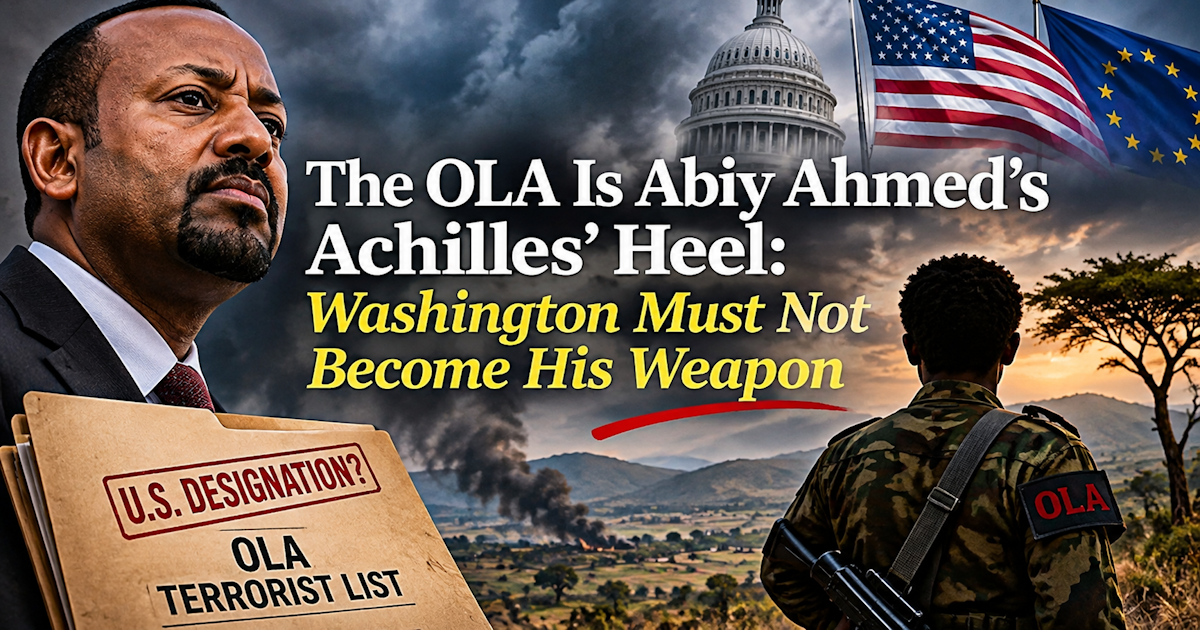
- OT Editorial, The OLA Is Abiy Ahmed’s Achilles’ Heel: Washington Must Not Become His Weapon, 8 November 2026, OROMIA TODAY.
- GIULIA PARAVICINI, "A REUTERS INVESTIGATION: In Ethiopia, a secret committee orders killings and arrests to crush rebels", 23 February 2024, Reuters.
- Analysis: No sign of redress for Karrayyu Abba Gadaas executed by Oromia police despite state minister, MP named culprits, 17 January, 2022, Addis Standard.
- Ethiopian singer Hachalu Hundessa shot dead in Addis Ababa, 30 June 2020, Al Jazeera.
- Hachalu Hundessa, Ethiopian Singer and Activist, Is Shot Dead, 30 June 2020, New York Times.
- News update: Lawyer of prominent opposition political figures found dead in Adama, 12 August 2021, Addis Standard.
- Elemoo Qilxu, Battee Urgeessaa Is Gone, Who Will Be Next For Koree Nageenyaa's Gestapo?, 11 April 2024, OROMIA TODAY.
- Senate Chair Cardin Statement on the Killing of Bate Urgessa in Ethiopia, 9–10 April 2024, US Senate.
- News: Milo Urgessa, brother of late Batte Urgessa, remains detained despite court release order, says family member, 18 July 2024, Addis Standard.
- OT Editorial, Shame on You, Shimelis Abdissa. Shame on You, Caffee Oromiyaa. Again., 24 October 2026, OROMIA TODAY.
- OT Editorial, To Shimelis Abdissa and Caffee Oromia: History Will Judge You for a Shameful Failure of Duty, 17 March 2026, OROMIA TODAY.
- OT Editorial, The Oromia Administration: Silence, Not Governance, 28 January 2026, OROMIA TODAY.
- OT Editorial Team, 10 Compelling Reasons Shimelis Abdissa Is Not Effectively Governing Oromia, 30 July 2025, OROMIA TODAY.
- OT Editorial, Parliamentary Silence and Collective Cowardice: Shame on Ethiopia’s Parliament and Caffee Oromia for Enabling Atrocity, 2 July 2025, OROMIA TODAY.
- Tsegaye R. Ararssa, The Moyale Fiasco: Countering the Myth of Oromo Expansionism, 28 October 2026, OROMIA TODAY.
- Tsegaye R. Ararssa, Managing Border Disputes Among Transboundary Pastoralist Communities: The Case of the Garrii–Borana Conflict in Moyale—A Report, 14 November 2026, OROMIA TODAY.
- MOYALE CONFLICT: The Somali–Oromo Crisis and the Politics Behind It | Faisal Roble, 27 October 2026, Dhab TV YouTube Channel, YouTube.
- IS ETHIOPIA A FAILED STATE? THE MOYALE CRISIS & LESSONS FOR ETHIOPIA | Prof. Mohamed Hassan, 14 November 2026, Dhab TV YouTube Channel, YouTube.
- The politics behind the Moyale conflict, Prof Mohamed Hassan, 6 November 2026, Dhab TV YouTube Channel, YouTube.
- Oromo Ultra-Nationalism: The Growing Danger to Ethiopia and Its People, 4 November 2026, Dhab TV YouTube Channel, YouTube.
- Elemoo Qilxuu and Kumaa Daadhii, The Politics of Spite—How Oromia’s Foundations Expose the Empty Ambitions of a Troubled Region, 12 November 2025, OROMIA TODAY.