OROMIA TODAY – Basic Politics Lessons 101 For members of political parties in general and the Prosperity Party in particular

Synopsis
It has become increasingly clear that many party members lack even a basic understanding of the norms, limits, and responsibilities of political life.
A dangerous assumption has taken root: that once a party forms a government, it automatically owns the state. This belief is false—and it is where criminality begins which is everyday occurrence with the Prosperity Party.
These politics lessons are written for reflection, not insult. The purpose is to help party members assess their conduct honestly and understand where political participation ends and personal liability begins.
Let us be clear from the outset:
- This is not ideology.
- This is not constitutional theory.
- This is basic governance hygiene—the basic minimum required of anyone near public power.
A. Politics Lessons as Bare Minimum Principles
A1. High office does not mean unlimited power
- Being a Prime Minister or a President does not mean you can do whatever you want.
- You are elected to implement the will of the people, not to replace it.
- Governance is carried out through consultation and consent, not intimidation, threats, humiliation, or terror.
- When fear becomes a tool of governance, legitimacy has already begun to erode.
A2. Government is not party ownership
- Being in government does not mean your party owns the state.
- Only elected individuals constitute the government or the opposition. They alone hold public authority.
- Unelected party members—no matter how loyal or connected—are ordinary citizens under the law.
- They have no special right to command officials, interfere with institutions, or access public resources.
A3. Party takeover of the state is not governance
When a party apparatus:
- floods government institutions,
- occupies administrative offices,
- interferes with professional civil servants,
- and draws salaries from public funds without electoral mandate,
- that is not governance.
- It is state capture.
- Using taxpayers’ money to sustain a party network disguised as government machinery is not a gray area. It is a criminal abuse of public trust.
A4. Public office is not a license to enrich yourself
- Holding public office grants responsibility, not privilege.
- Any gift received in connection with public office—whether as small as a pen or as large as a yacht or an airplane—is not personal property. It belongs to the public.
- Any money, benefit, favor, or advantage taken because of your position—and not because of a clearly published and lawful entitlement—is corruption.
This includes:
- bribes offered or coerced,
- direct or indirect theft of public funds,
- misuse of public property for personal or party benefit,
- unauthorized salaries, allowances, travel, housing, fuel, or security,
- benefits routed through relatives or associates.
- Corruption is not culture. It is high crime as abuse of entrusted power.
If you would be uncomfortable explaining a benefit openly to the public, it was never yours to take.
Self-Assessment #1
Have you violated any of the principles A1–A4—directly or indirectly?
B. Four Rules No Power Survives Violating
B1. Power is not ownership
- Holding office does not mean owning the state, the people, institutions, or the future.
- Power is temporary responsibility, not permanent property.
- When leaders behave like owners, legitimacy begins to rot—and rot never stops quietly.
B2. You are a public servant, not the other way round
- Public office exists to serve the people, not to command them.
- Citizens do not exist to protect your position, obey your party, or fear your authority.
- You exist to protect their rights, dignity, and access to services.
When officials:
- treat citizens as subjects,
- demand loyalty instead of professionalism,
- expect gratitude for basic services,
- or punish people for questioning authority,
they have reversed the purpose of public office.
Simple test: If citizens fear you more than they trust you, you are not serving them.
B3. Fear is a tax with compound interest
- Repression may buy silence today, but it creates resistance tomorrow.
- Every act of intimidation accumulates debt—paid later in instability, revolt, collapse, exile, prison, or disgrace.
- A system that relies on fear is not stable. It is borrowing time at an impossible interest rate.
B4. Silence is not consent
- People go quiet when speaking becomes dangerous.
- That silence is not approval.
- It is stored anger, waiting for an opening.
- When silence is mistaken for consent, collapse becomes a matter of timing—not possibility.
- The people you talk down to—regardless of their education, income, or social status—are judging you by how you treat them, not by how powerful you feel.
- If your questions, orders, or behavior aim to extract silence instead of truth, then you are failing as a public servant.
Self-Assessment #2
Which of the rules B1–B4 have you respected—and which have you violated?
C. Rule of Law vs. Rule of People
- A state is not defined by how many laws it has, but by who those laws restrain.
- When laws restrain only citizens, it is rule by people.
- When laws restrain power itself, it is rule of law.
C1. Law must bind power before it binds citizens
- The primary purpose of law is to limit those who govern, not discipline those who are governed.
- If officials can bypass rules without consequence, law has already failed.
- Where leaders stand above the law, citizens fall below dignity.
C2. Selective enforcement is not law
- Applying rules to critics while shielding allies is not order.
- It is privilege disguised as authority.
- If punishment depends on who you are rather than what you did, the system is already corrupt.
C3. Authority without accountability is not legal
- Titles, uniforms, and stamps do not create legality.
An act is lawful only when it:
- follows written rules,
- respects due process,
- and can be openly reviewed.
Power exercised in the dark is not authority. It is arbitrariness.
C4. Emergency powers do not suspend responsibility
- Emergencies may require speed, but they do not erase accountability.
Exceptional powers must be:
- clearly defined,
- time-limited,
- publicly justified,
- independently reviewed.
Permanent emergency is not stability. It is normalized abuse.
C5. Obedience to illegal orders is not a defense
- No instruction overrides basic responsibility.
- Following orders does not excuse unlawful arrests, forced silence, collective punishment, or abuse.
- When conscience is switched off, liability begins.
Self-Assessment #3
Ask yourself honestly:
- Do rules apply equally to me and ordinary citizens?
- Would I defend my actions if reviewed publicly?
- Do I rely on position more than procedure?
- Do I fear accountability more than criticism?
C6. Opposition is not an enemy or a traitor
In a functioning political system, democracy exists as a duality of government and opposition.
- The opposition is not a nuisance.
- It is not sabotage.
- It is not betrayal.
Opposition parties form a shadow government, offering alternative policies, scrutiny, and balance. Their role is to question, challenge, and correct those in power.
To the Speaker of the House and to the Head of State, government and opposition hold equal constitutional standing, differing only in mandate—not legitimacy.
Systems that lean toward autocracy do not tolerate opposition. They label critics “anti-government,” “destabilizers,” or “traitors.”
In reality, opposition strengthens governance, provided criticism is grounded in facts and public interest. Silencing opposition does not protect the state—it exposes its weakness.
- Where opposition is criminalized, rule of law has already collapsed into rule of power.
- A state that fears opposition fears accountability—and a state that fears accountability has already failed.
Self-Assessment #4: On Opposition and Dissent
Ask yourself honestly:
- Do I instinctively label criticism of the ruling party as “anti-government” or “hostile” rather than engaging with its substance?
- Have I ever treated opposition members, journalists, or critics as enemies instead of legitimate political actors?
- Do I support equal legal and institutional treatment for opposition parties, even when I strongly disagree with them?
- Would I defend the right of my opponents to speak, organize, and campaign if the roles were reversed?
- Have I remained silent—or participated—when dissent was criminalized or unfairly punished?
If answering truthfully makes you uncomfortable, that discomfort is the signal that democratic balance has been replaced by loyalty to power.
Closing Notes
- These politics lessons are not written to shame.
- They are written to prevent harm—to citizens, institutions, and to you.
- If followed honestly, they can help you become a better public actor tomorrow than today.
- Share these politics lessons with colleagues and subordinates.
- Translate them for those who do not read English.
- A better state begins with better citizens—especially those closest to power.
Remember this:
- Laws and lawmakers exist because people often fail to do the right thing.
- If you act with honesty, restraint, and respect for others, the law will rarely trouble you.
- The law becomes visible only when conscience disappears.
- Doing the right thing is not complicated.
- It does not require power, party loyalty, or permission.
- When you choose to act rightly, the law has nothing to chase—and history has nothing to accuse.
Life is a school that never closes. Open your mind to these clear and easy-to-digest Politics Lessons.
Observe and Live Safuu:
In Oromo moral philosophy, Safuu is the inner compass that governs conduct even when no one is watching. Simply put, Safuu is living by doing the right thing.
- It is not enforced by courts, uniforms, or fear.
- It is enforced by conscience. The inner you.
- Where Safuu lives, corruption has no shelter.
- Where Safuu guides action, power restrains itself.
- Where Safuu is practiced, law becomes a safeguard, not a threat.
Live Safuu.
And you will not need to fear the law, the people, or history.
When “Government” Is a Misnomer
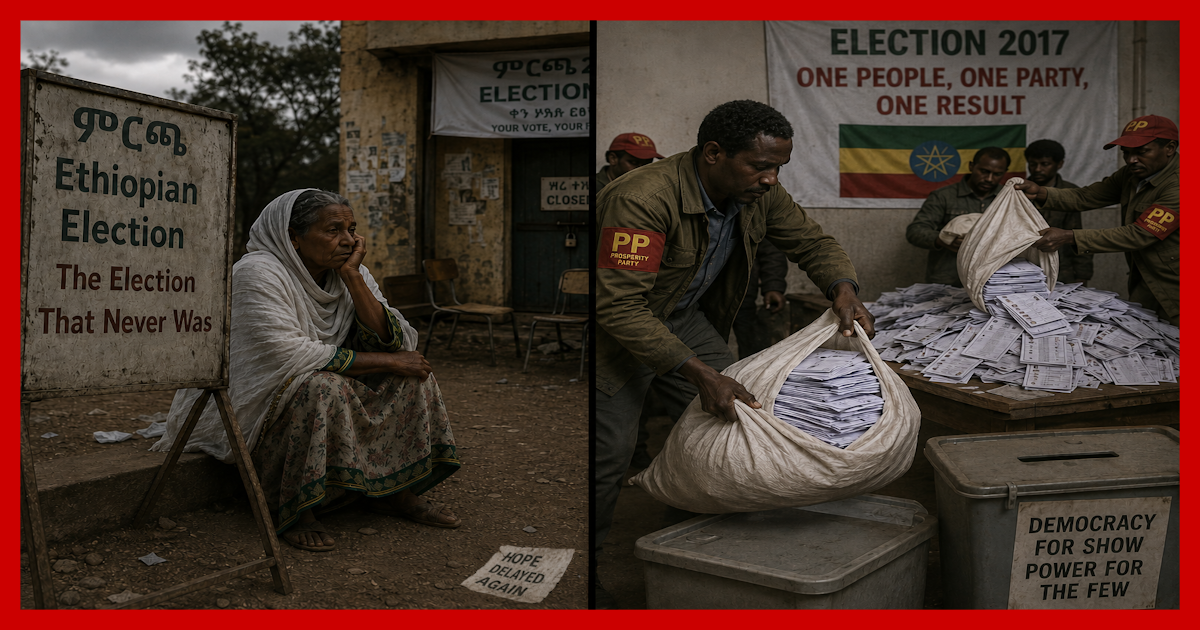
OROMIA TODAY deliberately avoids using the term government when referring to the PP regime. We use the term regime instead, and this choice is not rhetorical—it is analytical.
A government operates within recognized norms, institutional restraints, and the rule of law. The Ethiopian PP regime demonstrably lacks these fundamentals.
As shown in the principles outlined above, it is characterized by state capture by the ruling party, systematic disregard for the law, and the absence of meaningful accountability. These features are not accidental failures; they are defining traits of autocratic rule. By any serious standard, such a system does not qualify as a government in the proper sense of the word.
Selected References
- The Gentleperson Code: Part I—A Cross-Cultural Compass for Modern Dignity, 7 July 2025, OROMIA TODAY.
- The Gentleperson Code: Part II—When the Moral Compass Shatters, 8 July 2025, OROMIA TODAY.
- Amorelite: An Illuminating Word We Didn't Know We Needed, 10 May 2025, OROMIA TODAY.
- Kent M. Keith, The Universal Moral Code, 2003, Terrace Press.
- Ronald Arthur Howard and Clinton D. Korver, Ethics for the Real World: Creating a Personal Code to Guide Decisions in Work and Life, 2008, Harvard Business Press.