When A Foreign Scholar Trips Over Authoritarian Politics A Red Alert on Foreign Commentaries about Ethiopia’s National Dialogue and Unity
Excerpt
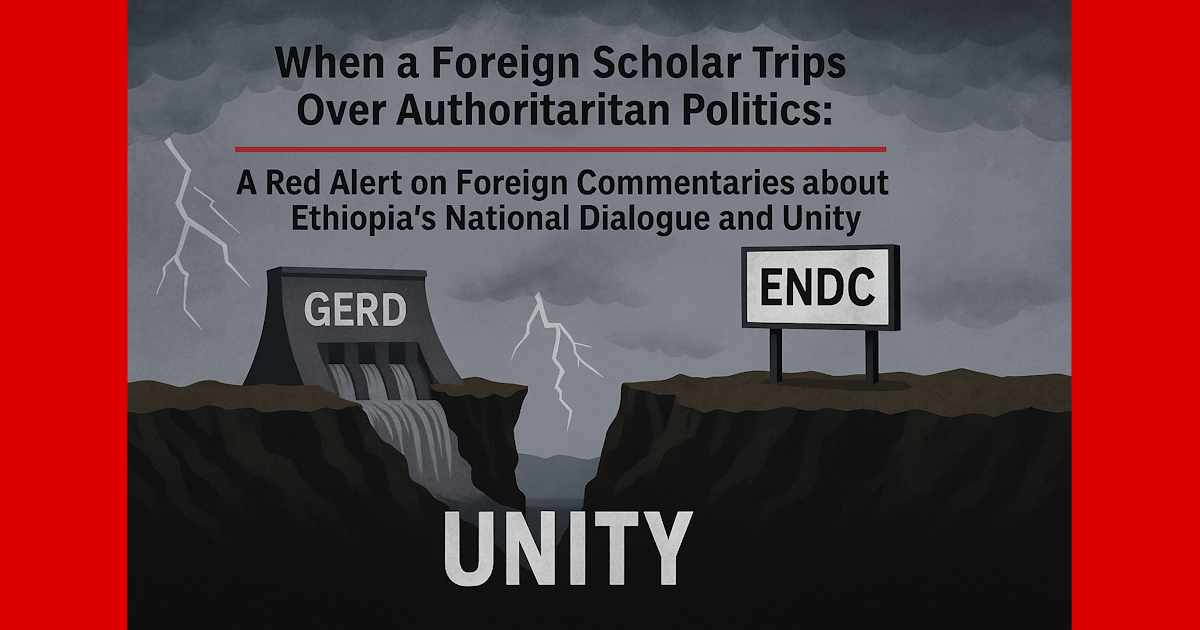
A recent The Conversation article by a foreign scholar lauds Ethiopia’s new dam and National Dialogue as signs of national unity. Yet beneath its polished tone lies a troubling detachment from Ethiopia’s lived realities. When foreign scholars echo autocratic narratives, they lend legitimacy to repression. Academic distance must not become moral distance — especially in a land scarred by stormy landscapes and rifted terrains of conflict, exclusion, and historical injustice.
Introduction
There is a fine line between scholarly observation and inadvertent endorsement of state narratives — and in deeply divided societies like Ethiopia, that line is razor thin. The recent article in The Conversation, titled “Ethiopia has struggled to build national unity: can its big new dam deliver it?” [1], sadly walks that line without sufficient caution.
While one must commend the author for taking interest in Ethiopia’s enduring quest for cohesion, the article reads less like a rigorous political analysis and more like an idealistic essay — smooth on the surface, but shallow in its grasp of Ethiopia’s complex, multi-layered fractures.
Respectful but Firm Caution
Let it be said with utmost respect: we owe much to foreign scholars who dedicate their lives to uncovering historical truths, challenging distortions, advancing human rights, fostering peace-building, informing conflict-resolution policies, enriching cross-cultural understanding, and strengthening global academic dialogue. Their objectivity and distance often enrich local debates. But that moral capital must never be spent endorsing autocrats or echoing state propaganda — however subtly.
Foreign academics tread dangerous ground when they validate incumbent-led processes like Ethiopia’s National Dialogue Commission (ENDC), whose legitimacy, inclusivity, and honesty are under intense scrutiny. When political contestations are this rife, multidimensional, and rooted in historical trauma, external scholars should illuminate contradictions, not obscure them under the glow of polite optimism.
Contrasting the Two Narratives
The Conversation article celebrates the Grand Ethiopian Renaissance Dam (GERD) alongside the National Dialogue Commission (ENDC) as symbols of a “shared opportunity” and potential catalysts for national unity. Yet in doing so, it glosses over the very fractures — political, historical, and moral — that define Ethiopia’s crisis of coexistence. By contrast, OROMIA TODAY’s editorial — “To the Ethiopian National Dialogue Commission: You Are Wasting Your Time and Everyone Else’s” [2]— cuts to the bone.
- Where the former sees hope in symbols, the latter sees manipulation.
- Where the former applauds dialogue, the latter questions its ownership.
- Where the former calls for unity, the latter demands honesty.
And it is honesty — about exclusion, historical injustice, and state capture — that Ethiopia desperately needs right now, not another round of elite symbolism.
Weaknesses in The Conversation Article
- Naïve optimism about the government’s intentions — overlooking the authoritarian consolidation and regional wars that undermine “unity.”
- Lack of ethno-federal sensitivity — treating Ethiopia’s diversity as demographic trivia, not as the central political reality it is.
- Selective historicity — invoking Haile Selassie and the GERD while erasing the Oromo, Sidama, Somali, and other suppressed narratives that reveal the true fault line in Ethiopia’s struggle over a backward-looking and ultimately untenable “unitarist” national identity.
- Superficial treatment of the National Dialogue — portrayed as a “good start” rather than what it has largely become: a state-managed instrument to pacify rather than reconcile.
- Absence of ethical self-restraint — foreign scholars, even with goodwill, must avoid normalizing autocratic regimes through academic gentleness.
A Red Alert to Scholars
To every well-intentioned foreign academic writing on Ethiopia or the Horn of Africa: exercise epistemic humility.
- Don’t take regime-crafted symbolism for social cohesion; it’s the oldest trick in the autocrat’s textbook — turning spectacle into proof of indispensability.
- Don’t mistake national pomp for people’s consent — especially where governance by fear remains the norm, as in the Ethiopian empire.
- And don’t lend the moral prestige of academia to projects that serve as political theater while the underlying conflicts remain unaddressed.
When the Ethiopian state weaponizes symbols — whether dams, industrial projects, or so-called “dialogues” — the role of scholars is not to applaud beyond objective observation; it is to interrogate. This is not to suggest that genuine achievements should go unacknowledged, but that praise must never substitute for scrutiny.
The Spectacle Politics of Survival
The Ethiopian National Dialogue Commission (ENDC) must be understood for what it truly is: not a sincere peace-building process, but part of the regime’s elaborate theater of survival. Like the recently trumpeted nuclear power station initiative [3,4], the supposed gas extraction venture in the volatile east [5], or the fertilizer factory project in the same conflict-ridden zone, the ENDC is another grandiose distraction — a white-elephant scheme designed to dazzle, not to deliver.
Each of these “national projects” serves a single political calculus: to project greatness, buy time, and secure the next election cycle. The message is as crude as it is consistent — “only we can deliver Ethiopia’s greatness.” Yet beneath the glossy press releases and televised ceremonies, the state knows full well that the outcome of these ventures — just like the dialogue itself — is nil from the outset.
Meanwhile, the ENDC wastes public resources in futile “consultations” abroad, parading through South Africa to Europe to North America as if the diaspora — many of whom are foreign nationals — were the Ethiopian electorate. It’s a costly charade, synchronized with a multi-million dollar digital propaganda apparatus that the nation can scarcely afford, but which the regime deems indispensable for its image management.
Such spectacles do not heal divisions; they entrench cynicism. They reduce the sacred work of reconciliation to public-relations performance, and nation-building to noise.
From Dam Walls to Dialogue Walls
The Grand Renaissance Dam may well light Ethiopia’s cities, but it cannot illuminate its conscience. The real power deficit is moral, not electrical. Until the Ethiopian state — and those analyzing it — confront the empire’s unfinished past, no amount of hydro-power will generate unity.
As for the ENDC, the signs are increasingly clear — from deliberate leaks, careless slips, and, most tellingly, the way it was formed: devoid of transparency and independence. With commissioners handpicked by the Prosperity Party leader, the Commission was never intended to strengthen federalism or empower citizens. Its hidden purpose is to dismantle the federation, centralize control, and crown the incumbent under the sugar-coated narrative of “national healing and unity.”
What is sold as dialogue is, in truth, a stage play of legitimacy — another act in the empire’s theater of unity. The truth needs no unveiling; it is already performing in plain sight.
If foreign scholars truly grasped Ethiopia’s intricate, century-old dilemmas, the following should be self-evident roadmaps to lasting solutions — not the simplistic GERD + ENDC prescriptions offered as cosmetic patchwork for an empire in terminal illness:
- Seek radical and lasting political solutions that redirect the billions wasted on civil wars and endemic corruption into genuine development programs — where lost productivity can finally be restored.
- Given the diversity of the empire’s nations and nationalities, enshrine the right of self-determination by instituting, at the very least, a genuine federation — or better still, a confederation, or full independence that ensures equality among all.
Understandably, the above are complex and demanding to unpack, but they remain the only viable routes for Ethiopia to glimpse peace and harmony. Foreign scholars are therefore cautioned to adjust their perspectives to this summit of complexity. Picking a random happy meadow while ignoring the stormy landscapes and rifted terrains risks narrating Ethiopia’s crisis much like a lightweight essay.
The Oromo perspective, voiced resoundingly through OROMIA TODAY, reminds the world that symbolic unity without justice is performative harmony. Those who choose to engage Ethiopia must engage that truth, not sidestep it.
References
- Namhla Thando Matshanda (University of Pretoria), Ethiopia has struggled to build national unity: can its big new dam deliver it?, 8 October 2025, The Conversation.
- OT Editorial, To the Ethiopian National Dialogue Commission: You Are Wasting Your Time and Everyone Else’s, 31 January 2025, OROMIA TODAY.
- OT Editorial, A Reactor in a Tinderbox: Why Ethiopia’s Nuclear Ambition Demands Global Scrutiny, 28 September 2025, OROMIA TODAY.
- Ethiopia and Russia sign Action Plan on building a nuclear power plant in Ethiopia , 25 September 2025, Fana Media Corporation.
- Ethio Forum News Documentary in Amharic on "Gas Extraction Secrets, Abiy's Lies, and Takele Uma's Fairytales", የጋዙ ምስጢሮችና የዐቢይ ውሸቶች ፤ የታከለ ዑማ ተረት እና ኩባንያው, 3 October 2025, Ethio Forum (YouTube Channel).