From Trauma to Transformation: Historical Violence and the Possibility of Healing in Oromia
Excerpt
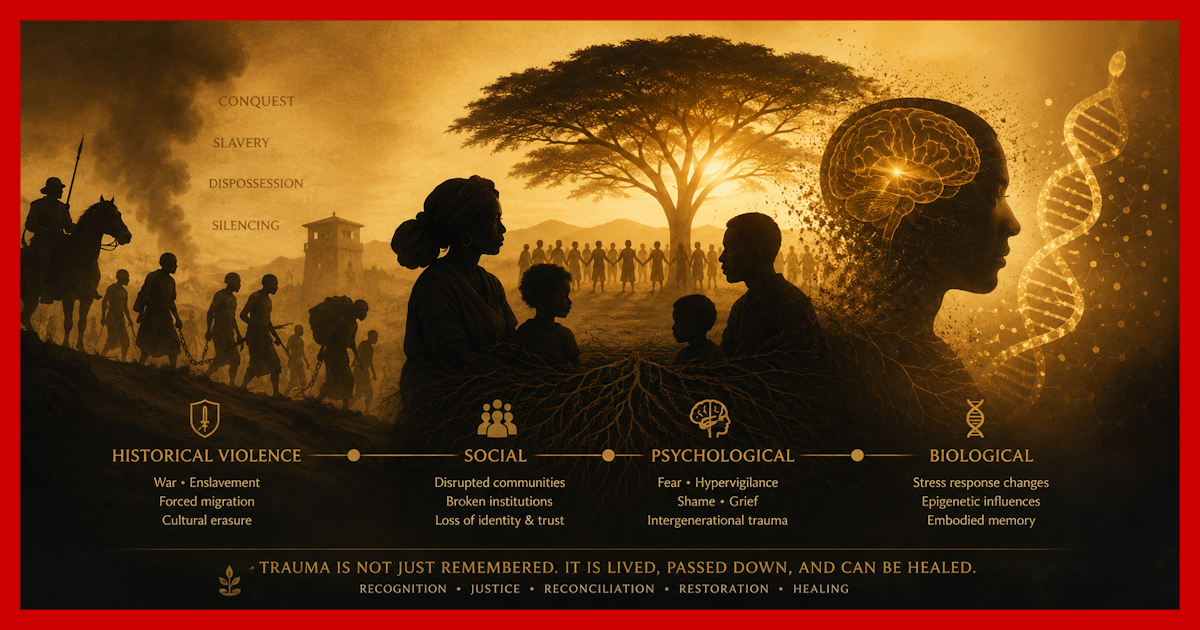
From conquest and slavery to modern conflict and insecurity, this article explores how historical violence continues to shape Oromia across generations socially, psychologically, and potentially biologically. Drawing on trauma studies, epigenetics, post-conflict research, and anti-colonial thought, it argues that lasting peace requires more than political change. Recognition, justice, cultural restoration, reconciliation, and healing are essential to breaking cycles of trauma and building a more stable and humane future.
Abstract
This article advances a historically grounded and theoretically informed analysis of violence against the Oromo from the late nineteenth century to the present. It integrates historiography on imperial conquest, slavery, and structural domination with contemporary scholarship on intergenerational trauma, collective memory, and epigenetics.
Drawing on primary narratives of enslavement and modern biological frameworks, it argues that Oromo historical trauma has been reproduced socially, psychologically, politically, and—potentially—through biological stress-response pathways. This article does not claim that trauma is mechanically or deterministically inherited through DNA. Rather, it proposes that severe and repeated historical trauma may leave biological traces through changes in gene expression, while its more firmly established transmission occurs through family life, disrupted institutions, cultural dislocation, chronic insecurity, and collective memory.
Domination damages identity; liberation creates the possibility of reconstructing it. This article concludes that meaningful peace in Oromia requires confronting historical violence through recognition, justice, cultural restoration, and sustained psychosocial healing.
Introduction: From Historical Violence to Embodied Memory
The Oromo experience of conquest, enslavement, and systemic marginalization represents not an isolated rupture in time but a continuous historical process. The expansion of the Ethiopian empire under Menelik II in the late nineteenth century initiated patterns of violence and domination that persisted through imperial, socialist, and contemporary regimes in varying forms.
This continuity matters. Trauma intensifies when it is not allowed to end. A wound that is repeatedly reopened does not heal; it deepens, reshapes behavior, and embeds itself in both individual and collective life.
Recent developments in trauma studies and epigenetics provide a framework—still evolving but increasingly influential—for understanding how such violence extends beyond memory. Trauma is not only remembered through narrative, ritual, and political consciousness. It is also embodied through chronic stress, disrupted attachment patterns, altered social behavior, and, in some cases, measurable changes in biological stress-response systems.
However, the concept of biological embedding must be handled with care. The available evidence does not support a simplistic or deterministic claim that trauma is “passed through DNA” in a fixed or inevitable way. Rather, research suggests that severe trauma may influence gene expression through epigenetic mechanisms—particularly those associated with stress regulation—and that some of these effects may be observable across generations.
Even so, these findings remain the subject of active scientific debate. The duration, mechanisms, and extent of intergenerational epigenetic transmission are not yet fully understood. Therefore, any biological account of trauma must be situated within a broader framework that includes social structures, political institutions, cultural disruption, and lived experience.
In this sense, trauma should be understood as layered. It moves through stories and silences, through institutions and inequalities, through parenting and fear, through displacement and dispossession. Epigenetics may add a biological dimension to this picture, but it does not replace the social and historical foundations of trauma transmission.
Demographic Collapse and Mass Violence under Imperial Expansion
The late nineteenth-century conquest of Oromia produced catastrophic demographic consequences. While precise figures remain debated due to limited historical records, uneven documentation, and methodological challenges, multiple scholarly sources converge on the conclusion that the scale of mortality and disruption was immense.
Some scholars, including Mohammed Hassen, estimate that mortality may have approached approximately half of the Oromo population, suggesting a possible decline from around 10 million to 5 million by the turn of the twentieth century. Other historians caution that such figures should be treated as indicative rather than definitive, given the scarcity of systematic census data from the period.
Contemporary observers, including European missionaries and military personnel, documented widespread killings, mutilations, famine-induced deaths, enslavement, and forced displacement. These accounts, while sometimes shaped by their own perspectives and limitations, nonetheless converge on a picture of extensive and sustained violence.
It is essential to understand that these losses were not confined to battlefield casualties. They resulted from a combination of warfare, scorched-earth tactics, forced migration, famine, disease, enslavement, and the destruction of local economic systems. The cumulative effect was not only demographic collapse but the fragmentation of social structures and the destabilization of entire communities.
Even where numerical precision is elusive, the broader historical reality is clear: the conquest constituted a profound rupture in Oromo social, cultural, and demographic continuity. Its effects were not temporary. They extended across generations.
Slavery and the Political Economy of Conquest
Slavery was not an incidental by-product of imperial expansion. It was structurally embedded within it, functioning both as a mechanism of control and as an economic system.
The work Children of Hope: The Odyssey of the Oromo Slaves from Ethiopia to South Africa provides rare empirical insight into this process. Sandra Rowoldt Shell reconstructs the lives of sixty-four Oromo children who were captured and enslaved in the late nineteenth century, based on structured interviews conducted shortly after their liberation.
These narratives reveal a consistent pattern of experience: violent capture during raids, forced marches under extreme conditions, high mortality during transit, and systematic separation from families and communities. The children’s accounts describe not only physical suffering but also psychological terror—the sudden loss of home, kinship, language, and identity.
Shell refers to this journey as the “first passage,” drawing attention to the traumatic transition from belonging to displacement. These accounts are particularly valuable because they capture trauma close to the moment of experience, rather than as distant memory reshaped over time.
Importantly, these narratives confirm that slavery affected far more individuals than those documented. The sixty-four cases serve as a window into a much larger system. Each captured child represents not only an individual tragedy but the rupture of a family, the interruption of a lineage, and the weakening of a community.
Slavery, in this context, was both an economic institution and a mechanism of social disintegration. It redistributed labor while simultaneously destroying the social fabric from which that labor emerged.
The Gabbar–Nafxanya System: Institutionalized Subjugation
Following conquest, Oromo society was reorganized under the gabbar–nafxanya system, a form of settler domination that restructured land, labor, authority, and identity.
Indigenous populations, referred to as gabbars, were reduced to tributary laborers, while armed settlers, known as nafxanya, exercised political and economic control. Land was expropriated and redistributed, and indigenous institutions, including the Gadaa system, were weakened, suppressed, or dismantled.
This system represents a form of structural violence in which domination becomes normalized through institutions rather than expressed only through episodic acts of brutality. The violence lies not only in what is done, but in what becomes permanent—who owns land, who commands labor, who speaks, who is silenced, and who is recognised as fully human within the system.
Equally significant was the condition imposed upon tenant families, where the wives and daughters of land tenants were often compelled to provide unpaid domestic and personal service to landlords and their households. Though frequently normalized within the social order of the time, such arrangements functioned in practice as another form of coerced servitude, blurring the boundary between feudal obligation and slavery. The exploitation extended beyond labor itself; it institutionalized dependency, reinforced humiliation, and embedded domination deep within the intimate structure of everyday life.
The effects of such a system are not confined to economics. To be dispossessed of land is to lose more than material resources. It is to lose the foundation of identity, memory, and belonging. It disrupts inheritance, weakens autonomy, and erodes dignity.
Over time, such conditions produce patterns of subordination, dependency, fear, and internalized limitation. These are not merely psychological states. They are adaptive responses to a system that consistently denies agency.
Gendered Violence and Social Reproduction
Violence against Oromo women formed a central component of conquest and control. Historical accounts describe patterns of enslavement, forced labor, sexual violence, coercion, and forms of mutilation designed not only to harm individuals but to terrorize entire communities.
Such violence must be understood within a broader framework of social reproduction. By targeting women, systems of domination targeted the continuity of Oromo society itself. Women are not only individuals within a community; they are central to the transmission of language, culture, memory, and social stability across generations.
When violence disrupts women’s lives, it disrupts the fabric of society at its most intimate level. Family structures are fractured. Kinship networks are weakened. The everyday processes through which children inherit identity, language, values, and emotional security are destabilized.
The consequences extend beyond the immediate moment of violence. They shape patterns of attachment, trust, fear, and identity formation within households. Trauma, in this sense, becomes embedded in relationships—between parents and children, between generations, and within communities struggling to maintain continuity under conditions of disruption.
These dynamics are critical for understanding intergenerational trauma. The transmission of trauma does not require biological mechanisms to be powerful. It is carried through silence, through unspoken grief, through altered parenting, and through environments marked by insecurity and loss.
Continuities of Violence: The Last Hundred and Fifty Years
The patterns established during imperial expansion did not end with the initial conquest. They persisted across successive political systems, adapting in form but maintaining underlying structures of domination and control.
Under imperial rule, including the eras of Menelik II and Haile Selassie, Oromo political expression, language, and identity were suppressed. Cultural institutions were marginalized, and participation in state structures often required assimilation or subordination.
The Derg regime introduced new forms of state violence, including mass imprisonment, forced resettlement, militarization, and widespread coercion. While the ideological framework shifted, the experience of insecurity, state power, and vulnerability remained central to everyday life.
Contemporary conflicts continue to produce displacement, detention, gender-based violence, and cycles of insecurity. Reports of drone strikes, militia violence, and political repression reinforce the perception that violence is not an exception but an enduring feature of the political environment.
These continuities are significant because trauma is cumulative. When violence is repeated across generations without meaningful resolution, it shapes not only memory but expectation. Communities learn to anticipate threat, to adapt to instability, and to organize their lives around survival.
In such conditions, trauma is not simply a response to past events. It becomes part of the present.
Epigenetics and Intergenerational Trauma
Emerging research in epigenetics provides a framework—carefully interpreted—for understanding how severe trauma may influence biological systems across generations. Studies involving Holocaust survivors, Indigenous populations, and descendants of enslaved peoples suggest that trauma can be associated with changes in gene expression, particularly in systems related to stress regulation.
These studies indicate that severe and prolonged trauma may affect biological processes such as cortisol regulation, emotional reactivity, and vulnerability to stress-related conditions. In some cases, similar patterns have been observed in the descendants of trauma survivors.
However, it is essential to approach these findings with caution. Epigenetic changes do not alter the genetic code itself. They influence how genes are expressed, and these effects are often reversible, context-dependent, and influenced by environmental conditions.
Moreover, the field remains under active investigation. The extent to which epigenetic effects persist across multiple generations, and the mechanisms through which they are transmitted, are not yet fully understood. As such, epigenetics should not be interpreted as evidence of biological determinism.
Instead, it should be seen as one layer within a broader system of trauma transmission. Social, cultural, economic, and political factors remain the primary and most clearly established pathways through which trauma is reproduced.
Applying this framework to the Oromo experience suggests that repeated exposure to conquest, slavery, displacement, repression, and insecurity may contribute to long-term patterns of stress and vulnerability. These patterns are expressed not only biologically but socially—in behavior, relationships, institutions, and political life.
Trauma, therefore, should be understood as multi-dimensional. It is carried through bodies, but also through stories, silences, institutions, and environments.
From Historical Trauma to Contemporary Political Behavior
Unresolved trauma shapes collective behavior in complex and often indirect ways. It does not determine political outcomes, but it influences the conditions under which decisions are made and actions are taken.
One effect is heightened threat perception. Communities that have experienced repeated violence may become hyper-vigilant, interpreting uncertainty as danger and responding defensively even in ambiguous situations.
Another effect is political radicalization. Historical grievances, when combined with ongoing repression, can fuel mobilization and strengthen movements that promise protection, dignity, or justice.
Cycles of violence may also emerge. Trauma can be reproduced through reactive conflict, internal fragmentation, and mistrust. In some cases, communities turn inward, and violence becomes internalized, manifesting as Oromo-on-Oromo conflict or factional division.
Institutional mistrust is another significant outcome. When state structures are associated with coercion or exclusion, communities may find it difficult to trust legal systems, elections, negotiations, or reconciliation processes.
It is important, however, not to reduce these dynamics to biology. Political behavior is shaped by leadership, ideology, economic conditions, institutional design, and strategic choices. Trauma influences these factors, but it does not override human agency.
A careful analysis must therefore avoid deterministic explanations. Trauma provides context, not destiny.
Breaking the Cycle: Toward Healing and Justice
Breaking the cycle of violence requires a multidimensional approach that addresses both historical injustice and present conditions. Trauma that has accumulated over generations cannot be resolved through a single intervention.
Historical recognition is a necessary starting point. Acknowledging past atrocities—conquest, slavery, land dispossession, cultural suppression, and systemic violence—creates the foundation for meaningful dialogue and repair.
Truth and reconciliation mechanisms can provide structured spaces for testimony, acknowledgment, and documentation. These processes are not substitutes for justice, but they can contribute to collective understanding and emotional release.
Restoration of cultural institutions is equally important. Revitalizing systems such as Safuu and Gadaa, and strengthening Afaan Oromo as a language of identity and knowledge, supports cultural continuity and psychological resilience.
Community-based trauma healing programmes are essential for addressing the everyday effects of trauma. These may include culturally grounded approaches to grief, dialogue between generations, and locally designed psychosocial support systems.
Gender-sensitive justice frameworks must address both historical and ongoing violence against women, recognizing their central role in social reproduction and community stability.
Finally, no healing process can succeed while violence continues. Ending structural violence—through institutional reform, accountability, and protection of human rights—is a precondition for sustainable recovery.
Healing requires more than policy. It requires a shift in moral and political orientation—from denial to recognition, from domination to dignity, and from silence to truth.
Theoretical Foundations: Liberation as Psychological Decompression
Anti-colonial thinkers have long argued that domination is not only political but psychological. Frantz Fanon, in The Wretched of the Earth, described how colonial systems produce internalized inferiority, fragmentation of identity, and alienation from one’s own culture.
For Fanon, liberation is not merely the removal of external control. It is a rupture that restores agency and allows individuals and communities to reconstitute themselves as subjects rather than objects of history.
Ngũgĩ wa Thiong’o extends this argument through the concept of the “decolonization of the mind.” He emphasizes that language, culture, and narrative are central to identity, and that reclaiming them is essential for psychological recovery.
These perspectives are directly relevant to the Oromo experience. Systems of domination do not only control land and labor. They shape how people see themselves, how they interpret their history, and how they imagine their future.
Liberation, in this sense, can be understood as a form of psychological decompression—a release from imposed identities and constraints that allows for the reconstruction of dignity and self-understanding.
Collective Trauma and Historical Healing
In trauma studies, healing is understood as both an individual and collective process. Maria Yellow Horse Brave Heart introduced the concept of historical trauma response to describe the cumulative and intergenerational impact of colonization on Indigenous populations.
Her work highlights the importance of collective acknowledgment, mourning, and cultural restoration in the healing process. Trauma that affects entire communities cannot be addressed solely through individual interventions.
Collective healing may involve public recognition of past atrocities, restoration of suppressed cultural systems, and community-led practices that rebuild trust and continuity. These processes create space for grief, memory, and reconstruction.
Without such processes, trauma often remains unresolved, manifesting in social fragmentation, cycles of conflict, and persistent psychological distress.
Self-Determination as a Health Determinant
There is growing empirical evidence that self-determination contributes to improved social and psychological outcomes. Research by Michael Chandler and Christopher Lalonde on First Nations communities in Canada found that communities with higher levels of self-governance and cultural continuity had significantly lower youth suicide rates.
This finding suggests a broader relationship between political autonomy, cultural continuity, and psychological resilience. Communities that have control over their institutions, education systems, and cultural practices are better positioned to sustain identity and well-being.
For Oromia, this insight is critical. Self-determination is not only a political question. It is also a matter of collective health and long-term stability.
Transitional Justice and Post-Conflict Healing
Political transformation can create opportunities for structured processes of acknowledgment and repair. Truth and reconciliation initiatives, such as those implemented in South Africa, demonstrate how public testimony, institutional recognition, and narrative reconstruction can contribute to healing.
These processes are often imperfect. They may fall short of delivering full justice, and they may be shaped by political constraints. Nevertheless, they provide a framework for addressing historical violence in a collective and institutional manner.
For Oromia, any meaningful transition must incorporate mechanisms for truth-telling, accountability, and recognition. Without these elements, unresolved trauma is likely to persist.
Epigenetics and the Possibility of Reversal
One of the more hopeful aspects of epigenetic research is the suggestion that biological responses to trauma may be modifiable. Studies indicate that supportive environments, reduced stress, and access to care can influence the regulation of stress-response systems.
This does not imply that biological effects can be easily reversed, nor does it suggest a simple or direct pathway from political change to biological recovery. However, it supports a broader conclusion: human biology is responsive to environment.
Conditions of safety, dignity, and stability can support recovery, just as conditions of violence and insecurity can perpetuate harm. This reinforces the importance of addressing structural conditions alongside psychological and cultural dimensions of trauma.
Important Limitation: Liberation Is Not Sufficient
Historical experience shows that political independence alone does not guarantee healing. Postcolonial societies often face internal conflicts, elite domination, and the reproduction of oppressive structures.
Trauma that is not addressed can re-emerge in new forms. Cycles of violence may persist, and systems of inequality may be reproduced within newly independent states.
Liberation should therefore be understood as a necessary but not sufficient condition for transformation. Without deliberate efforts to address trauma, reform institutions, and build inclusive systems, the underlying conditions of instability may remain.
When Does Liberation Enable Healing?
Research and historical experience suggest that liberation contributes to healing when it is accompanied by recognition of historical injustice, restoration of cultural and institutional autonomy, inclusive governance, and deliberate trauma-healing processes.
Reducing ongoing structural violence is also essential. Without changes in lived conditions, symbolic recognition alone cannot sustain recovery.
In this sense, liberation must be understood as a process rather than an event. It involves continuous effort to transform institutions, relationships, and narratives.
Application to Oromia
For Oromia, meaningful self-determination has the potential to function as a structural intervention in historical trauma. It can create conditions under which cultural restoration, institutional reform, and psychosocial healing become possible.
However, its effectiveness depends on how it is implemented. Without inclusive systems, accountability, and a commitment to healing, political change alone may not produce the desired outcomes.
The central challenge is not only to end domination but to prevent its reproduction in new forms. This requires attention to both structural and psychological dimensions of transformation.
Conclusion
The Oromo experience illustrates how prolonged violence can become embedded across generations—socially, psychologically, culturally, institutionally, and, potentially, through biological stress-response pathways. From the mass killings, enslavement, and dispossession of the nineteenth century to contemporary conflict and insecurity, the continuity of trauma is difficult to ignore.
At the same time, caution is necessary. The biological dimensions of intergenerational trauma, including epigenetic transmission, remain an evolving field of scientific inquiry. The mechanisms are still debated, and trauma should not be understood in deterministic terms. Human beings are not prisoners of biology, and societies are not condemned by history to endlessly reproduce suffering.
Yet even if the biological mechanisms remain only partially understood, the broader evidence from psychology, sociology, public health, post-conflict studies, and Indigenous trauma research is overwhelming: prolonged collective trauma reshapes societies across generations. It influences trust, fear, identity, political behavior, social cohesion, and the ability of communities to imagine stable futures.
This reality helps explain why societies subjected to long-term domination sometimes struggle not only against external oppression but also against internal fragmentation, mistrust, criminality, cycles of retaliation, and self-destructive behavior. Trauma that remains unresolved may become internalized. Violence experienced over generations can distort social relationships, weaken institutions, normalize fear, and produce maladaptive survival behaviors that undermine collective progress.
This should not be interpreted as a condemnation of victims, nor as a justification for oppression. On the contrary, it reinforces the urgency of healing. A traumatized society requires more than political slogans or constitutional arrangements. It requires conditions under which human beings can recover dignity, stability, trust, and psychological security.
Research from multiple societies—including Indigenous communities, post-conflict states, and populations affected by historical violence—suggests that reconciliation, cultural restoration, self-determination, institutional trust, and reduction of ongoing violence can significantly improve collective well-being. Studies linking cultural continuity and self-governance to lower suicide rates and stronger social resilience provide compelling evidence that healing is not merely symbolic; it has measurable societal consequences.
For Oromia, this means that breaking the cycle of violence requires more than ending visible conflict. It requires confronting historical truth honestly, restoring dignity to wounded communities, rebuilding institutions around justice and inclusion, protecting women and children from continuing violence, and creating social conditions that interrupt the transmission of trauma rather than reproduce it.
The central argument of this article is therefore not that trauma is destiny, but that unhealed trauma has consequences. The future of Oromia depends not only on political outcomes but on whether society develops the moral, institutional, and psychological capacity to transform historical pain into collective recovery.
History does not heal itself. Silence does not heal trauma. Denial does not produce stability. Lasting peace requires recognition, justice, reconciliation, and the deliberate reconstruction of social trust across generations.
References
- Brave Heart, M.Y.H. (2003). Historical Trauma and Healing in Indigenous Populations.
- Brave Heart, M.Y.H. (2003). The Historical Trauma Response among Natives.
- Bulcha, M. (2005). Genocidal Violence in the Making of Nation and State in Ethiopia.
- Chandler, M.J., & Lalonde, C. (1998). Cultural Continuity as a Hedge against Suicide.
- Dugassa, B. (2017). Collective violence and public health: The experience of the Oromo people in Ethiopia.
- Elemoo Qilxuu. Ethiopia’s 6 Big Les Fueling its Impending Collapse. 13 March 2024, Oromia Today.
- Fanon, F. (1961). The Wretched of the Earth.
- Hassen, M. (2002). Conquest, Tyranny, and Ethnocide against the Oromo.
- Kellermann, N. (2013). Epigenetic Transmission of Holocaust Trauma.
- Mallory, E.B., & Yehuda, R. (2016). Intergenerational Transmission of Stress in Humans.
- Ngũgĩ wa Thiong’o. (1986). Decolonising the Mind.
- Olii Boran. The Myth of Ethiopia’ Historical Continuity: A Political Invention Disguised as Legacy. 17 March 2025, OROMIA TODAY.
- Pankhurst, R. (1968). Economic History of Ethiopia.
- Shell, S.R. (2013). From Slavery to Freedom: The Oromo Slave Children of Lovedale. University of Cape Town.
- Shell, S.R. (2018). Children of Hope: The Odyssey of the Oromo Slaves from Ethiopia to South Africa. Ohio University Press.
- Shell, S.R. (2021). Trauma and Slavery, Gilo and the soft, subtle of Lovedale. Toposcope.