The 2026 Ethiopian Election That Never Was
Excerpt
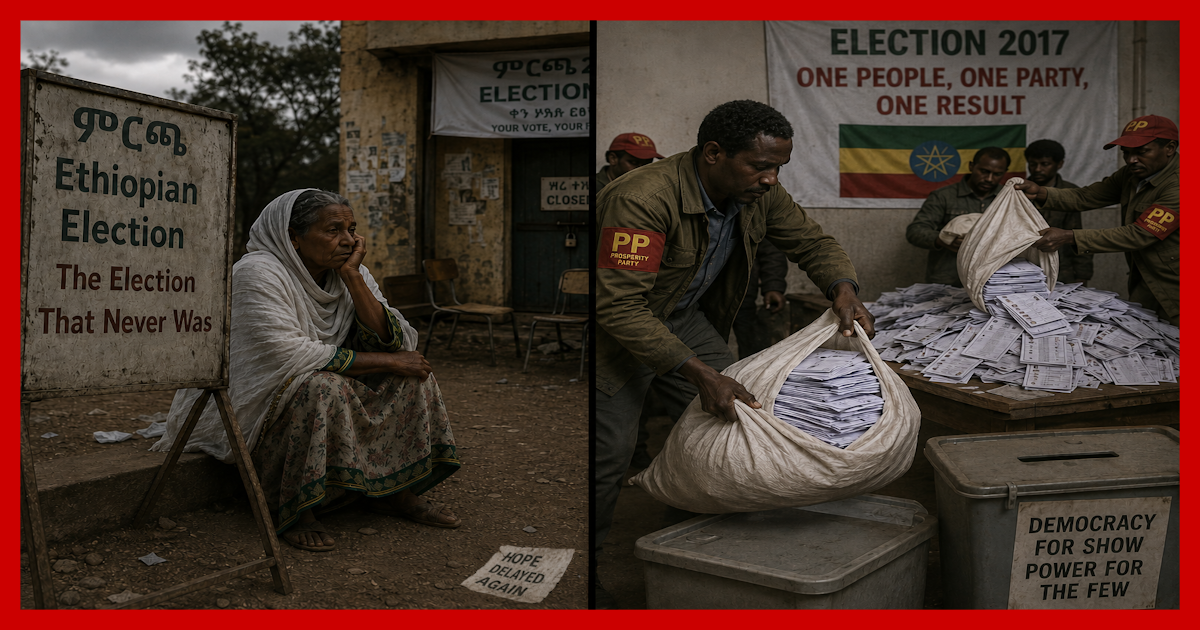
The 2026 Ethiopian election was presented as a democratic exercise through which citizens would renew the mandate of their government. Yet when vast portions of the country remained outside normal electoral conditions and the outcome appeared predetermined long before voting day, the more fundamental question became unavoidable: can an election still be called an election when millions of citizens are effectively absent from the process?
The Mandate Without a Contest
So, they called it an election.
An election intended to confer a popular mandate when much of the population never meaningfully participated in the first place.
The question still lingers: why bother to stage an election that never was?
- Was it to manufacture legitimacy and further tighten a grip on power in the name of the people?
- Was it to reassure foreign governments and international institutions that continue to finance the state?
- Or was it simply to preserve the appearance of constitutional continuity, the ritual of democracy while dispensing with its substance?
Election day itself produced a series of farcical dramas, promoted by state-affiliated media as evidence of extraordinary civic devotion. According to official reports:
- A woman arrived at a polling station within two hours of giving birth in order to cast her vote.
- Another was said to have chosen voting over burying her father, despite later contradictions indicating that her father had in fact died a decade earlier.
- Former lovers, separated or fell out for years, were said to have reunited at polling stations.
- Citizens were depicted as overcoming every imaginable obstacle, not short of miracles, to make their voices heard.
One headline captured the mood of the official narrative: "The miracle [of the 2026 election] is continuing...". Thus, the election became something more than an election. It became a stage for civic miracles, a testament to citizens answering a call beyond ordinary civic duty.
The strategy appears familiar: aim for the sky-high narrative in the hope that public perception eventually settles somewhere around "normal," rather than the "nothing" that many observers saw. Such exaggeration reflects a recurring characteristic of authoritarian systems: a belief that the public can be manipulated, distracted, and ultimately persuaded to accept fiction as reality.
The underlying logic was familiar though very low IQ. Aim for the extraordinary. Aim for the unbelievable. Fill the public space with stories so dramatic that the debate shifts from whether anything happened at all to which parts of the story should be believed.
History offers many parallels. Authoritarian regimes have frequently sought legitimacy through theatrical displays of popular enthusiasm, choreographed participation, implausible voting figures, and carefully curated stories designed to demonstrate overwhelming public support. Yet history also shows that propaganda often reveals more about the insecurity of those in power than the confidence they seek to project.
Yet even these stories distracted from a far more consequential reality.
The most important fact about the 2026 Ethiopian election is not what happened on election day. It is what had already happened before election day.
For all practical purposes, experts put that 100 percent of Tigray, at least 80 percent of Amhara, and at least 60 percent of Oromia remained outside normal electoral conditions. Significant security concerns also persisted across parts of Somali, Afar, Gambella, and Benishangul-Gumuz.
These conditions existed before voting even began. The broader context has already been documented elsewhere [1]. What followed on election day merely added further questions about the integrity of the process.
Under such circumstances, the central question ceases to be who won. The more relevant question becomes whether an election took place at all.
An election derives legitimacy from participation, competition, and public confidence in the process. When entire regions are unable to participate under normal conditions, electoral legitimacy becomes increasingly difficult to sustain regardless of what occurs inside the polling stations that do open.
In that sense, the election was not decided on election day. Its credibility had already been severely compromised beforehand.
The Irregularities That Even the Regime Could Not Manage
Beyond reports of voters being openly instructed whom to support, numerous irregularities emerged that stretched the limits of plausible deniability.
- The Chairperson of the National Election Board of Ethiopia (NEBE), during a press briefing, confirmed that voting had been suspended at certain polling stations because of irregularities. One cited example involved ruling-party cadres allegedly casting large numbers of votes on behalf of voters.
- During the same briefing, the Chairperson acknowledged that many polling stations were unreachable because of poor telecommunications coverage. This raises an obvious question: if irregularities were discovered in accessible areas, to what extent might similar or more serious violations have occurred in remote areas where monitoring was limited or nonexistent?
- Related concerns arise regarding locations with weak transportation and communications infrastructure. Where observers are absent and reporting mechanisms are ineffective, electoral violations become considerably more difficult to detect, document, and correct.
- There were reports of polling stations possessing ballot papers in numbers exceeding the total registered electorate. Such discrepancies require explanation. Absent a credible administrative justification, they inevitably raise concerns regarding ballot manipulation and fraudulent voting.
- Later in the day, reports emerged of individuals being pressured to leave their homes and proceed to polling stations. Some accounts suggested that even those lacking voter registration cards were nevertheless compelled to vote.
These reports raise further questions. In a system lacking nationwide digital voter verification, how is a vote reconciled when cast outside the location where a voter is registered? How can votes be legitimately cast without voter registration documentation? Such practices invite concerns that electoral participation figures may have been artificially inflated.
Vote manipulation can take many forms. The examples listed above are noteworthy not because they are necessarily exhaustive, but because they are among the more visible and difficult to explain away.
Taken individually, any one of these allegations might be dismissed as administrative failure. Taken collectively, they point to something more serious. They suggest a system in which electoral integrity becomes increasingly dependent upon trust precisely when trust is most difficult to justify. Nor are these necessarily the most significant irregularities. They are simply the irregularities visible enough to surface publicly.
The more difficult question concerns what occurred beyond public scrutiny, in areas where independent observation was absent, communications were limited, and the institutions responsible for enforcement possessed neither the capacity nor the apparent willingness to guarantee compliance. Those questions remain unanswered.
Beyond Irregularities
Ultimately, however, focusing exclusively on electoral irregularities risks missing the larger point. An election can be procedurally flawed yet still broadly competitive. Conversely, an election can be procedurally tidy while lacking genuine democratic substance. The fundamental problem facing the 2026 election was not merely that irregularities occurred.
It was that the election unfolded in circumstances where vast portions of the country were excluded from normal participation, where state institutions and ruling-party structures appeared increasingly indistinguishable, where opposition forces operated under severe constraints, and where the outcome was widely assumed long before the first ballot was cast. Under such conditions, voting becomes less a mechanism for choosing a government than a ritual for confirming one.
The result was not an election that failed. It was an election that never truly existed in the first place.
Opposition Dilemma and Participation Paradox
The skepticism was not confined to ordinary voters. Interviews and public statements from opposition figures revealed a dilemma that received far less attention than it deserved. Several parties appeared to participate less out of confidence in the electoral process than out of belief that refusing to participate carried risks of its own.
Some opposition leaders suggested that declining participation could result in marginalization, loss of political relevance, or even difficulties maintaining formal political status. Participation therefore became, at least in part, an act of institutional survival [1,2]. Their presence on the ballot should not automatically be interpreted as evidence that they considered the process fair, competitive, or capable of producing a credible outcome [2].
This helps explain what otherwise appears to be a contradiction. Why would parties take part in an election while simultaneously expressing profound doubts about its integrity? The answer may be that participation served purposes other than winning office. For some, it preserved legal standing. For others, it maintained organizational visibility. Still others viewed participation as necessary to avoid accusations of abandoning the political process altogether.
Under such circumstances, the existence of multiple parties on the ballot does not necessarily indicate the existence of meaningful political competition. Participation itself can become a defensive strategy adopted within a political environment whose outcome is already widely assumed.
Some opposition actors openly acknowledged that they had little expectation of securing power through the election. Their involvement was intended not to legitimize the process but to ensure they remained present within the political landscape once the process concluded. In effect, participation became a means of avoiding political extinction rather than a pathway to democratic victory.
International Diplomacy and the Language of Recognition
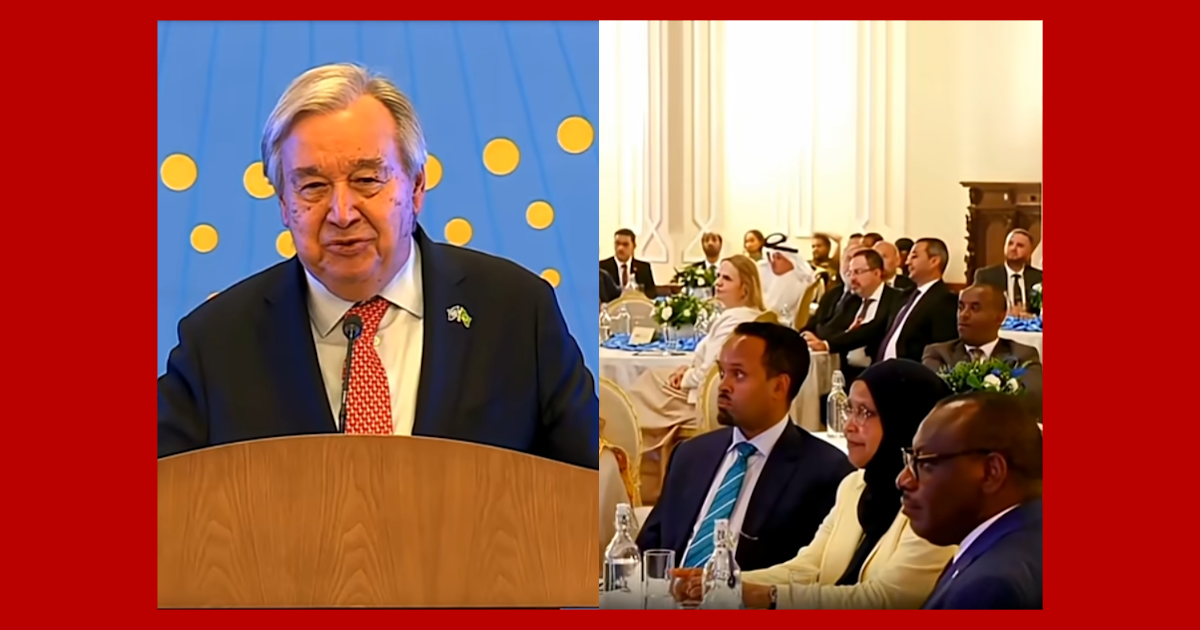
Equally revealing was the reaction of the international diplomatic community. Following the vote, a number of foreign missions, international organizations, and development partners issued carefully crafted statements regarding the election. What stood out was not merely what these statements said, but what many of them did not say.
Several diplomatic missions praised the National Election Board of Ethiopia (NEBE) for its administrative preparations, logistical efforts, and management of the electoral process. Others congratulated election officials for conducting voting operations under challenging circumstances. Such acknowledgments were undoubtedly significant and reflected recognition of the technical aspects of election administration.
Yet many of these statements appeared noticeably cautious when addressing the election itself. Direct endorsements describing the vote as free, fair, competitive, credible, or representative of the will of the electorate were often absent. Instead, the emphasis frequently rested on procedural management, institutional effort, and administrative execution.
The distinction may appear subtle, but diplomatically it is highly significant. Praising the management of an electoral exercise is not necessarily the same as validating its democratic legitimacy. Diplomatic language often communicates as much through omission as through explicit endorsement. Experienced observers understand that carefully chosen wording can reveal discomfort, uncertainty, or reservations that official protocol discourages from being stated directly.
In this case, many statements appeared calibrated to acknowledge the conduct of the process without fully embracing the political substance of its outcome. The NEBE could be commended for organizing an election while entirely separate questions remained regarding the broader political environment in which that election took place.
Such caution reflected realities that were difficult to ignore. Large portions of the country remained outside normal electoral conditions, significant opposition actors faced severe structural disadvantages, and the outcome itself was widely assumed long before the first ballot was cast.
Against this backdrop, diplomatic missions found themselves navigating a familiar dilemma. Openly rejecting the election risked confrontation with the regime. Fully endorsing it risked associating themselves with a process whose credibility remained contested. The resulting statements often occupied a carefully balanced middle ground: acknowledging the process, praising administrative efforts, and encouraging democratic development while avoiding unequivocal validation of the election's legitimacy.
For attentive readers, the omissions were often as revealing as the praise.
Conclusion: The Question That Remains
Ultimately, the debate surrounding Ethiopia's 2026 election extends far beyond the technical conduct of voting. Ballot boxes, voter registration, polling stations, counting procedures, and election-day administration are important components of any electoral process. Yet democratic legitimacy cannot be reduced to procedural mechanics alone. The more fundamental question is whether citizens were presented with a meaningful opportunity to determine who governs them.
Where outcomes are widely perceived as predetermined, where major political competitors operate under profound structural disadvantages, and where substantial parts of the country remain outside normal electoral conditions, the legitimacy of the process inevitably comes into question. That question cannot be resolved merely by counting ballots, nor solely through administrative competence or diplomatic recognition of procedural achievements.
The central issue, therefore, is not whether votes were cast, counted, and certified. It is whether meaningful political choice truly existed.
That distinction lies at the heart of the debate surrounding Ethiopia's 2026 election and may ultimately determine how this electoral cycle is remembered: not as a milestone of democratic consolidation, but as an election whose greatest controversy was that many believed the result was known before the vote was ever cast.
In that sense, the enduring question is not who won the election. The enduring question is whether there was an election to win in the first place.
Selected References
- OT Editorial, "The Election of the Wheat Sheaf: An Election Already Decided Before the Ballots Are Cast?", 27 May 2026, OROMIA TODAY.
- The Standard Signal Ep.21| Why Ethiopia's Opposition Coalition Refuses to Take Seats After the Elect, 6 June 2026, The Standard Signal YouTube Channel, YouTube.