Why Oromia’s Future Demands Clarity: Independence vs. “Democritizing Ethiopia”

Excerpt
This article examines the evolving debate over Oromo self-determination any time soon, contrasting the independence path with the argument for democratizing Ethiopia’s federation. Grounded in constitutional analysis, human rights reporting, security trends, and long-term governance patterns, it evaluates which option aligns with the lived realities in Oromia today. The evidence increasingly challenges assumptions about a reformable Ethiopian state, raising critical questions about whether a monitored Article 39 referendum is now the most credible way to resolve the Oromo self-determination question.
Synopsis
For half a century, Oromo politics has entertained two major ideas. One sees the Oromia–Ethiopia relationship as colonial in nature and argues that full Oromo self-determination requires independence through the right of external self-determination. The other claims Ethiopia can be democratized from within and that Oromo rights are best secured by reforming the federation. The question today is which path better aligns with the political and human rights realities on the ground at present.
The Fork in the Road
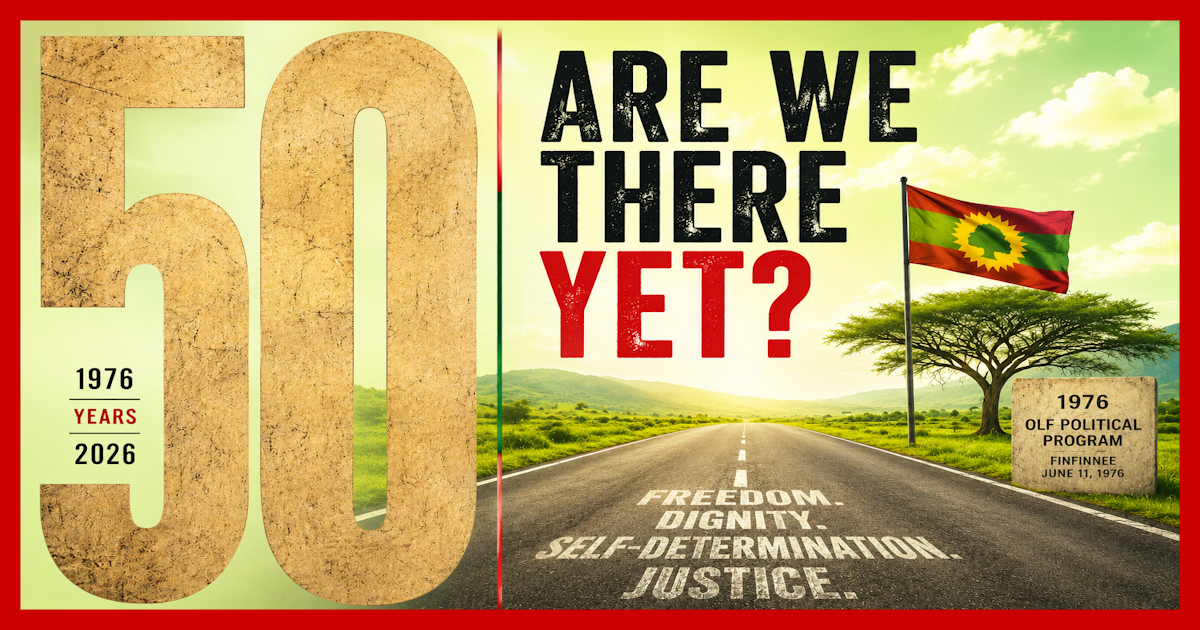
The Oromo Liberation Front (OLF) emerged in the 1970s from field research, underground study circles, and a coherent anti-colonial diagnosis led by organizers like Baro Tumsa. The OLF’s founding program set a clear goal: national liberation and a democratic Republic of Oromia. Recent scholarship reconstructs that formative period and its core framing [1].
By the late 1990s, a counter-thesis crystallized. Leenco Lata—an OLF veteran—argued that the Oromo question could be solved by democratizing Ethiopia’s multi-national federation. His 1999 book laid out that vision; years later he helped found the Oromo Democratic Front (ODF) to pursue it [2].
What Changed and What Didn’t Since 1991?
On paper, Ethiopia’s 1995 Constitution is unusually explicit: Article 39 recognizes the unconditional right of nations, nationalities, and peoples to self-determination “including the right to secession.” In practice, however, legal analyses and political science work observe that federal arrangements often remain centralized or “unitary” in effect [3]. This gap between constitutional promise and political reality has direct implications for debates around Oromo self-determination.
Oromia’s most decisive mass politics of the last decade—the Qeerroo-led protests—were triggered by land maladministration and the Addis Ababa “Master Plan,” then met by lethal force and sweeping arrests. Human rights conditions in 2023–24 remained precarious [4], with OHCHR documenting arbitrary deprivations of life and liberty amid clashes in Oromia, and the U.S. State Department noting serious abuses in zones across Oromia, including Horo Guduru, West Guji, and West Arsi [5].
All opposition parties saw their political space shrink: OLF leading members were imprisoned, and leading figure Battee Urgessa was shot dead and dumped by the roadside in April 2024 [6].
Security dynamics have also been fluid. The federal government signed a peace deal with the OLF on 7 August 2018 in Asmara [7], which unraveled within months.
On 1 December 2024, the Oromia regional government announced a peace agreement with OLF-OLA breakaway leader Sanyi Nagasa [8]; within days, monitors reported hundreds of fighters from that faction entering rehabilitation centers. Violence persisted elsewhere despite such agreements.
Finally, the political economy that helped fuel contention has not been defused. The Laga Dambii gold mine—suspended in 2018 after protests over pollution—resumed operations without adequate safeguards. Human Rights Watch and independent researchers have since detailed ongoing contamination and health impacts [9]. This, too, shapes public attitudes toward the prospects for internal remedies versus external Oromo self-determination.
Why the Two Arguments Truly Differ
The independence case argues that Ethiopia’s treatment of Oromia amounts to internal colonialism that persists across regimes. If internal self-determination is systematically blocked in practice—on rights, land, language, and political organization—external self-determination becomes the credible remedy. Advocates point to Article 39 as a legal path and to a long-standing pattern of coercive governance as evidence that “democratize first” has repeatedly failed [3]. In this view, Oromo self-determination requires a referendum.
The democratization case assumes the center can be reformed through party competition, cross-regional coalitions, and security-sector and fiscal federalism fixes—so that Oromo rights are secured within a functioning Ethiopian federation. This view presupposes a reformable state and a political marketplace capable of reliably protecting opponents [2], and sees Oromo self-determination as achievable through deep federal reform.
What the Evidence Says in 2025 About Oromo Self-Determination
1. Constitutional promise vs. practice.
Ethiopia’s constitution offers unusually strong textual guarantees, yet federal practice has remained markedly centralized; scholars describe a persistent gap between promise and delivery [3]. This tension lies at the heart of contemporary debates over Oromo self-determination.
2. Enduring coercion in Oromia.
From the 2015–16 crackdown through 2024, reputable monitors document killings, arbitrary detention, and suppression of opposition—even as formal peace gestures came and went. This persistent pattern of coercive governance weakens the premise that “internal remedies” are available and effective [4], strengthening arguments for an external path to Oromo self-determination.
3. Grievance-producing development.
Laga Dambii is emblematic of how extractive decisions have proceeded without local consent or adequate safeguards, entrenching distrust rather than resolving it [9]. The lack of accountability reinforces skepticism about the viability of internal Oromo self-determination.
4. Cross-border incursions and contested frontiers (east and north-west).
From the east (Somali Regional State / “Ogaden”). The 2017–2018 Oromia–Somali border conflict displaced ~1,073,764 people by mid-April 2018, according to OCHA/DTM. Liyu Police units carried out raids inside Oromia, including 23–24 May 2018 attacks in Chinaksen (East Hararghe) that killed farmers and burned homes—documented by Amnesty International. After a lull, renewed inter-communal violence since July 2025 displaced ~288,000 people along the border by 1 October 2025, again per OCHA. Recent field work underscores ongoing administrative competition along this frontier [10].
From the north and north-west (Amhara region / Wollo, North Shewa, East & Horo Guduru Wollega). The Amhara–Oromia interface has repeatedly flared: the 2021 Ataye/Kemise violence killed hundreds and displaced large populations across North Shewa and the Oromia Special Zone; later that year, December 2021 summary executions in Dewa Cheffa were reported by ACLED’s Ethiopia Peace Observatory. Since 2024–25, local officials, humanitarian assessments, and press reports have described Amhara Fano presence and attacks in Abe Dongoro (Horo Guduru Wallega) and adjacent districts, with documented civilian killings and displacement. National and international reporting for 2024 also lists Horo Guduru and multiple Shewa zones such as Dhara and Nonno as among the worst-affected areas [11].
Bottom line: The burden of proof now lies with those who claim the Ethiopian federation can—and will—protect Oromo collective rights in a sustained, non-coercive way. The empirical record increasingly points in the opposite direction and intensifies the relevance of Oromo self-determination as a political remedy.
The Hard Questions Independence Must Answer, and Can
On law and process, Article 39 provides a domestic legal pathway. A rights-respecting referendum under independent observation—and preceded by verifiable de-escalation—remains the gold standard [3] for determining the will of the Oromo people regarding Oromo self-determination.
On minority rights and borders, any transition must publish detailed guarantees (language, religion, property, representation) and negotiate special-status arrangements for shared spaces like the capital area—lessons widely reflected in comparative secession practice and Ethiopia’s own federal debates [12].
On economics, mineral resources, coffee, food security, and logistics tie Oromia to national and global markets. The latest USDA reporting estimates Oromia produces ~59% of Ethiopia’s coffee; coffee remains a pillar export and major source of livelihoods. A phased plan for customs, currency, and market access is both realistic and necessary [13].
A Principled Next Step
The case for independence is not about denying interdependence—it’s about consent. A lawful, peaceful test of the Oromo people’s will under Article 39 would clarify mandate, reduce confusion, and force all sides to plan seriously for either outcome. In practical terms, it would finally provide a definitive, democratic expression regarding Oromo self-determination.
That means:
- A unified civil-political front in Oromia demanding a time-bound, monitored referendum;
- Rights-first draft guarantees for minorities and shared urban spaces;
- A transparent economic transition, especially for coffee, mining, and cross-border trade; and
- Verifiable de-escalation so people can vote without fear [14].
References
- Asafa Jalata, Baro and the Founding of the OLF: The Principal Architect of the Oromo Liberation Front, 17 September 2024, Springer Nature.
- Leenco Lata, The Ethiopian State at the Crossroads: Decolonization and Democratization or Disintegration?, 1999, Internet Archive.
- Ahmednasir M. Abdullahi, Article 39 of the Ethiopian Constitution On Secession and Self-determination: A Panacea to the Nationality Question in Africa?, Vol. 31, No. 4 (4. Quartal 1998), pp. 440-455, Law and Politics in Africa, Asia and Latin America.
- “Such a Brutal Crackdown”: Killings and Arrests in Response to Ethiopia’s Oromo Protests, 15 June 2016, Human Rights Watch.
- UPDATE ON THE HUMAN RIGHTS SITUATION IN ETHIOPIA, JUNE 2024, United Nations Human Rights Office of the Commissioner.
- Kalkidan Yibeltal, Bate Urgessa: Ethiopian opposition OLF figure shot dead and dumped by road, 10 April 2024, BBC News.
- News Agencies, Ethiopia signs deal with Oromo rebels to end hostilities, 7 Aug 2018, Al Jazeera Media Network.
- Ministry Hails Peace Deal Between Oromia Regional Government, OLA Senior Leader as Critical Step, 1 December 2024, Ethiopian News Agency.
- Lega Dembi environmental/rights reporting, Ethiopia: Companies Long Ignored Gold Mine Pollution: Provide Effective Remedy to Oromia Residents who Suffered Harm, 26 April 2023, Human Rights Watch.
- Ethiopia: Oromia – Somali Conflict-Induced Displacement, Situation Report No. 4, 20 June 2018, UN OCHA.
- 2021 Ataye clashes, Wikipedia.
- Shumet Amare Zeleke, Self-determination, secession, and indigeneity in Ethiopia's federation, Volume 7, Issue 1, 2023, Elsevier ScienceDirect.
- Coffee Economy Baselines, 3 June 2025, Foreign Agricultural Service, United States Department of Agriculture.
- Ethiopia Weekly Update (10 December 2024), Ethiopia Peace Observatory, USA.
- Elemoo Qilxuu, ETHIOPIA WILL NEVER BE AT PEACE WITHOUT RESOLVING THE OROMO QUESTIONS, 2 December 2024, OROMIA TODAY.