Much Ado About Nothing—The Illusion of Elections in Oromia and Ethiopia
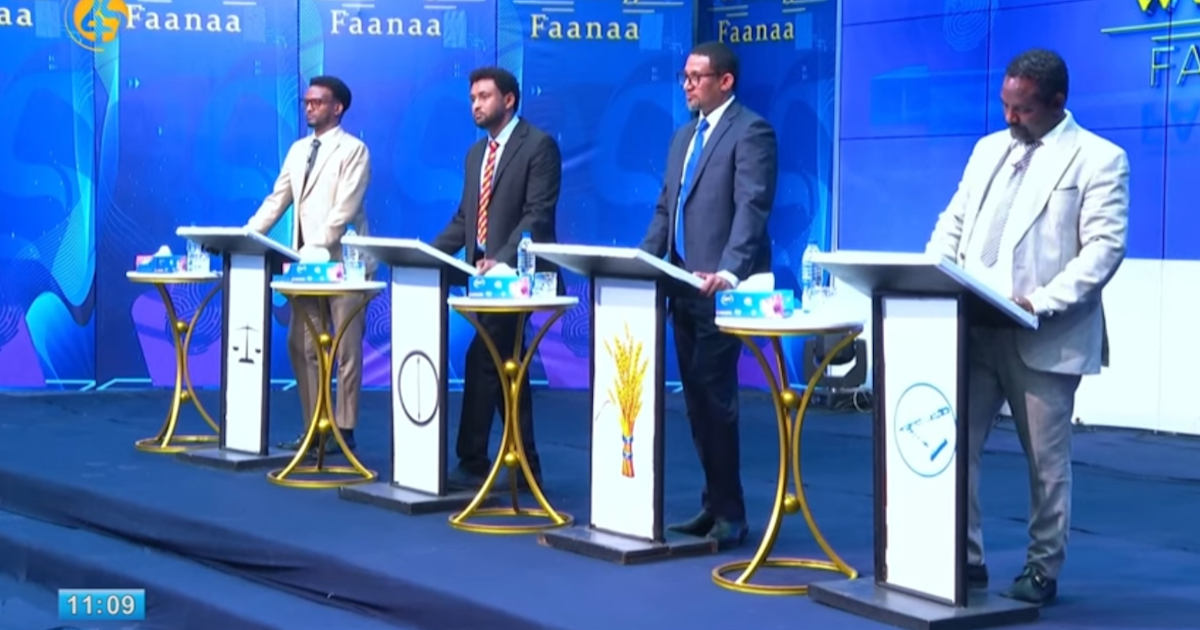
* Freedom and Equality Party
Debate held on 21 March 2026
Excerpt
The forthcoming Oromia and Ethiopia elections are being presented as competitive democratic contests, complete with debates, campaigns, and political messaging. Yet beneath the spectacle lies a political reality many already understand: elections that confirm power rather than contest it. But the real story may not lie in the predictable outcome. It lies on the sidelines—in the debates, the personalities, the rhetoric, and the revealing moments that quietly expose the true nature of politics in Oromia and Ethiopia today.
A Predictable Election, An Unexpected Interest
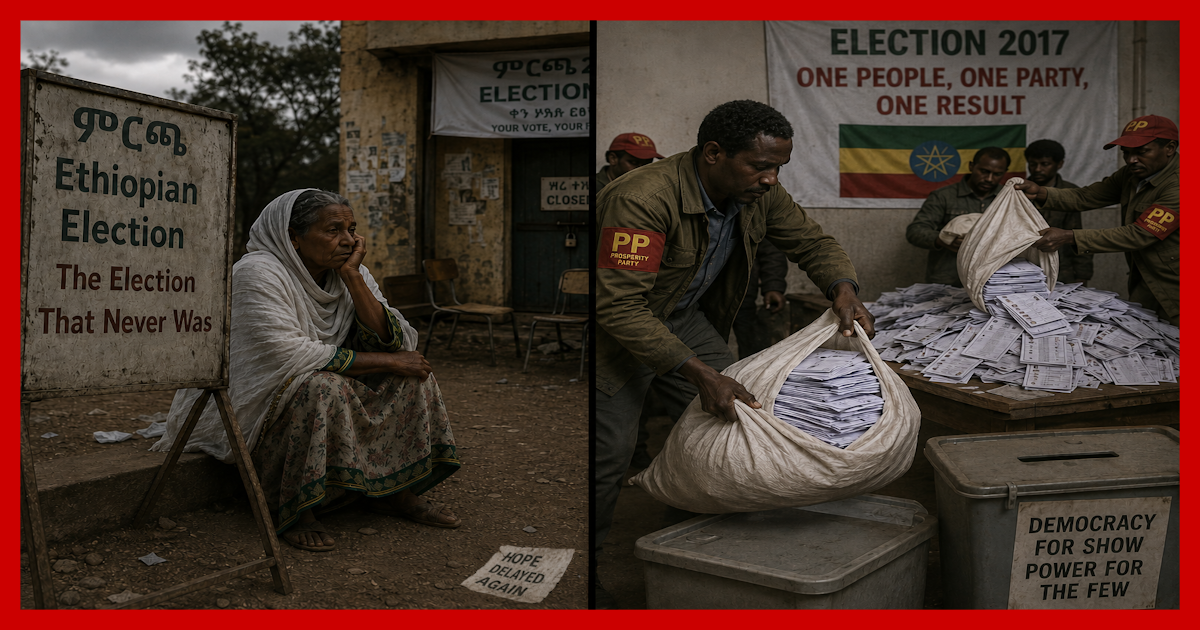
As predictable as Ethiopian elections have become—the incumbent always wins and change comes only through forced regime change rather than through the ballot box—I had resigned myself to not wasting my time writing any commentary, even in satirical form. What would be the point of analysis when the outcome is already known? Elections that do not change power eventually stop being political events and become administrative events.
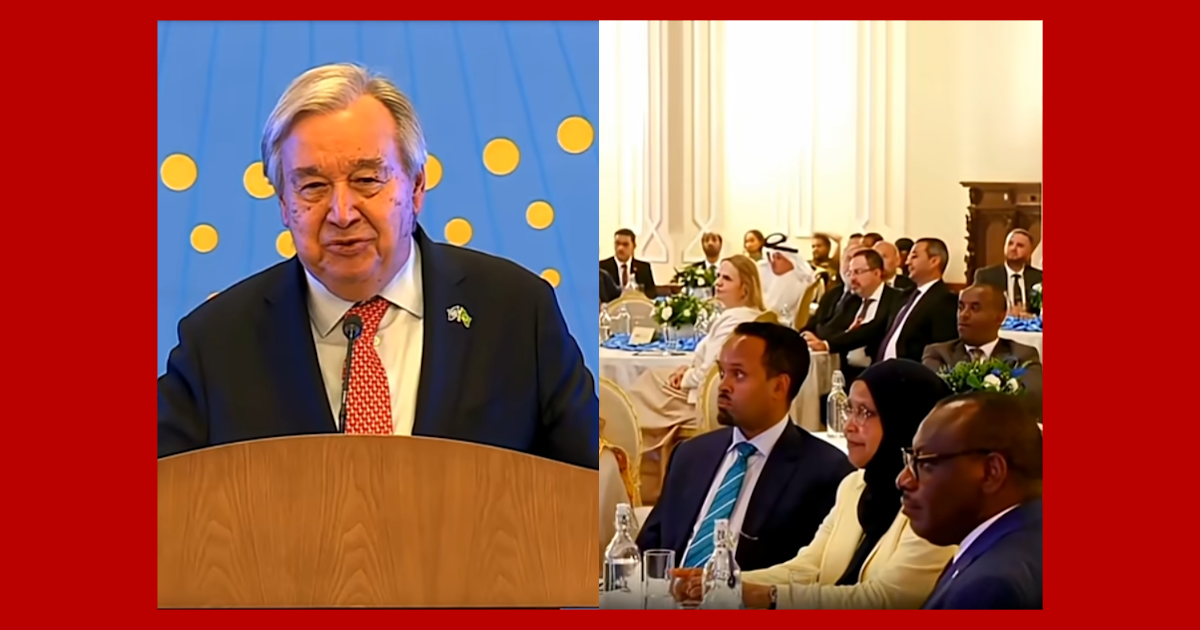
Even my faint inclination to write something was almost completely extinguished when the Prosperity Party regime summoned the Governor of the National Bank of Ethiopia (NBE) to appear as its party representative to debate the party’s financial policy [1]. The supposedly independent architect of national monetary policy standing on a party political stage defending the ruling party’s economic programme—at that moment the entire exercise revealed itself for what it was. Not serious politics. Not institutional governance. Just political theater where even the boundaries between state institutions and party structures no longer matter.
It was that unserious.
And yet, despite all this predictability and political choreography, the emerging political contestation in Oromia is turning what could have been a completely avoidable and predictable political landscape into something unexpectedly dynamic and, in a strange way, instructive. Not because democracy is suddenly taking root and not because elections will bring political change, but because the current moment is providing a subtle window—a rare opportunity for politics to reveal itself in ways that are normally hidden behind official narratives and formal procedures.
That is what grabbed my attention.
Not the presumed core substance of the election, whose outcome many believe is already decided, but the sidelines—the behavior of parties, the rhetoric of candidates, the political psychology on display, the performances, the contradictions, the unexpected talents, and the revealing mistakes [2,3]. Those sidelines, I suspect, may ultimately tell us more about the future political direction of Oromia and Ethiopia than the election results themselves.
And that is why this essay is not really about who will win the election. It is about what the election is quietly revealing while everyone is busy pretending that the election is the main story.
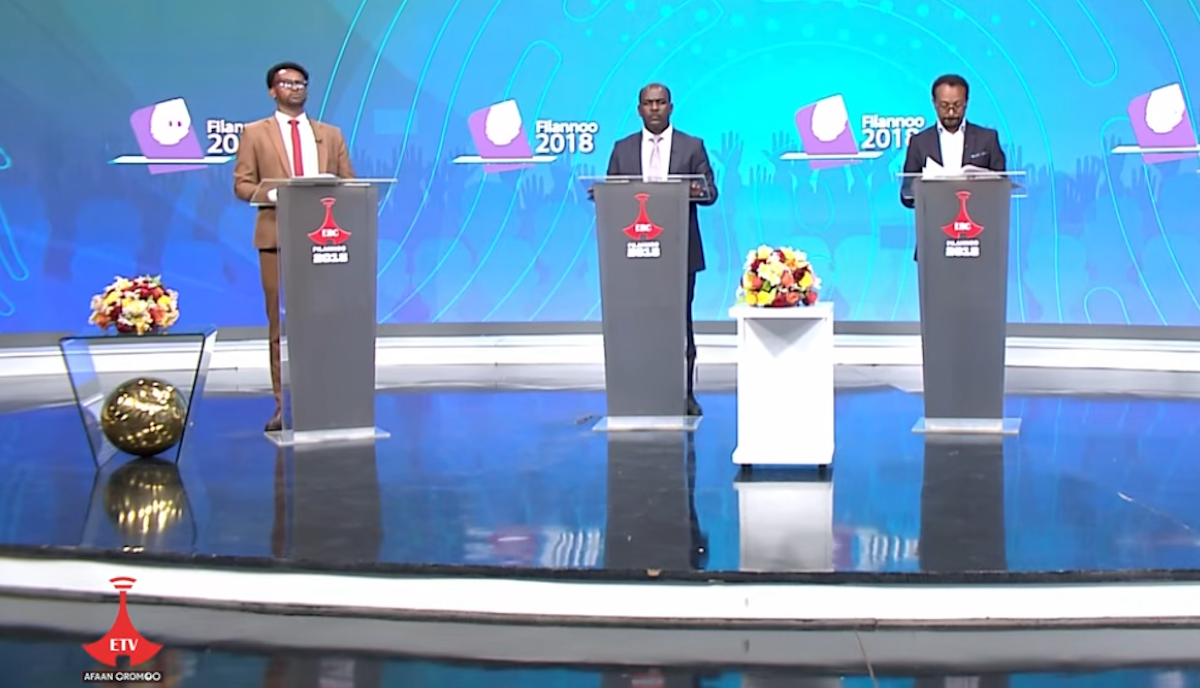
Debate held on 6 March 2026
When Elections Confirm Power Instead of Changing It
I have been watching the election debates ahead of the forthcoming Ethiopian general election in June. The entire exercise is political theater—carefully staged, carefully lit, carefully scripted. The whole choreography is a replica of what the main corridors of Finfinnee (aka Addis Ababa) have become with the street lights, courtesy of the PP regime’s developmental programme: bright, modern, impressive from a distance, but ultimately cosmetic when measured against the deeper political reality.
The debate is presented as democracy, more like the hard-hitting Democratic vs Republican debates in the United States or Labor vs Conservative in the United Kingdom, but it feels more like a rehearsal where the ending has already been written.
Everyone watching knows the result. The ruling Prosperity Party will win the election.
Not because it convinced voters. Not because it presented the best policies.
But because it controls the state, the machinery, the counting, and the outcome.
Ballots are counted by the state.
Security is controlled by the state.
Administration is controlled by the state.
Media is controlled by the state.
In such a system, elections are not competitions. They are confirmations.
The Mathematics of Power
In real democracies, elections are uncertain. In controlled systems, elections are mathematics. The ruling party does not ask, “Will we win?” It asks, “By how much should we win?”
Winning 100% looks bad internationally.
Winning 95% still looks bad.
Winning 90% looks slightly better.
Winning 85% looks like democracy.
So the regime may “lose” a few seats here and there.
- A few seats for EZEMA.
- A few seats for OLF.
- A few seats for other chosen minority parties.
Not because they won them. But because they were allowed to win them.
Giving away 5–10% as breadcrumbs costs nothing if you already control 90%. But that 5–10% buys something very important: legitimacy.
It allows the regime to say: “Look, the opposition won seats. Therefore the election was free and fair.”
This is not democracy. This is political stage management.
Why the Opposition Still Participates
This is the question many people ask: If the election is predetermined, why do opposition parties participate?
Because politics is not always about winning power. Sometimes politics is about not disappearing.
- If they boycott, they disappear from media.
- If they boycott, they disappear from the political map.
- If they boycott, they disappear from international diplomacy.
So they participate, not to win, but to remain visible, relevant, and alive—in the off chance that some breadcrumbs may be thrown their way to show up in the parliament.
The system therefore creates a strange political environment:
- The ruling party participates to legitimize its rule.
- The opposition participates to legitimize its existence.
- The public watches but does not decide anything.
- Foreign observers, if they're willing, participate to legitimize the process.
Everyone participates. But the voters are the least important participants in the entire process.
The Debate: Performance Without Consequence
The debates themselves are fascinating to watch—not because they will change the election result, but because they reveal something else: there are capable politicians in the opposition and pseudo-politicians who should not be there at all. This is the sideline that interested me most and why I decided to scribble this essay. I saved this aspect for later.
So the debates become strange spectacles:
- Talented and not-so-talented politicians arguing policies.
- Intelligent and dumb discussions.
- Good and bad speeches.
- Good and bad ideas.
And none of it will change who wins power.
It is like watching a football match where the score is already written before the game starts.
Elections as Political Theater
What we are witnessing is not democracy. It is the simulation of democracy.
There are debates.
There are parties.
There are campaigns.
There are ballot papers.
There may be observers.
There are results.
All the components of democracy exist. Except uncertainty.
And without uncertainty, elections are not elections. They are ceremonies.
The purpose of the ceremony is not to choose leaders. The purpose of the ceremony is to confirm leaders and legitimize power, another five years.
Much Ado About Nothing
So the famous phrase fits perfectly: Much Ado About Nothing.
Endless debates.
Endless campaigns.
Endless speeches.
Endless posters.
Endless promises.
And in the end, nothing changes.
But perhaps it is not entirely nothing.
It is much ado about:
- Legitimacy
- International image
- Political survival
- Controlled opposition
- Managed democracy
- Power without risk
The election may not decide who governs Ethiopia. That decision may already have been made long ago. The election simply announces it in a democratic language.
And that is why the debates, the campaigns, and the entire election spectacle feel less like politics and more like theater.
A very expensive theater. With a script already written. And an ending everyone already knows.
The Sidelines That Grabbed My Attention
If the election debates did not convince me about who will win the election, they certainly revealed something else: the true political character of the parties involved, the intellectual depth—or lack of it—among some politicians, the emergence of serious political voices, and even the quiet but remarkable rise of Afan Oromo as a language of political discourse.
It is therefore these sideline observations, rather than the election itself, that I found far more interesting and worth documenting as outlined below in no particular order.
1. The Infantile Politics of EZEMA
The sudden endearment politicians show during elections is nothing new. They want votes, and during election season they all become unusually friendly, unusually humble, and unusually attentive to the people. In the West, this often takes the form of the famous baby-kissing moments—politicians smiling for cameras, holding babies, visiting factories, eating in local diners. But despite these gestures, politicians in established democracies are usually careful not to bend their core ideological positions simply to endear voters, because ideological inconsistency can be politically costly in the long run.
It seems such caution does not apply to EZEMA.
I heard something during the March 6 ebates [2] that was so astonishing that it deserves special mention. EZEMA now says it supports the Gadaa system. Whether EZEMA supports the Gadaa system or not is actually inconsequential, because Gadaa does not require political endorsement from modern parties to exist or to be respected. Gadaa is a civilizational system that existed centuries before EZEMA and will exist long after EZEMA disappears. What makes this statement remarkable is not the support itself, but the political opportunism behind suddenly discovering admiration for a system they historically did not center in their political thinking.
What makes this even more absurd is that in the same political breath, the same political circles have advocated dividing Oromia into four or more administrative units. One cannot claim to respect the Gadaa system while simultaneously proposing political fragmentation that undermines the very historical, cultural, and political unity within which that system evolved. It is political contradiction at its finest—supporting the cultural system of a people while simultaneously proposing political structures that weaken the political foundation of that same people.
One could even sarcastically suggest that perhaps, if they truly want to align with Gadaa, they might next propose partitioning Oromia along the five traditional Gadaa parties. That would at least show ideological consistency, however absurd the proposal might be in modern state administration. But of course, such thinking was not included in the current political manifesto.
The more serious problem with EZEMA, however, lies not in these symbolic political gestures, but in their attempt to redefine federalism itself in order to fit it into their Ethiopianist unitary political vision. They seem to believe that political realities can be changed simply by redefining words on a debate stage. They want the public to believe that federalism must be “for citizens and not on ethnic lines,” as if federalism is a word whose meaning can be adjusted for political convenience rather than a political system with well-established historical, legal, and political definitions across the world.
This is essentially the same identity-erasure attempt that previously appeared in the form of proposals to partition Oromia, but this time it is being attempted through semantic gymnastics rather than administrative maps. If maps did not succeed, perhaps words will. That appears to be the strategy.
But political science is not poetry, and political terminology is not something that can be redefined during campaign debates.
- Federalism has meaning.
- Citizenship has meaning.
- Nations have meaning.
- Identity has political meaning whether some political groups like it or not.
One cannot simply stand on a debate stage and redefine federalism to mean something it has never meant, just as one cannot redefine gravity because one does not like physics.
This raises a serious question: do these people actually understand the ABC of politics—what federalism means, what a federation is, what citizenship means in multinational states, and how federal systems across the world are structured?
Or are they simply attempting to reshape political language to fit a predetermined ideological objective?
Their persistent attempt to redefine federalism while simultaneously advocating policies that weaken multinational federal structures suggests not intellectual innovation, but political confusion.
If this ideological confusion continues, one is tempted to conclude that their greatest contribution to Ethiopian politics may simply be to demonstrate how not to understand federalism. And if that is the case, perhaps the most responsible political decision they could make would be to step aside and allow more serious political thinkers to occupy the political space.
Because politics is not a debating club where words can mean whatever one wants them to mean. Politics shapes countries, borders, identities, rights, and power.
And those who do not understand the fundamentals should be very careful before attempting to redesign an empire.
2. The Cynical Politics of Prosperity Party
The ruling Prosperity Party candidates, particularly Kadir Mamo in the 6th March debate and Birhanu Lenjiso in the 21st March debate, spoke as if they were genuinely competing to win power on merit. They presented policies, defended regime performance, and attacked opposition arguments as if the election outcome would be determined by the strength of their arguments and the judgment of voters.
But this is where the entire performance becomes cynical. We know that the election is already predetermined. And most importantly, they know that the election is already predetermined.
So what exactly are they debating for?
They are not debating to win power; power is already theirs.
They are debating to justify power, to normalize power, and to present power as if it were contested and earned through democratic competition.
Listening to the Prosperity Party representatives, one cannot fail to notice that they are all singing from the same hymn sheet of lies—the familiar vocabulary authored by their political leadership: Medemer, prosperity, economic transformation, development, stability, unity, peace. According to their narrative, Ethiopia is on an unprecedented path of economic miracle, political reform, and national harmony—developments that, curiously, seem visible primarily to Prosperity Party officials themselves.
They also paint a picture of Ethiopia as one of the most peaceful places on the planet, a claim that would surprise millions of Ethiopians who live in regions affected by conflict, displacement, insecurity, and political repression. But such contradictions are not new in Ethiopian political discourse. This is, after all, the same political establishment that announced some six or seven years ago that Ethiopia would soon become an "oil-producing country" within weeks or months. That promise quietly disappeared, replaced by new narratives, new promises, and new slogans.
Now the same regime tells citizens to comply with austerity measures, to reduce fuel consumption, and to prepare for economic hardship due to possible global supply disruptions from international conflicts such as a potential US-Israeli confrontation with Iran. The pattern is familiar: grand promises during good times, austerity lectures during difficult times, and always the expectation that the public should believe both without question.
Another notable aspect of the Prosperity Party debate performance was their patronizing tone when discussing armed insurgencies and opposition movements. They repeatedly lectured the audience that democracy does not come out of the barrel of a gun. On the surface, this sounds like a reasonable and even admirable democratic principle. But when coming from a political establishment whose rise to power is deeply intertwined with decades of armed struggle, military conflict, and war—including the Eritrean war, the TPLF armed struggle, and various insurgent movements across Ethiopian history—the statement carries a heavy dose of irony.
It is one of those statements that is technically correct in theory but politically ironic in context. Many of the political elites who today lecture others that democracy does not come from the barrel of a gun are themselves products of political systems that came through the barrel of a gun, with the top echelons of OPDO/PP historically emerging as military captives of the Eritrean and TPLF wars — an irony that history will record with a straight face. History has a long memory, even when politicians hope the public has a short one.
But perhaps the most notable moment for the Prosperity Party in the debates came during Dr. Birhanu Lenjiso’s appearance, when he authored what may become his own indelible political legacy on a debate stage. When asked a direct and simple question about Finfinnee, he refused to acknowledge that Finfinnee is an Oromo city, instead repeating the familiar political mantra that Finfinnee belongs to all Ethiopians.
This was not a difficult question.
It was a politically difficult answer.
The issue was not about excluding others from the city. No serious political movement argues that others should not live, work, or participate in Finfinnee. Cities everywhere in the world belong administratively and historically to particular regions or peoples while being economically and socially open to all citizens. London belongs to England but is open to the world. Paris belongs to France but is open to the world. Finfinnee/Addis Ababa being an Oromo city does not mean others cannot live there; it means acknowledging historical, cultural, and political reality.
But politics is often not about truth; it is about constituencies. And in that moment, Dr. Birhanu Lenjiso chose political safety over historical clarity. He chose not to offend certain constituencies rather than to state a historically grounded fact. That moment may pass unnoticed by many viewers, but history often remembers such moments—the small moments where political opportunism reveals itself more clearly than long speeches ever could.
Without a doubt, history may record that debate moment as one of the most revealing political moments of the election debates: an Oromo elite, Dr Birhanu Lenjiso, on national television, refusing to acknowledge the Oromo identity of Finfinnee in order to maintain political alignment within a broader party structure.
Politics is full of speeches, manifestos, and promises. But sometimes history remembers a single sentence someone refused to say.
And that moment may become one of those sentences.
Dr. Birhanu Lenjiso, history will remember your denial of Finfinnee long after this debate is forgotten.
3. The Serious Politics of the OLF in an Unserious Situation
Call me biased—although I challenge anyone to show me politics without bias—but what we saw from the OLF representatives in the debates was what real politics looks like when practiced by people who actually know why they are in politics in the first place. These are politicians shaped not merely by party offices and television debates, but by a long political tradition, a liberation movement, ideological struggle, and political clarity about identity, power, and political solutions.
Whether one agrees with them or not is beside the point; what is undeniable is that they know what they stand for, they know what political problem they are trying to solve, and they know what political future they are advocating. That kind of clarity is rare in Ethiopian politics, where many politicians speak in slogans rather than in political philosophy.
I have a confession to make. I was initially against the idea of the OLF party participating in this election. My reasoning was simple: participation in a predetermined election risks doing one thing and one thing only—legitimizing the incumbent Prosperity Party by providing the appearance of competition. That argument may still hold some truth. But after watching the debates, I began to see another dimension to their participation that I had not fully appreciated before.
Even if the election itself does not transfer power, the debates create something else: a political record, a political narrative, and a political memory. And in that arena, the OLF representatives delivered something that can only be described as political dynamite.
This brings me to what I would call The Obama Moment of Lammii Gammachuu.
Anyone who followed American politics remembers Barack Obama’s famous speech at the 2004 Democratic National Convention. At that time he was relatively unknown nationally, but that speech instantly announced the arrival of a major political figure. Calm, articulate, confident, persuasive, intellectually sharp—he spoke like a man who knew exactly where he stood and where he wanted to take his country.
In the 21st March debate, Lammii Gammachuu had the same presence Barack Obama displayed years before he became president: calm under pressure, articulate in argument, confident without arrogance, and persuasive without raising his voice. Here is a short video clip [4] that says it all. Watch Birhanu Lenjiso's uncomfortable body language.
The kind of speaker who, in a real democratic system, could change the political landscape simply through clarity of thought and strength of argument.
But this is where the tragedy lies.
In a real democratic system, such a speaker might one day become prime minister. In this system, such a speaker may at best become an opposition MP in a parliament that does not control executive power.
Gadaa Gabisaa on the 6th March debate was no less impressive in his eloquence and mastery of the subject matter. Both representatives displayed something that is extremely rare in Ethiopian political debates: ideological clarity. They did not speak in vague slogans. They explained clearly why they stood for Oromia, what political problems they believe exist, and what political solutions they propose. Their answers were sharp, direct, and grounded in political reasoning rather than emotional rhetoric.
What made their performance even more notable was the way the interviewers attempted to diffuse their arguments—interruptions, rapid-fire follow-up questions, attempts to shift topics—but the OLF representatives maintained composure and continued to deliver structured, coherent political arguments. That kind of discipline does not come from debate coaching; it comes from political education, ideological grounding, and long political experience.
And this is where the irony becomes painful. The Ethiopian political system, historically and currently, has not been particularly good at recognizing and elevating competent politicians based on intellectual clarity, political vision, and leadership ability. Often, political advancement has depended more on alignment with power structures than on competence or vision. As a result, many capable political minds remain outside executive power structures, while less capable individuals sometimes occupy positions of authority.
But history does not only remember those who held office. History also remembers those who spoke clearly when clarity was rare.
Even if the OLF does not win seats proportional to their political strength, even if they do not enter government, even if the election itself changes nothing in terms of power, something else may have happened in those debates. They may have won something more important at this stage: the ears and the minds of their people.
Politics is not only about winning elections:
- Sometimes politics is about shaping narratives. Sometimes politics is about educating the public.
- Sometimes politics is about demonstrating political maturity and leadership.
- Sometimes politics is about showing that serious politicians still exist.
You may not win the election. But you may win something else:
- political respect,
- historical memory, and
- the confidence of your people.
And sometimes, in the long arc of political history, those victories matter more than parliamentary seats.
4. The Freedom and Equality Party? Where is the OFC?
One of the surprising moments in the debates was hearing about the Freedom and Equality Party (FEP), represented by Obbo Amaan Shugee in the March 21 debate. I must admit this was the first time I had heard the party presented so prominently, so I listened carefully to understand what the party stood for and how it differed from the ruling Prosperity Party and other opposition parties.
After listening to his overview of the party manifesto and his responses to the questions, I struggled to identify any meaningful policy differences between the Freedom and Equality Party and the Prosperity Party. The language was similar, the priorities sounded similar, and even the criticisms were mild and carefully measured. It felt less like an opposition party presenting an alternative political direction and more like a parallel voice repeating a slightly modified version of the same political script.
This inevitably raises political questions. In political systems dominated by a ruling party, it is not uncommon for “friendly opposition” parties to emerge—parties that participate in elections, create the appearance of political plurality, but do not fundamentally challenge the structure of power. Such parties help create the image of competition without creating the risk of political change.
There is a famous saying:
If it walks like a duck, and quacks like a duck, then it must be a duck.
That is the logic many viewers may apply when observing such political similarity. When an opposition party sounds almost indistinguishable from the ruling party, voters naturally begin to question whether this is truly an alternative or simply another actor within the same political framework.
It is therefore quite possible that Obbo Amaan Shugee has already secured a parliamentary seat within the small percentage allocated to opposition parties. But beyond that, there does not appear to be much that distinguishes this party politically in a way that would excite voters, challenge power, or introduce new political thinking.
Opposition parties are supposed to challenge power, not echo it. When an opposition party sounds like the ruling party, elections become not a competition of ideas, but a distribution of roles.
And once again, we are brought back to the central theme of this entire election season:
Much Ado About Nothing.
5. A Testbed for Afan Oromo — Beyond Coming of Age
In the spirit of these sideline observations that grabbed my attention more than the election itself, I cannot conclude without mentioning something that may have gone unnoticed by many viewers but was, to me, one of the most remarkable aspects of the debates: the linguistic maturity of Afan Oromo.
It was simply breathtaking.
This is a language that was actively suppressed until 1974, partially tolerated but still constrained until 1991, and even after that never given the full national status and institutional space it deserved. And yet, despite this historical suppression and delayed institutional support, Afan Oromo today functions as a fully capable language of political debate, policy discussion, economic analysis, legal argument, and national discourse. What we witnessed in these debates was not just politicians arguing; it was a language demonstrating its full intellectual and political capacity.
One must pause and think about this for a moment. Afan Oromo has had barely three decades of serious institutional development in education, media, administration, and literature. Three decades is nothing in the life of a language, especially a language that had to recover from deliberate suppression and marginalization. Many European languages took centuries to develop political, scientific, and administrative vocabularies. Afan Oromo has had to do this in a fraction of that time and often without full federal institutional support.
Now imagine, just for a moment, that none of the historical obstacles existed. Imagine if Afan Oromo had been allowed to develop freely in education, administration, literature, science, and governance over the past century. Where would the language be today? The mind can only speculate. But even under constraint, the language has advanced at a remarkable pace.
The debates demonstrated this very clearly. The debaters spoke with eloquence, precision, and confidence. The presenters and moderators, whose job it is to navigate complex political and policy terminology live on television, handled sophisticated vocabulary, political terminology, economic language, and legal concepts with impressive fluency. There was no linguistic hesitation, no conceptual limitation, no sense that the language was inadequate for modern political discourse. On the contrary, Afan Oromo sounded like exactly what it is becoming: a formidable working language of a federation.
At one point I found myself listening carefully to the terminology being used—economic terms, governance terminology, political theory vocabulary—and I was genuinely impressed by how naturally these concepts were expressed. I even caught myself wondering about some of the complex terminologies that Dr. Birhanu Lenjiso was using so comfortably in Afan Oromo. This is a sign not just of individual linguistic ability but of a language ecosystem that has matured enough to handle modern political discourse.
What we are witnessing is not just the development of a language; we are witnessing the normalization of a language into political, intellectual, and administrative life. This is what linguists call language institutionalization—when a language moves from home and cultural use into education, government, media, law, and national political discourse.
In that sense, these debates unintentionally served as a kind of testbed for Afan Oromo, and the language passed the test with distinction.
Ironically, one of the few genuinely positive outcomes of these otherwise predictable and politically uncompetitive debates is that they showcased the strength, flexibility, and maturity of Afan Oromo to a national audience. Even if the election changes nothing politically, the debates revealed something culturally and linguistically significant: Afan Oromo is no longer merely a regional language struggling for recognition; it is increasingly functioning as a language capable of carrying the full weight of modern political, economic, and intellectual discourse.
The language is not just coming of age. It is moving beyond coming of age into institutional maturity.
And that may be one of the most important sidelines that this entire fake election debate unintentionally revealed to us.
6. A Trivia Tongue-in-Cheek — You Don’t Have to Take This Seriously, But …
Before I close, let me allow myself one small detour into mischief. What follows is entirely my personal assessment, offered in a deliberately light-hearted spirit after all the heavier political observations above.
As the author, I take full responsibility for these completely unofficial marks. They are not scientific, not binding, and certainly not endorsed by any electoral body on earth. They are simply my own tongue-in-cheek scorecard of how the debaters came across to me—plus one special entry for the real silent winner of the debates: Afan Oromo. This, I hope, may also offset the lengthy nature of this article, perhaps one of the longest to appear on OROMIA TODAY, and offer a light smile at the end of a rather serious political journey.
| # | Name | Party | Marks |
| 1. | Afan Oromo | — | 100% |
| 2. | Amaan Shugee | FEP | 35% |
| 3. | Birhanu Leenjisoo | PP | 40% |
| 4. | Gadaa Gabbisaa | OLF | 90% |
| 5. | Kadir Mamo | PP | 45% |
| 6. | Lammii Gammachuu | OLF | 95% |
| 7. | Tariku Dinberu | EZEMA | 10% |
Conclusion — Much Ado About Nothing
After watching the debates, listening to the arguments, observing the parties, and reflecting on the sidelines that grabbed my attention, I return to where I started: this entire election season feels like an elaborate performance whose ending is already known. The debates were real, the politicians were real, the discussions were sometimes intelligent and sometimes absurd, but the election itself remains largely symbolic rather than decisive.
And yet, despite being a largely predetermined political exercise, the debates revealed something important about Ethiopian politics today. They revealed the opportunism of some parties, the cynicism of power, the seriousness of a few politicians, the emergence of articulate political voices, and even the remarkable rise and maturity of Afan Oromo as a language of political discourse. In other words, while the election itself may not change who governs, the debates revealed who understands politics, who does not, who stands for something, who stands for anything, and who simply stands wherever the wind is blowing.
Perhaps that is the irony of the entire exercise. The election may not have been a true competition for power, but it became a competition of ideas, competence, clarity, and political maturity. And in that competition, the results were not predetermined. Some politicians distinguished themselves, some exposed themselves, and some unfortunately confirmed what many already suspected.
Politics is not always about who wins the election. Sometimes politics is about who wins the argument, who wins the respect of the people, who demonstrates leadership, and who leaves a political record that history will remember. Elections come and go, but political memory is long. Speeches are recorded, positions are remembered, and moments of courage—or moments of opportunism—do not disappear as quickly as campaign posters.
The Prosperity Party will almost certainly win the election. That was never really in doubt. But the debates may have produced a different kind of result that will not appear on any official election board: a political ranking in the minds of the people about who spoke with clarity, who spoke with courage, who spoke with confusion, and who spoke only because they had to.
So in the end, the Ethiopian election debates may indeed be what Shakespeare described centuries ago: Much Ado About Nothing. Much debate, much campaigning, much speech, much movement, but very little change in the structure of power.
But perhaps, just perhaps, it was not entirely about nothing.
Perhaps it was much ado about legitimacy.
Much ado about political survival.
Much ado about image.
Much ado about language.
Much ado about identity.
Much ado about political memory.
And in that sense, even a predetermined election can still reveal the political character of diverse nations and nationalities of the empire.
The election result may already be known.
But the political story behind it is still being written.
The elephant in the room
We already know that elections in Oromia and Ethiopia are largely predetermined. Yet the larger question remains: even if the appearance of elections can be staged, can the broader political reality be staged as well?
An empire convulsed by civil wars in Oromia and Amhara, a lingering shadow of renewed conflict over the pseudo-independent Tigray region, an open challenge by the Somali region’s president to the authority of Abiy Ahmed, and Western embassies issuing travel advisories that reflect widespread insecurity — in such an environment, one must ask whether a credible electoral structure exists even for the purpose of simulating an election.
That question — perhaps the most important of all — deserves its own discussion. That will be the subject of the next installment.
References
- OT Editorial, The Day Monetary Policy Joined the Ruling Party, 24 February 2026, OROMIA TODAY.
- Falmii Paartiilee Sirna Ijaarsa Dimokiraasii Irratti, 6 March 2026, EBC, ETV Afaan Oromoo, YouTube.
- Falmii Paartilee Siyaasaa Heeraa Mootummaa fi Federaalizimii irratti Taasifame | Waltajjii Faanaa, 21 March 2026, Fana Afaan Oromoo, YouTube.
- Video clip of Lammii Gammachuu's debate speech (Reel by Abdii Oromoo), 22 March 2026, Facebook.