One Song, Five Messages
Excerpt
In just days, one song by Tewodros "Teddy Afro" Kassahun has ignited a firestorm—revealing not unity, but multiple Ethiopias speaking past each other. What appears as controversy is, in truth, a deeper collision of meanings shaped by power, history, identity, and memory. This article unpacks the layered messages behind the moment, exposing how one song became a prism through which a fractured empire sees itself.
When a Song Becomes a Mirror
There are songs that entertain. There are songs that inspire. And then—once in a rare while—there are songs that act as a “truth wand,” detonating softly, but exposing everything.
The latest release from Tewodros "Teddy Afro" Kassahun belongs to the third category.
In a matter of days, one track—“Das Tal”—has ignited Ethiopia’s already volatile discourse into something far more revealing than controversy. It has exposed fault lines, triggered competing narratives, and—most strikingly—forced millions to confront a truth long hidden in plain sight: Ethiopia is not one conversation. It is many conversations happening at once, in parallel worlds that rarely intersect except in moments of tension.
At first glance, the reaction seemed predictable. The ruling Abiy Ahmed administration appeared visibly irritated, with state-aligned narratives quickly framing the song as veiled dissent. International outlets, including BBC [1], gravitated toward this angle—another artist, another critique, another political ripple before a high-stakes election. Many Habasha digital media outlets predictably converged on the same line of analysis and commentary—amplifying a uniform narrative, as seen with Ethio Forum [2], Reyot Media [3], and Zara Media [4].
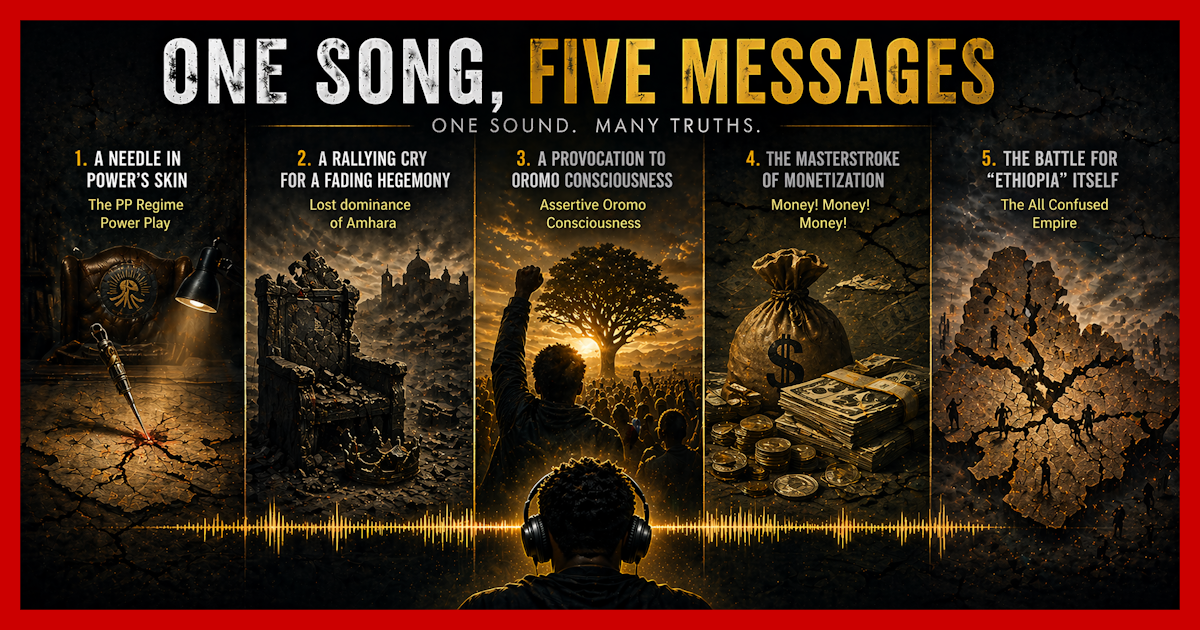
But that reading barely scratches the surface. Because “Das Tal” is not one message. It is five. And each audience hears a completely different song.
The Empire of Parallel Meanings
Ethiopia has always been more than a state—it is a layered psychological and historical space where symbols, colors, language, and memory carry meanings far beyond their literal form. A gesture is never just a gesture. A lyric is never just a lyric.
Even the phrase “Das Tal”—loosely interpreted as “pitch the tent”—evokes more than a simple act. It conjures the imagery of mourning tents, communal grief, a gathering around something dying… or already dead.
A nation?
An idea?
A dominance?
The ambiguity is not accidental. It is the architecture. And within that architecture, five powerful messages unfold.
1. A Needle in Power’s Skin
For the ruling Prosperity Party (PP) regime, the song lands as a subtle but unmistakable provocation.
Not through direct confrontation—but through suggestion. Through metaphor. Through the kind of artistic ambiguity that cannot be easily censored without amplifying it.
Timing matters. With elections looming, sensitivity is heightened. Any narrative hinting at decline, instability, or “mourning” becomes politically radioactive. The irritation is therefore not just about the song—it is about what it might awaken.
Because in fragile moments, even poetry becomes dangerous.
What followed only amplified that danger. Abiy Ahmed, true to a pattern observed since he rose to power, did not let the moment pass quietly. Instead, he stepped into it—forcefully, emotionally, and with the kind of rhetoric that rarely diffuses tension. In doing so, he transformed a provocative song into an international spectacle.
At every turn, whether responding to criticism or preempting it, his interventions have often carried an edge that blurs the line between leadership and confrontation. This time was no different. Rather than dampening the conversation, his remarks injected fresh energy into it—fueling curiosity, sharpening divisions, and inadvertently amplifying the very message he seemed intent on countering.
The result? A cultural moment that exploded in reach, with the song surging past seven million views in under forty-eight hours.
But it was not just the response—it was the language. Metaphors that might have been intended as political imagery landed instead as deeply charged signals. References to “uprooting stumps” (ጉቶ መንቀል) left little ambiguity about the targets in the public imagination. The contrast he drew—casting his camp as the “eagle” while dismissing critics as shouting “dirty crows”—did more than provoke; it entrenched.
In a climate already thick with suspicion and competing narratives, such rhetoric does not settle the storm. It becomes part of it.
2. A Rallying Cry for a Fading Hegemony
For segments of Amhara nationalist sentiment, however, “Das Tal” resonates very differently.
It is heard as lament.
A lament for a perceived loss—of influence, of centrality, of historical dominance. The symbolism taps into deeper anxieties, particularly around contested spaces like Finfinnee (Addis Ababa), where identity, ownership, and power collide.
Here, the “tent” is not just mourning—it is gathering. A quiet consolidation of sentiment. A cultural echo of “we are losing something—and we must recognize it.”
Whether intended or not, the song becomes a mirror reflecting that unease.
3. A Provocation to Oromo Consciousness
Among Oromo nationalists, the reception shifts again—this time toward suspicion and utter offense.
Not merely because of what is said, but because of what is implied and veiled with color schemes, symbols and typography.
The layering of imperial nostalgia, subtle historical references, and symbolic cues triggers a different reading: one of encoded messaging that appears to romanticize a past many Oromos associate with dispossession and forced assimilation.
And yet, paradoxically, this is where the song’s complexity deepens.
Because for some, the same message is also interpreted as unintentionally exposing the very contradictions it may be trying to veil. A kind of artistic self-incrimination—where the nostalgia itself becomes the evidence.
The result? A reaction that is not uniform, but sharply divided between rejection and critical reinterpretation.
The response from the Oromo artistic space was immediate—and electric. Prominent voices such as Gelana Garomsa and Yosan Getahun did not wait for the dust to settle. Within hours, they delivered a counterstroke—“Galmee Seenaa” [5]—not as a planned release, but as a rapid, instinctive act of cultural rebuttal. It was less a song in the conventional sense and more a statement—urgent, reactive, and unmistakably intentional.
The impact was staggering. Crossing one million views in under twenty hours, “Galmee Seenaa” demonstrated something deeper than virality—it revealed readiness. A readiness to respond, to reclaim narrative space, and to challenge meaning in real time. This was not production; this was reflex.
And it did not stop there. The wave expanded almost instantly into the digital frontier. AI-generated tracks—emerging in both Afaan Oromo and Amharic—joined the chorus, each attempting to reinterpret, counter, or dismantle the message of “Das Tal.” The speed, volume, and diversity of these responses signaled a new phase in cultural contestation: one where narrative battles are no longer slow, but instantaneous—and increasingly decentralized.
All of this converges on a single, unavoidable conclusion: “Das Tal” is not merely one song. It is a multi-layered signal—transmitted differently, received differently, and contested differently by every audience it reaches.
4. The Masterstroke of Monetization
And then there is the fourth message—the one least discussed publicly, yet perhaps the most concrete.
This is business. Teddy Afro is not just an artist; he is a brand. And controversy, in the modern attention economy, is currency.
By crafting a song that simultaneously provokes, attracts, offends, and mobilizes, he has achieved what few artists can: total market penetration across ideological divides. Streams surge. Conversations explode. Visibility multiplies. From this angle, the controversy is not collateral—it is strategy.
And critics point to a pattern. Previous works invoking figures like Menelik II have sparked similar tensions, even leading to real-world repercussions such as the cancellation of corporate-backed events by a Dutch company, including a high-profile concert linked to Bedele Beer.
The formula is familiar. The scale, this time, is not.
Tewodreos "Teddy Afro" Kassahun is not without his critics—and his critique goes beyond the music into the realm of responsibility. As an artist of Gurage heritage, his repeated invocation of imperial Amhara symbols and narratives has drawn scrutiny from those who see a calculated pattern: selectively weaving the grandeur of past kings into his lyrics while operating above the very tensions such imagery ignites. To them, this is not incidental—it is strategic.
The charge, at its core, is not simply about identity, but about influence. When an artist of his stature reaches across historical fault lines and activates deeply contested symbols, the outcome is rarely neutral. It shapes discourse and sharpens divides. And, inevitably, it amplifies attention—commercially as much as culturally. One thing is clear here: he is doing what Guragees are good at: monetizing.
There is, therefore, a harder question that cannot be sidestepped: where does artistic freedom end, and where does responsibility begin? Because in a landscape as sensitive and symbol-laden as Ethiopia’s, artistry is never just expression—it is intervention. And intervention, whether intentional or not, has consequences.
5. The Battle for “Ethiopia” Itself
Here is where the story stops being about a song—and becomes something far more consequential.
Because “Ethiopia” is not a neutral word. It is a contested idea. A political instrument. A psychological battleground.
And every stakeholder hears—and uses—it differently.
For the Prosperity Party, “Ethiopia” is a balancing act. A necessary umbrella to hold together competing forces. Yet within that, Abiy Ahmed is widely perceived—even by critics and supporters alike—as an uncompromising Ethiopianist at his core, often prioritizing a unified national identity over ethnonational distinctions. For some, this raises uncomfortable questions about where Oromummaa fits within that hierarchy—if at all.
Among Amhara elites and intellectual traditions, the concept of Ethiopia has historically functioned as something more layered—sometimes even strategic. Figures such as Asrat Woldeyes, Mesfin Woldemariam, and Andargachew Tsige have, at different times, articulated positions that appear to dissolve Amhara identity into a broader Ethiopianism.
On the surface, this reads as transcendence of ethnicity. But the underlying logic has often been interpreted differently: why settle for a narrower Amhara identity when the larger Ethiopian construct already carries the historical weight, prestige, and legacy associated with Amhara dominance?
That logic, however, did not hold indefinitely.
From the EPRDF/TPLF era—particularly after the ethnic federal arrangement formalized regions and birth of the Amhara region—saw the parallel rise of explicit Amhara nationalism.
Yet Ethiopianism did not disappear; it evolved into a dual-track project. One track asserts Amhara nationalism. The other nostalgically preserves an Ethiopia aligned with past imperial glory. For the Amharas, the two now move in tandem.
For Oromo nationalists, however, the equation is fundamentally different.
“Ethiopia” is not an aspirational umbrella—it is, in many interpretations, the very architecture of historical grievance. It is seen not as a shared home, but as a system that institutionalized marginalization, cultural suppression, and political exclusion.
This is the disconnect that continues to confound Ethiopianist thinkers across the spectrum.
For Oromo consciousness, certain issues are not negotiable—they are incendiary. The status of Finfinnee. The recognition of Afaan Oromo at the federal level. These are not policy debates; they are existential markers of dignity and justice.
Against this backdrop, symbols matter—immensely.
A cross-like emblem featured in the song’s publicity evokes more than a religious symbol—it carries echoes of the historical dominance of the Ethiopian Orthodox Church, which many perceive as exclusionary toward Muslim communities, and it sits uneasily with Oromo nationalist sentiment. The familiar tricolor associated with Menelik II is not merely a national flag variant—it carries layered meanings that can inspire pride in one audience and provoke deep resentment in another.
Thus, what appears to one group as nostalgia becomes, for another, a reawakening of trauma.
And then there are those who attempt to straddle both worlds—Ethiopianism and Oromummaa. Figures like Lemma Megersa [6], with sentiments such as “Ethiopia Suusee”, exemplify this posture. They are joined by others within the Prosperity Party orbit who project a fluid—often blurred—identity between the two.
This includes elements of the party’s top leadership, as well as former members of the Oromo Liberation Front who now align with the Prosperity Party line. What emerges is not a clear synthesis, but an uneasy overlap—one that raises persistent questions about coherence, intent, and where ultimate loyalties reside.
But this middle ground is far from stable. This is where the deeper problem lies. The attempt to simultaneously inhabit Ethiopianism and Oromummaa—whether as strategy, conviction, or convenience—often produces not synthesis, but dilution. It softens the sharp edges of history that demand clarity. It reframes structural grievances into manageable ambiguities.
And in doing so, it risks postponing, rather than resolving, the very injustices that require direct and honest confrontation.
What emerges is a politics of half-answers. A language that gestures toward unity while sidestepping the substance of inequality. A narrative that seeks to reconcile without first reckoning. In such a space, historical wounds are neither denied nor addressed—they are absorbed into a blurred middle, where urgency fades and accountability weakens.
This is precisely where the tension hardens. Because for those who carry these grievances as lived realities, any framework that appears to dilute them is not seen as bridge-building—it is seen as deflection. And deflection, over time, deepens mistrust.
A durable political solution cannot be built on ambiguity alone. It requires clarity—on history, on power, on identity, and on justice. Without that clarity, the middle ground becomes less a meeting point and more a holding pattern, where competing truths coexist uneasily, and resolution remains perpetually out of reach.
The suspicion is clear: one cannot simultaneously advance a project rooted in Ethiopianist centralism while claiming to represent a movement grounded in Oromo self-determination.
From within Oromo nationalist thought, it is precisely this straddling—this attempt to occupy both camps at once—that is seen as the most immediate and insidious threat to Oromo aspirations.
Unlike clearly defined opponents, whose positions are visible and contestable, this middle posture operates in ambiguity—blurring lines, softening demands, and, in the process, diluting the clarity required for a coherent political struggle. It introduces uncertainty into a movement that depends on precision, and it reframes core questions of justice into negotiable language that risks eroding hard-won consciousness.
Whether that judgment is fair or not is almost beside the point. What matters is that it exists—and it shapes how every symbol, every lyric, every gesture is interpreted.
Beyond One Song
What makes “Das Tal” extraordinary is not just its composition—but its consequence.
It has become a diagnostic tool.
A single piece of art revealing five distinct Ethiopias:
- One anxious about power.
- One grieving perceived loss.
- One resisting historical narratives.
- One capitalizing on all of it.
- All are locked in a deeper, irreconcilable battle over what “Ethiopia” even means—each projecting their own version onto it—creating a fractured narrative that fuels enduring psychological, political, and historical tension, and this is where the empire quietly breaks.
Ironically, this is not confusion—it is clarity at its most unforgiving, exposing fractures long buried beneath a single name. It is a ruthless clarity, revealing nations speaking in many voices, none willing to yield and competing truths collide without resolution.
It is clarity—uncomfortable, unfiltered clarity.
Because when one song can mean five entirely different things depending on who is listening, the real story is not the song.
It is the empire.
The empire that speaks in many meanings to many peoples—and in doing so, speaks to none as one. The empire that cannot mean the same thing to the peoples it claims to unite. The empire that has become too many meanings to too many peoples—and in that excess, finds its fracture.
Postscript
What gives the song its charge is not just its craft, but its audacity. Beneath the melody runs a deliberate invocation of a glorified past—presented as pride for some, but heard by others as the sanctification of dominance. For those who experienced that history from the margins, the same imagery does not read as nostalgia; it reads as erasure, even contempt. It is this collision of memory and meaning that makes the song so combustible.
One is therefore tempted to censor such contemptuous expression—to shut it down in the name of dignity and social peace. But that temptation must be resisted. The instinct to silence a work like this is understandable. When art appears to legitimize dominance or reopen historical wounds, the reaction is not merely emotional—it is political. But silencing it would be a mistake.
Not because the message is harmless, but because it is revealing. It exposes, in raw form, the unresolved tensions that polite discourse often conceals. The answer, therefore, is not censorship, but confrontation—naming the message, dissecting its implications, and challenging it in the open.
Freedom of expression may have its limits, but the greater danger lies in leaving such narratives unexamined.
It is in the open contest of ideas—not their suppression—that societies find their way forward.
References
- Millions listen to Ethiopian star's song taking swipe at government, 18 April 2026, BBC.
- ቴዲ አፍሮና ዐቢይ አሕመድ፤ አራት ኪሎን ዳስ ያስጣለው ከያኒ |ETHIO FORUM, 17 April 2026, Ethio Forum YouTube Channel, YouTube.
- የተጣለው ዳስ እና የታወከው ደሴት። ብልጽግናን ያሸበረው ብእር። ቴዲን በመስማታቸው የታሰሩት 04/18/2026, Reyot Media YouTube Channel, YouTube.
- ፕሮፌሰሩ ስለቴዲ አነጋጋሪው ሙዚቃና የብልፅግና ምላሽ/አምቦ ታዲዎችን አግቶ 19 የወለደው @Zaramedianet, 19 April 2026, Zara Media Network YouTube Channel, YouTube.
- Gelana Garomsa ft Yosan Getahun - Galmee Seenaa - new Ethiopian (music 2026 ), 17 April 2026, Gelana Garomsa YouTube Channel, YouTube.
- Lemma Megersa Wako Official Facebook Page.
- Elemoo Qilxuu, ETHIOPIA'S 6 BIG LIES FUELING ITS IMPENDING COLLAPSE, 13 March 2024, OROMIA TODAY.