7 Reasons Why There Can Be No Credible Electoral Process in an Empire Disintegrating Before Our Eyes
Excerpt
Even if elections are predetermined, they still require minimum conditions and structures to stage the illusion of democracy. In today’s Ethiopia, those conditions no longer exist. Large parts of Ethiopia are outside regime control, opposition parties participate only to avoid deregistration, insecurity is widespread, and political intimidation is routine. Some regions appear politically detached, actively contemplating a post-Ethiopia political order, and therefore cannot be considered fully participatory in the electoral process. This is no longer an election that can be rigged; it is an election that cannot even be convincingly staged.
Introduction
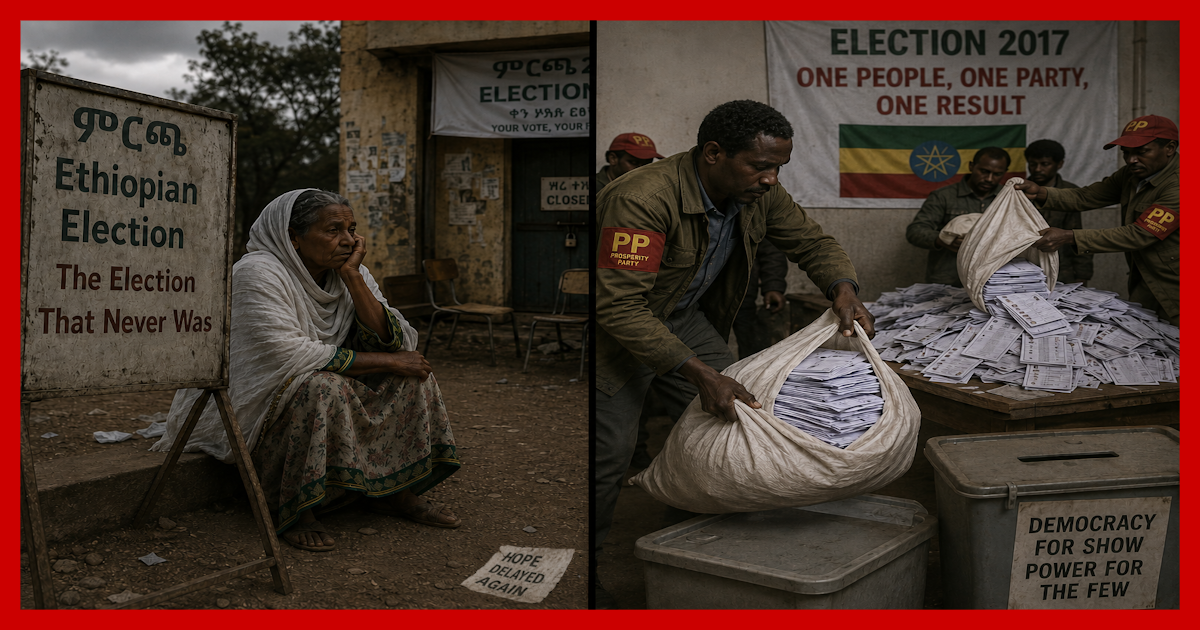
A previous op-ed by one of the authors [1] argued that the upcoming elections in Oromia and Ethiopia this coming June 2026 are an illusion of democracy — a predetermined political exercise designed to legitimize an incumbent regime rather than reflect the will of the people.
Yet the larger question remains: even if the appearance of elections can be staged, can the broader political reality be staged as well?
The reality on the ground suggests otherwise. The political, security, and administrative conditions required even to simulate a fake election simply do not exist.
Elections require territorial control, administrative structure, political participation, freedom of movement, and minimum security stability. None of these conditions required for a credible electoral process currently exist across large parts of Ethiopia.
Below are seven reasons supporting this conclusion, many of which are corroborated by independent reports, travel advisories, political statements, and observable realities on the ground.
#1. Oromia Region Insurgency and OLA’s Stark Warning
Significant parts of Oromia remain outside effective federal regime control due to the ongoing conflict between the Oromo Liberation Army (OLA) and regime forces. Various reports and statements from both sides suggest that significant portions of rural Oromia, estimated at 40%, are contested or controlled by insurgent forces rather than the regime.
In such conditions, the fundamental requirement for credible electoral process — administrative control over territory — does not exist. Elections require voter registration, candidate campaigning, secure transport of ballot materials, and functioning local administration. Where armed conflict is ongoing, these processes are impossible to conduct in any meaningful way.
Statements from OLA leadership have also warned that elections conducted under military occupation or conflict conditions cannot be considered legitimate political processes. Whether one agrees with the OLA politically or not, their warning highlights a fundamental reality: elections cannot be conducted in areas where the regime itself cannot move freely without military escort.
#2. Amhara Region Insurgency
The Amhara region is also experiencing armed conflict between Amhara Fano militia forces and federal forces. Reports indicate that large areas of the region are unstable, contested, or outside effective federal administrative control. Experts suggest that more than 80% of the region is beyond the reach of the regime.
The scale of instability in Amhara further undermines the possibility of nationwide elections. Elections are not simply events held in urban centers; they require nationwide administrative coordination. When two of the largest regions are in active conflict, the concept of a national election becomes largely symbolic rather than real.
An election in which large parts of two major regions cannot participate freely cannot be described as a national democratic exercise.
#3. Tigray Region – A Pseudo-Independent Political Reality
Tigray region currently exists in a political reality that is neither fully integrated into the federal system nor fully independent. The region has its own armed forces, political administration, and unresolved disputes with the federal regime. Tensions remain high, and discussions of a possible renewed conflict of 2020-2022 have been ongoing for months.
Under such conditions, the upcoming national elections have little political meaning in Tigray. A region that operates with quasi-state autonomy and unresolved post-war tensions cannot meaningfully participate in a federal electoral process.
An election that excludes or marginalizes one of the major political regions further undermines the credibility of the entire process.
#4. Somali Region – The Mustafe Mohammed Omer Controversy
A leaked audio recording allegedly involving Somali Region President Mustafe Mohammed Omer added another layer of political uncertainty. The recording, reported by Ethio Forum on 19th March [2], allegedly included statements suggesting that there would be no free and fair elections under the current regime and that the political future of the region could take a different direction if Ethiopia were to disintegrate.
The most controversial part of the alleged conversation suggested that before Prime Minister Abiy Ahmed could remove him from office, Ethiopia itself would disintegrate, after which the Somali region would pursue broader political ambitions related to Somali reunification.
Mustafe Mohammed Omer belatedly after 10 days, and it would appear unconvincingly, issued a denial on 29th March [3], but the incident itself reflects the level of mistrust, fragmentation, and political uncertainty within the federal system. Regardless of the authenticity debate, the fact that such conversations are believable to many people already demonstrates how fragile the political structure has become.
When regional leaders are suspected of preparing for a post-Ethiopia political order, the concept of a unified national election becomes increasingly detached from reality.
#5. Professor Marara Gudina and the Token Participation of OFC
The statement by veteran opposition politician Professor Marara Gudina of the Oromo Federalist Congress (OFC) is particularly revealing. Speaking on BBC Afaan Oromo [4], Professor Marara explained that due to the hostile political environment, security problems, and regime restrictions, the party decided to field only six candidates — not to compete seriously, but simply to avoid being deregistered by the electoral board.
Under electoral board rules, two successive election boycotts can lead to a party being struck from the register. Having already boycotted the 2021 elections, the party, therefore, decided to participate symbolically rather than politically.
This is perhaps one of the most telling indicators of the political environment. In previous elections, OFC fielded over one hundred candidates across Oromia. Today, one of the largest opposition parties in Ethiopia participates with only six token candidates simply to remain legally registered.
As discussed in the recent article [1], most other political parties, including the Oromo Liberation Front (OLF), are participating primarily to avoid deregistration, fielding only a limited number of candidates. They know the election outcome is largely predetermined; their participation is not to win seats, but merely to survive as legally recognized political parties.
That fact alone speaks volumes about the political environment in which these elections are taking place.
As an aside, Professor Marara’s political predicament illustrates how alien peaceful political struggle is to the Ethiopian empire. OLA commander Marro Dirriba captured this irony sarcastically when he said that Professor Marara, a lifelong practitioner of peaceful politics, deserved a Nobel Prize for his peaceful activism — yet the fate of his party today shows what peaceful struggle ultimately earns in Ethiopia.
#6. International Travel Advisories Confirm Widespread Insecurity
Travel advisories issued by Western governments such as the United Kingdom [5] and the United States [6] confirm widespread insecurity across large parts of Ethiopia. These advisories are based on intelligence assessments, security reports, and risk analysis, and they often advise against travel to large parts of Ethiopia due to conflict, kidnapping risks, ethnic violence, and general insecurity.
These advisories effectively provide an independent external assessment of security situation. If foreign governments advise their citizens not to travel to large parts of Ethiopia due to security risks — see the color coded map below — it raises a fundamental question: how can nationwide elections be conducted safely in those same areas?
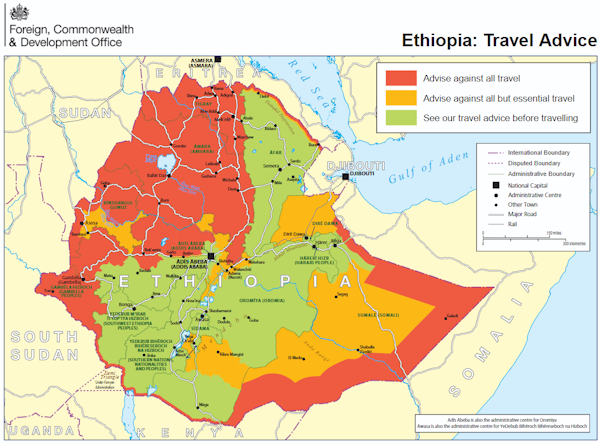
Security stability is a basic prerequisite for elections. Without security, the electoral process becomes either impossible or purely symbolic.
#7. Pre-Election Psychological Warfare and Harassment
Reports from various areas in Oromia indicate that polling stations are already being opened and guarded nearly three months before the election. Local residents are reportedly being instructed to guard polling stations in rotation and to provide food and supplies for those guarding the stations.
The purpose of opening polling stations months in advance is unclear from an electoral logistics perspective. However, some observers suggest that this may be part of a broader psychological warfare strategy — either to demonstrate regime presence in contested areas or to provoke attacks that can later be used for political narratives.
There are also reports of harassment, intimidation, forced participation in political meetings, and pressure on civil servants and local communities to demonstrate loyalty to the ruling party. Intimidation is rife, often delivered through veiled and coded messages: vote for the regime’s Prosperity Party — or face the consequences.
As of this writing, serious attacks on polling stations are reportedly underway in central-western Oromia, raising the question of whether the premature opening of polling stations was a security necessity — or a political trap waiting to be triggered.
The well-budgeted “digital army” known as Faarseebulaa [7], which Ethiopia can ill afford at a time of economic hardship, is also in full swing, running coordinated disinformation and propaganda campaigns that further poison the political atmosphere and undermine any remaining public trust in the electoral process. When intimidation exists on the ground and disinformation dominates the digital space, the electoral process ceases to be a democratic exercise and instead becomes a managed political operation.
It is also crucial to note that the National Election Board of Ethiopia (NEBE), the body tasked with managing the election, is independent in name only. In reality, it functions as a regime-controlled institution that has steadily narrowed the political landscape in favor of the Prosperity Party.
Even without all the other factors discussed, such a political environment alone would be sufficient to invalidate the credibility of the entire electoral process.
Conclusion: Elections Require an Electoral Process and System That Functions
Elections are not simply ballot papers and polling stations. An electoral process requires a functioning political system, territorial control, security stability, political freedom, opposition participation, and public trust. Regional cohesion is equally vital for an empire state like Ethiopia.
When large parts of the empire are in armed conflict, when opposition parties participate only symbolically, when regions operate in political fragmentation and discord, when travel advisories warn of widespread insecurity, and when political intimidation is reported — the electoral process cannot be described as a democratic exercise.
It becomes political theater.
The election result may already be known. But the political story behind it is still being written.
And that story may not be about an election at all — but about the slow fragmentation of a political system that can no longer hold together the empire it once controlled.
References
- Kumaa Daadhii, Much Ado About Nothing—The Illusion of Elections in Oromia and Ethiopia, 23 March 2026, OROMIA TODAY.
- “ዐቢይ ሳያባርረኝ ይፈርሳሉ” ር/መስተዳድሩ፣ የጌታቸው ረዳ “3 አመት”፣ የጠ/ሚኒስትሩ ስልክ ወደ ዱባይና የኢራን ጥቃት፣ የባንኩ ሪፖርት | EF, 19 March 2026,
- Somali Regional President Mustafa Omar Fires Back | Tigray President | Iran US War Updates, 29 March 2026, My Views on News YouTube Channel, YouTube.
- Pirofeesar Mararaa Guddinaa waa'ee filannoo Itoophiyaa maaliif callisan?, 26 March 2026, BBC Afan Oromo YouTube Channel, YouTube.
- Foreign Travel Advice: Ethiopia (still current at 29 March 2026), UK FCDO (Foreign, Commonwealth & Development Office).
- Ethiopia Travel Advisory, US State Department.
- Olii Boran and Ed Chapman, Digital Serfdom in Ethiopia: Faarseebulaa, Propaganda, and the Politics of Praise, 22 May 2025, OROMIA TODAY.