Elite Integration Without Institutional Consolidation The Gobana Pattern and the Structural Logic of External Alignment
Excerpt
Elite Integration has repeatedly appeared in Oromo political history as a rational response to fragmentation, weak internal authority, and expanding centralized power. This essay argues that the “Gobana Pattern” is not a story of regional betrayal or personal defect, but a recurring structural dynamic in which elites align externally when institutional consolidation is absent. It concludes a broader series on fragmentation, authority architecture, and the political consequences of mobilization without durable institutional power.
Preface: Beyond Blame — Reframing Gobana in Oromo Political Memory
This essay concludes a broader series examining the structural roots of Oromo political fragmentation. Earlier essays in the series explored three related dynamics: the proliferation of competing elites within fragmented political environments, the absence of an authority architecture capable of assigning roles and coordinating strategy, and the strategic risks that arise when mass mobilization outpaces institutional consolidation during moments of regional conflict [1,2,3].
The present article completes that analytical arc by examining how these conditions repeatedly produce patterns of elite external alignment across Oromo political history.
Ras Gobana occupies a uniquely sensitive place in Oromo political discourse, particularly in Central Oromia among Tulama and Maccaa communities. For more than a century, his name has been invoked within intra-Oromo rivalries as evidence of Central Oromia’s supposed predisposition toward submission. In response, some elites from the region have attempted to rehabilitate him as a misunderstood strategist or even a proto-nationalist.
Both reactions, though understandable, obscure a deeper structural reality.
Gobana was not an anomaly, nor was he the only Oromo leader who aligned with expanding imperial power. Kumsa Moroda, Jote Tullu, Abba Jiffar, and numerous local chiefs across different regions made similar choices. Their decisions were not rooted in ethnic betrayal or regional pathology. They emerged from a structural condition: the absence of consolidated Oromo institutional authority at a moment when external power was rapidly centralizing.
Gobana did not exist because Oromos in Central Oromia were flawed. Gobana existed because Oromo institutional fragmentation created a vacuum that external power could fill.
This reframing removes moralistic blame and replaces it with a structural explanation that applies across regions and generations.
The Gobana Pattern refers to the recurring alignment of elites from internally fragmented societies with expanding centralized power when internal institutional consolidation is weak.
The Gobana pattern is therefore not a Central Oromia story. It is an Oromo story — one that recurs whenever internal authority is diffuse and external power is organized.
Understanding this structural dynamic shifts the debate away from regional accusations and toward the deeper institutional question: how durable internal authority can be built so that future political openings translate into collective bargaining power rather than renewed fragmentation.
The Recurring Structural Puzzle
Across modern Oromo political history, a striking pattern recurs during moments of political transition. Regimes weaken. Imperial architectures shift. Federal coalitions fracture. Political openings emerge.
In theory, such moments should catalyze internal consolidation — institution-building, disciplined authority formation, and coordinated negotiation capacity.
Yet repeatedly, segments of the Oromo elite pursue influence primarily through external alignment rather than internal consolidation.
The result is paradoxical: Oromo individuals rise within broader state structures; representation increases; visibility expands. Yet collective institutional leverage remains fragile. Elite presence does not translate into durable internal architecture.
The issue is not a shortage of talent. It is the substitution of integration for consolidation.
Gobana as Archetype, Not Accusation
Institutional orientation is shaped less by identity than by incentive structures, administrative embedding, resource dependency, and political socialization. Authority tends to follow institutional location rather than ethnic origin [4].
The late nineteenth century was a period of profound political transformation in the Horn of Africa. As Emperor Menelik II consolidated imperial authority from Shewa, military modernization and territorial expansion accelerated the formation of a centralized Ethiopian state.
At the same time, Oromo political structures remained regionally organized and internally fragmented, with authority dispersed among multiple autonomous polities.
Within this environment, Oromo leaders confronted a strategic dilemma: attempt slow coordination across divided regions or align with the expanding imperial center.
Gobana operated in a landscape defined by:
• internal fragmentation among Oromo polities
• inter-clan rivalry
• uneven military modernization
• rapid imperial centralization under Menelik II [5]
Under such conditions, internal consolidation required slow and uncertain coordination. External alignment, by contrast, offered immediate access to centralized power — military resources, administrative continuity, and recognition within a consolidating imperial order.
Gobana’s decision was therefore strategic within its historical context.
He represents not betrayal, but a recurring structural choice:
When internal authority is diffuse and external power is organized, alignment offers speed while consolidation demands patience.
Gobana thus becomes an archetype of a broader institutional dilemma rather than a moral symbol.
Elite Ethnicity vs Institutional Orientation
A persistent analytical error in Oromo political discourse is equating elite ethnicity with institutional orientation.
Oromo individuals have held some of the most powerful positions in Ethiopian political history — prime ministers, generals, senior bureaucrats, and cultural figures. Yet institutional orientation is shaped less by identity than by:
• incentive structures
• administrative embedding
• resource dependency
• survival calculus
• political socialization
An Oromo elite operating within a centralized state apparatus may reproduce that apparatus more effectively than they reconstruct an alternative Oromo institutional base.
Thus:
Elite integration does not equal collective empowerment.
Without internal consolidation, integration can reinforce asymmetry rather than correct it.
Incentive Structures: Why External Alignment Becomes Rational
External alignment provides immediate, tangible benefits:
• access to centralized resources
• bureaucratic continuity
• security guarantees
• political protection
• proximity to decision-making centers
It reduces uncertainty and accelerates personal advancement.
Internal consolidation, by contrast, requires:
• long-term discipline
• delayed gratification
• management of internal competition
• sacrifice without guaranteed payoff
It demands building trust before influence, structure before recognition, and mandate before negotiation.
Where internal authority architecture remains weak, incentives become asymmetric: the external state is organized and resourced, while internal authority remains diffuse and uncertain — a pattern long recognized in classical elite theory [6].
Under such conditions, integration becomes a rational strategy.
Mechanisms of the Gobana Pattern
The Gobana Pattern operates through three distinct mechanisms: locally rooted intermediaries, externally engineered intermediaries, and follower-network dynamics.
Locally Rooted Intermediaries
Historical intermediaries such as Gobana, Kumsa Moroda, Jote Tullu, and Abba Jiffar entered imperial alliances from positions of locally consolidated authority. They commanded localized military capacity and cohesive constituencies, giving them negotiating weight.
Their incorporation into imperial structures was therefore not purely symbolic. Their authority rested on demonstrable local power, even as it became integrated into a larger system.
In contrast, later generations of Oromo elites emerged in a political environment where such local power bases had been weakened or absorbed into centralized state structures.
As a result, many modern elites operate without independent constituencies capable of sustaining their authority.
Externally Engineered Intermediaries
The Gobana pattern can also be deliberately produced by stronger actors.
During the formation of the EPRDF in the early 1990s, the TPLF facilitated the creation of the OPDO from captured Oromo prisoners of war and other recruits. Rather than confronting fragmentation directly, the ruling coalition incorporated a new Oromo organization within its own institutional architecture.
Oromo individuals gained representation, yet strategic authority remained external to an independently consolidated Oromo base.
Follower-Network Dynamics — The Girrisaa Phenomenon
Under conditions where elites lack strong independent constituencies, loosely connected local groups may rally behind regional elites in expectation that proximity to state power will yield localized benefits.
In contemporary Oromo discourse, this dynamic is sometimes described as the Girrisaa phenomenon — a clustering of followers around elites perceived to be advancing toward state power.
Such patterns are not unique to Oromo history. Fragmented societies frequently reproduce alignment through networks of regional loyalty rather than consolidated authority structures [7].
Structural Reproduction and Breaking the Cycle
The persistence of the Gobana pattern reflects structural incentives rather than cultural traits. Where internal authority remains fragmented and external institutions remain powerful, elites repeatedly encounter the same strategic calculus.
Integration appears immediately consequential; internal consolidation requires sustained institutional discipline.
Across much of Africa, centralized state structures introduced during imperial and colonial expansion reshaped local incentives, encouraging integration into state hierarchies rather than independent consolidation.
Breaking this cycle requires altering these incentives rather than moralizing historical actors.
When internal authority architecture becomes credible — when mandate clarity, role discipline, leadership reproduction, and negotiation coherence are institutionalized — external alignment loses primacy.
Elites consolidate internally because deviation becomes strategically irrational.
Institutional gravity replaces external dependence.
Conclusion: Completing the Analytical Arc
Recognizing the Gobana pattern is not an exercise in historical accusation. It is a step toward institutional clarity.
Movements do not escape recurring dilemmas through moral condemnation. They escape them by altering the structures that shape incentives.
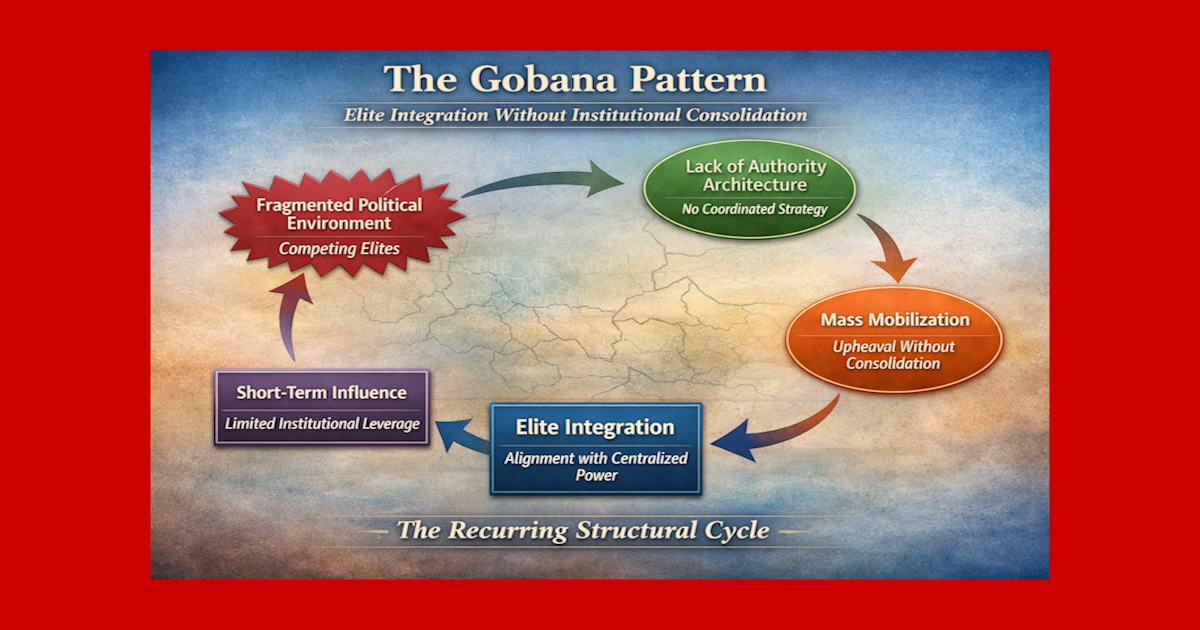
The four essays in this series collectively describe a recurring structural cycle:
Fragmentation produces elite proliferation.
The absence of authority architecture prevents coordinated strategy.
Moments of upheaval generate mobilization without institutional consolidation.
Under these conditions, external elite alignment becomes the rational pathway to influence.
The Gobana pattern represents the historical manifestation of that final stage.
Breaking this cycle requires the deliberate construction of institutions capable of assigning authority, coordinating strategy, and sustaining political legitimacy across generations.
Without such architecture, each generation will rediscover the same dilemma under different names.
With it, the cycle may finally be broken.
References
- Dereje Hawas, Oromos and the Architecture of Authority, 10 March 2026, OROMIA TODAY.
- Dereje Hawas, Oromos and the Rising Risk of Regional War: Power, Leverage, and Post-War Reality, 22 February 2026, OROMIA TODAY.
- Dereje Hawas, When a Just Cause Is Made to Fail: Oromo Fragmentation, Elite Proliferation, and the Cost of Permanent Politics, 10 February 2026, OROMIA TODAY.
- Max Weber, Economy and Society: An Outline of Interpretive Sociology (Google Books), 1978, University of California Press.
- Mohammed Hassen, The Oromo of Ethiopia, 1500–1850: With Special Emphasis on the Gibe Region (SOAS Research Online record), 1983, Mohammed Hassen.
- Vilfredo Pareto, The Mind and Society (Open Library record), 1935, Harcourt, Brace and Company (New York).
- Mahmood Mamdani, Citizen and Subject: Contemporary Africa and the Legacy of Late Colonialism, 1996, Princeton University Press.