Ethiopia Forward to the Past: The Politics of Nostalgia and the “Menelik Syndrome”
Excerpt
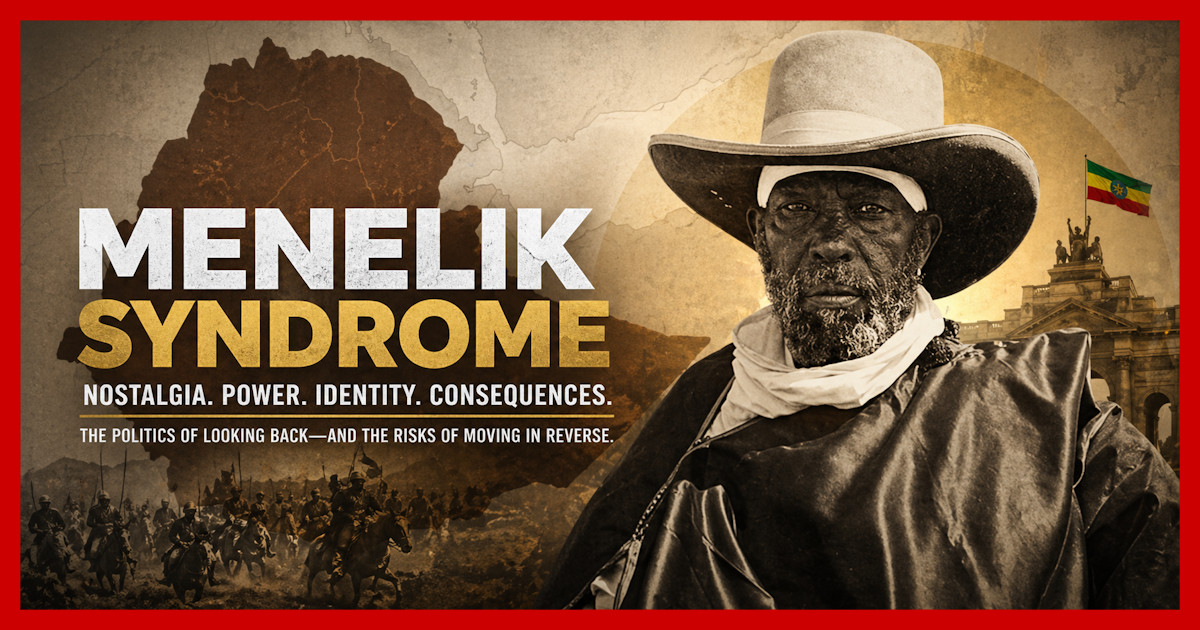
“Menelik Syndrome” captures a recurring pattern in Ethiopia’s political imagination: the selective revival of an idealized imperial past as a solution to present crises. Framed around the legacy of Menelik II, it is meant to elevate symbols of unity, strength, and state consolidation while downplaying the coercive foundations on which that unity was built. In contemporary discourse, this manifests in calls to “restore Ethiopia’s past glory”—a narrative that, for some, resonates emotionally but risks reopening unresolved historical contradictions. As a political lens, Menelik Syndrome helps explain how nostalgia, when filtered through power, can shape national identity, influence policy direction, and—paradoxically—intensify fragmentation rather than resolve it.
Abstract
In recent years, Ethiopia’s political discourse has taken on a strikingly retrospective tone. Under the leadership of Abiy Ahmed, the country has increasingly been invited to look backward—to an imagined era of unity, strength, and imperial grandeur. This narrative, often framed as a call to “Return Ethiopia to its Past Glory,” draws heavily on symbols and figures from the imperial past, most notably Menelik II. But beneath the rhetoric lies a deeper question: is this vision a path forward—or a return to unresolved historical contradictions and potential fragmentation?
The Allure of a Glorious Past
Every nation constructs myths about its past. In Ethiopia, the reign of Menelik II occupies a central place in this mythology—associated with territorial expansion, the victory at Adwa, and the subsequent consolidation of the imperial state.
Across much of Africa, however, the same historical moment—defined by the Scramble for Africa—marks the imposition of colonial rule and loss of sovereignty. Within Ethiopia’s own trajectory, this period also involved concurrent processes of internal expansion and incorporation into the Abyssinian imperial state. Against this layered backdrop, Adwa is often projected as a symbol of modern Ethiopian state exceptionalism and, more broadly, African pride.
This contrast makes the legacy not only powerful, but politically potent for some segments of society—while remaining deeply contested by others.
Abiy Ahmed’s speeches and symbolic gestures frequently tap into this reservoir of national pride. The language of unity, greatness, and restoration resonates with citizens fatigued by instability and fragmentation. Nostalgia, in this sense, becomes a unifying emotional force—a way to rally a diverse population around a shared story.
Nostalgia is seldom politically neutral—especially in contested historical contexts.
What Is “Menelik Syndrome”?
The term “Menelik Syndrome” can be understood as a political and psychological attachment to an idealized imperial past, particularly one that overlooks its coercive foundations. It is not simply admiration for history; it is the selective remembrance of history.
Menelik II’s expansion of the Abyssinian state involved conquest, assimilation, and the subjugation of various peoples—particularly in the southern and eastern regions. For communities such as the Oromo, Somali, and others, this period is remembered as dispossession, forced annexation, and assimilation.
To invoke Menelik uncritically, then, is to elevate one historical narrative while marginalizing others. It risks re-inscribing the very hierarchies and grievances that continue to shape modern Ethiopia’s political tensions.
The Problem with “Returning Ethiopia to its Past Glory”
The phrase itself carries an assumption: that Ethiopia once existed in a state of greatness that can be restored. But this raises uncomfortable questions.
Great for whom? At what cost? And can a modern, pluralistic state be built on the foundations of an imperial order?
The danger lies in mistaking symbolic unity for substantive justice. A nation cannot move forward by romanticizing a past that remains deeply contested. Doing so may temporarily inspire cohesion, but it ultimately postpones the harder work of reconciliation and structural reform.
Moreover, the focus on past glory can become a substitute for present accountability. Economic hardship, conflict, and governance challenges require forward-looking solutions. Invoking history may mobilize emotion, but it does not, on its own, resolve contemporary crises.
Selective Memory and Political Strategy
It would be naïve to view this nostalgic turn as accidental. Political leaders often use history strategically—to legitimize authority, shape identity, and consolidate power. By aligning himself with symbols of Ethiopian greatness, Abiy Ahmed positions his leadership within a lineage of strong, unifying figures.
Yet this strategy comes with risks. Ethiopia today is not the Abyssinia of the 19th century. It is more politically conscious, more demographically complex, and more attuned to issues of representation and justice. A narrative that excludes or minimizes the experiences of large segments of the population is unlikely to produce lasting stability.
Moving Forward Without Erasure
Critiquing “Menelik Syndrome” does not require rejecting Ethiopia’s history. Rather, it calls for a more honest engagement with it. A mature national identity is one that can hold complexity—acknowledging both achievement and injustice, unity and coercion.
The challenge for Ethiopia is not to abandon its past, but to transcend selective nostalgia. This means creating a political vision that is inclusive, equitable, and grounded in present realities rather than imperial memory.
The Risk of Fragmentation as an Unintended Consequence
The call to “Return Ethiopia to its Past Glory,” championed in varying forms by Abiy Ahmed, is not merely a cultural or symbolic project; it is a political strategy with real structural implications.
One of its least acknowledged risks is fragmentation, not as an explicit goal, but as a classic unintended consequence.
When Nostalgia Hardens Political Identity
A retrospective national vision tends to simplify history into a unifying narrative. But in a country like Ethiopia, where historical memory is deeply plural and often contested, simplification does not unify—it polarizes.
For those who identify with the imperial legacy of Menelik II, the rhetoric of restoration affirms pride and belonging. For others—particularly communities whose incorporation into the Abyssinian state was experienced as coercive—it can feel like a reassertion of dominance.
This asymmetry matters. When one group’s nostalgia is another group’s grievance, the political center begins to erode.
The Mechanism of Fragmentation
Fragmentation rarely begins as a demand for secession. It begins as a loss of faith in the shared project.
As the state leans into a retro-imperial narrative:
- Regional elites may perceive a threat to the federal balance.
- Marginalized groups may interpret symbolic centralization as a precursor to political and economic exclusion.
- Historical grievances—previously contained or negotiated—can resurface with renewed intensity.
In this context, anti-centrist sentiment does not emerge irrationally; it emerges as a defensive posture. The more the center invokes a singular past, the more the periphery begins to imagine alternative futures.
From Federal Tension to Secessionist Thinking
Ethiopia’s multinational federal system was, in part, designed to manage diversity by granting regions a degree of autonomy, even including the constitutional right to self-determination. While imperfect, it created a framework for coexistence.
However, when the central narrative shifts toward restoring a unitary sense of identity rooted in imperial history, it creates a perceived contradiction:
- A federal structure on paper,
- A centralizing ideology in practice.
This tension can push regional actors to reconsider the terms of their participation in the state. What begins as calls for greater autonomy can gradually evolve into discussions of independence—not necessarily because separation is preferred, but because the shared system is no longer trusted.
The Law of Unintended Consequences
There is an irony here. A project intended to strengthen national unity may, under certain conditions, accelerate its unraveling.
History offers many examples where states attempting to reassert a singular national identity inadvertently triggered fragmentation. The pattern is familiar:
- Central authority promotes a unifying historical narrative.
- Peripheral groups experience exclusion or threat.
- Identity hardens on all sides.
- Political compromise becomes more difficult.
- Fragmentation becomes thinkable—and eventually actionable.
Ethiopia may not be at the final stage of this sequence, but the early signals are visible in heightened regional assertiveness, distrust of central authority, and the normalization of previously fringe ideas about disassembly.
Can This Trajectory Be Altered?
Fragmentation is not inevitable, but it becomes more likely when narratives close rather than open political space.
A forward-looking approach would require:
- Reframing national identity as plural rather than singular,
- Acknowledging historical grievances without defensiveness,
- Strengthening federal institutions in practice, not just in form,
- Ensuring that unity is built on consent, not memory alone.
The alternative—continuing down a path of selective nostalgia—risks turning political disagreement into existential division.
Conclusion
The push to “Return Ethiopia to its Past Glory” may be intended as a unifying vision. But in a diverse and historically complex society, it carries the latent risk of fragmentation.
Not because people inherently seek separation, but because they may come to see it as the only viable response to a state that no longer feels shared.
In that sense, fragmentation would not be a deliberate choice—it would be the unattended consequence of a backward-looking political imagination in a country that cannot afford to move in reverse.
If Ethiopia is to move forward meaningfully, it must resist the temptation to treat history as a solution. The task is not to restore greatness, but to redefine it—on terms that reflect the dignity, diversity, and lived realities of all its peoples.
The risk of fragmentation must be assessed as the law of the unintended consequence. As the retro approach gains momentum, it can harden positions and motivate anti-centrists to think more of independence and disassembling.
References
- Asafa Jalata – Analysis of Oromo nationalism and historical state formation.
- Mohammed Hassen – Historical account of Oromo society and incorporation into the Ethiopian state.
- Bahru Zewde – Overview of imperial expansion and modern state formation.
- Christopher Clapham – Comparative analysis of state-building and fragmentation in the region.
- Ahmednasir M. Abdullahi, Article 39 of the Ethiopian Constitution On Secession and Self-determination: A Panacea to the Nationality Question in Africa?, Vol. 31, No. 4 (4. Quartal 1998), pp. 440-455, Law and Politics in Africa, Asia and Latin America.
- International Crisis Group, Reports on Ethiopia’s political transitions and conflict risks.
- Human Rights Watch, Documentation of conflict dynamics and governance challenges in Ethiopia.
- Elemo Qilxuu, Erasing Oromia: How a Fringe Party Exposed the Complacency and Paralysis of Oppressed Nations and Nationalities of the Ethiopian Empire, 7 December 2025, OROMIA TODAY.
- Yadessa Guma, Why Is No One Talking About the Dissolution of the Ethiopian Empire?, 20 February 2025, OROMIA TODAY.