Oromos and the Rising Risk of Regional War: Power, Leverage, and Post-War Reality

Excerpt
War is not decided by outrage, slogans, or population size, but by organization, internal consolidation, and clear political priorities. As tensions re-emerge in northern Ethiopia, Oromos face a strategic question: will they shape a potential regional war’s outcome, or be shaped by it? Demography and geography create leverage only when converted into disciplined coordination. The lessons of 1991 and 2018 show that mobilization without institutional capacity yields participation without authorship.
Why This Conversation Is Necessary
War is not a slogan. It is not a declaration shouted from podiums, nor merely an emotional rupture between political actors. War is a mechanism through which political disputes that cannot be reconciled through negotiation are forced toward resolution. In such moments, the decisive factor is rarely outrage or rhetoric. It is organization, consolidation, and clarity of political objective.
Recent reporting by Reuters [1], ACLED [2], and Human Rights Watch [3] points to renewed tensions between the federal government and northern power centers, marked by hardened rhetoric, military positioning, and the fragility of the post-war settlement in Tigray. This tension goes as far as Ethiopia's direct accusation that demands Eritrea to "immediately withdraw" troops from its territory [4]. These developments do not make war inevitable, but they underscore that the structural conditions for escalation are clear and present.
For a people whose land and political permanence remain contested, the stakes of such confrontation are not abstract.
Political instability in Ethiopia has historically reshaped not only governments, but also constitutional arrangements, regional balances of power, and long-term economic trajectories. In such moments, the most urgent question for Oromos is not which side to join. The more consequential question is whether Oromos are positioned to shape the outcome of a regional war—or risk being shaped by it.
This essay proceeds from a simple thesis: in moments of structural rupture, political authorship belongs not to the largest population or the most emotionally mobilized community, but to the actor that enters the transition internally consolidated, strategically disciplined, and clear about its non-negotiable priorities. Participation in war and influence over the post-war settlement are not the same.
History repeatedly shows that those who contribute manpower are not always those who design the new order. Post-war reality is shaped by actors who enter conflict internally consolidated, strategically coordinated, and clear about what cannot be negotiated away.
Structural Incentives and Irreconcilable Political Projects
Political confrontation in Ethiopia cannot be reduced to personalities or temporary alliances. It is rooted in competing visions of statehood. As political scholar Merera Gudina argues in his reflection [5] on Ethiopia’s nation-state-building process, successive political transitions have layered new contradictions upon old ones, leaving foundational questions of sovereignty, identity, and legitimacy unresolved.
These unresolved tensions reflect fundamentally different conceptions of state structure and political belonging. Where inclusive restructuring is deferred rather than achieved, mistrust hardens and structural tension accumulates. Instability in such an environment becomes cyclical rather than temporary.
When political visions remain structurally irreconcilable, periods of instability increase the likelihood that actors will view escalation not as recklessness but as recalibration. In deeply divided systems, war has often functioned—at enormous cost—as a means of renegotiating the political and economic architecture of the state.
The federal government’s orientation toward consolidation and centralized national coherence stands in tension with visions emphasizing durable regional autonomy and identity-based authority. Northern power centers operate under their own structural imperatives—security concerns, economic positioning, and long-term political influence [6,7]. Any post-war settlement they pursue will naturally reflect those priorities. This is not a matter of goodwill or hostility; it is a matter of incentives.
Understanding these structural incentives shifts analysis away from personalities and toward the mechanics of power.
The Oromo Structural Position: Strength Without Consolidation
If war is shaped by consolidation, then the Oromo position must be examined with clarity rather than sentiment.
Oromos possess significant demographic weight, geographic centrality, and economic importance. Oromia occupies a pivotal position within the territorial and agricultural landscape of the state. In purely material terms, this would appear to create substantial leverage.
Yet material weight alone does not produce political influence. Leverage requires organization. Organization requires cohesion. And cohesion is not merely institutional; it is psychological and strategic.
Over recent decades, Oromo political identity has experienced internal drift. While the language of self-rule and autonomy has grown more pronounced, it has not consistently translated into unified political behavior [8]. Political expression has multiplied across parties, civic platforms, and armed movements, but multiplication has not yielded consolidation. The result is a widening gap between emotional attachment to Oromummaa and coordinated strategic action in its defense.
This fragmentation has institutional consequences. Without coordinated command logic, defined red lines, and disciplined alignment, demography without consolidation does not equal leverage. Geography without coordination does not equal control.
The core vulnerability is not numerical weakness. It is the absence of disciplined consolidation during moments of transition.
The lesson is not about blame. It is about mechanics: post-war settlements are designed by those who enter transitions consolidated, not by those who enter merely numerous.
Fragmentation within Oromo politics has not emerged from cultural predisposition or an inherent inability to cooperate. It has been structurally reproduced. Successive regimes have governed through selective co-optation of elite actors, calibrated repression of independent structures, and manipulation of survival incentives. Ambitious individuals are often rewarded for alignment rather than consolidation, while independent organization is tolerated only until it threatens centralized authority. Under such conditions, unity becomes costly while fragmentation becomes adaptive. The dispersion of authority is therefore not accidental; it is environmentally reinforced.
Historical Pattern: Lessons from 1991 and 2018
Moments of national transition reward internal organization.
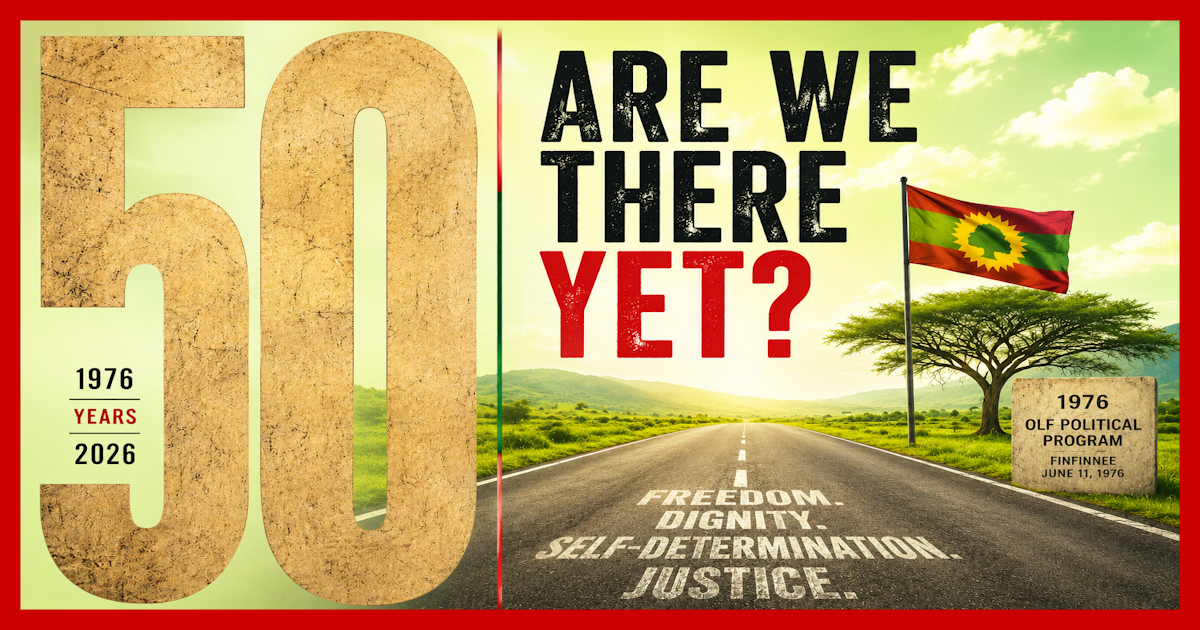
The 1991 transition illustrates this dynamic clearly. Oromos entered that historical moment demographically significant but politically underdeveloped as a consolidated national actor. The Oromo Liberation Front carried symbolic legitimacy and mobilized meaningful support, yet the broader Oromo population had not undergone sustained political socialization as a unified political force. Many educated Oromos remained integrated into dominant national structures where identity was secondary to state affiliation.
The structure of the negotiations—shaped by diplomatic considerations and prevailing military realities—constrained OLF leverage at the London Conference and in the transitional arrangements that followed.
By contrast, northern liberation movements entered the transition with embedded organizational networks, disciplined political education systems, coordinated command structures, and deep integration between leadership and society. The post-war order reflected the priorities of the most internally organized actors.
The 2014-2018 Qeerroo mobilization demonstrated immense mass energy and political awakening. It showed that Oromos could act collectively when motivated by shared grievance. Yet mass mobilization without long-term institutional consolidation does not automatically translate into structural authorship. The absence of unified command logic, coordinated political infrastructure, and a consolidated national negotiating position limited how far that moment reshaped institutional arrangements.
Recent episodes of large-scale mobilization further illustrate this distinction. Collective energy can disrupt political equilibrium, but disruption alone does not generate negotiating power. Strategic capacity emerges only when mobilization is converted into durable organizational infrastructure, policy preparation, administrative depth, and disciplined representation.
The Oromo People’s Democratic Organization (OPDO), embedded within the federal ruling coalition at the time, occupied a structurally distinct position during the 2018 uprising. Unlike decentralized Qeerroo networks, OPDO possessed administrative continuity, access to state resources, communication infrastructure, and negotiating channels within the federal system. In transitional environments, actors with institutional continuity often convert popular mobilization into bargaining leverage rather than systemic rupture.
Following the transition, segments of the mobilization network were incorporated into formal political structures, while others were marginalized or subjected to security pressure. Such differentiation is consistent with post-mobilization consolidation dynamics, where embedded institutional actors selectively absorb or neutralize decentralized leadership to stabilize authority.
The OPDO case illustrates a broader pattern: where mobilization lacks unified command and institutional architecture, actors embedded within the state enjoy structural advantages in shaping the post-transition order.
The institutional consequences of these transitions remain visible today.
The lesson is not about blame. It is about mechanics: post-war settlements are designed by those who enter transitions consolidated, not by those who enter merely numerous.
Organization Over Hardware: What Actually Decides Wars
Public debate during periods of escalation often centers on military hardware and external sponsorship—drones, artillery systems, foreign backing, and regional alliances. These factors matter, but they do not determine who shapes the political order after war.
Actors who arrive with coherent policy frameworks, institutional discipline, and unified negotiating mandates shape outcomes disproportionately.
History shows that organizational coherence can overcome material imbalance. The northern liberation movements of the late twentieth century did not begin with superior weaponry. They built resilience through sustained political education, disciplined chains of command, strategic patience, and deep societal integration.
Wars are not won solely by equipment. They are won by cohesion, morale, logistical discipline, and clarity of political objective.
Participation without consolidation risks repeating historical asymmetry: contribution without authorship.
Post-conflict political orders are rarely determined by battlefield momentum alone. They are constructed through structured negotiation processes, constitutional drafting mechanisms, administrative design committees, and technocratic preparation. Actors who arrive with coherent policy frameworks, institutional discipline, and unified negotiating mandates shape outcomes disproportionately. Participation in upheaval does not guarantee authorship of settlement. Institutional readiness does.
Conclusion: Strategic Non-Alignment and Conditional Engagement
In moments of regional war, the pressure to choose sides intensifies rapidly, often presenting alignment as urgency rather than strategy. Yet premature alignment in the absence of internal consolidation does not strengthen leverage; it dissipates it. Strategic non-alignment, in this context, is not passivity or indecision. It is a deliberate refusal to surrender political agency before priorities are clearly defined and collectively owned.
Conditional engagement is therefore essential. Any future participation in a regional war must be anchored in explicit and enforceable red lines: the protection of land, the preservation of political autonomy, the consolidation of institutional capacity, and the safeguarding of cultural permanence. These are not rhetorical aspirations to be invoked after the fact; they are preconditions for engagement. Without them, participation risks repeating a familiar pattern—sacrifice without authorship, involvement without influence. In a regional war whose outcomes will shape political order long after the fighting ends, strategic survival depends not on speed of alignment, but on clarity of purpose and discipline of action.
References
- Ethiopian Airlines cancels flights to Tigray region after clashes, 30 January 2026, Reuters.
- Jalale Getachew Birru, “Ethiopia: Fresh clashes renew fears of return to conflict: Expert Comment”, 2 February 2026, ACLED (Armed Conflict Location and Event Data).
- Allan Ngari, “Global Leaders Should Speak Out on Ethiopia Crisis: African Union Summit Crucial Opportunity to Address Protection of Civilians", 13 February 2026, Human Rights Watch.
- “Ethiopia demands Eritrea ‘immediately withdraw’ troops from its territory”, 8 February 2026, Al Jazeera.
- Merera Gudina, “Revisiting Ethiopia’s Nation State Building Processes: Challenges, Lost Opportunities”, 13 February 2026, Addis Standard.
- Olii Boran, A New Abyssinian Alliance in the Making and What it Means for Oromia,19 March 2025, OROMIA TODAY.
- OT Editorial, The Habesha Axis and the Horn's Tipping Point, 29 May 2025, OROMIA TODAY.
- Dereje Hawas, When a Just Cause Is Made to Fail: Oromo Fragmentation, Elite Proliferation, and the Cost of Permanent Politics, 10 February 2026, OROMIA TODAY.