When a Just Cause Is Made to Fail: Oromo Fragmentation, Elite Proliferation, and the Cost of Permanent Politics
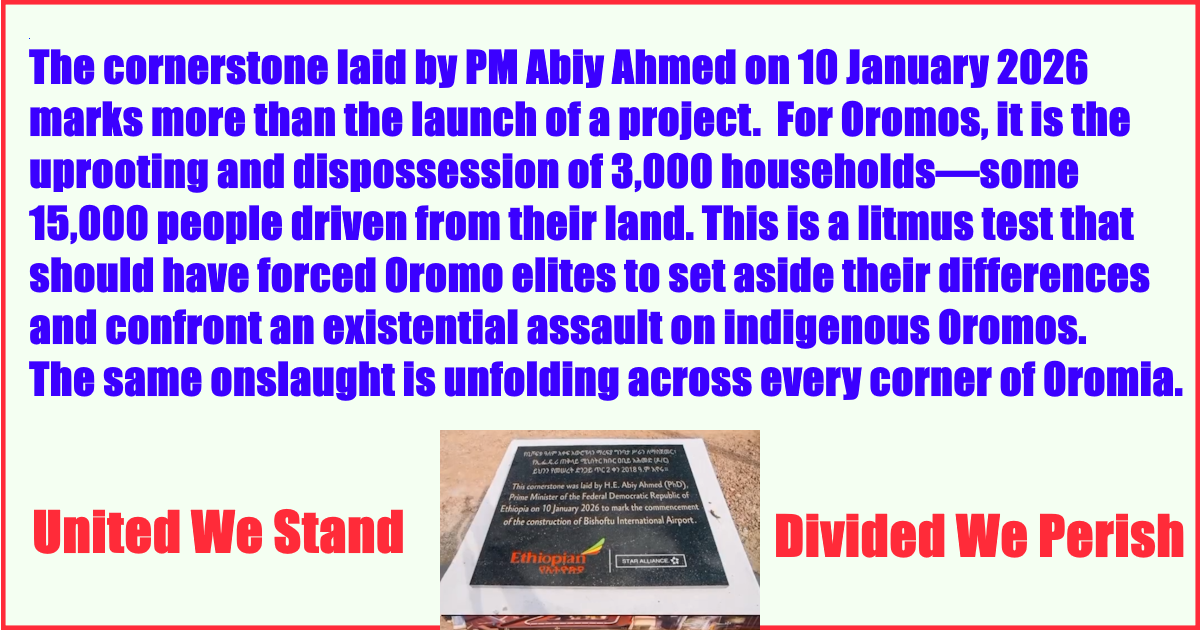
Excerpt
Oromo Fragmentation is not a sign of political maturity or ideological diversity; it is the visible cost of elite proliferation detached from existential survival. As land is taken and communities are displaced, the struggle splinters into competing parties, fronts, and narratives that drain energy without building power. Fragmentation shields elites from accountability while leaving ordinary Oromos without leverage, unity, or an effective defense against dispossession and erasure. This op-ed argues that moral unanimity must precede politics if a just cause is to survive.
1. Opening: Experience Before Theory
I am not approaching this question as a theorist or a partisan of any Oromo political faction. I am writing as someone who has seen unity work and seen fragmentation fail—not in books, but in deserts, trenches, and real movements.
As an Ethiopian soldier in the 1980s, I served in Eritrea and Tigray. I witnessed firsthand the operational strength of liberation movements such as the Eritrean People’s Liberation Front (EPLF) and the Tigray People’s Liberation Front (TPLF). Whatever one thinks of their later political outcomes, their internal structure during struggle was unmistakable: one front, one voice, one media narrative, and near-total unanimity of their base.
That unanimity was not accidental, and it was not ideological diversity masquerading as strength. It was discipline born from existential clarity.
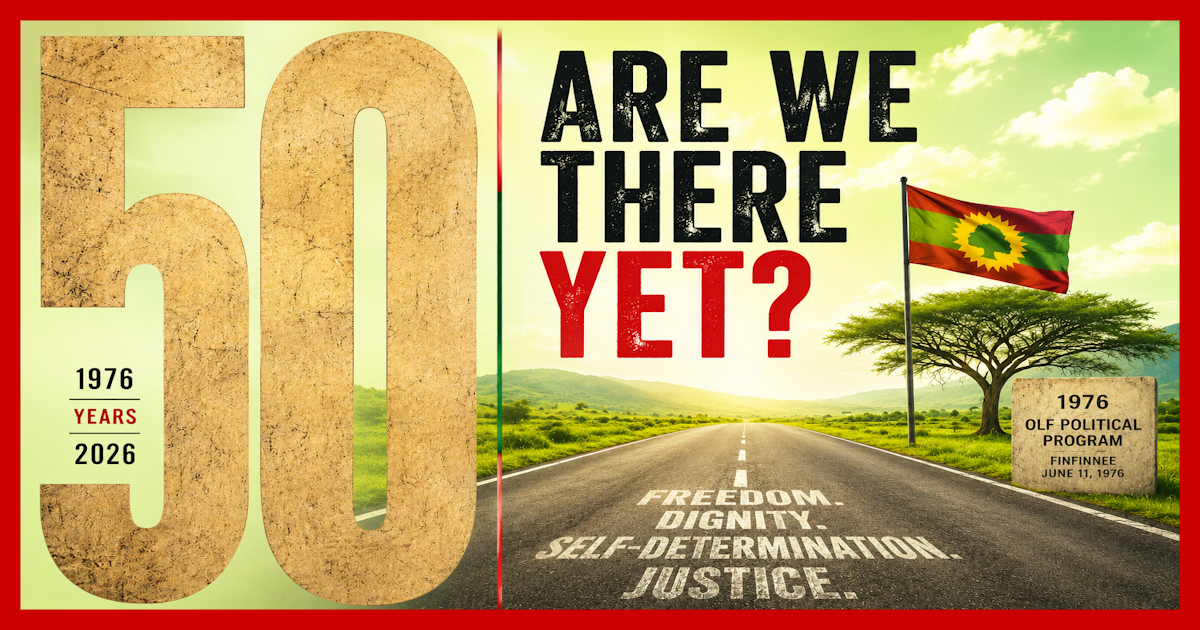
The Oromo struggle, by contrast, has endured for over half a century with immense sacrifice, yet today it has little to show in terms of consolidated power, protected land, or durable institutions. This is not due to lack of legitimacy or numbers. It is due to something far more corrosive.
2. Moral Struggles vs. Political Struggles
One of the most persistent confusions within Oromo political culture is the failure to distinguish between existential struggles and ideological struggles.
Political ideology is, by definition, plural:
- Independence vs. federalism
- Unitary vs. multinational state
- Electoral participation vs. armed resistance
These are legitimate political disagreements.
But land dispossession, forced displacement, and permanent identity erasure are not political preferences. They are existential threats.
History is unequivocal on this point. Slavery was not debated as a “policy option.” Apartheid was not treated as a constitutional nuance. Ethnic cleansing has never been resolved through ideological pluralism. These were moral crimes first, political systems second.
Politics explains how harm is executed. It does not decide whether harm is acceptable.
No ideology can unify a people against an existential threat unless that threat is first framed as morally non-negotiable.
That moral framing is not weakness. It is the foundation of unity.
3. Why Successful Resistance Requires Unanimity
Every successful resistance movement, without exception, first achieved unanimity on one thing: this cannot continue.
Only after that moral floor was established did strategy, governance, and ideology become relevant.
Unanimity does not mean the absence of disagreement. It means agreement on non-negotiables.
Moral unanimity is not synonymous with authoritarian control. It precedes power; it does not police thought. It defines what cannot be compromised, not how dissent is punished. Coercion emerges when survival is secured but unanimity is falsely extended into permanent ideological obedience.
This is why struggles against slavery, apartheid, and ethnic cleansing unified their constituencies almost completely. These causes had no doors or windows for division. One could argue about tactics, but not about legitimacy.
The Oromo land question belongs in this category. Land cannot be federalist or separatist. It cannot belong to ninety-nine parties. It cannot be debated away. Either Oromo land remains Oromo land, or Oromo existence becomes historical memory.
4. The Oromo Elite Pathology
This brings us to the most uncomfortable subject: the Oromo elite.
The Oromo political and cultural environment has produced an elite class that confuses multiplication with representation.
The result is tragic and measurable:
- One cause
- Dozens of parties
- Dozens of “fronts”
- Dozens of media outlets
- Dozens of fundraising campaigns
Ordinary Oromos—often poor, often displaced—are asked to write ninety-nine different checks to support what is essentially the same struggle, fragmented into ego-driven containers.
This critique is not a blanket indictment of every Oromo intellectual or activist, but of a dominant structural pattern in which elite fragmentation carries little cost for its architects and devastating cost for the people.
This is not pluralism. It is elite disintegration.
Fragmentation carries no cost for elites, but it carries enormous cost for the people:
- Donor fatigue
- Strategic incoherence
- Zero negotiating leverage
- Perpetual internal conflict
Over time, fragmentation becomes normalized. Unity begins to look suspicious. Moral clarity is dismissed as “emotional.” Survival instincts are reframed as “crying.”
That is how movements rot from the top.
5. Land as the Ultimate Exposure
Land Beyond Ideology
The land issue has exposed this elite failure precisely because land refuses abstraction:
- Land cannot be theorized.
- Land cannot be postponed.
- Land cannot be divided among factions.
Displacement activates a pre-political survival instinct, the same instinct that drives any living being to defend its home when escape is no longer possible. This is not ideology. It is biology.
When Culture Enforced Unity
To understand how land could become so easily abstracted today, it is necessary to recall that this was not always the Oromo condition. There was a time when land, leadership, and collective survival were culturally inseparable; when authority could not distance itself from accountability; and when social restraint enforced unity as a matter of survival rather than ideology.
History itself offers a stark counterexample to the present condition. There was a time when Oromo society produced leaders whose authority was inseparable from their accountability to the social base. Under the Gadaa system, leadership was neither permanent nor insulated. A Gadaa class governed for a fixed term, under constant social scrutiny, and with a singular obligation: the protection of Oromo land, people, and moral order.
The relationship between leadership and society was not adversarial or transactional; it was unified. Political authority rested on cultural legitimacy, and cultural legitimacy rested on performance. Leaders who failed did not hide behind ideology or factionalism. They faced collective correction.
During this period, Oromo society produced a formidable fighting force rooted not in coercion but in shared survival. Figures such as Abba Dula of the Oromo Raayyaa did not command armies detached from the people; they emerged from them. Oromo fighters went to battle not as a fragmented population, but as a society defending its land, sacred spaces, and continuity. Victory was not accidental. It was the product of unity enforced by culture.
Displacement as Cultural Rupture
That history makes the present moment impossible to dismiss as fate.
How did we arrive at a point where fleets of excavators can roll into the land of the Galaan—the elder clan of all Oromos—desecrating sacred sites, ancestral burial grounds, and farmlands that sustained Oromo life for centuries? How did it become so easy for the state to send trucks, load Aabbuu farmers like cargo, and empty entire villages without consultation, consent, or resistance?
The answer cannot be that these farmers “agreed” with a development agenda that has rendered them homeless within weeks of displacement, reduced to beggars on the streets of Bishoftu and surrounding towns. The claim of consent collapses the moment one looks at the outcome: displacement, dispossession, and cultural erasure disguised as progress.
The deeper question is moral and cultural: how did a society that once enforced unity and discipline allow itself to reach a point where its own children—educated through the sacrifices of farming parents, sent to schools and universities in Dukem, Bishoftu, Adama, Finfinnee, and elsewhere—lost not only the courage to defend their parents, but in some cases became instruments through which the state implemented this historic injustice? How did silence replace obligation, and how did proximity to power and meagre financial benefit dull the instinct to protect home?
The significance of this displacement cannot be understood without recognizing the place of the Galaan clan within Oromo history. As the angafa, the elder of the Oromo nation, the Galaan have preserved Oromo culture, rituals, customs, and religious life with remarkable continuity, surviving more than a century of systematic assimilation efforts. In many respects, they remained a living archive of Oromuma when other regions were fractured or diluted by external pressure.
The uprooting of this community therefore carries consequences beyond physical displacement. It pierces the cultural core of Oromo society, striking a place where land, identity, and collective memory remained most intact. When such a community is removed and replaced under the banner of “development,” the result is not neutral modernization but profound cultural rupture—one that accelerates assimilation not through persuasion, but through erasure.
Whether framed as policy or progress, displacement at this scale functions structurally as replacement. And replacement, when applied to a people whose identity is inseparable from land, becomes the most efficient instrument of assimilation.
Elite Silence and the Erosion of Obligation
The Oromo elite and this generation of Oromos must acknowledge that what has changed is not the centrality of land to Oromo survival, but the erosion of the cultural restraints that once made its violation unthinkable. It is this erosion that allows dispossession today to be administered as policy rather than confronted as existential rupture.
When a society no longer expects its educated sons and daughters to act as the voice and shield of their community, elite selfishness finds fertile ground. Collusion becomes conceivable. Fragmentation becomes normal. And what would once have provoked collective outrage becomes administratively routine.
Attempts to reframe this instinct as merely a “constitutional problem” or an “ideological issue” serve one purpose only: to reopen space for elite maneuvering.
When such reframing comes from perpetrators or beneficiaries of dispossession, it is understandable.
When it comes from within the oppressed community, it functions—regardless of intent—as either ignorance or betrayal.
There is no neutral ground here.
6. Comparative Lesson: EPLF and TPLF (Without Romance)
Referencing the EPLF and TPLF is not endorsement, nostalgia, or moral approval of later outcomes. It is a structural comparison.
Their strength during struggle rested on:
- Singular command logic
- Disciplined messaging
- Intolerance for factional dilution
- Absolute clarity on the existential nature of their cause
Pluralism came later—after survival and power were secured.
The Oromo elite inverted this sequence. We institutionalized pluralism before survival, and we are paying the price.
Unanimity precedes victory.
Pluralism follows it.
Never the reverse.
7. Fifty Years, and the Cost of Permanent Politics
After fifty years, the Oromo struggle faces a brutal accounting:
- No unified land protection mechanism
- No consolidated national leverage
- No durable political institution that transcends factions
What we do have is permanent politics: endless debates, endless conferences, endless media, endless fragmentation.
A just cause can still fail if it never learns to speak with one voice when it matters most.
8. Conclusion: The Choice We Avoid Naming
The Oromo people face a choice that elites often refuse to articulate:
- Establish moral unanimity on land, displacement, and identity as non-negotiable, and force politics to operate downstream of that truth
- Continue infinite ideological fragmentation and accept permanent defeat dressed up as debate
Moral unanimity does not dictate structure or leadership, but it creates the social conditions under which unified institutions, disciplined negotiation, and effective resistance become possible.
History is merciless on this question.
Oppressed peoples do not lose because their cause is unjust. They lose because they never decide what is not open for discussion.
Selected References
- GLONA Taskforce, Save the Tuulamaas and Their Ancestral Lands, 9 January 2026, OROMIA TODAY.
- OROMIA TODAY, Waayee Aabbuu Seeraa Fi Misooma Ilaalchisee, Ergaa Faarseebulaa Fi, 12 January 2026, OROMIA TODAY.
- OT Editorial, The Oromia Administration: Silence, Not Governance, 28 January 2026, OROMIA TODAY.
- OT Editorial, Aabbuu Seeraa: Building Progress on Indigenous Erasure, 30 January 2026, OROMIA TODAY.