Scramble for Africa (Berlin 1884) vs. Scramble for Oromia (Finfinnee 2026)
Excerpt
This article examines the parallels between the Scramble for Africa, formalized at the Berlin Conference of 1884, and what it argues is a contemporary Scramble for Oromia unfolding through Ethiopia's National Dialogue Conference of 2026. It compares their genesis, roadmaps, selection of participants, deliberative processes, and consequences, focusing on who has the authority to decide Oromia's territorial future, who has been excluded from that decision, and what the contest over Finfinnee and its other cities may mean for Oromia and the Ethiopian empire.
1. Genesis — the Political Project
What is presented at ENDC as a neutral dialogue process was announced, in substance, in Prime Minister Abiy Ahmed's inaugural speech — a vision of restoring Ethiopia's imperial past, drawn directly from Ethiopian Restorationist Ideologues (ERI) narratives. Amid the relief that came with the end of the EPRDF/TPLF era, few registered what it meant for a prime minister installed to lead a transition government to arrive with a dream of reviving a fallen empire.
The erasure of Oromo identity, political rights, and the right to self-determination — including the claim on Finfinnee — and the dismantling of the federal arrangement, with the abolition of Oromia at its center, were not later developments. The inaugural speech was the cover note. Everything that followed during his tenure has been the execution of it, and the erasure of Finfinnee from Oromia is one of its clauses, not a deviation from it.
That inaugural vision did not stay a speech. It had a real target — a city Oromia has never stopped claiming.
2. The Berlin Principle — Territorial Decisions Without Territorial Standing
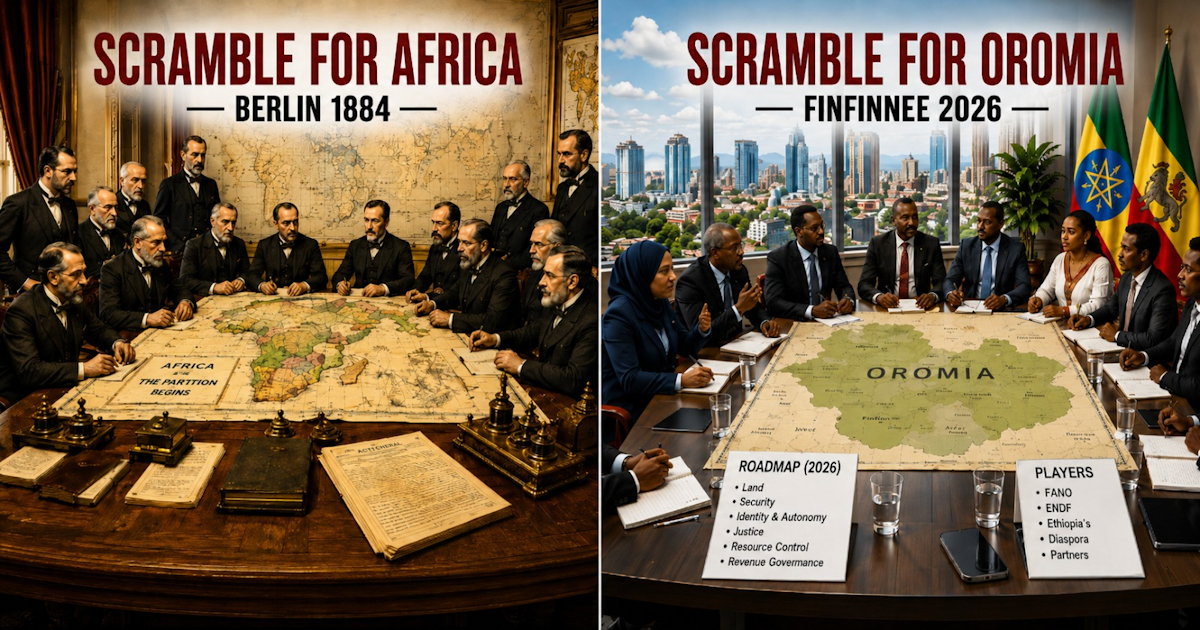
The argument here is not that Berlin in 1884 and Finfinnee in 2026 are historically identical. They plainly are not. The comparison concerns the architecture of decision-making: who claims territory, who is permitted to negotiate it, who is excluded, and how a decision made without the affected people is subsequently presented as legitimate.
Berlin convened fourteen powers that had already staked claims across Africa, or fully intended to do so, and gave them a room in which to formalize their priorities among themselves. Not a single African state, ruler, or representative was present. The mechanism was effective occupation: whoever established administrative control first legally got to keep it.
Underwriting the entire proceeding was an unspoken legal fiction — that the continent being divided was, in the eyes of its dividers, Terra Nullius: "land belonging to no one" with standing to object, however many nations, kingdoms, and peoples lived on it. The conference did not start the scramble — it arrived after the scramble was already underway, and its function was to ratify what had already been seized, converting a land grab into a treaty, with the silence of the dispossessed treated as consent.
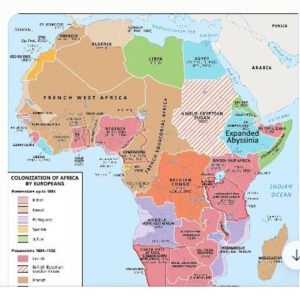
Berlin needed no manufactured crisis — the land was already held before the room convened. ENDC needed one first.
ENDC runs the same roadmap in reverse and reproduces the same fiction. Its membership seats Fanno's political wing, ERI-aligned Prosperity Party members, and the leaders of every ethnic faction pressing a border claim against Oromia. It does not seat the Oromo Liberation Army, the Oromo Liberation Front, the Oromo Federalist Congress, or any of the civic and Gadaa institutions that constitute Oromia's actual political and customary authority.
Oromia's future is being decided in a room built specifically to exclude the institutions Oromia itself would send to defend it — which is Terra Nullius in practice, if not in name: a region treated as available for other states, militias, and factions to draw claims across, precisely because the bodies with standing to refuse were never invited to the table where refusal would matter.
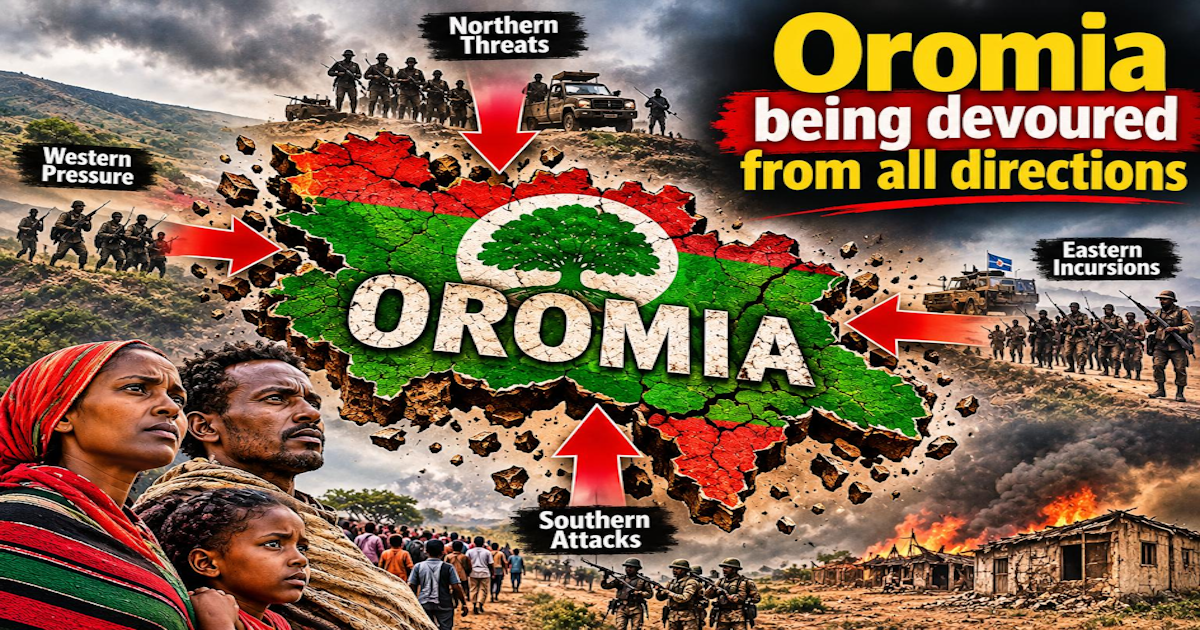
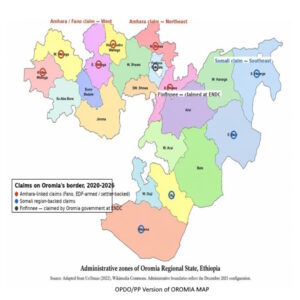
While Berlin's powers arrived holding territory and negotiating who kept what, ENDC's architects had to manufacture the territorial dispute first. In the west, ENDF resources armed and financed Fanno militia in East Wollega, Kiramu, Angar Gutu, and Horro Guduru, displacing over 300,000 residents and leaving Fanno in occupation of fertile Oromia land. In central Oromia, Amhara settlers and local Fanno were encouraged to claim Fantale, Dhara, and surrounding villages, displacing their populations.
In the east, armed forces financed and backed by the Somali regional government sustained a parallel pattern of confrontation along Oromia's border. In the southeast and south, the central government encouraged fresh claims on Moyale, the Dawa zone, Cinaqisen, Elkere, Madaa Waalaabu, and Baabiilee, while Sidama pressed its own regular border claims with PP government backing. In the southwest, trained militias based in Benishangul-Gumuz raided Oromia villages across the border.
Every direction on the compass produced its own engineered flashpoint, and the same government's cabinet convened the commission that would later sit the architects of each conflict down to “resolve” a crisis manufactured for that purpose. But the manufacturing works only because the absence is already assumed: land that no legitimate Oromo authority is in the room to defend is land available for others to carve up, from every direction at once.
The process converges on the same result by different roads: a map redrawn by outsiders, ratified by a body that excludes the people whose land is being redrawn, and dressed in language — free trade and civilization in 1884, national dialogue and unity in 2026 — that has nothing to do with what the process actually does.
Berlin's partition is a history Africa still lives with. Oromia's partition, if ENDC proceeds, is only the beginning — a beginning that may carry unintended consequences for everyone seated at that table, not only for Oromia.
3. Finfinnee and Dirre Dhawaa — the Principal Cases at Scramble for Oromia
Finfinnee was Oromo land before it was Addis Ababa. The city was built on territory seized during Menelik II's imperial conquest and made the seat of an empire that displaced the Oromo population on whose land it stood — a fact the 1995 Constitution itself concedes.
Article 49 recognizes Addis Ababa as the federal capital while simultaneously entitling Oromia to a “special interest” in it, covering social services, the use of natural resources, and joint administrative matters — a constitutional acknowledgment that the capital's relationship with Oromia was never fully settled and was never meant to be foreclosed. That special interest has never been legislated into meaningful form. It exists on paper as a promise deferred, not a right exercised.
Finfinnee is not the only city built this way. Dirre Dhawaa and other Oromo cities carry the same wound, in different locations.
Dirre Dhawaa carries a parallel history. Built as a railway town during the same imperial expansion, on land taken from Oromo communities, it was later settled by Somali populations brought in gradually to displace and dilute the Oromo presence — a demographic engineering exercise aimed at undermining Oromia's claim to the city. It was then carved out as a federally chartered city administered outside Oromia's jurisdiction — a second capital-sized exception to the federal map, its Oromo character eroded by design and its administration withheld by the same design. Both cities function today as islands excised from the territories that surround them, administered by the center, claimed by the periphery, and left permanently unresolved by design.
Both cities remain open questions on paper. ENDC now proposes to close both of them for good.
ENDC's agenda item on Finfinnee is not an offer to finally legislate Article 49's promise. It is the opposite: a mechanism to close the claim permanently, using a body that excludes Oromia's own institutions to decide a question the Constitution left open specifically because it could not be decided without them.
4. The Wider Scramble for Oromia — Borders and Dirre Dhawaa
The establishment of ENDC was among the first decisions made by Abiy Ahmed's cabinet. The justification for a national dialogue was manufactured through the initiation of ethnic and cross-ethnic conflict along the federal borders, with border disputes collected afterward as the platform for “resolving” what had been deliberately started. These conflicts were concentrated along Oromia's borders.
Several of the flashpoints were financed and armed directly by the Ethiopian National Defense Force: the ENDF armed and financed the Amhara militia known as Fanno in East Wollega, Kiramu, Angur Gutu, and Horo Guduru, displacing over 300,000 Oromo residents over five years and leaving Fanno in occupation of fertile Oromia territory. In 2025, the central government encouraged fresh claims on Moyale and the Dawa zone in southern Oromia, alongside Cinaqisen, Elkere, Madaa Waalaabu, and Babile — a constant and recurring set of flashpoints.
Along Oromia's eastern border, armed forces financed and backed by the Somali regional government maintain a parallel pattern of confrontation. In the south, Sidama's regular claims against Oromia have proceeded with PP government backing. In the southwest, trained militias based in Benishangul-Gumuz raid Oromia villages across the border. In central Oromia, Amhara settlers and local Fanno have been encouraged to claim Fantalle, Dharra, and a number of surrounding villages, displacing their residents.
Through all of this, the president of the Oromia regional government and its officers — commanding their own militia, police, and security apparatus — have not once condemned Fanno's actions, Somali regional expansion, or any of the other claims pressed on Oromia's territory. No fund has been raised and no relief campaign mounted for the over two million displaced from Cinaqisen near Jijiga, nor for the more than 300,000 displaced from Horo Guduru and Kiramu, nor for those driven from East Wollega, Elkere, Moyale, and the Dawa zone — displacements that, in most cases, continue to this day with no resolution and no accounting.
The same government that has not named a single perpetrator and has not funded a single relief effort for its own displaced population has nonetheless submitted an agenda item to ENDC: the role of the Oromia state and its claims on Finfinnee.
A map makes this pattern easier to see than any list of place names can.
ENDC's membership is a fifth column by design.
5. Who Is at the Table, and Who Is Missing?
Fanno is waging armed territorial claims in northeastern, central, and western Oromia even as its political wing sits inside the commission meant to resolve the conflict it is fighting.
The fifth column proper is inside the Prosperity Party itself: PP members who hold the ERI vision are not merely seated at ENDC; they are its architects — the spearheads who developed the commission and now lead its proceedings, shaping the agenda to fit the same Restorationist vision Abiy Ahmed planted in his inaugural speech.
Around them sit every ERI-aligned party accommodated within PP's parliament, as well as the leaders of the ethnic factions on the opposite side of every border conflict listed above.
The commission is chaired by the architect and writer of Abiy Ahmed's own Ethiopia roadmap.
The territorial fight is not the only front here. A second one runs entirely online.
A second agenda run by the same PP fifth column operates through algorithmic amplification rather than armed occupation. Using AI-driven content networks, ERI insiders within the party promote the claim that Abiy Ahmed is Oromo and that the PP government is, by extension, an Oromo government. The claim is a double-edged knife.
To non-Amhara ERI sympathizers, it recasts eight years of federal dismantlement and mass atrocity as something other than what it is — work attributable to “an Oromo government” rather than to the Restorationist project actually driving it. What Abiy Ahmed has actually done, repeatedly and in public, is the reverse: he has characterized Oromo nationalism itself — in particular, the political priorities of the Oromo Liberation Front — as a weakness in Oromo politics, an outdated and out-of-time agenda that undermines the Oromo national quest rather than serving it.
This framing simultaneously strips credit from the thousands of Oromo youth, the Qeerroo, whose struggle actually overthrew the EPRDF and opened the path to his own premiership, recasting their sacrifice as an obstacle to the “unity” his government demands rather than the foundation on which his office was built. The myth of Abiy as Oromo champion and the public dismissal of Oromo nationalism are not contradictory positions — they are the same maneuver from two directions, both of which end with Oromo political agency subordinated to his own.
A crisis engineered from within does not end on its own. It ends when its engineer decides it has served its purpose.
6. From 14 Powers to 4,000 Discussants — Numbers Without Mandate
The most conspicuous difference between Berlin and ENDC is numerical. Berlin gathered fourteen foreign powers around the table; ENDC has assembled roughly 4,000 discussants and presents that scale of participation as evidence of national inclusion. But numbers answer only the question of how many people participated. They do not answer the more important question: what authority do those participants possess to decide the rights, identity, and territory of a people?
Participation is not the same as representation, and representation is not the same as mandate. A consultative body may legitimately gather thousands of citizens to debate matters of common national concern. That numerical breadth does not, by itself, confer authority to determine the territorial status of Oromia, dispose of its claim on Finfinnee, redraw its boundaries, or extinguish constitutional rights belonging to nations and peoples.
This distinction becomes particularly important when the institutions with the clearest political standing on the affected side are absent. The Oromo Liberation Front, Oromo Federalist Congress, Oromo Liberation Army, and independent Oromo civic and Gadaa institutions are not participating as parties capable of defending Oromia's territorial and constitutional position. Yet organizations and political interests associated with competing territorial claims are represented in or around the process. Increasing the number of discussants does not correct that asymmetry. A larger room cannot compensate for the absence of those whose standing matters most to the question being decided.
Representation is not measured by how many people occupy the room, but by whether those whose rights and territory are being decided have legitimate standing in it.
This is where the comparison with Berlin becomes especially instructive. The fundamental defect of the Berlin Conference was not that fourteen was too small a number. Adding another hundred European delegates would not have made the partition of Africa more legitimate. The defect was one of standing: those dividing the territory were present; those whose territory was being divided were not.
The same principle applies in reverse to ENDC. Four thousand is obviously a much larger number than fourteen, but multiplication cannot create a mandate that the participants did not possess individually or collectively. If the question concerns Oromia's territorial integrity, its constitutional status, or its relationship with Finfinnee, an external majority cannot transform itself into the rights-holder merely by becoming numerically large.
Nor can such questions properly be reduced to an ordinary majority vote. Fifty percent plus one may be an appropriate rule for choosing between competing candidates, passing ordinary legislation, or deciding matters within the legitimate authority of an electorate. It is a fundamentally different proposition to use the same arithmetic to determine the identity, territorial rights, or constitutional existence of a people. A majority may choose a government. It cannot simply vote another people's homeland away.
This is why the figure of 4,000 can be simultaneously impressive and constitutionally beside the point. The relevant question is not whether ENDC assembled enough people to fill a conference hall, nor whether a majority among them can be produced for a particular recommendation. The question is whether the body itself possesses a legitimate mandate to decide matters that properly belong to the people and institutions whose constitutional and territorial rights are at stake.
The danger arises when consultation is converted into authorization after the fact: thousands are consulted, their recommendations are aggregated, and the resulting numerical weight is then invoked as though it constituted popular sovereignty. A selected national dialogue can advise, expose disagreements, identify grievances, and recommend avenues toward settlement. It cannot acquire constituent authority merely by declaring its recommendations national.
On questions of identity and territory, a larger number does not cure the absence of mandate. On a flawed premise, it merely produces a larger mistake.
Fourteen powers could not acquire legitimate authority over Africa by agreeing among themselves in Berlin. Four thousand discussants cannot acquire authority over Oromia merely by reaching agreement in Finfinnee. In both cases, the decisive question remains unchanged across 142 years: who has standing to decide?
7. Consequences for Oromia and the Empire at Large
Berlin's consequences did not end when the conference adjourned. The significance of the decisions taken there lay in what they authorized afterward: territorial acquisition, boundary-making, administrative control, and the conversion of decisions made without Africans into political realities Africans were subsequently forced to live with. The danger posed by ENDC must be assessed in the same way — not merely by what is said inside the conference hall, but by what authority may later be claimed in its name.
If recommendations emerging from ENDC are subsequently presented as an expression of national consensus, the process creates a route by which questions that presently enjoy constitutional protection can be reopened as though they had already received popular authorization. Oromia's relationship with Finfinnee, the territorial configuration of the federal states, and constitutional provisions protecting the rights of nations, nationalities and peoples could then move from matters requiring their own legitimate constitutional processes to matters portrayed as having been settled beforehand by “the national dialogue.”
ENDC does not itself possess legislative or constituent power. But it does not need such power if its political function is to supply legitimacy to institutions that do.
That distinction is crucial. ENDC does not itself possess legislative or constituent power. But it does not need such power if its political function is to supply legitimacy to institutions that do. A recommendation produced by thousands of discussants can be carried into parliament not merely as a proposal, but as something bearing the rhetorical weight of a national mandate. Parliament would still perform the formal act; ENDC would have supplied the claim that “the people” had already spoken.
The danger is not that a dialogue commission can rewrite the Constitution by itself. It is that others may rewrite it while claiming the commission supplied the consent.
This is where the distinction developed in the previous section — between participation, representation, and mandate — becomes consequential. If a body lacking territorial standing is nevertheless treated as representative of the whole country, its recommendations can become the political foundation for decisions it had no authority to make directly.
For Oromia, the consequences could be profound. A recommendation concerning Finfinnee could be invoked to foreclose the unresolved constitutional claim embodied in Article 49(5). Recommendations concerning federal restructuring could provide political cover for weakening or dismantling the present nationality-based federal arrangement. Proposals affecting Articles 39 and 49 could similarly be presented not as initiatives originating from the ruling party, but as demands emerging from a national consultative process.
The same concern extends beyond Oromia. Once the principle is accepted that a selected national body may confer legitimacy on decisions affecting the territorial status, constitutional identity, or self-government of a particular people without that people's specific mandate, no federal state is insulated from the precedent. A mechanism employed against Oromia today could become the mechanism through which another region's boundaries, constitutional status, or political rights are reconsidered tomorrow.
The question of presidential government belongs in this same category. If ENDC recommends replacing the present parliamentary system with a presidential one, the proposal may subsequently be advanced as a nationally generated reform rather than a political project of the government that convened the process. Whether such a change ultimately occurs remains to be seen. What matters here is the mechanism by which a recommendation from a consultative body may be transformed into the appearance of prior popular authorization.
This is why the Scramble for Oromia has consequences for the Ethiopian empire at large. The immediate territorial stakes may fall disproportionately on Oromia, but the institutional precedent is national: consultation becomes mandate, recommendation becomes authorization, and numerical participation becomes a substitute for the consent of those whose rights are directly affected.
Berlin offers the warning precisely because its lasting significance lay not merely in who sat around the table, but in what followed from treating their agreement as sufficient authority to act. The parallel does not require ENDC to possess Berlin's colonial power, nor does it require the two processes to produce identical outcomes. It requires only that decisions made without adequate standing be carried forward by institutions capable of turning them into political fact.
Fourteen powers could not make partition legitimate by agreeing among themselves. Four thousand discussants cannot make dispossession legitimate by recommending it. The danger begins when institutions with actual power pretend that either agreement constitutes consent.
The Scramble for Oromia would therefore not be completed inside the conference hall. It would be completed only if recommendations produced there are subsequently used to redraw territory, diminish constitutional protections, or restructure the federation without the specific consent of the peoples whose rights are being altered. Until then, these remain possible outcomes. But the institutional road by which they could be reached is precisely what demands scrutiny now.
8. Conclusion — You Cannot Manufacture Consent
Berlin and Finfinnee are separated by nearly a century and a half, but they share the same design: a room built to include everyone with a claim to press and no one with standing to refuse. What Berlin did to a continent, ENDC proposes to do to a region — manufacture the crisis, convene the loyal, and call the result consent. Oromia's future, like Africa's before it, is being decided by people who do not have to live with the consequences. That asymmetry, not the language of dialogue and unity dressing it up, is what this article has set out to show.
References
- OT Editorial Team, Ethiopian Restorationist Ideologues (ERI), 15 August 2026, OROMIA TODAY.
- Federal Foreign Office of Germany, Political Archive. (1885/2024). General Act of the Berlin West Africa Conference, 26 February 1885.
- Federal Foreign Office of Germany. (2024). Recognizing colonial injustice, strengthening trust: 140 years since the Berlin West Africa Conference.
- Federal Democratic Republic of Ethiopia. (1995). Constitution of the Federal Democratic Republic of Ethiopia, Article 49(5).
- Ethiopian National Dialogue Commission. (2026). Major Agenda Pillars of the Ethiopian National Dialogue.
- Ethiopian National Dialogue Commission. (6 July 2026). National Dialogue Forum Preparations Enter Final Stage as Commission Confirms Readiness.
- Ethiopian National Dialogue Commission. (6 August 2026). Update on the Progress of the Ethiopian National Dialogue Conference.
- Addis Standard. (24 January 2022). Over 60 Oromo organizations call for a credible and inclusive national dialogue and neutral convener.
- Addis Standard. (14 February 2022). Ethiopian Political Parties Joint Council requests Parliament to temporarily halt National Dialogue commissioners' selection and resume the process in an inclusive and trustworthy manner.
- The New Humanitarian. (18 April 2022). Ethiopia launches a national dialogue, but divisions run deep.
- Addis Standard. (18 February 2025). Parliament extends National Dialogue Commission's mandate by one year amid criticism over inclusivity.
- Addis Standard. (July 2026). Ethiopia's National Dialogue Forum opens amid criticism from opposition parties.
- Addis Standard. (22 July 2026). Opposition coalition, OLF-OLA dismiss National Dialogue as a “mock process”, call for unified front against government.
- United Nations Development Programme (UNDP). (2025). Mid-Term Evaluation of the Support to an Inclusive and Effective National Dialogue Process in Ethiopia Project, September 2022–August 2025.
- Human Rights Watch. (2022). Ethiopia's Other Conflict.
- Human Rights Watch. (2026). World Report 2026: Ethiopia.
- Amnesty International. (2026). Ethiopia: Authorities must investigate sexual violence, summary killings and torture by OLA fighters.
- United Nations Ethiopia. (2025). Youth in Action for Peace: Ethiopia marks International Day of Peace.
- Ue3lman. (2022). Oromia Zones map. Wikimedia Commons. Creative Commons Attribution 4.0 International (CC BY 4.0).
- Middle East Eye. (15 April 2026). Exclusive: The Ethiopian army base covertly supporting Sudan's RSF.
- Reuters, reported via DW and The New Arab. (February 2026). Ethiopia hosts secret camp to train RSF fighters, with UAE backing.
- The National. (12 February 2026). UAE rejects report alleging support for RSF training camp in Ethiopia.
- The Africa Report. (6 February 2026). Is Ethiopia's Abiy helping RSF in Sudan's civil war?
- Africa Center for Strategic Studies. (17 June 2024). Domestic Disinformation on the Rise in Africa.
- MultiFactCheck. (21 November 2025). AI-Generated Video Claims Yemen Warned Oromo Ethiopians.