The Policy of Lying: How Power Is Sustained by Fabrication

Excerpt
Ethiopia has crossed a moral and political threshold. Lying is no longer an occasional deviation but a governing method. From the fabricated pretext of the Tigray war to the attempted rewriting of Eritrea’s role—publicly rebutted by Gedu Andargachew—the pattern is unmistakable. When power substitutes for truth, institutions collapse, Parliament applauds falsehood, and citizens are conditioned to accept governance without reality. This is not political spin; it is rule by fabrication.
Lying as Governance, Not Deviation
There comes a moment in the life of a nation when lying is no longer a flaw of leadership but its operating system. Ethiopia, not as a nation, rather as an empire, has crossed that line.
What we are witnessing is not a sequence of political misstatements, nor the familiar evasions of power under pressure. It is something far more corrosive: the systematic substitution of truth with assertion, delivered from the highest office of the state and normalized by institutions that have abandoned their constitutional duty.
This is not lying as deviation. It is lying as governance.
In ordinary politics, lies are defensive. They are told sparingly, often clumsily, and usually under duress, almost certainly with consequences. Here, the opposite is true. Truth is no longer something to be aligned with. Truth is something to be replaced.
Falsehoods are delivered publicly, confidently, repeatedly, and at length. They are wrapped in sermons, moral lectures, emotional appeals, and even at sacred venues when addressing parliament. They are not whispered; they are proclaimed.
The leader does not ask: Is this believable? Will this be disproven? He instead asks: Can I say this while standing in power? Can I force others to react to my version instead of theirs? If yes, then the lie has already succeeded, even if everyone knows it’s a lie.
There is a mistake analysts repeatedly make when interpreting Abiy Ahmed: they assume belief. Ideology. Vision. Reformism. Even malice rooted in conviction. There is none.
What governs Abiy Ahmed’s actions is not belief but power calculus. And lying is not incidental to this calculus—it is central to it. Not as spin, not as exaggeration, but as policy.
This is deliberate. When a leader governs by lying, the objective is not persuasion but domination—to condition institutions and citizens alike to accept that reality itself is negotiable. Once truth is no longer binding, power becomes unconstrained.
The Eritrea Lie: A Scandal That Should Have Ended a Premiership
Nowhere is this clearer than in Abiy Ahmed’s handling of Eritrea’s role in the Tigray war of 2020-2022.
It is a matter of public record—documented by survivors, journalists, human rights organizations, and governments [1,2]—that Eritrean forces fought alongside Ethiopian federal forces throughout the war, committing atrocities on a massive scale. Eritrea’s involvement was not incidental. It was invited.
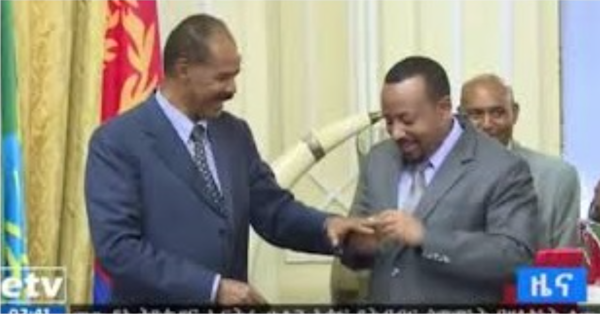
In any functioning democracy, that invitation alone—bringing a foreign army into a civil war against one’s own population—would trigger parliamentary inquiries, resignations, and criminal investigations.
Instead, Abiy Ahmed sat before Parliament and told what can only be described as the lie of the century [3].
This was not a matter of interpretation or emphasis. It was a fabrication. Eritrean troops were present, embedded, and operational throughout the Tigray war—at the direct invitation of Prime Minister Abiy Ahmed. The TPLF served as the common nemesis: for Abiy Ahmed, a main rival power center threatening his yet-to-be-consolidated rule; for President Isayas Afewerki, a long-standing enemy born of the bitter 1998–2000 war that claimed the lives of an estimated 100,000 people [4].
The irony is historic. The same conflict dynamic—briefly recast as “peace”—had earlier earned Abiy Ahmed the Nobel Peace Prize, only for that veneer to collapse into a war prosecuted jointly with Eritrea against the people of Tigray.
Their involvement was systematic. Their atrocities were widely reported. The United States repeatedly demanded Eritrea’s withdrawal [1,2]. This is not contested history. Yet the Prime Minister spoke as if the Tigray war itself could be rewritten by assertion alone.
When Poking the Swamp for Fish, Produces a Python: “ኣሳ ጎርጉዋሪ ዘንዶ ያወጣል”
The Prime Minister claimed that he dispatched several “peace envoys” to Eritrea—including Ato Gedu Andargachew, on at least two occasions—carrying a message to Shabiya (the Eritrean regime of Isayas Afewerki) urging it “not to trouble my Tigrayan people, not to loot their property, and to make a clear distinction that the issue is with the TPLF and not the civilian population of Tigray".
He further asserted that these envoys, wherever they may now be, could attest to this account for the sake of their conscience and faith, and he additionally named Ato Demeke Mekonnen, Gedu’s successor, as part of the same purported peace mission.
In naming Gedu Andargachew as a witness, the Prime Minister appeared to assume what unchecked power often assumes: silence, submission, or ambiguity.
Gedu Andargachew—alive, in exile, and speaking freely—responded with an open letter that dismantled the Prime Minister’s claims with precision [5].
He stated unequivocally that he was not sent to Eritrea with such a message, that Eritrean forces were deeply involved in the Tigray war, even as further into the Amhara region, and that the Prime Minister’s account to Parliament was false.
This was not opposition rhetoric. It was a factual rebuttal from the very individual invoked as proof. The swamp poked for a fish, instead, produced a python, as well articulated in the Ethio Forum DocuNews on this very topic [6].
In any functioning democracy, such a contradiction—public, documented, and direct—would trigger an immediate crisis of legitimacy. Parliamentary inquiries would follow. Accountability would be unavoidable. Resignation would be expected.
In Ethiopia, Parliament applauded and moved on. That silence is not neutral. It is enabling.
Parliament and the Collapse of Accountability
A lie of this magnitude cannot survive without institutional surrender. Parliament is constitutionally mandated to scrutinize power, demand evidence, and protect the public interest. When it instead responds to demonstrable falsehoods with applause, it ceases to function as a legislature and becomes a stage.
This is how governance decays: representatives know they are being lied to, they choose compliance over duty, and citizens internalize powerlessness. Over time, people stop expecting truth—not because they believe the lies, but because they no longer believe lying has consequences.
The Manufactured Pretext for the Tigray War
The Eritrea lie is not an isolated incident. It belongs to a wider architecture of deception that predates the Tigray war itself.
The Tigray war was publicly justified as a defensive response to an alleged attack on the Ethiopian National Defense Forces. This narrative was repeated relentlessly and used to legitimize one of the most destructive conflicts in modern Ethiopian history.
Yet Obbo Taye Danda’a—a senior ruling party figure and cabinet member at the time—later revealed a radically different account with numerous other criminal revelations [7,8, 9,10,11,12,13,14]. According to him, Prime Minister Abiy Ahmed personally admitted to his inner circle that the Tigray war was launched on a false pretext, deliberately manufactured to justify a preplanned campaign.
For revealing this, Taye Danda’a is now serving a seven-year prison sentence—conveniently under an unrelated pretext.
If this account is true—with no credible evidence to the contrary—the implications are grave: the Tigray war was not defensive but premeditated. In any society governed by law, such a revelation would trigger criminal investigations and national reckoning.
In Ethiopia, the truth-teller is imprisoned, and the architect of the lie governs on.
This inversion—where truth is punished and falsehood rewarded—is not accidental. It is the logic of rule by fabrication.
A Moral Wake-Up
The greatest danger is not that leaders lie. The danger is that lies are told without consequence.
When a regime learns it can fabricate the origins of the Tigray war, rewrite atrocities, invoke false witnesses, and face parliamentary applause rather than accountability, lying becomes normalized. Governance becomes theatrical. Reality becomes optional.
We issue a challenge to our readers. Listen carefully to the full parliamentary Q&A session, which in practice devolved into an extended monologue [15,16]. Then ask a simple question: what percentage of the statements made by the Prime Minister are actually true or factually correct?
Examine, in particular, the sweeping and often absurd claims about Ethiopia’s global and continental standing in skills, medicine, technology, project management, and other sectors. When measured against verifiable evidence, many of these assertions unravel.
This is not exaggeration or optimism; it is lying delivered as policy.
Colonizing the Future Through Lies
Note very carefully how, through persistent lying, Abiy Ahmed inserts himself into the future. A subtle psychological conditioning is at play here.
Grand projections are repeatedly announced—GDP soaring to fantastical levels, Ethiopia becoming one of the world’s leading economies, even to second position in not too distant future, and many other similar claims like this—claims offered without credible pathways, institutional foundations, or empirical grounding. No demonstrated causal chain is offered between current realities—conflict, prevailing abject poverty, abysmal depreciation of local currency, institutional decay, capital flight, diminishing foreign direct investment, aid suspension, etc—and the promised economic leap. Repetition does the work of evidence.
Over time, citizens accustomed to hearing such proclamations begin to visualize the future with Abiy Ahmed already embedded in it.
The lie ceases to function as prediction and becomes a tool of political permanence, colonizing the future so thoroughly that imagining national progress without Abiy Ahmed starts to feel inconceivable.
Abiy Ahmed as an Exception
Abiy Ahmed has proved himself to be an exception to a rule that restrains most politicians. Even habitual liars tend to self-limit, inhibited by fear of exposure, reputational damage, or self-debasement. Excessive lying usually carries a cost.
Abiy Ahmed, however, has inverted that logic. He does not merely tolerate falsehood; he deploys it instrumentally. Lies are delivered expansively, repeatedly, and without embarrassment—often as extended lectures at any venue—because the usual restraints no longer apply. Where other politicians lie defensively, Abiy Ahmed lies offensively, testing how far assertion can replace reality.
The absence of consequences has transformed lying from a risk into a governing tool, revealing a mode of rule in which self-debasement is no longer a deterrent but an acceptable price for consolidating power.
And Here is Where the Danger Lies...
Modern democracies—however imperfect—are built on the assumption that falsehood, once exposed, carries consequence. When lying is normalized, applauded, and left unchallenged, governance itself is corroded.
What we are witnessing is not an accidental drift but a governing method. The policy of lying has become one of the central pillars sustaining power of the PP regime under Abiy Ahmed, and unless citizens refuse to accept governance without truth, that pillar will continue to hold—at the expense of accountability, dignity, and democratic life itself.
Citizens cannot outsource conscience to institutions that no longer function. Silence in the face of blatant lying is not neutrality; it is participation.
A society that accepts governance without truth eventually loses the ability to recognize justice, responsibility, or dignity.
The question is no longer whether the lie has been exposed—it has—but why it is still told, again and again, as if truth were irrelevant.
The question is whether citizens will accept a future where power, not truth, decides what is real. That decision belongs not to leaders alone, but to all who live under them.
Public representatives, civic leaders, and citizens alike ignore such warnings at their own peril.
References
- Faisal Ali, US urges Eritrean troops to withdraw from Ethiopia's Tigray region, 12 December, 2020.
- Ethiopia's Tigray crisis: US calls for Eritrea troops to withdraw, 27 January 2021, BBC.
- “የቀይ ባሕር ጉዳይ አይደለም ችግር የፈጠረው”, 3 February 2026, Fana TV Channel, YouTube.
- Eritrean–Ethiopian War of 1998-2000, Wikipedia.
- To PM Abiy Ahmed ( By Gedu Andargachew), 5 February 2026, BORKENA.COM.
- የገዱ ምላሽና አዲስ ምስጢር ፤ ‘ሻዕቢያ ደብረታቦርም ገብቷል’, 5 February 2026, Ethio Forum Channel, YouTube.
- OT Editorial, The Fearless Obbo Taye Danda'a Arado Intervews, 15 June 2025, OROMIA TODAY.
- Part 1 Interview, Turtii Addaa Taayyee Danda'aa Waliin: Kutaa 1ffaa, 10 Jun 2025, Horn Conversation Channel, YouTube.
- Part 2 Interview, Turtii Addaa Taayyee Danda'aa Waliin: Kutaa 2ffaa, 11 Jun 2025, Horn Conversation Channel, YouTube.
- Part 3 Interview, Turtii Addaa Taayyee Danda'aa Waliin: Kutaa 3ffaa, 12 Jun 2025, Horn Conversation Channel, YouTube.
- Part 4 Interview, Turtii Addaa Taayyee Danda'aa Waliin: Kutaa 4ffaa fi isa Xumuraa, 13 Jun 2025, Horn Conversation Channel, YouTube.
- Obbo Taye Danda'a's BBC Afan Oromo Interview - English Translation Transcript, 10 December 2023, OROMIA TODAY.
- Part 1 of 2 BBC Afan Oromo Interview, 7 December 2023, BBC Afan Oromo.
- Part 2 of 2 BBC Afan Oromo Interview, 8 December 2023, BBC Afan Oromo.
- ጠቅላይ ሚኒስትር ዐቢይ አሕመድ (ዶ/ር) የተገኙበት የፓርላማ ውሎ (ክፍል 1), 3 February 2026, Fana TV Channel, YouTube.
- ጠቅላይ ሚኒስትር ዐቢይ አሕመድ (ዶ/ር) የተገኙበት የፓርላማ ውሎ (ክፍል 2), 3 February 2026, Fana TV Channel, YouTube.