What Should OLA Do Today if Article 39 is to be Rescinded Tomorrow? Reserving Today the Right That May be Rescinded Tomorrow
Overview
If PM Abiy Ahmed uses a disputed electoral mandate and a distrusted dialogue process of the ENDC to dismantle multinational federalism, the result may be constitutional rupture rather than constitutional reform.
Ethiopia’s deepest problem is not excessive recognition of diversity, but the absence of a trusted compact among its peoples. Replacing multinational federalism with geographic provinces would be read by many communities not as modernisation, but as restoration: the return of the imperial state through technocratic language.
That is why the move could accelerate, not prevent, disintegration. Article 39 may be disliked by Ethiopian unitarists, but even as a nominal right it has served as a pressure-release mechanism. Remove it without consensus, and those who relied on it may conclude that the legal door is closing and that their rights must be asserted before the lock is changed.
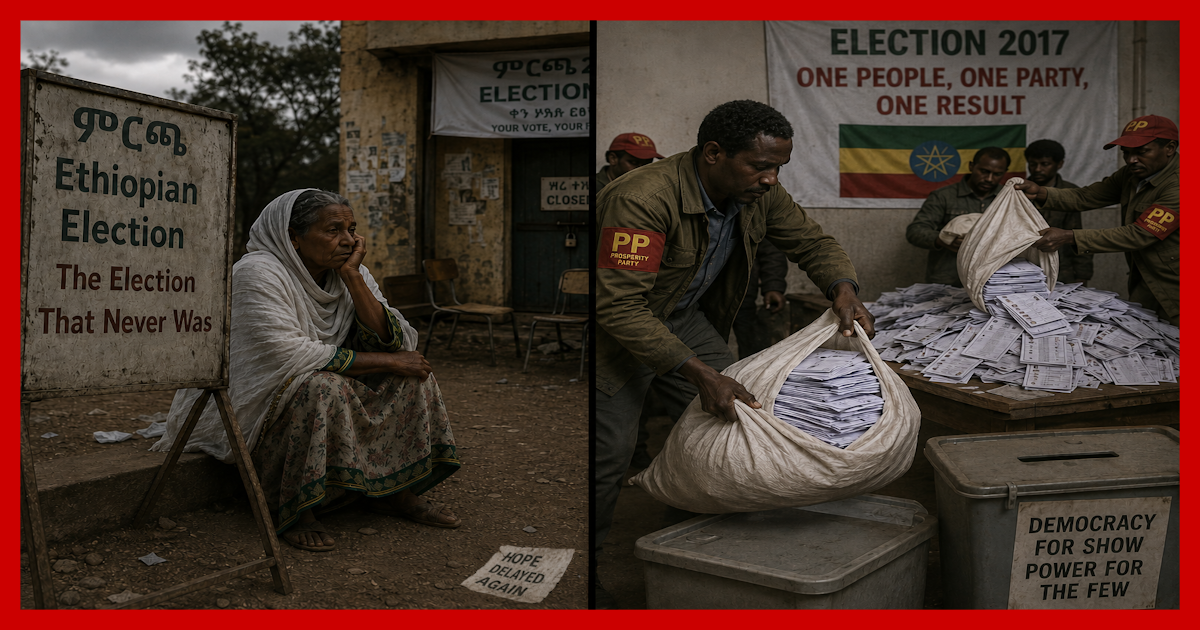
Ethiopia may be approaching a constitutional moment disguised as an electoral aftermath. If the 2026 election is used to legitimise the dismantling of multinational federalism, the state will not be curing its fragmentation; it may be formalising the conditions for it.
Reserving Todays Right for Tomorrow
The underlying principle is fairly simple:
When a constitutional or legal entitlement is believed to be under imminent threat of repeal, its holders may seek formally to assert, invoke, preserve, or reserve that entitlement before the repeal takes effect.
Lawyers sometimes describe this in terms of vested rights, accrued rights, preservation of claims, or intertemporal law—that is, determining which legal regime governs a right when the governing framework changes.
Historical Analogies
1. The dissolution of the USSR (strongest analogy)
Dissolution of the Soviet Union: The Soviet Constitution contained provisions recognizing a republic's right to secede.
As the Soviet Union weakened, republics did not wait for Moscow to redefine or remove those provisions.
They declared sovereignty, asserted constitutional rights, and moved toward independence while the constitutional framework still existed.
The Baltic republics provide perhaps the clearest example. They effectively argued:
The right exists today. Its future availability is uncertain. Therefore we exercise or preserve it now.
This is not identical to Ethiopia because they actually moved toward independence, rather than merely reserving a future option. But the logic is comparable.
2. Montenegro before independence
Montenegrin independence referendum: Montenegro acted while the constitutional avenue remained available. The argument was essentially:
We proceed under the current constitutional order before it is fundamentally altered.
Again, not exactly the same, but the timing rationale resembles the Oromo self-determination scenario as framed herein.
3. Quebec and constitutional bargaining
Quebec sovereignty movement: Quebec repeatedly emphasized that constitutional arrangements are bargains among constituent peoples.
Political actors occasionally suggested that if the bargain were fundamentally rewritten without consent, claims based on the prior compact could survive politically and morally. Courts, however, stopped short of endorsing a unilateral legal entitlement.
4. Eritrea
Eritrean independence referendum: Eritrea is less useful legally because its independence emerged from war, negotiated settlement, and international recognition.
Still, one can argue that political actors sought to crystallize their claim before alternative constitutional arrangements could foreclose it.
The Legal Theory
A lawyer would probably avoid saying:
"We declare independence because Article 39 may disappear."
That sounds speculative. Instead, they might argue as follow.
Concise Formulation
The constitutional right presently exists and forms part of the foundational compact upon which the federal order rests.
Public proposals aimed at rescinding or substantially impairing that right create legitimate uncertainty regarding its continued availability.
Accordingly, the affected people reserve and formally assert their constitutional entitlement while it remains operative, without prejudice to its future exercise through the procedures prescribed by the Constitution.
That wording is intentionally cautious. It does not exercise the right. It preserves it.
A Stronger Formulation
Constitutional rights cannot be extinguished retroactively after their holders have formally asserted or invoked them under the legal regime in force at the time.
The subsequent repeal of the enabling provision cannot invalidate actions lawfully initiated prior to repeal unless the repealing instrument expressly provides otherwise and itself satisfies requirements of constitutional legitimacy.
That is the kind of argument constitutional lawyers might test. Whether a court would accept it is another matter.
The Practical Problem
The difficulty in Ethiopia is institutional.
Who adjudicates such a dispute?
The federal judiciary is limited in constitutional interpretation.
Under the 1995 Constitution, constitutional disputes ultimately involve the House of Federation advised by the Council of Constitutional Inquiry.
If opponents regard those institutions as politically aligned, then the question becomes less legal and more political.
In that environment, a declaration may function less as a courtroom pleading and more as:
- a constitutional notice;
- a preservation of claims;
- a political signal;
- an appeal to domestic constituencies;
- an appeal to future negotiations;
- an appeal to international audiences.
A Short Attorney-style Statement
The right of self-determination embodied in Article 39 constitutes a substantive constitutional guarantee forming part of the federal compact.
In light of publicly articulated proposals seeking its repeal or diminution, the Oromo People hereby reserve, affirm, and preserve all rights presently available under Article 39, including those relating to self-determination and constitutional status.
Such reservation is made while the constitutional provision remains in force and shall not be construed as a waiver, abandonment, or forfeiture of rights arising thereunder.
That is probably the most concise legal expression. Whether it would succeed legally is uncertain.
Whether it could become politically significant is much easier to imagine.