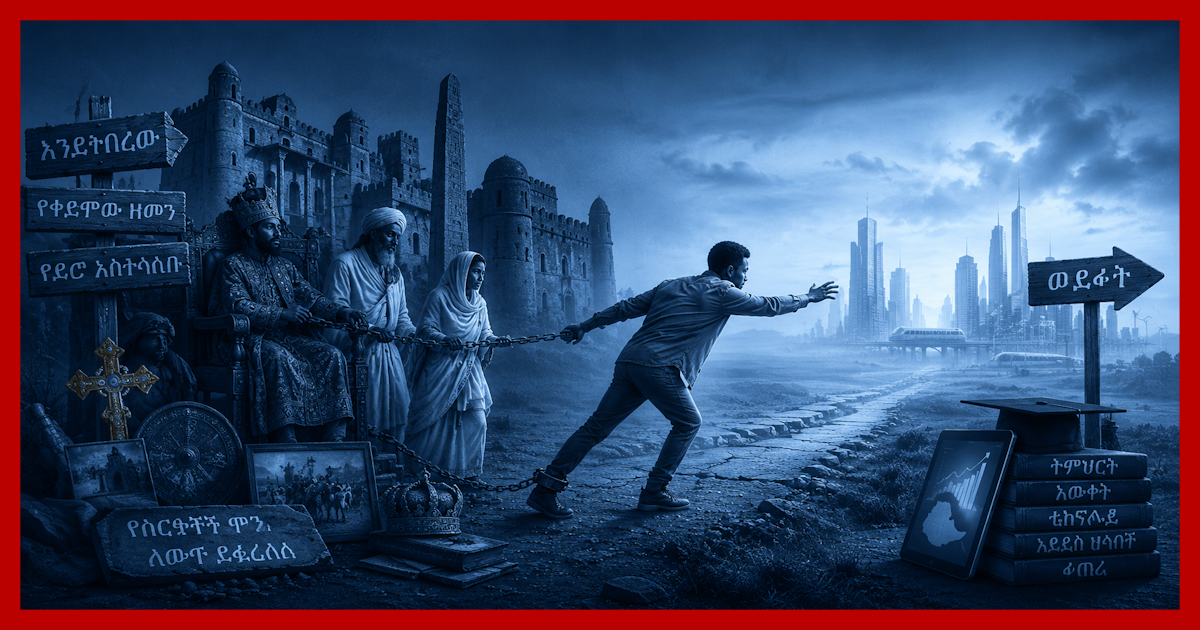
The Election of the Wheat Sheaf An Election Already Decided Before the Ballots Are Cast?
Excerpt
As Ethiopia approaches the 2026 election, questions increasingly shift from who will win to whether meaningful electoral conditions exist at all. With large territories remaining outside normal voting conditions, state machinery openly intertwined with campaigning, and outcomes widely presumed in advance, the election raises deeper questions about democratic legitimacy and political ritual. In what some critics describe as the modern election of the wheat sheaf, the central issue is no longer competition among alternatives, but whether the process serves genuine choice, predetermined confirmation, or merely the optics of electoral continuity.
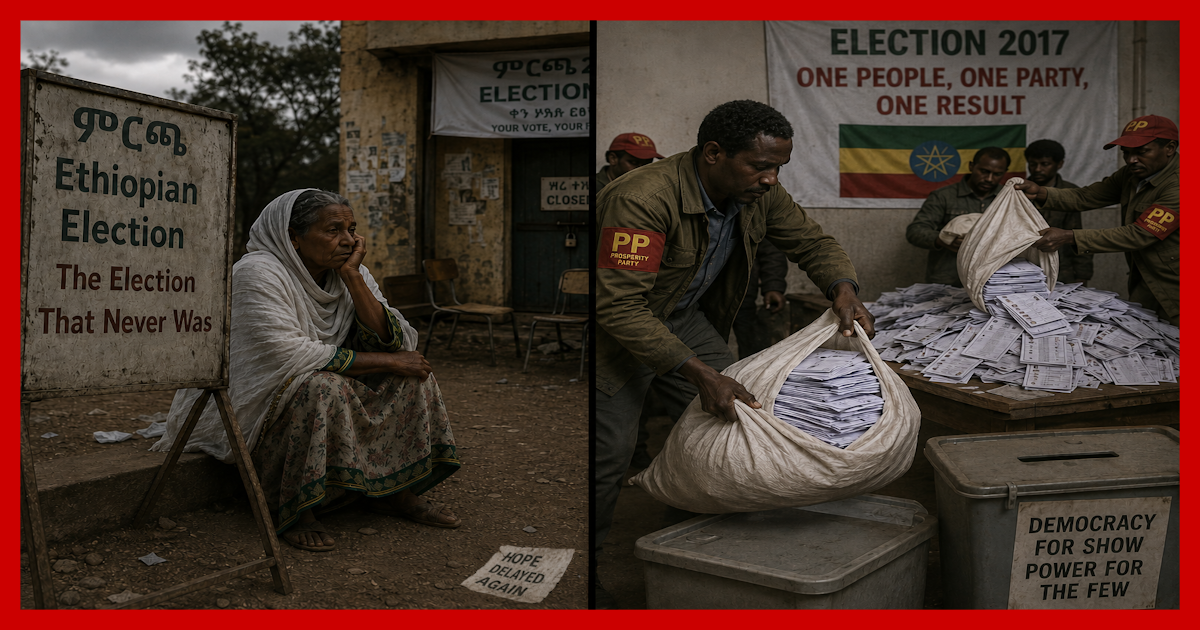
The Old Woman Who Understood the Whole Election
The old woman spoke quietly.
There was no anger in her voice. No theatrical outrage. Only the calm resignation of someone who had lived long enough to watch history repeat itself in different clothes.
“We attended the meeting,” she said. “They told us to vote for the wheat sheaf. That should be easy because there are no other signs.”
Those nearby laughed. Not because the statement was humorous. Because it felt painfully true.
An Election That May Not Even Exist in Much of the Country
The election was only days away.
Yet, across large parts of Ethiopia, people increasingly spoke not about who might win but whether an election was even taking place in any meaningful sense.
In many localities of western Oromia, residents reportedly say they have been openly told there will effectively be no election. Similar sentiments emerge from parts of southern and eastern Oromia.
All of Tigray — viewed by many observers as a de facto quasi-independent entity following years of conflict and political divergence — and large parts of the Amhara region also remain outside normal electoral conditions.
- Conflict zones.
- Administrative disruption.
- Security uncertainty.
Areas where normal political activity itself has become difficult.
A National Vote Without National Conditions
The irony is difficult to ignore.
The country is preparing for a national election while substantial territories appear unable to participate under ordinary electoral conditions.
Eight weeks earlier, critics had already outlined seven reasons why no credible electoral process could emerge under such circumstances [1,2]. Their argument was blunt: even a staged election requires minimum conditions to stage the illusion convincingly, and those conditions themselves no longer exist.
- Yet the campaign continues.
- The theater continues.
- The choreography continues.
And thus another question begins to emerge:
- Why?
- Why bother at all?
Beyond Domestic Critics: What External Observers Are Saying
Concerns regarding the credibility of Ethiopia's 2026 election are not confined to opposition voices, political activists, or ordinary citizens. A number of foreign policy institutes, research organizations, and human-rights groups have also raised questions about the conditions under which the election is taking place.
While these organizations differ in emphasis and perspective, their assessments reveal striking areas of convergence.
The Nordic Africa Institute (NAI), in its analysis "Ethiopia Elections Put National Fault Lines in the Spotlight" [3], argues that full electoral participation is unlikely to be possible in Tigray, Amhara, and significant parts of Oromia. Rather than asking whether an election can be held, the analysis suggests that the more relevant question is how much of the country can realistically participate under prevailing conditions.
Chatham House, in "Ethiopia Needs More Than an Election to Calm Internal and Regional Conflict" [4], presents a broader policy assessment. It argues that the 2026 vote may be among the least competitive elections held since 1991 and cautions that elections conducted amid unresolved conflict can deepen political fragmentation rather than strengthen legitimacy.
Similarly, Africa Practice, in "Ethiopia's 2026 Electoral Dilemma" [5], questions whether a genuinely national election is possible under current circumstances. Its analysis suggests that electoral participation may in practice be concentrated in relatively stable areas, potentially leaving millions of citizens excluded from meaningful participation.
The human-rights dimension has also received considerable attention. In a joint statement titled "Ethiopia: Civic Space and Security at Risk Ahead of the 7th General Election", FIDH and OMCT [6] argue that an election cannot reasonably be regarded as fully credible where armed conflict, intimidation, restrictions on civic space, and pressure on journalists and civil-society actors continue to persist.
Policy Magazine, in its article "Redefining Free and Fair: Ethiopia's Election and Electoral Legitimacy" [7], examines the very meaning of electoral credibility in circumstances where participation is uneven and state authority itself is contested across parts of the country.
A Remarkable Degree of Convergence
Although these analyses originate from different institutions and employ different methodologies, they converge on a common observation.
The central issue is not merely whether polling stations open on election day.
The deeper question is whether the election can genuinely be described as national, inclusive, and representative.
Across these assessments, a recurring concern is that insecurity and conflict in Tigray, Amhara, and parts of Oromia make comprehensive participation unrealistic. If substantial portions of the population cannot participate under ordinary electoral conditions, the election's claim to broad democratic legitimacy becomes inherently more difficult to sustain.
Election Observation and Its Limits
Regional organizations have nevertheless proceeded with election observation efforts.
The Intergovernmental Authority on Development (IGAD [8] has deployed an election observation mission ahead of the 1 June 2026 vote, while the African Union Election Observation Mission [9] has similarly arrived to monitor the process.
Their presence reflects the regional significance of the election and the attention it continues to receive across Africa.
Yet observation missions, however important, cannot by themselves resolve the underlying challenge identified by many analysts: the exclusion of large populations arising from conflict, insecurity, and uneven political conditions.
Observers may evaluate what occurs where voting takes place.
They cannot easily measure the democratic significance of those who, for one reason or another, are unable to participate at all.
Campaigning Without Persuasion
Officially, what is happening is called campaigning.
Yet increasingly little resembles campaigning in its ordinary democratic meaning.
- Campaigning suggests persuasion.
- Competing manifestos.
- Rival visions.
- Political debate.
- Citizens weighing alternatives.
But in locality after locality, a different pattern appears to be unfolding exclusive to the ruling party.
- Markets reportedly pause.
- Roads are diverted.
- Public gatherings are assembled.
- Citizens are instructed to attend.
The Civic Liturgy of the Wheat Sheaf
Party operatives stand before crowds asking ritualized questions.
“What sign are you voting for?”
The crowd responds: “The wheat sheaf!”
“What date are you voting for the wheat sheaf?”
Again, comes the collective answer. The exchange repeats. Over and over. Until it begins to resemble less a political campaign and more a civic liturgy.
The Threat That Does Not Need Explanation
Then comes the warning.
“We know how to find out if you do not vote correctly; You have been warned.”
Nobody explains how. They do not need to. Fear often works most effectively when left undefined.
The Harvest of Compliance
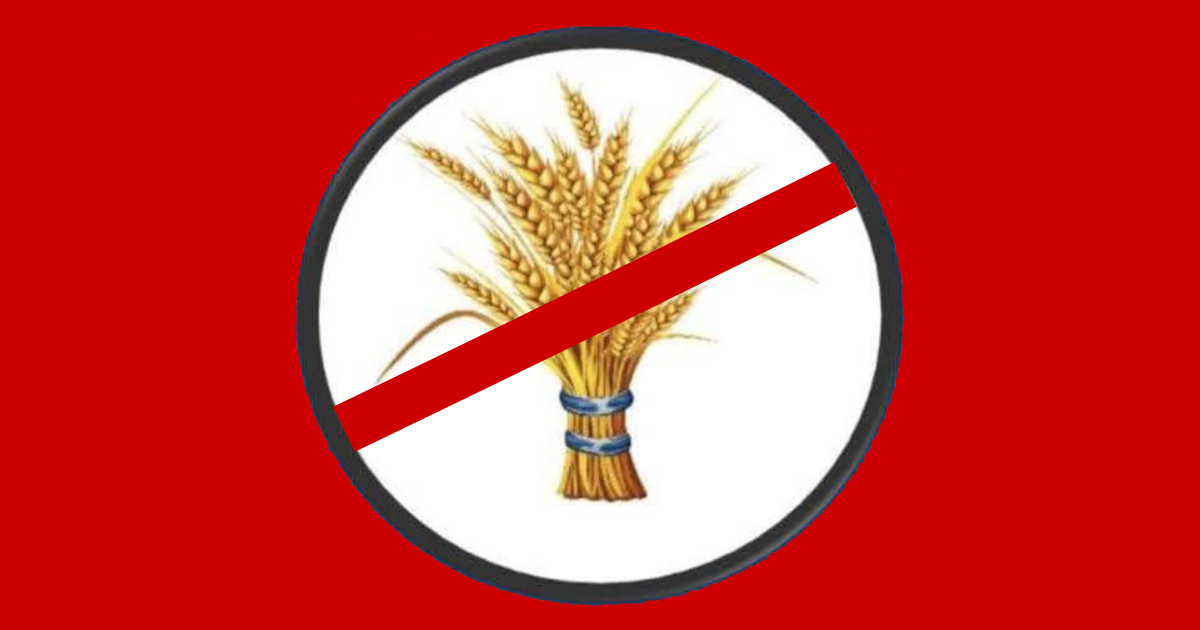
The Wheat Sheaf — Nadoo Qamadii— የስንዴ ነዶ — symbol of the ruling Prosperity Party — carries imagery associated with abundance, harvest, productivity, and prosperity.
Yet another harvest seems to be taking place beneath the symbolism. The harvesting of compliance. The cultivation of inevitability.
Citizens repeatedly exposed to one answer until alternatives slowly disappear from public imagination.
“There Are No Other Signs”
The old woman’s observation suddenly acquires deeper meaning: “There are no other signs.”
Perhaps she was not merely referring to the ballot paper. Perhaps she meant something larger.
No visible alternatives. No equivalent presence. No competing machinery. No equal organizational reach. No comparable access to state infrastructure.
A Race Where Only One Runner Has the State
How could opposition parties possibly compete? For the Prosperity Party, on the other hand, there is no distinction between a political party and ruling regime.
- The distinction between state and campaign increasingly appears blurred.
- Government structures seem to function as campaign logistics.
- The race began long before others reached the stadium.
- No opposition party possesses state apparatus available to the Prosperity Party.
- No opposition party has administrative chain reaching villages as the Prosperity Party does.
- No opposition party has government vehicles as the Prosperity Party does.
- No opposition party has local bureaucracy, paid for by taxpayers, as the Prosperity Party does.
- No opposition party has ability to halt markets as the Prosperity Party does.
- No opposition party has authority to divert roads as the Prosperity Party does.
- No opposition party has capacity to summon entire communities as the Prosperity Party does.
Yet even if such glaring structural inequalities were somehow corrected, a deeper problem would remain unresolved as the mechanisms necessary to guarantee genuinely fair electoral outcomes simply do not exist..
The Operational Machinery Behind the Outcome
Beyond the visible asymmetry between the ruling party and its challengers, numerous allegations and troubling accounts have circulated from various localities regarding how the electoral process itself has allegedly been operationalized long before voting day.
Some observers remarked that these developments deserved equal attention because they reveal not merely an uneven playing field, but the underlying mechanics through which electoral outcomes are perceived to be shaped in advance.
A frequently cited concern relates to access to fertilizer, an indispensable agricultural input upon which rural livelihoods depend. In some localities, farmers reportedly complained that fertilizer distribution became intertwined with voter registration and broader electoral mobilization efforts. Whether formally stated or merely implied, critics argue that such practices create a powerful perception that access to essential services is contingent upon political compliance. For vulnerable farming communities, the message need not be spoken explicitly; the fear that withholding support for the ruling party could carry practical consequences is often sufficient to exert pressure.
Particularly disturbing are also repeated accounts emerging from rural communities — especially in parts of Oromia — involving elderly men and women, many regarded as less educated or unfamiliar with electoral procedures.
According to multiple accounts, some were explicitly told:
“Do not worry. We will vote on your behalf. Just place your signature here.”
In many cases, that “signature” reportedly meant little more than a fingerprint placed in ink.
Such practices were allegedly carried out particularly among frail elderly citizens who may neither fully understand the electoral process nor feel able to challenge local authorities.
There were also widespread complaints regarding voter registration anomalies.
Allegations included individuals obtaining more than one voter registration card, irregularities in voter rolls, and intense pressure placed on local electoral structures to meet numerical registration targets.
Particularly alarming were claims that underage school children were being encouraged or pressured into registration activities in order to artificially inflate voter numbers and influence local electoral arithmetic.
For many observers, the obvious question naturally follows:
If the outcome is already widely presumed, why push manipulation to such extraordinary lengths?
Another recurring allegation concerns the proliferation of what critics describe as “pseudo-opposition parties.”
These organizations formally appear as independent political actors and participate in media campaigns, yet many citizens reportedly perceive them as little more than extensions of the ruling establishment operating under different names and symbols.
Critics argue that such parties serve several purposes simultaneously:
- creating the appearance of political pluralism,
- fragmenting opposition votes, and
- ensuring that even nominal electoral competition ultimately remains within the orbit of the ruling party itself.
Some allegations go even further.
According to various political observers and commentators, certain opposition-like parties are allegedly facilitated, protected, and quietly accommodated in areas where the Prosperity Party itself may choose not to compete directly, including in parts of the capital.
Whether fully accurate or not, such perceptions have deepened public cynicism regarding the authenticity of the broader political process.
The scale of campaign spending has also become a major source of controversy.
Many citizens openly question how a poor country facing profound economic hardship could witness such extravagant political expenditure.
To ordinary Ethiopians struggling with inflation, unemployment, and rising living costs, the campaign increasingly appears less like a democratic exercise and more like a massive state-sponsored political operation financed, directly or indirectly, by public resources [10].
For many citizens, these are not merely isolated irregularities.
They are viewed as interconnected components of a much larger system designed not to discover the will of the people, but to manufacture the appearance of it.
The Compromised Referee
When discussing campaign asymmetries, voter-registration anomalies, intimidation, misuse of public resources, or the many other concerns raised throughout this article, we should not lose sight of the largest elephant in the room: the institution ultimately entrusted with administering, supervising, and certifying the election itself.
For many critics, that institution is the National Election Board of Ethiopia (NEBE).
The concern is not merely about individual decisions or isolated administrative shortcomings. Rather, it is the broader perception that the Board operates under conditions that compromise its independence and leave it vulnerable to influence from the ruling establishment.
Its leadership and senior officials are widely perceived by critics as products of a political process ultimately controlled by the incumbent regime. As a result, many citizens and opposition actors do not regard the institution as sufficiently independent from the government whose continued tenure it is tasked with overseeing.
This raises a fundamental question.
If the referee itself is not widely trusted to act independently, can confidence in the match ever truly exist?
In mature democracies, electoral commissions derive their legitimacy not merely from legal mandates but from broad public confidence that they stand above partisan interests. Where such confidence is absent, every stage of the electoral process—from voter registration to campaigning, voting, counting, dispute resolution, and final certification—becomes vulnerable to suspicion and dispute.
Ultimately, therefore, the issue extends far beyond individual irregularities. It concerns the credibility of the entire institutional architecture responsible for safeguarding the electoral process.
In an entrenched autocratic system, where institutions are often perceived as serving power rather than constraining it, genuinely independent oversight becomes exceedingly difficult.
Under such circumstances, the mechanisms necessary to guarantee broadly trusted and genuinely fair electoral outcomes are not merely weakened; many would argue they are absent altogether.
For all practical purposes, this raises an uncomfortable question: at what point does a formally multi-party system cease to function as one?
When one party alone commands the machinery of the state, dominates the administrative structure from the national level down to the village, enjoys overwhelming access to public resources, faces no genuinely independent institutional oversight, and enters elections whose outcomes are widely perceived as predetermined, the distinction between a multi-party system and a de facto single-party state becomes increasingly difficult to discern.
Opposition parties may continue to exist on paper. Their names may appear on ballot papers. Their representatives may participate in debates and campaigns. Yet if they possess no realistic pathway to power, their existence serves more to preserve the appearance of political competition than to provide its substance.
In that sense, the central question facing Ethiopia may no longer be whether it formally permits multiple parties. The more consequential question is whether its political system still allows a genuine possibility of alternation of power through the ballot box.
Why Campaign When Victory Is Presumed?
And yet the larger paradox remains. If victory is already assured, why campaign at all?
If the outcome is already known, why mobilize so aggressively?
- Why the urgency?
- Why the assemblies?
- Why the repeated messaging?
- Why the spectacle?
When Elections Become Displays of Power
One possible answer is uncomfortable. Perhaps elections in such systems serve a purpose different from choosing leaders.
- Perhaps they exist to display power.
- The objective is not uncertainty.
- It is demonstration.
- The election ceases to be a contest and becomes affirmation.
- Participation itself becomes evidence.
- Attendance becomes symbolism.
- Visibility becomes legitimacy.
The performance matters more than competition. The ritual matters more than persuasion.
Religion Drawn Into the Electoral Theater
The optics increasingly drift into the surreal. Religious institutions appear drawn into the process. Reports emerge of faith communities being told to pray for the success of the ruling establishment [11].
Images circulate of Orthodox clergy displaying umbrellas bearing ruling party insignia. Politics and sacred symbolism begin occupying the same visual frame.
- Even seasoned observers pause.
- The images feel jarring.
- Cringe-inducing.
- Difficult to reconcile with contemporary democratic norms.
One almost imagines future historians encountering such photographs and assuming satire. Yet they are real. Reality itself has become surreal.
The Result Before the Vote
The election day has not yet arrived with only days to go to 1st of June 2026. Yet many already speak as though it has already happened.
Voting merely awaits administrative execution. The result precedes the process. The destination exists before the journey. The script appears written before actors enter the stage.
Citizens will still queue. Ballots will still be cast. Boxes will still be counted. Announcements will still be made. Perhaps observers will still arrive. Perhaps foreign journalists will still report.
Is the Performance Meant for Foreign Eyes?
But another question now hangs over everything.
- Is this exercise partly intended for them?
- For foreign media?
- For diplomatic audiences?
- For external validation?
- To preserve the optics of electoral continuity?
- To maintain the language of democratic process?
- To demonstrate procedural normality despite extraordinary conditions?
What Exactly Remains?
Because if extensive territories effectively have no election, if conflict regions remain excluded, if outcomes are widely presumed in advance, then what exactly remains?
- An election?
- A mandate?
- Or political theater performed for domestic and international consumption?
The earlier analysis argued that this was no longer simply an election vulnerable to manipulation. It was an election struggling even to simulate normal electoral conditions convincingly. That observation feels increasingly difficult to dismiss.
When Alternatives Disappear
The old woman had already answered the entire question without realizing it: “We were told to vote for the wheat sheaf.”
Then she smiled gently: “That should be easy. Because there were no other signs."
And perhaps therein lies the deeper tragedy. The problem is not merely coercion. History has known coercion. The greater danger is when alternatives disappear so completely that people stop expecting them. When inevitability becomes normalized. When citizens cease asking who should govern and begin asking only how the result will be announced.
The Wheat Sheaf as a Metaphor
At that point elections no longer determine power. They narrate it. And the wheat sheaf becomes not merely a party symbol. It becomes a metaphor.
- For inevitability.
- For ritual.
For an election many believe concluded long before voting day arrived.
The Old Woman’s Verdict
In the end, perhaps the entire election was summarized not by politicians, observers, analysts, or official statements, but by the quiet words of an old woman standing among ordinary citizens.
“They told us to vote for the wheat sheaf. That should be easy because there are no other signs.”
Those few words speak volumes. Think of how democracy is conducted in the 21st century in the empire state of Ethiopia.
They capture not merely the atmosphere surrounding this election, but the deeper unease many Ethiopians feel about the entire exercise.
An election increasingly viewed as fake because, for many, it has long ceased to be an open question. It is widely regarded as a foregone conclusion that the ruling Prosperity Party regime of Prime Minister Abiy Ahmed will retain power, whatever the circumstances and whatever the cost.
- Fake because many have come to regard the democratic ideal itself as fundamentally alien to the historical political culture of the Ethiopian empire-state — where power has more often been inherited, seized, defended, or imposed than genuinely contested and peacefully transferred.
- Fake because history itself appears to offer a troubling pattern.
No incumbent regime in Ethiopia existed as having voluntarily relinquished power through a genuinely competitive democratic process.
Regimes collapsed. So-called governments were overthrown. Power changed hands.
But not through the ordinary democratic rhythm of incumbents peacefully accepting electoral defeat.
And if history becomes expectation, expectation becomes inevitability. Perhaps that is the deepest concern of all.
For when citizens no longer ask who may win, but merely how victory will be announced, elections cease to determine power.
They merely narrate it.
References
- Elemoo Qilxuu and Kumaa Daadhii, 7 Reasons Why There Can Be No Credible Electoral Process in an Empire Disintegrating Before Our Eyes, 30 March 2026, OROMIA TODAY.
- Kumaa Daadhii, Much Ado About Nothing—The Illusion of Elections in Oromia and Ethiopia, 23 March 2026, OROMIA TODAY.
- Nordic Africa Institute (NAI). "Ethiopia Elections Put National Fault Lines in the Spotlight." 28 April 2026.
- Chatham House. "Ethiopia Needs More Than an Election to Calm Internal and Regional Conflict." May 2026.
- Africa Practice. "Ethiopia's 2026 Electoral Dilemma."
- FIDH and OMCT. "Ethiopia: Civic Space and Security at Risk Ahead of the 7th General Election."
- Policy Magazine. "Ethiopia's Looming Election: Redefining Free and Fair."
- IGAD Election Observation Mission Arrives in Ethiopia Ahead of 7th General Election.
- African Union Election Observation Mission. "Arrival Statement to the 1 June 2026 Elections in the Federal Democratic Republic of Ethiopia." 26 May 2026.
- A Video Clip Showing Lavish PP Campaign in Adama. Who Pays for This?, TikTok.
- A Video Clip Showing a Briefing to Multi Faith Groups by PP Mayor in Adama, TikTok.