Oromos and the Architecture of Authority Survival, Role Discipline, and Institutional Design

Excerpt
Calls for unity within the Oromo political sphere have become increasingly frequent, yet unity alone does not produce strategic effectiveness. This article argues that the deeper problem is the lack of an effective architecture of authority capable of assigning roles, managing disagreement, and converting mobilization into institutional power. Drawing on the historical experience of 1991 and the 2014–2018 mobilizations, it examines why fragmentation persists and outlines the institutional design needed for durable political authority.
Series Context
This article forms part of a broader series examining structural challenges within Oromo political life. A previous essay, “When a Just Cause Is Made to Fail” [1], explored how fragmentation and elite proliferation repeatedly undermine moments of political opportunity. A second piece, “Oromos and the Rising Risk of Regional War” [2], examined the consequences of such fragmentation, showing how movements can generate large-scale mobilization without securing authorship over political outcomes.
The present article turns to the underlying mechanism behind both patterns: the absence of an authority architecture capable of assigning roles, managing disagreement, and converting mobilization into durable institutional power.
A forthcoming essay will examine the historical roots of this problem, particularly the recurring tendency of elites to seek external alignment in the absence of consolidated Oromo institutional authority.
Why This Conversation Matters Now?
In recent months, renewed calls have emerged urging diaspora elites to unite as one of the preconditions for meaningful progress in the Oromo struggle. The appeal is understandable. It reflects urgency. It reflects frustration with repetition. It reflects a desire to see sacrifice translated into results.
Yet beneath this appeal lies a deeper structural question that has not been sufficiently confronted: Where does decisive authority reside in a liberation-oriented movement, and how is it structured?
Calls for “unity” often assume that unity itself produces effectiveness. In reality, unity rarely emerges from appeals alone. It emerges when clear authority structures exist to assign roles, manage disagreement, and coordinate action.
Before getting into the core aim of this article—clarifying how authority must be structured to assign roles effectively and prevent fragmentation—one foundational point must be stated plainly. No struggle can sustainably externalize its center of gravity. A movement whose leadership is distant from the people who bear the consequences cannot maintain legitimacy or strategic clarity.
Diaspora communities are indispensable. They widen narrative space, provide diplomatic engagement, document abuses, mobilize resources, and protect homeland actors from isolation. But decisive political direction—especially where land, displacement, generational continuity, and escalation decisions are concerned—must remain grounded in the lived reality of those who bear the material consequences of those decisions.
The Oromo political experience over the past decades has repeatedly demonstrated this tension between homeland realities and diaspora activism. Diaspora networks have played crucial roles in advocacy and mobilization, yet strategic direction has often remained diffuse due to the absence of recognized institutional authority linking these spheres.
The persistence of fragmentation across homeland and diaspora elites suggests that the problem is not a shortage of commitment or intellectual production. It is the absence of an architecture of authority capable of assigning roles, sequencing disagreement, and reproducing legitimacy across transitions.
A movement without authority architecture does not lack energy. It lacks gravity.
Authority Is Not Declared — It Is Accumulated
Authoritative institutions do not emerge through rhetoric, emotional resonance, or social media visibility. Authority accumulates through sustained credibility over time [3].
It is built through:
- disproportionate sacrifice relative to rhetoric
- measurable delivery of outcomes
- internal discipline in managing ambition
- transparent procedures for leadership renewal
- demonstrated resilience under pressure
When institutions consistently demonstrate these characteristics, authority becomes recognized rather than proclaimed. Alignment with such institutions becomes rational, not emotional.
Where no such authority consolidates, fragmentation becomes adaptive rather than accidental. Actors hedge. They position. They preserve flexibility. Under uncertainty, dispersion appears safer than disciplined consolidation.
In the absence of institutional gravity, fragmentation is not betrayal—it is a rational response to structural ambiguity.
The Authority Vacuum and Role Inflation
In environments lacking recognized authority architecture, visibility substitutes for legitimacy, commentary substitutes for command, mobilization substitutes for infrastructure, and ambition substitutes for assignment.
Diaspora activists, homeland bureaucrats, academics, mobilizers, regional associations, and political entrepreneurs operate within what can be described as an open-access leadership environment. Roles are self-declared rather than institutionally conferred.
Authoritative institutions also recognize that leadership roles emerge from different dispositions and competencies. Movements require organizers capable of building durable structures, strategists capable of long‑term planning, and mobilizers capable of awakening collective energy. Training may refine these capacities, but it rarely creates them from nothing. Authority architecture exists precisely to identify and assign these complementary roles so that talent is coordinated rather than forced into unsuitable functions. In the absence of such structure, intellectuals, activists, professionals, and diaspora commentators can easily find themselves performing roles for which they were neither prepared nor positioned—where historians, economists, or engineers may feel compelled to debate strategic command questions from afar while those responsible for organization and mobilization lack institutional recognition.
This phenomenon is not confined to one geography. It spans elite layers across the homeland and diaspora. Without a legitimate mechanism to assign roles and discipline overlap, every disagreement risks public proliferation. Every mobilizer may feel compelled to speak strategically. Every intellectual may feel positioned to define direction.
The result is not democratic vibrancy but structural diffusion.
Fragmentation persists not because disagreement exists, but because no recognized structure exists to manage disagreement without dispersion.
Authority architecture does not necessarily require a single party or permanent centralized command. What it requires is a recognized institutional mechanism capable of assigning roles, sequencing disagreement, and representing the movement during decisive moments. In periods of existential pressure, such mechanisms often operate with temporary consolidation authority so that coordination can occur without fragmentation. Without this structure, even well-intentioned actors drift toward improvisation, and improvisation cannot substitute for institutional authority.
Mobilization Without Architecture
Historical transitional moments illustrate this deficiency.
In 1991 and again during the 2014–2018 mobilizations, collective Oromo energy generated unprecedented leverage. Mass awakening altered political equilibrium. Yet leverage did not translate into authorship of the post-transition order.
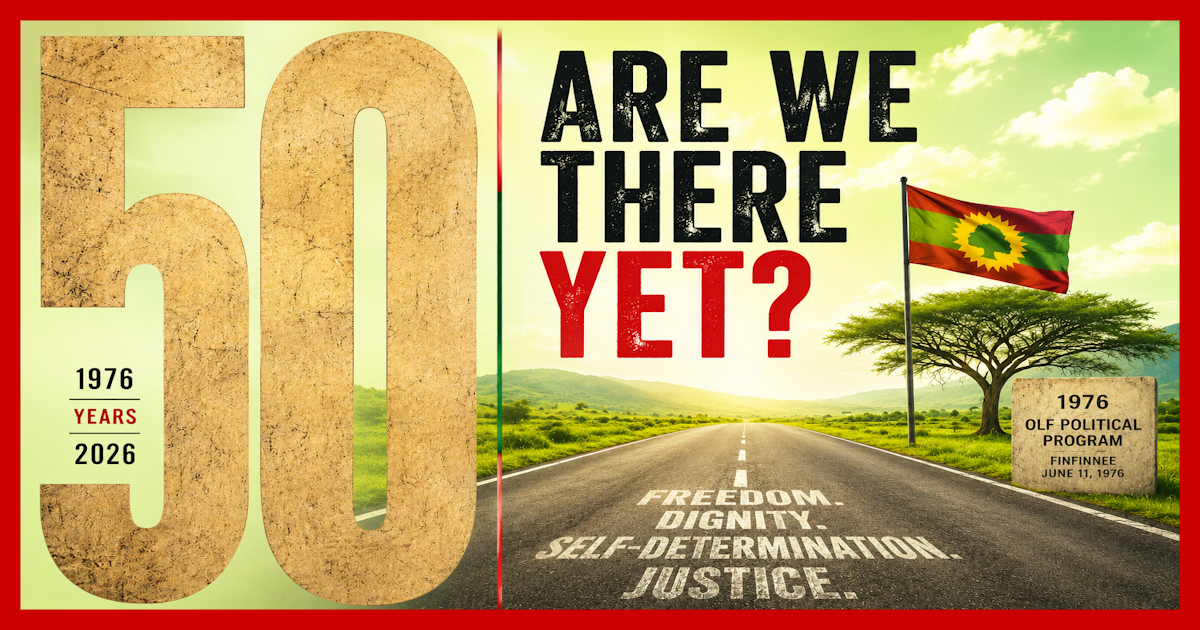
In 1991, the Oromo Liberation Front (OLF) entered the transitional moment with strong symbolic legitimacy but limited institutional depth. While it was able to generate rapid popular mobilization across many Oromo urban centers, it lacked the administrative continuity, organizational infrastructure, and negotiation capacity necessary to compete with more structurally consolidated actors emerging from the northern liberation movements. As a result, despite the presence of widespread Oromo political energy, the organization was unable to translate mobilization into sustained participation within the post‑transition political order.
A similar dynamic appeared during the 2014–2018 mobilizations. The Qeerroo youth movement succeeded in generating an extraordinary wave of political awakening across Oromo society, significantly destabilizing the existing political equilibrium under the TPLF‑led federal system. Yet the movement itself operated primarily as a decentralized mobilization network rather than a consolidated institutional structure capable of monopolizing negotiation channels or coordinating transitional governance.
When the political opening finally arrived in 2018, actors embedded within existing state institutions possessed structural advantages that decentralized mobilization networks lacked. Organizational continuity, administrative access, and communication infrastructure allowed these actors to convert the broader wave of mobilization into a reconfiguration of leadership within the state system. Once again, mass mobilization reshaped political equilibrium but did not independently author the institutional design of the transition.
Mobilization can disrupt equilibrium, but disruption alone does not generate negotiating power [4]. Strategic capacity emerges only when mobilization converts into durable organizational infrastructure.
Participation in upheaval does not guarantee authorship of settlement. Institutional readiness does [5].
Reactive Models Under Existential Pressure
When fragmentation persists under conditions perceived as existential—where concern extends beyond political loss to civilizational continuity, including language, land, memory, and cultural self-definition—movements often oscillate between corrective extremes.
These oscillations are not random. They represent structural attempts to compensate for the absence of a legitimate authority architecture. When movements lack recognized authority architecture, they tend to gravitate toward three recurring corrective patterns—each attempting to restore coherence, but each carrying its own structural risks.
Three trajectories typically emerge, each with its own internal logic and its own dangers as highlighted below. One of three outcomes typically emerges as a reactive model under existential pressure.
Vanguard Consolidation: Coherence at the Price of Closure
The first instinct is consolidation through a disciplined vanguard capable of enforcing unity, monopolizing negotiation channels, and protecting non-negotiable red lines. This model promises decisiveness and insulation from fragmentation. Under pressure, it appears efficient.
But vanguardism carries a predictable structural risk: emergency authority tends to become permanent authority [6].
Mechanisms built to defend collective survival can gradually transform into mechanisms that suppress plurality long after the emergency has passed. What begins as protective consolidation can mutate into monopolization of representation.
Expansive Pluralism: Openness at the Price of Coherence
The second instinct is expansive pluralism—preserving ideological diversity, protecting competitive political space, and preventing authoritarian drift.
This model guards against the excesses of vanguardism.
Yet under existential pressure, boundaryless pluralism produces its own structural failure: permanent diffusion. Foundational red lines become endlessly contested. Negotiation mandates splinter. Strategic coordination collapses precisely when coherence is most required.
Pluralism without architecture becomes a marketplace of vetoes rather than a system of collective decision-making.
Unmanaged Fragmentation: Drift as Erosion
The most dangerous outcome is not choosing between the first two models—it is drifting between them without committing to either.
Unmanaged fragmentation is not neutrality. It is erosion. It dissolves leverage, confuses external actors, and rewards the most performative voices rather than the most responsible ones. Escaping this cycle requires deliberate sequencing rather than reactive oscillation.
In the following two sections, the article discusses the road to realizing an integrated authority structure in phases.
Sequencing: The Two Phases of Political Maturation
Movements confronting existential vulnerability must distinguish between two layers of political action deployed in sequence.
Phase I: Consolidation Around Non-Negotiable Baselines
This phase safeguards collective continuity. It protects cultural transmission, territorial integrity, and institutional survival. In practical terms, Phase I resembles the traditional meaning of liberation: securing existence before debating form.
Phase II: Determination of Long-Term Political Form
Once foundational security is achieved, the movement transitions to determining constitutional arrangements—whether federal restructuring, confederation, independence, or other frameworks.
Such decisions require legitimate popular mandate, potentially through referendum or other widely accepted mechanisms of democratic consultation.
These phases cannot operate without tension. The danger arises when movements attempt to conduct both phases simultaneously. Competitive political pluralism requires institutional stability, while existential consolidation requires disciplined coordination. When this logic is blurred, movements risk either suppressing legitimate political diversity too early or dispersing their collective leverage before foundational security is achieved.
A movement cannot defend existential baselines while functioning as an unrestricted competitive arena. Yet consolidation must never become permanent monopolization. Authority in Phase I must be mandate-bound and explicitly transitional, pre-committed to opening Phase II once foundational benchmarks are secured.
Toward an Integrated Authority Architecture
The solution is neither permanent vanguard nor boundaryless pluralism nor continued drift. It is deliberate authority design.
Designing such an authority architecture requires several institutional commitments:
- mandate boundaries
- transparent role assignment
- institutional management of disagreement
- structured leadership renewal
- explicit transition mechanisms tied to popular mandate
Authority is not the enemy of pluralism. It is the condition that makes pluralism sustainable.
Without authority architecture, unity remains a slogan and fragmentation becomes rational strategy.
With architecture, disagreement can coexist with cohesion. Mobilization can convert into authorship. Energy can translate into institutional gravity.
The Oromo dilemma is not a shortage of ideas or sacrifice. It is the unfinished work of institutional design.
Credibility in such a consolidation effort requires more than procedural commitment. It requires alignment between risk and authority. Where those entrusted with safeguarding collective survival appear insulated from the dangers borne by their constituents, legitimacy weakens quietly.
Phase I leadership must therefore embody disproportionate responsibility and visible exposure to consequence—not as spectacle, but as structural proof that consolidation serves collective continuity rather than personal advancement. The willingness to incur risk without guarantee of reward—and to relinquish claim to peacetime power once foundational objectives are secured—is the highest safeguard against corruption of necessary authority.
Movement toward authoritative structure requires deliberate institutional steps:
- convening a broadly representative mandate-setting assembly
- establishing transparent leadership selection procedures
- clearly defining complementary roles between homeland and diaspora actors
- committing in advance to transition benchmarks that move the movement from Phase I consolidation toward Phase II democratic determination
Yet the absence of authoritative architecture in Oromo political life has not emerged in isolation. It reflects a longer historical pattern in which moments of opportunity repeatedly encountered fragmented leadership, competing elite alignments, and institutional underdevelopment. Understanding how this pattern developed—and why it has proven so persistent—requires examining the historical relationship between Oromo elites, external power centers, and the unfinished project of internal consolidation. That deeper historical pattern will be explored in the next essay in this series.
Institutional gravity is not declared. It is engineered.
The Oromo political challenge, therefore, is not simply to mobilize again when crisis arrives. It is to design the institutional structures capable of converting future mobilization into durable authority. Without such architecture, energy will continue to appear in moments of upheaval only to dissipate when the time comes to shape the political order that follows.
References
- Dereje Hawas, When a Just Cause Is Made to Fail: Oromo Fragmentation, Elite Proliferation, and the Cost of Permanent Politics, 10 February 2026, OROMIA TODAY.
- Dereje Hawas, Oromos and the Rising Risk of Regional War: Power, Leverage, and Post-War Reality, 22 February 2026, OROMIA TODAY.
- Max Weber, Economy and Society (1922).
- Samuel P. Huntington, Political Order in Changing Societies (1968).
- Guillermo O’Donnell and Philippe Schmitter, Transitions from Authoritarian Rule (1986).
- Robert Michels, Political Parties (1911).