Skip to content
OROMIA TODAY

OROMIA TODAY

Oromia is a Country

BAKKALCHA OROMIYAA
  • Home
  • Articles
  • Editorial
  • News
  • Opinions
  • About
  • Contact
OROMIA TODAY
OROMIA TODAY
Oromia is a Country
BAKKALCHA OROMIYAA
  • Dereje Gerefa Tullu
    Op-Ed | Politics | ⏭

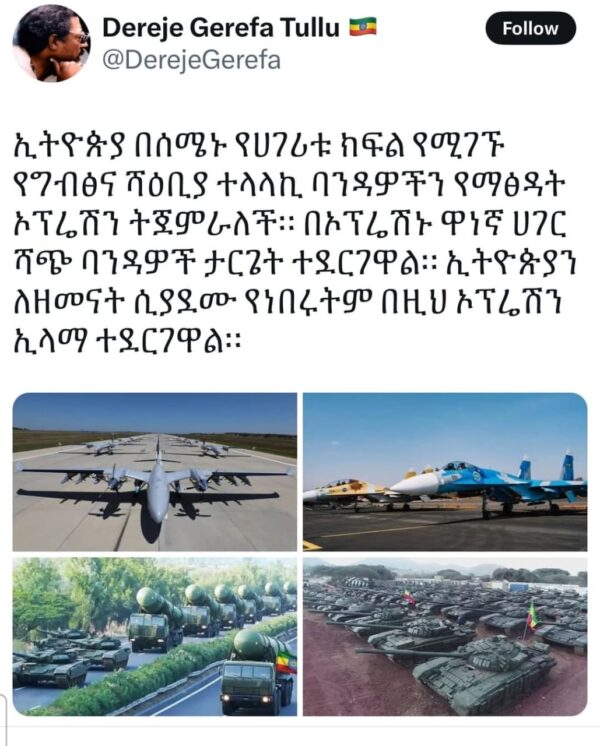
    "Dr Dereje Gerefa Tullu": When Education Turns Against Humanity

    By Malkkaa Beenyaa (MA, Social Psychologist) Posted on2026-02-182026-02-17

    When a PhD-educated public figure like Dereje Gerefa Tullu employs dehumanizing, eliminationist rhetoric, the issue is not political disagreement but moral collapse. Education is meant to civilize power, not aestheticize violence. When learning is repurposed to normalize threats and glorify force, it ceases to be enlightenment and becomes an accessory. The danger lies not only in the words spoken, but in how confidently they are spoken—revealing how ordinary cruelty can sound when dressed in educated language.

    Read More "Dr Dereje Gerefa Tullu": When Education Turns Against HumanityContinue

  • Just Cause
    Op-Ed | Opinion | Politics

    When a Just Cause Is Made to Fail: Oromo Fragmentation, Elite Proliferation, and the Cost of Permanent Politics

    By Dereje Hawas (PhD, Elec Eng) Posted on2026-02-102026-02-10

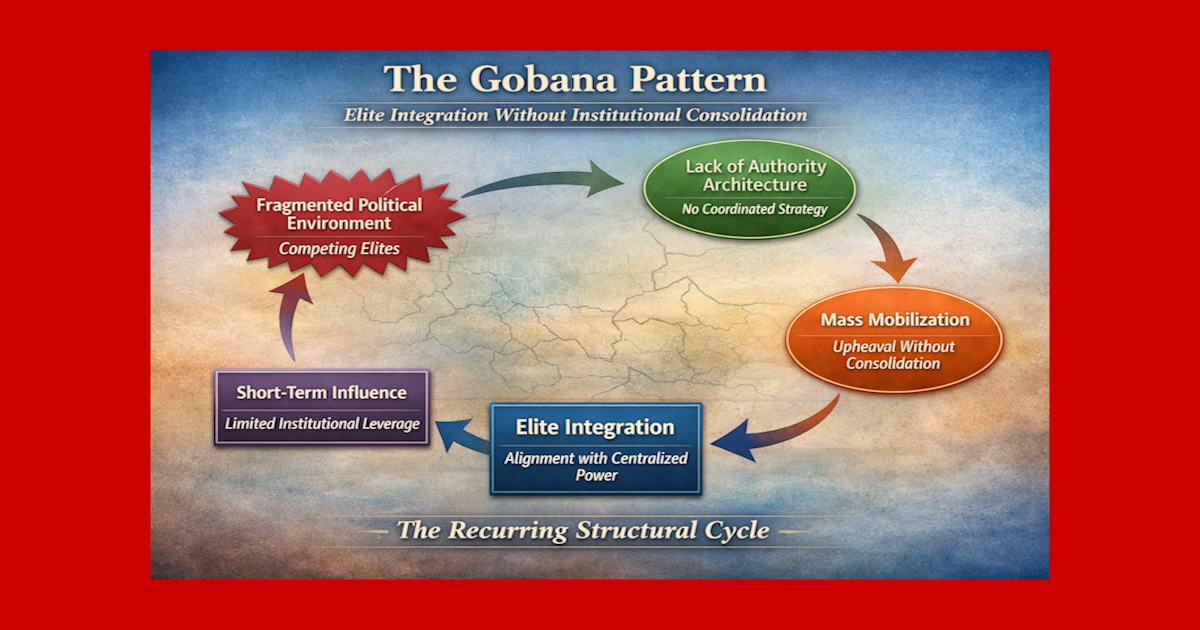
    Oromo Fragmentation is not a sign of political maturity or ideological diversity; it is the visible cost of elite proliferation detached from existential survival. As land is taken and communities are displaced, the struggle splinters into competing parties, fronts, and narratives that drain energy without building power. Fragmentation shields elites from accountability while leaving ordinary Oromos without leverage, unity, or an effective defense against dispossession and erasure. This op-ed argues that moral unanimity must precede politics if a just cause is to survive.

    Read More When a Just Cause Is Made to Fail: Oromo Fragmentation, Elite Proliferation, and the Cost of Permanent PoliticsContinue

  • Lying
    Article | Op-Ed | Opinion | Politics | ⏭

    The Policy of Lying: How Power Is Sustained by Fabrication

    By Elemoo Qilxuu (MA, Political Science) and Roobaa Hawaas (MA, Psychology) Posted on2026-02-062026-02-05

    Ethiopia has crossed a moral and political threshold. Lying is no longer an occasional deviation but a governing method. From the fabricated pretext of the Tigray war to the attempted rewriting of Eritrea’s role—publicly rebutted by Gedu Andargachew—the pattern is unmistakable. When power substitutes for truth, institutions collapse, Parliament applauds falsehood, and citizens are conditioned to accept governance without reality. This is not political spin; it is rule by fabrication.

    Read More The Policy of Lying: How Power Is Sustained by FabricationContinue

  • PP Regime
    Article | Opinion | Politics | ⏭

    The PP Regime Now Has the Accolade: No Other Ethiopian Regime Has Acted Against the Oromo People So Intensely in Such a Short Time

    By Kumaa Daadhii (PhD, Political History) and Olii Boran (PhD, Sociology) Posted on2026-02-022026-02-01
    3 Comments

    The inauguration of the Shebele Resort near Jijigaa under the PP regime of PM Abiy Ahmed is more than a development event; it is a political statement. Held without Oromo representation in an Oromo city, and amid ongoing violence in eastern Oromia, the ceremony signals the normalization of exclusion and the quiet ratification of a long-contested administrative arrangement. What was once presented as a temporary “loan” of Jijigaa has now hardened into permanent political appropriation, with profound consequences for constitutional order and regional stability.

    Read More The PP Regime Now Has the Accolade: No Other Ethiopian Regime Has Acted Against the Oromo People So Intensely in Such a Short TimeContinue

  • Aabbuu Seeraa
    Article | Campaign | Human Rights | Politics | ⏭

    Aabbuu Seeraa: Building Progress on Indigenous Erasure

    By OROMIA TODAY Posted on2026-01-302026-01-24

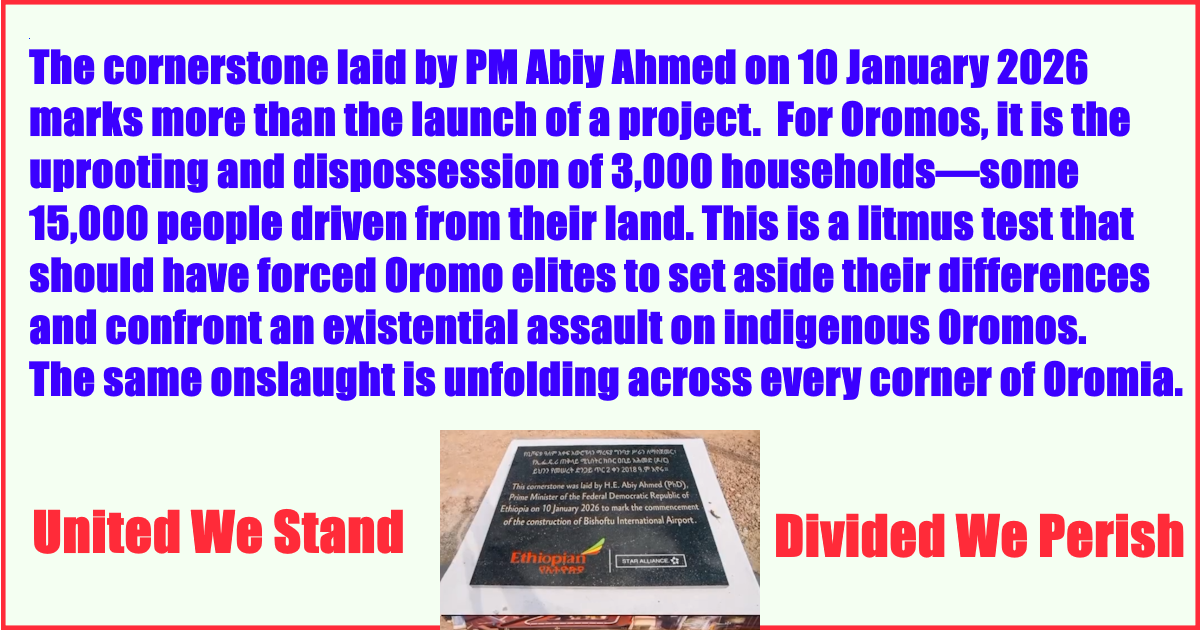
    In Aabbuu Seeraa, thousands of indigenous Oromo families are being displaced to build a flagship airport. Model houses are showcased to project “modernization,” while most households remain without shelter, land, or livelihood—and those who protest face detention. This is not opposition to development; it is a demand for development as a social contract. Minimum conditions are proposed for legitimacy, including housing, livelihood restoration, heritage and environmental protection, demographic sensitivity, perpetual stakeholding, and independent international assessment.

    Read More Aabbuu Seeraa: Building Progress on Indigenous ErasureContinue

  • Oromia Administration
    Editorial | Politics | ⏭

    The Oromia Administration: Silence, Not Governance

    By OT Editorial Posted on2026-01-282026-01-28

    The Oromia Administration is conspicuously absent as Oromia faces multi-front aggression, mass dispossession, and deepening corruption. From Somali regional incursions in the east—politically encouraged by president Mustafe Mohammed Omer—to Amhara Fano violence in the west and north east, and forced evictions in central Oromia, silence has become policy. This editorial argues the Oromia Administration is not merely failing, but enabling a proxy-war strategy in which Oromia must be weakened for the Ethiopian empire to endure.

    Read More The Oromia Administration: Silence, Not GovernanceContinue

  • 12 billion
    Editorial | Politics | ⏭

    Math Meets PP Myth No. 5: When 12 Billion Birr GERD Contributions Become Insults

    By OT Editorial Posted on2026-01-232026-01-23

    In this fifth installment of Math Meets PP Myth, the dismissal of 12 billion birr as “insignificant” reveals more than numerical abuse. It exposes a psychology of power that cannot tolerate shared ownership. Leaders secure in legitimacy thank contributors; insecure ones belittle them. Reducing citizens to percentages is not economic analysis—it is political conditioning, preparing the public to accept exclusion, silence, and hierarchy under the guise of math.

    Read More Math Meets PP Myth No. 5: When 12 Billion Birr GERD Contributions Become InsultsContinue

  • Lidetu Ayalew
    Article | Opinion | Politics | ⏭

    Lidetu Ayalew, Finfinnee, Oromia, Federalism, and the Perils of Principle-free Politics

    By Elemoo Qilxuu (MA, Political Science) Posted on2026-01-162026-01-15

    When politics loses its grammar, words stop meaning what they mean and power begins to masquerade as principle. In critiquing Lidetu Ayalew, this piece is not about personal disappointment but about a deeper political failure: the refusal to accept irreversible facts of federalism, Oromo self-rule, and historical reality. Denial is not argument. Semantic inversion is not moderation. And restoration politics, however eloquent, cannot substitute for credible, principled leadership.

    Read More Lidetu Ayalew, Finfinnee, Oromia, Federalism, and the Perils of Principle-free PoliticsContinue

  • Politics Lessons
    Article | Opinion | Politics | ⏭

    OROMIA TODAY – Basic Politics Lessons 101For members of political parties in general and the Prosperity Party in particular

    By Malkkaa Beenyaa (MA, Social Psychologist) Posted on2026-01-092026-01-09

    It has become increasingly clear that many party members lack even a basic understanding of the norms, limits, and responsibilities of political life. A dangerous assumption has taken root: that once a party forms a government, it automatically owns the state. This false belief is where criminality begins, now an everyday occurrence under the Prosperity Party. Written as Politics Lessons for reflection rather than insult, this article helps members identify where political participation ends and personal liability begins, concluding with Safuu as a moral anchor in public life.

    Read More OROMIA TODAY – Basic Politics Lessons 101For members of political parties in general and the Prosperity Party in particularContinue

  • Medemer
    Op-Ed | Politics | ⏭

    How Will Medemer Be Remembered?

    By Kumaa Daadhii (PhD, Political History) Posted on2026-01-072026-01-07

    Medemer will not be remembered by its promises but by its consequences. Branded as a "doctrine" of unity, Medemer instead presided over spectacle development confined to the capital, permanent war governance, economic unraveling, normalized brutality, and systematic evictions of central Oromia. The glitter of street lights masked structural collapse, while fear became an instrument of rule. History is likely to record Medemer not as "addition", but as "subtraction"—of lives, trust, justice, and peoples' unrealized potential.

    Read More How Will Medemer Be Remembered?Continue

  • Assab
    Editorial | Politics | ⏭

    An Empire That Refuses to Learn — When Power Is Reduced to Drawing Lines with Assab Port

    By OT Editorial Posted on2026-01-062026-01-06

    The delusional redrawing of maps to suggest the annexation of Assab Port is not a harmless provocation but a dangerous rehearsal for an unnecessary war—one that diplomacy can and must avert. History shows who pays when empires test fantasies with force: coerced Oromo youth sent to fight wars they did not choose. The Oromo people have learned from loss, and they reject yet another imperial gamble with their sons and daughters.

    Read More An Empire That Refuses to Learn — When Power Is Reduced to Drawing Lines with Assab PortContinue

  • Wallaga
    Op-Ed | Politics | ⏭

    The Forgotten War in Wallaga: Why Atrocities in Western Oromia Remain Uncounted

    By Yadessa Guma (PhD, Anthropology) Posted on2026-01-032026-01-02
    1 Comment

    While the world associates Ethiopia’s mass violence with the Tigray war, a longer and largely uncounted war has devastated western Oromia—especially Wallaga—since 2018. Displacement, repeated massacres, school closures, and the collapse of health services have become a grim norm, yet the true civilian death toll remains unknown. This article explains what we know, what we still do not know, why the suffering has been under-reported, and why an independent investigation by credible human rights bodies is now urgent.

    Read More The Forgotten War in Wallaga: Why Atrocities in Western Oromia Remain UncountedContinue

  • Yonas Biru
    Op-Ed | Politics

    Gadaa on Trial: How Yonas Biru Turns Selective Ethnography into Political Prosecution

    By Kumaa Daadhii (PhD, Political History) Posted on2025-12-242025-12-24
    1 Comment

    Yonas Biru’s “Gadaa is part apartheid” is not scholarship but a political prosecution dressed in citations. It announces a verdict (“Oromummaa is a lie”), then cherry-picks evidence to delegitimize Oromo identity claims, smear Oromo scholarship as extremism, and insinuate guilt-by-association with violence. The apartheid analogy is a sensational moral grenade, not a serious comparison. UNESCO’s recognition of Gadaa underscores its governance value, not Yonas Biru caricature.

    Read More Gadaa on Trial: How Yonas Biru Turns Selective Ethnography into Political ProsecutionContinue

  • Injustice
    Op-Ed | Politics | ⏭

    Injustice Always Produces Independence

    By Kumaa Daadhii (PhD, Political History) Posted on2025-12-212025-12-20
    1 Comment

    Injustice is not a permanent condition; it is an unstable one. Where dignity, consent, and autonomy are denied, resistance does not fade—it evolves. Between those who fight injustice with clarity and those who preserve it through denial or opportunism lies a spectrum of hesitation that slows justice but cannot stop it. History is clear: stability is not imposed by force, but reached through courage, accountability, and self-determination.

    Read More Injustice Always Produces IndependenceContinue

  • EZEMA
    Op-Ed | Politics | ⏭

    EZEMA’s Four “Core Problems of Ethiopia”: A Diagnosis Without Literacy of Ethiopian History

    By Biqila Bariso (PhD, Physics; MSc, Cognitive Sci.) Posted on2025-12-132025-12-10
    1 Comment

    EZEMA claims Ethiopia faces four fundamental problems, but its diagnosis reveals profound political illiteracy. By blaming the EPRDF for an “ethnic problem” and proposing the absurd abolition of ethnic politics, EZEMA misreads Ethiopia’s history, structure, and lived realities. This article exposes why EZEMA’s worldview collapses under scrutiny — from sovereignty and rights to poverty and national narrative — and why Ethiopia’s future cannot be grounded in such conceptual blindness.

    Read More EZEMA’s Four “Core Problems of Ethiopia”: A Diagnosis Without Literacy of Ethiopian HistoryContinue

  • First Principles
    Op-Ed | Politics | ⏭

    The First Principles Violated: The Simple Truth Behind a Century of Ethiopian Instability

    By Biqila Bariso (PhD, Physics; MSc, Cognitive Sci.) Posted on2025-12-112025-12-11

    Politics remains the only profession where immense power requires no mastery of first principles, and nowhere is this more destructive than in Ethiopia. Identity is reshaped, consent bypassed, and self-determination denied—violations that predictably produce rebellion, collapse, and endless conflict. This article distills the political laws of stability Ethiopia keeps defying, and shows why stability, peace, and development will remain elusive until its leaders embrace these foundational truths. It ends with a postscript message to the Ethiopian National Dialogue Commission (ENDC), warning it against repeating the foundational violations at the root of Ethiopia’s instability.

    Read More The First Principles Violated: The Simple Truth Behind a Century of Ethiopian InstabilityContinue

Page navigation

Previous PagePrevious 1 2 3 4 … 7 Next PageNext

Archives

Recent Posts

  • The Ethiopian Perspective Gap: Why Some Voices Sound Like Truth—and Others Like Rebuttal
  • One Song, Five Messages
  • Cui Bono? The Political Economy of Conflict and the Oromo Question
  • Ambo: Cruelty in Plain Sight — Violence, Impunity, and the Political Crisis in Oromia
  • Remembering Guyyaa Gootota Oromoo
  • Oromo Martyrs Day—April 15, 2026: Memory, Sacrifice, and the Unfinished Future of Oromia
  • The Peace Conference Without the Other Side
  • 7 Reasons Why There Can Be No Credible Electoral Process in an Empire Disintegrating Before Our Eyes
  • History Comes to the UN and Asks for a Vote
  • Much Ado About Nothing—The Illusion of Elections in Oromia and Ethiopia

Authors

Categories

Recent Comments

  • webmaster on Remembering Guyyaa Gootota Oromoo
  • ejigu etana on Remembering Guyyaa Gootota Oromoo
  • ejigu etana on Remembering Guyyaa Gootota Oromoo
  • Raba Dori on Between Water at the Margins and SurvivalEnvironmental Precarity and the Political Economy of Inequality in Oromia
  • Dereje Hawas on Between Water at the Margins and SurvivalEnvironmental Precarity and the Political Economy of Inequality in Oromia
Facebook X YouTube TikTok Telegram

© 2026 OROMIA TODAY

Report an Incident

Tags Cloud

3000-Year Myth Aabbuu Seeraa Aabbuu Seeraa Airport Abiy Ahmed Amhara Elite Amhara Fano Caffee Oromia Calii Tuulamaa ENDC Eritrea Ethiopian Empire EZEMA Faarseebulaa Fact-checking FearlessTayeDanda'a Finfinnee Gadaa Supercity GERD History & Memory IMF Indigenous Oromo Indigenous Rights Irreechaa July 2024 Macroeconomic Policy Math Meets PP Myth MMPPM Moyale Multinational Federalism OLA OLF OLF-OLA OPDO/PP Oromia Oromo Questions Oromo Struggle Oromummaa PP Regime PP Regime Brutality Remembrance Safuu Shimelis Abdissa Somali Region Taye Danda'a TPLF Tribute
Scroll to top
  • Home
  • Articles
  • Editorial
  • News
  • Opinions
  • About
  • Contact
Search